
Puck, 1879-07-02 · page 3 of 16
Puck — July 2, 1879 — page 3: what you’re looking at
What you’re looking at
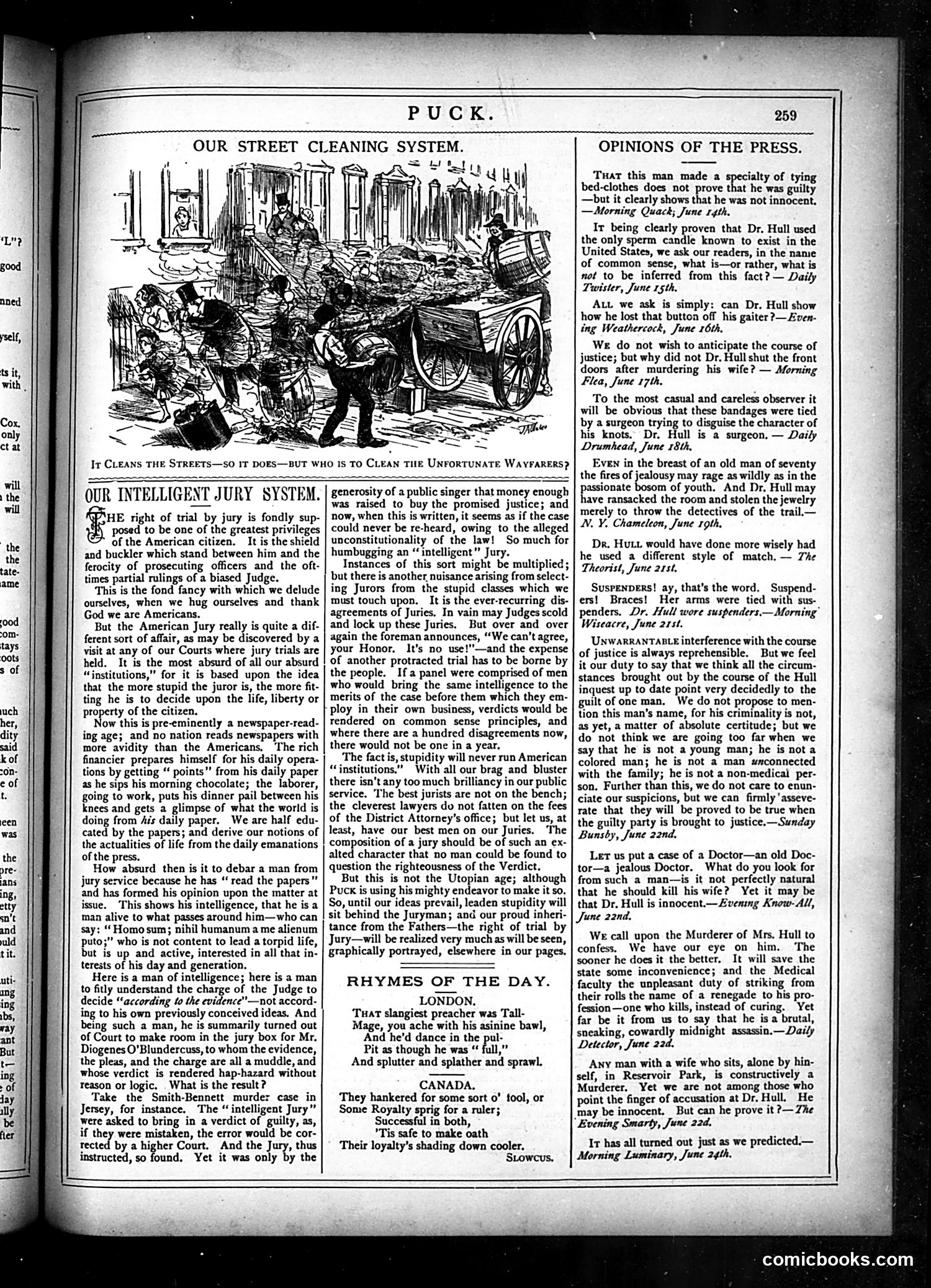
This Puck cartoon satirizes New York's street sanitation through a chaotic scene showing garbage piled high with workers and a cart amid the refuse. The accompanying text critiques the city's ineffective cleaning infrastructure, with the headline asking "who is to clean the unfortunate wayfarers?" The satire targets the disconnect between the city's public sanitation claims and street reality—streets remained filthy despite claims of systematic cleaning. The cartoon's exaggerated depiction of waste accumulation emphasizes the failure of municipal services to address urban cleanliness. The page also includes commentary on jury trials and references what appears to be a contemporary murder case (Dr. Hull), suggesting this reflects broader public frustration with both civic mismanagement and the justice system circa June 1911.
📄 Transcribed text from this page (OCR, searchable)
Machine-transcribed from the original scan — historical spelling and the odd misread are preserved.
PUCK. OUR STREET CLEANING SYSTEM. Ir CLEANS THE STREETS—SO IT DOES—BUT WHO 1S TO CLEAN THE UNFORTUNATE WAYFARERS? OUR INTELLIGENT JURY SYSTEM. HE right of trial by jury is fondly sup- posed to be one of the greatest privileges of the American citizen. It is the shield and buckler which stand between him and the ferocity of prosecuting officers and the oft- times partial rulings of a biased Judge. This is the fond fancy with which we delude ourselves, when we hug ourselves and thank God we are Americans, But the American Jury really is quite a dif- ferent sort of affair, as may be discovered by a visit at any of our Courts where jury trials are held. It is the most absurd of all our absurd “institutions,” for it is based upon the idea that the more stupid the juror is, the more fit- ting he is to decide upon the life, liberty or property of the citizen. low this is pre-eminently a newspaper-read- ing age; _and no nation reads newspapers with more avidity than the Americans, The rich financier prepares himself for his daily opera- tions by getting “ points” from his daily paper as he sips his morning chocolate; the laborer, going to work, puts his dinner pail between his knees and gets a glimpse of what the world is doing from Ais daily paper. We are half edu- cated by the papers; and derive our notions of the actualities of life from the daily emanations of the press, How absurd then is it to debar a man from jury service because he has ‘‘ read the papers” and has formed his opinion upon the matter at issue. This shows his intelligence, that he is a man alive to what passes around him—who can say: “ Homo sum; nihil humanuma me alienum puto;” who is not content to lead a torpid life, but is up and active, interested in all that in- terests of his day and generation. Here is a man of intelligence; here is a man to fitly understand the charge of the Judge to decide “according to the evidence""—not accord- ing to his own previously conceived ideas. And being such a man, he is summarily turned out of Court to make room in the jury box for Mr, Diogenes O’Blundercuss, to whom the evidence, the pleas, and the charge are all a muddle, and whose verdict is rendered hap-hazard without Teason or logic, . What is the result? Take the Smith-Bennett murdez case in Jersey, for instance. The “intelligent Jury” were asked to bring in a verdict of guilty, as, if they were mistaken, the error would be cor- rected by a higher Court. And the Jury, thus instructed, so found. Yet it was only by the generosity of a public singer that money enough was raised to buy the promised justice; and now, when this is written, it seems as if the case could never be re-heard, owing to the alleged unconstitutionality of the law! So much for humbugging an “intelligent” Jury. Instances of this sort might be multiplied; but there is another nuisance arising from select- ing Jurors from the stupid classes which we must touch upon, It is the ever-recurring dis- agreements of Juries. In vain may Judges scold and lock up these Juries. But over and over again the foreman announces, “We can’t agree, your Honor. It's no use!"’—and the expense of another protracted trial has to be borne by the people. If a panel were comprised of men who would bring the same intelligence to the merits of the case before them which they em- ploy in their own business, verdicts would be rendered on common sense principles, and where there are a hundred disagreements now, there would not be one in a year. ‘The fact is, stupidity will never run American “institutions.” With all our brag and bluster there isn't any too much brilliancy in our public service. The best jurists are not on the bench; the cleverest lawyers do not fatten on the fees of the District Attorney's office; but let us, at least, have our best men on our Juries. The composition of a jury should be of such an ex- alted character that no man could be found to question the righteousness of the Verdict. But this is not the Utopian age; although Puck is using his mighty endeavor to make it so. So, until our ideas prevail, leaden stupidity will sit behind the Juryman; and our proud inheri- tance from the Fathers—the right of trial by Jury—will be realized very much as will be seen, graphically portrayed, elsewhere in our pages. RHYMES OF THE DAY. LONDON. Tuat slangiest preacher was Tall- Mage, you ache with his asinine bawl, And he'd dance in the pul- Pit as though he was “ full,” And splutter and splather and sprawl. CANADA, They hankered for some sort 0’ tool, or Some Royalty sprig for a ruler; Successful in both, 'Tis safe to make oath Their loyalty’s shading down cooler. Stowcus. OPINIONS OF THE PRESS. Tat this man made a ialty of tyin; bed-clothes does not prove that he was guilty —but it clearly shows that he was not innocent, —Morning Quack; June r4th. Ir being clearly proven that Dr, Hull used the only sperm candle known to exist in the United States, we ask our readers, in the name of common sense, what is—or rather, what is not to be inferred from this fact? — Daily Twister, June 15th. ALL we ask is simply: can Dr. Hull show how he lost that button off his gaiter?—Even- ing Weathercock, June 16th, We do not wish to anticipate the course of justice; but why did not Dr. Hull shut the front doors after murdering his wife? — Morning Flea, June 17th. To the most casual and careless observer it will be obvious that these bandages were tied by a surgeon trying to disguise the character of his knots. Dr. Hull is a surgeon, — Daily Drumhead, June 18th, Even in the breast of an old man of seventy the fires of jealousy may rage as wildly as in the passionate bosom of youth. And Dr, Hull may have ransacked the room and stolen the jewelry merely to throw the detectives of the trail.— XN. Y. Chameleon, June 19th. Dr. Hutt would have done more wisely had he used a different style of match. — Zhe Theorist, June 2151, Suspenpers! ay, that’s the word. Suspend- ers! Braces! Her arms were tied with sus- penders. Dr. Hull wore suspenders.— Morning’ Wiseacre, June 21st. UnwarranTan Le interference with the course of justice is always reprehensible. But we feel it our duty to say that we think all the circum- stances brought out by the course of the Hull inquest up to date point very decidedly to the guilt of one man. We do not propose to men- tion this man’s name, for his criminality is not, as yet, a matter of absolute certitude; but we do not think we are going too far when we say that he is not a young man; he is not a colored man; he is not a man waconnected with the family; he is not a non-medical per- son, Further than this, we do not care to enun- ciate our suspicions, but we can firmly 'asseve- rate that they will be proved to be true when the guilty party is brought to justice.—Sunday Bunsby, June 22nd. Ler us put a case of a Doctor—an old Doc- tor—a jealous Doctor. What do you look for from such a man—is it not perfectly natural that he should kill his wife? Yet it may be that Dr. Hull is innocent.—Zvening Know-All, June 220d, We call upon the Murderer of Mrs. Hull to confess. We have our eye on him. The sooner he does it the better, It will save the state some inconvenience; and the Medical faculty the unpleasant duty of striking from their rolls the name of a renegade to his pro- fession—one who kills, instead of curing. Yet far be it from us to say that he isa brutal, sneaking, cowardly midnight assassin.— Daily Detector, June 22d, Any man with a wife who sits, alone by hin- self, in Reservoir Park, is constructively a Murderer. Yet we are not among those who point the finger of accusation at Dr. Hull, He may be innocent. But can he prove it ?— Zhe "Evening Smarty, June 22d, Ir has all turned out just as we predicted.— Morning Luminary, June 24th. comicbooks.com