
Puck, 1879-07-02 · page 7 of 16
Puck — July 2, 1879 — page 7: what you’re looking at
What you’re looking at
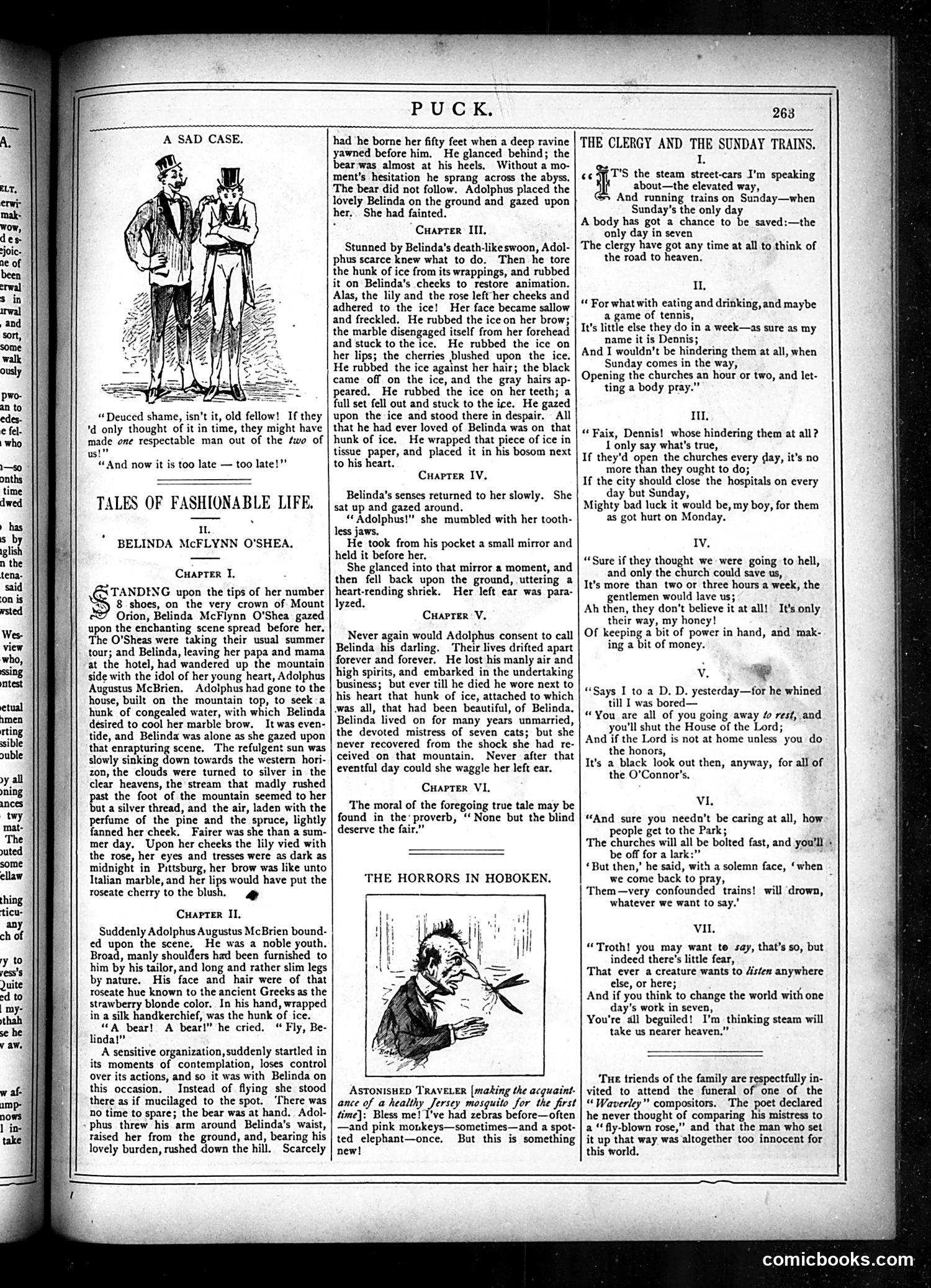
This page contains **serialized fiction rather than political cartoons**. The main content is "Tales of Fashionable Life" by Belinda McFlynn O'Shea, a narrative story with accompanying illustrations. The page includes two illustrated sections: "A Sad Case" (showing a man and woman in period dress) and "The Horrors in Hoboken" (depicting a grotesque creature or monster). There's also a separate section titled "The Clergy and the Sunday Trains," which presents a dialogue about steam-powered street-cars and Sunday train service—likely satirizing contemporary debates about religious observance and modern transportation. This appears to be **general entertainment content** rather than political satire, typical of Puck's mix of humorous fiction and social commentary aimed at middle-class readers.
📄 Transcribed text from this page (OCR, searchable)
Machine-transcribed from the original scan — historical spelling and the odd misread are preserved.
PUCK. A SAD CASE. “Deuced shame, isn’t it, old fellow! If they 'd only thought of it in time, they might have made one respectable man out of the éwo of us!” “And now it is too late — too late!’ TALES OF FASHIONABLE LIFE. IL BELINDA McFLYNN O'SHEA. Cuapter I. FS TANDENG upon the tips of her number 4) 8 shoes, on the very crown of Mount Orion, Belinda McFlynn O'Shea gazed upon the enchanting scene spread before her. The O’Sheas were taking their usual summer tour; and Belinda, leaving her papa and mama at the hotel, had wandered up the mountain side with the idol of her young heart, Adolphus Augustus McBrien. Adolphus had gone to the house, built on the mountain top, to seek a hunk of congealed water, with which Belinda désired to cool her marble brow. It was even- tide, and Belinda was alone as she gazed upon that enrapturing scene. The refulgent sun was slowly sinking down towards the western hori- zon, the clouds were turned to silver in the clear heavens, the stream that madly rushed past the foot of the mountain seemed to her but a silver thread, and the air, laden with the perfume of the pine and the spruce, lightly fanned her cheek. Fairer was she than a sum- mer day. Upon her cheeks the lily vied with the rose, her eyes and tresses were as dark as midnight in Pittsburg, her brow was like unto Italian marble, and her lips would have put the roseate cherry to the blush. Cuarter II, Suddenly Adolphus Augustus McBrien bound- ed upon the scene, He was a noble youth, Broad, manly shoulders had been furnished to him by his tailor, and long and rather slim legs by nature. His face and hair were of that roseate hue known to the ancient Greeks as the strawberry blonde color. In his hand, wrapped in a silk handkerchief, was the hunk of ice. “A bear! A bear!” he cried. “ Fly, Be- linda!” A sensitive organization, suddenly startled in its moments of contemplation, loses control over its actions, and so it was with Belinda on this occasion. Instead of flying she stood there as if mucilaged to the spot. ‘There was no time to spare; the bear was at hand. Adol- Phus threw his arm around Belinda’s waist, raised her from the ground, and, bearing his lovely burden, rushed down the hill. Scarcely had he borne her fifty feet when a deep ravine yawned before him. He glanced behind; the bear'was almost at his heels, Without a mo- ment's hesitation he sprang across the abyss. The bear did not follow. Adolphus placed the lovely Belinda on the ground and gazed upon her, She had fainted. Cuarter III, Stunned by Belinda’s death-likeswoon, Adol- phus scarce knew what to do. Then he tore the hunk of ice from its wrappings, and rubbed it on Belinda’s checks to restore animation. Alas, the lily and the rose left her cheeks and adhered to the ice! Her face became sallow and freckled. He rubbed the ice on her brow; the marble disengaged itself from her forehead and stuck to the ice. He rubbed the ice on her lips; the cherries blushed upon the ice. He rubbed the ice against her hair; the black came off on the ice, and the gray hairs ap- peared. He rubbed the ice on her teeth; a full set fell out and stuck to the ice. He gazed upon the ice and stood there in despair. All that he had ever loved of Belinda was on that hunk of ice. He wrapped that piece of ice in tissue paper, and placed it in his bosom next to his heart. Cuarter IV, Belinda’s senses returned to her slowly. She sat up and gazed around. “Adolphus!” she mumbled with her tooth- less jaws. He took from his pocket a small mirror and held it before her. She glanced into that mirror a moment, and then fell back upon the ground, uttering a heart-rending shriek. Her left ear was para- lyzed. Cuaprer V. Never again would Adolphus consent to call Belinda his darling. Their lives drifted apart forever and forever. He lost his manly air and high spirits, and embarked in the undertaking business; but ever till he died he wore next to his heart that hunk of ice, attached to which .was all, that had been beautiful, of Belinda, Belinda lived on for many years unmarried, the devoted mistress of seven cats; but she never recovered from the shock she had re- ceived on that mountain. Never after that eventful day could she waggle her left ear. Cuarter VI. The moral of the foregoing true tale may be found in the‘ proverb, “None but the blind deserve the fair.” THE HORRORS IN HOBOKEN. ASTONISHED TRAVELER [making the acquaint- ance of a healthy (fe mosquito for the first time]: Bless me! T've had zebras before—often —and pink monkeys—sometimes—and a spot- ted elephant—once. But this is something new! THE CLERGY AND THE SUNDAY TRAINS. I ce Hf, 'S the steam street-cars I'm speaking about—the elevated way, And running trains on Sunday—when Sunday’s the only day A body has got a chance to be saved:—the only day in seven The clergy have got any time at all to think of the road to heaven. IL. “ For what with eating and drinking, and maybe a game of tennis, It’s little else they do in a week—as sure as my name it is Dennis; And I wouldn’t be hindering them at all, when Sunday comes in the way, Opening the churches an hour or two, and let- ting a body pray.” Il, ‘Faix, Dennis! whose hindering them at all? lL only say what's true, If they’d open the churches every day, it’s no more than they ought to do; If the city should close the hospitals on every day but Sunday, Mighty bad luck it would be, my boy, for them as got hurt on Monday. Iv. “Sure if they thought we were going to hell, and only the church could save us, It’s more than two or three hours a week, the gentlemen would lave us; Ah then, they don’t believe it at all! their way, my honey! of keeping a bit of power in hand, and mak- ing a bit of money. It's only v. ‘@ “Says I to a D. D. yesterday—for he whined till I was bored— “You are all of you going away 4 rest, and you'll shut the House of the Lord; And if the Lord is not at home unless you do the honors, It’s a black look out then, anyway, for all of the O'Connor's. Vi. “And sure you needn't be caring at all, how people get to the Park; The churches will all be bolted fast, and you'll be off for a lark:”” t “But then,’ he said, with a solemn face, ‘when _ we come back to pray, ‘Them—very confounded trains! will ‘drown, whatever we want to say.’ VII. “Troth! you may want te say, that’s so, but indeed there's little fear, That ever a creature wants to disfen anywhere else, or here; ¥ And if you think to change the world with one day’s work in seven, You're ali beguiled! I’m thinking steam will take us nearer heaven,” ‘Tue triends of the family are respectfully in- vited to attend the funeral of one of the “ Waverley" compositors. The poet declared he never thought of comparing his mistress to a “‘fly-blown rose,” and that the man who set it up that way was altogether too innocent for this world. comicbooks.com