
Puck, 1879-07-02 · page 12 of 16
Puck — July 2, 1879 — page 12: what you’re looking at
What you’re looking at
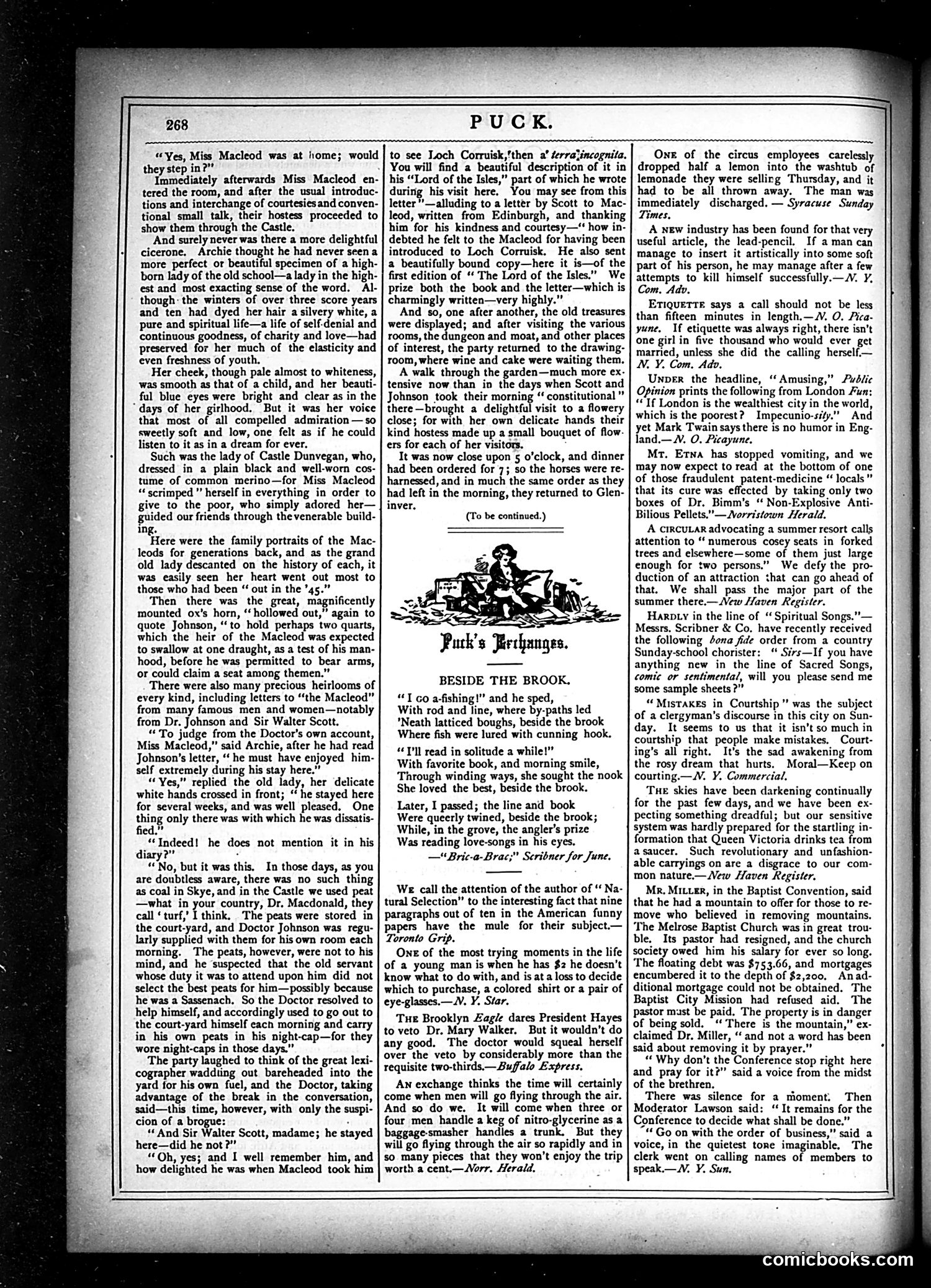
This page contains a literary short story titled "Beside the Brook" rather than a political cartoon. The narrative poem describes a young man fishing by a brook, reading love songs and romantic literature while seeking solace in nature. The page also includes several brief satirical notes commenting on contemporary topics: circus employee practices, newspaper advertisements, patent medicines, and church fundraising controversies. One item mocks the "cosey seats" at theaters; another critiques the Brooklyn Eagle's coverage of President Hayes. The humor is gentle social commentary rather than sharp political satire—typical of Puck's miscellaneous editorial content. No specific political figures or major events are caricatured on this particular page.
📄 Transcribed text from this page (OCR, searchable)
Machine-transcribed from the original scan — historical spelling and the odd misread are preserved.
PUCK. “Yes, Miss Macleod was at home; would they step in?” Immediately afterwards Miss Macleod en- tered the room, and after the usual introduc- tions and interchange of courtesiesand conven- tional small talk, their hostess proceeded to show them through the Castle. And surely never was there a more delightful cicerone. Archie thought he had never seen a more perfect or beautiful specimen of a high- born lady of the old school—a lady in the high- est and most exacting sense of the word. Al- though: the winters of over three score years and ten had dyed her hair a silvery white, a pure and spiritual life—a life of self-denial and continuous goodness, of charity and love—had preserved for her much of the elasticity and even freshness of youth, Her cheek, though pale almost to whiteness, was smooth as that of a child, and her beauti- ful blue eyes were bright and clear as in the “days of her girlhood. But it was her voice that most of all compelled admiration —so sweetly soft and low, one felt as if he could listen to it as in a dream for ever. Such was the lady of Castle Dunvegan, who, dressed in a plain black and well-worn cos- tume of common merino—for Miss Macleod “ scrimped " herself in everything in order to give to the poor, who simply adored her— guided our friends through the venerable build- ing. Frere were the family portraits of the Mac- leods for generations back, and as the grand old lady descanted on the history of each, it was easily seen her heart went out most to those who had been “ out in the 45.” Then there was the great, magnificently mounted ox’s horn, “hollowed out,” again to quote Johnson, “to hold perhaps two quarts, which the heir of the Macleod was expected to swallow at one draught, as a test of his man- hood, before he was permitted to bear arms, or could claim a seat among themen.” There were also many precious heirlooms of every kind, including letters to “the Macleod” from many famous men and women—notably from Dr. Johnson and Sir Walter Scott. “To judge from the Doctor's own account, Miss Macleod,” said Archie, after he had read Johnson's letter, “ he must have enjoyed him- self extremely during his stay here.” “Yes,” replied the old lady, her delicate white hands crossed in front; “he stayed here for several weeks, and was well pleased. One thing only there was with which he was dissatis- fied.” “Indeed! he does not mention it in his di: eH : “No, but it was this. In those days, as you are doubtless aware, there was no such thing as coal in Skye, and in the Castle we used peat —what in your country, Dr. Macdonald, they call ‘turf,’ Y think, The peats were stored in the court-yard, and Doctor Johnson was regu- larly supplied with them for his own room each morning. The peats, however, were not to his mind, and he ‘suspected that the old servant whose duty it was to attend upon him did not select the best peats for him—possibly because he was a Sassenach. So the Doctor resolved to help himself, and accordingly used to go out to the court-yard himself each morning and carry in his own peats in his night-cap—for they wore night-caps in those days.” The party laughed to think of the great lexi- cographer waddting out bareheaded into the yard for his own fuel, and the Doctor, taking advantage of the break in the conversation, said—this time, however, with only the suspi- cion of a brogu 5 : “And Sir Walter Scott, madame; he stayed here—did he not?” “Oh, yes; and I well remember him, and how delighted he was when Macleod took him to see Loch Corruisk,’then a’ ¢errajincognita, You will find a beautiful description of it in his “Lord of the Isles,” part of which he wrote during his visit here. You may see from this letter "—alluding to a letter by Scott to Mac- leod, written from Edinburgh, and thanking him for his kindness and courtesy—* how in- debted he felt to the Macleod for having been introduced to Loch Corruisk. He also sent a beautifully bound copy—here it is—of the first edition of “ The Lord of the Isles.” We prize both the book and the letter—which is charmingly written—very highly.” And 50, one after another, the old treasures were displayed; and after visiting the various rooms, the dungeon and moat, and other places of interest, the party returned to the drawing- room, where wine and cake were waiting them. A walk through the garden—much more ex- tensive now than in the days when Scott and Johnson took their morning “ constitutional” there —brought a delightful visit to a flowery close; for with her own delicate hands their kind hostess made up a small bouquet of flow. ers for each of her visitors. It was now close upon 5 o'clock, and dinner had been ordered for 7; so the horses were re- harnessed, and in much the same order as they had left in the morning, they returned to Glen- inver. (To be continued.) BESIDE THE BROOK, “1 Go a-fishing!" and he sped, With rod and line, where by-paths led ‘Neath latticed boughs, beside the brook Where fish were lured with cunning hook. “T'll read in solitude a while!” With favorite book, and morning smile, Through winding ways, she sought the nook She loved the best, beside the brook. Later, I passed; the line and book Were queerly twined, beside the brook; While, in the grove, the angler’s prize Was reading love-songs in his eyes. —"Bric-a-Brac;" Scribner for June, WE call the attention of the author of ‘ Na- tural Selection” to the interesting fact that nine paragraphs out of ten in the American funny papers have the mule for their subject.— Toronto Grip. One of the most trying moments in the life of a young man is when he has $2 he doesn’t know what to do with, and is at a loss to decide which to purchase, a colored shirt or a pair of eye-glasses.— JV. Y. Star. Tue Brooklyn Eagle dares President Hayes to veto Dr. Mary Walker. But it wouldn’t do any good. The doctor would squeal herself over the veto by considerably more than the requisite two-thirds Buffalo Express, An exchange thinks the time will certainly come when men will go flying through the air. And so do we. It will come when three or four men handle a keg of nitro-glycerine as a baggage-smasher handles a trunk. But they will go flying through the air so rapidly and in so many pieces that they won’t enjoy the trip worth a cent.—Norr, Herald, One of the circus employees carelessly dropped half a lemon into the washtub of lemonade they were selling Thursday, and it had to be all thrown away. The man was immediately discharged. — Syracuse Sunday Times, A new industry has been found for that very useful article, the lead-pencil. If a man can manage to insert it artistically into some soft part of his person, he may manage after a few attempts to kill himself successfully.—. ¥, Com, Adv. Etiquette says a call should not be less than fifteen minutes in length.—/. O. Pica- yune, If etiquette was always right, there isn’t one girl in five thousand who would ever get married, unless she did the calling herself.— N.Y. Com, Ado. Unper the headline, “Amusing,” Pwdlic Opinion prints the following from London Fun: “Tf London is the wealthiest city in the world, which is the poorest? Impecunio-sity.” And yet Mark Twain says there is no humor in Eng- land.—M. O. Picayune, Mt. Etna has stopped vomiting, and we may now expect to read at the bottom of one of those fraudulent patent-medicine “ locals” that its cure was effected by taking only two boxes of Dr. Bimm’s “ Non-Explosive Anti- Bilious Pellets."— Norristown Herald. A CIRCULAR advocating a summer resort calls attention to “ numerous cosey seats in forked trees and elsewhere—some of them just large enough for two persons.” We defy the pro- duction of an attraction that can go ahead of that. We shall pass the major part of the summer there.— Mew Haven Register. Harpty in the line of “Spiritual Songs.”— Messrs, Scribner & Co. have recently received the following Jona fide order from a country Sunday-school chorister: “ Sirs—If you have anything new in the line of Sacred Songs, comic or sentimental, will you please send me some sample sheets ?”” “Mistakes in Courtship” was the subject of a clergyman’s discourse in this city on Sun- day, It seems to us that it isn’t so much in courtship that people make mistakes, Court- ing’s all right. It’s the sad awakening from the rosy dream that hurts. Moral—Keep on courting.—V. Y. Commercial. Tue skies have been darkening continually for the past few days, and we have been ex- pecting something dreadful; but our sensitiv system was hardly prepared for the startling in- formation that Queen Victoria drinks tea from asaucer. Such revolutionary and unfashion- able carryings on are a disgrace to our com- mon nature.— Mew Haven Register. Mr. Mixxer, in the Baptist Convention, said that he had a mountain to offer for those to re- move who believed in removing mountains. ‘The Melrose Baptist Church was in great trou- ble. Its pastor had resigned, and the church mae. owed him his salary for ever so long. The floating debt was $753.66, and mortgages encumbered it to the depth of $2,200, Anad- ditional mortgage could not be obtained. The Baptist City Mission had refused aid. The pastor must be paid. The property is in danger of being sold. ‘There is the mountain,” ex- claimed Dr. Miller, “and not a word has been said about removing it by prayer.” ““ Why don’t the Conference stop right here and pray for it?” said a voice from the midst of the brethren. There was silence for a moment. Then Moderator Lawson said: “It remains for the Conference to decide what shall be done.” “Go on with the order of business,” said a voice, in the quietest tone imaginable. The clerk went on calling names of members to speak.—. ¥. Sun,