
Puck, 1879-07-02 · page 11 of 16
Puck — July 2, 1879 — page 11: what you’re looking at
What you’re looking at
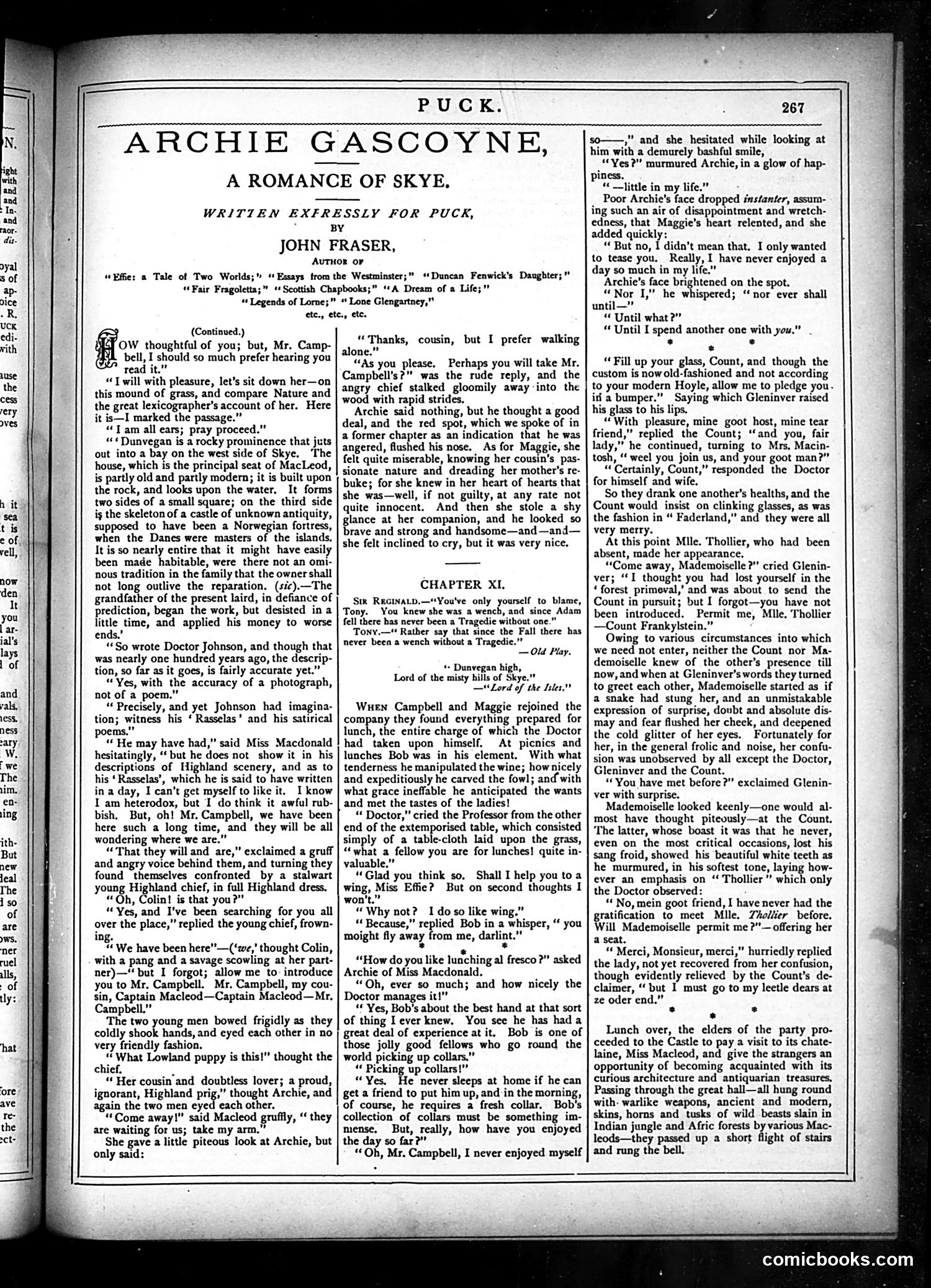
This page contains serialized fiction rather than political satire or cartoons. It's Chapter XI of "Archie Gascoyne, A Romance of Skye" by John Fraser, written expressly for Puck magazine. The narrative focuses on romantic and social drama among Scottish Highland characters—Archie, Campbell, Maggie, the Doctor, and others. The humor derives from character dialogue and situations: Campbell's romantic jealousy, Archie's teasing about Highland customs (notably the recurring joke about "picking up collars"), and social pretensions. Rather than political commentary, this represents Puck's serialized fiction content, which complemented the magazine's satirical cartoons elsewhere.
📄 Transcribed text from this page (OCR, searchable)
Machine-transcribed from the original scan — historical spelling and the odd misread are preserved.
PUCK. ARCHIE GASCOYNE, A ROMANCE OF SKYE. WRITTEN EXFRESSLY FOR PUCK, . BY JOHN FRASER, AvtHor or “Effie: a Tale of Two Worlds;" «Essays trom the Westminster; Duncan Fenwick’s Daughter; ” ‘+Fair Fragoletia;™ ‘+Seotish Chapbooks;” “+A Dream of a Lifes” “ Legends of Lorne;” “ Lone Glengartney,” ete., etc., etc. (Continued.) OW thoughtful of you; but, Mr. Camp- bell, I should so much prefer hearing you read it.” “Twill with pleasure, let’s sit down her—on this mound of grass, and compare Nature and the great lexicographer’s account of her. Here it is—I marked the passage.” “T am all ears; pray proceed.” “¢ Dunvegan is a rocky prominence that juts out into a bay on the west side of Skye. The house, which is the principal seat of MacLeod, is partly old and partly modern; it is built upon the rock, and looks upon the water. It forms two sides of a small square; on the third side is the skeleton of a castle of unknown antiquity, epposed to have been a Norwegun fortress, when the Danes were masters of the islands. It is so nearly entire that it might have easily been made habitable, were there not an omi- nous tradition in the family that the owner shall not long outlive the reparation. (sic).—The grandfather of the present laird, in defiance of prediction, began the work, but desisted in a little time, and applied his money to worse ends,’ “*So wrote Doctor Johnson, and though that was nearly one hundred years ago, the descrip- tion, so far as it goes, is fairly accurate yet.” “Yes, with the accuracy of a photograph, not of a poem.” “ Precisely, and yet Johnson had imagina- tion; witness his ‘ Rasselas’ and his satirical “‘ He may have had,” said Miss Macdonald hesitatingly, ‘‘ but he does not show it in his descriptions of Highland scenery, and as to his ‘Rasselas’, which he is said to have written in a day, I can’t get myself to like it. I know I am heterodox, but I do think it awful rub- bish, But, oh! Mr. Campbell, we have been here such a long time, and they will be all wondering where we are.” “That they will and are,” exclaimed a gruff and angry voice behind them, and turning they found themselves confronted by a stalwart young Highland chief, in full Highland dress. “Oh, Colin! is that you?” “Yes, and I've been searching for you all over the place,” replied the young chief, frown- ing. “ We have been here”—(‘zwe,' thought Colin, with a pang and a savage scowling at her part- ner)—“ but I forgot; allow me to: introduce you to Mr, Campbell. Mr. Campbell, my cou- sin, Captain Macleod—Captain Macleod—Mr, Campbell.” The two young men bowed frigidly as they coldly shook hands, and eyed each other in no very friendly fashion. i What Lowland puppy is this!” thought the chief, “Her cousin and doubtless lover; a proud, ignorant, Highland prig,” thought Archie, and again the two men fits each other, “Come away!” said Macleod gruffly, “ they are waiting for us; take my arm.” She gave a little piteous look at Archie, but only said: “Thanks, cousin, but I prefer walking alone.” “As you please, Perhaps you will take Mr. Camp sbell's?” was the rude reply, and the angry chief stalked gloomily away into the wood with rapid strides. Archie said nothing, but he thought a good deal, and the red spot, which we spoke of in a former chapter as an indication that he was angered, flushed his nose. As for Maggie, she felt quite miserable, knowing her cousin's pas- sionate nature and dreading her mother’s re- buke; for she knew in her heart of hearts that she was—well, if not guilty, at any rate not quite innocent. And then she stole a shy piance at her companion, and he looked so rave and strong and handsome—and—and— she felt inclined to cry, but it was very nice. CHAPTER XI. Six REGINALD.—"You've only yourself’ to blame, Tony. You knew she was a wench, and since Adam fell there has never been a Tragedie without one.” Tony.— Rather say that since the Fall there has never been a wench without a Tragedie.”” —Old Play. + Dunvegan high, Lord of the misty hills of Skye.” —Lord of the Isles.” Wuen Campbell and Maggie rejoined the company they found everything prepared for lunch, the entire charge of which the Doctor had taken upon himself, At picnics and lunches Bob was in his element. With what tenderness he manipulated the wine; how nicely and expeditiously he carved the fowl; and with what grace ineffable he anticipated "the wants and met the tastes of the ladies! “ Doctor,” cried the Professor from the other end of the extemporised table, which consisted simply of a table-cloth laid upon the grass, “what a fellow you are for lunches! quite in- valuable,” “Glad you think so, Shall I help you toa wing, Miss Effie? But on second thoughts I won't.” “Why not? I do so like wing.” “Because,” replied Bob in a whisper, “ you moight fly away from me, darlint.” “How do you like tastshing al fresco?” asked Archie of Miss Macdonald. “Oh, ever so much; and how nicely the Doctor manages it!” “ Yes, Bob’s about the best hand at that sort of thing I ever knew. You see he has great deal of experience at it. Bob is one of those jolly good fellows who go round the world picking up collars.” “ Picking up collars!” “Yes, He never sleeps at home if he can get a friend to put him up, and in the morning, of course, he requires a fresh collar, Bob's collection of collars must be something im- mense, But, really, how have you enjoyed the day so far?” “Oh, Mr. Campbell, I never enjoyed myself ind she hesitated while looking at with a demurely bashful smile, Yes?” murmured Archie, in a glow of hap- piness. “little in my life.” Poor Archie's face dropped instanter, assum- ing such an air of disappointment and wretch- edness, that Maggie's heart relented, and she added quickly: “ But no, I didn’t mean that. I only wanted to tease you. Really, I have never enjoyed a day so much in my life.” Archie's face brightened on the spot. hit “Nor I,” he whispered; “nor ever shall until—” “ Until what?” “ Until I spend another one with you." * * * “ Fill up your glass, Count, and though the custom is now old-fashioned and not according to your modern Hoyle, allow me to pledge you. in’ a bumper.” Saying which Gleninver raised his glass to his lips. “With pleasure, mine goot host, mine tear friend,” replied the Count; “and you, fair lady,” he continued, turning to Mrs, Macin- tosh, “ weel you join us, and your goot man?” “Certainly, Count,” responded the Doctor for himself and wife. So they drank one another's healths, and the Count would insist on clinking glasses, as was the fashion in “ Faderland,” and they were all very merry. At this point Mile. Thollier, who had been absent, made her appearance. “Come away, Mademoiselle ?” cried Glenin- ver; “I thought you had lost yourself in the ‘forest primeval,’ and was about to send the Count in pursuit; but I forgot—you have not been introduced. Permit me, Mile. Thollier —Count Frankylstein.” Owing to various circumstances into which we need not enter, neither the Count nor Ma- demoiselle knew of the other’s presence till now, and when at Gleninver’s words they turned to greet each other, Mademoiselle started as if a snake had stung her, and an unmistakable expression of surprise, doubt and absolute dis- may and fear flushed her check, and deepened the cold glitter of her eyes. Fortunately for her, in the general frolic and noise, her confu- sion was unobserved by all except the Doctor, Gleninver and the Count. “You have met before?” exclaimed Glenin- ver with surprise. Mademoiselle looked keenly—one would al- most have thought piteously—at the Count. ‘The latter, whose boast it was that he never, even on the most critical occasions, lost his sang froid, showed his beautiful white teeth as he murmured, in his softest tone, laying how- ever an emphasis on “ Thollier" which only the Doctor observed: “ No, mein goot friend, I have never had the gratification to meet Mlle. Zhollier before. Will Mademoiselle permit me ?”— offering her a seat. “ Merci, Monsieur, merci,” hurriedly replied the lady, not yet recovered from her confusion, though evidently relieved by the Count’s de- claimer, “ but I must go to my leetle dears at ze oder end.” * . . Lunch over, the elders of the party pro- ceeded to the Castle to pay a visit to its chate- laine, Miss Macleod, and give the strangers an opportunity of becoming acquainted with its curious architecture and antiquarian treasures. Passing through the great hall—all hung round with: warlike weapons, ancient and modern, skins, horns and tusks of wild beasts slain in Indian jungle and Afric forests by various Mac- leods—they passed up a short flight of stairs by h ji and rung the bell. comicbooks.com