
A complete issue · 16 pages · 1879
Puck — May 14, 1879
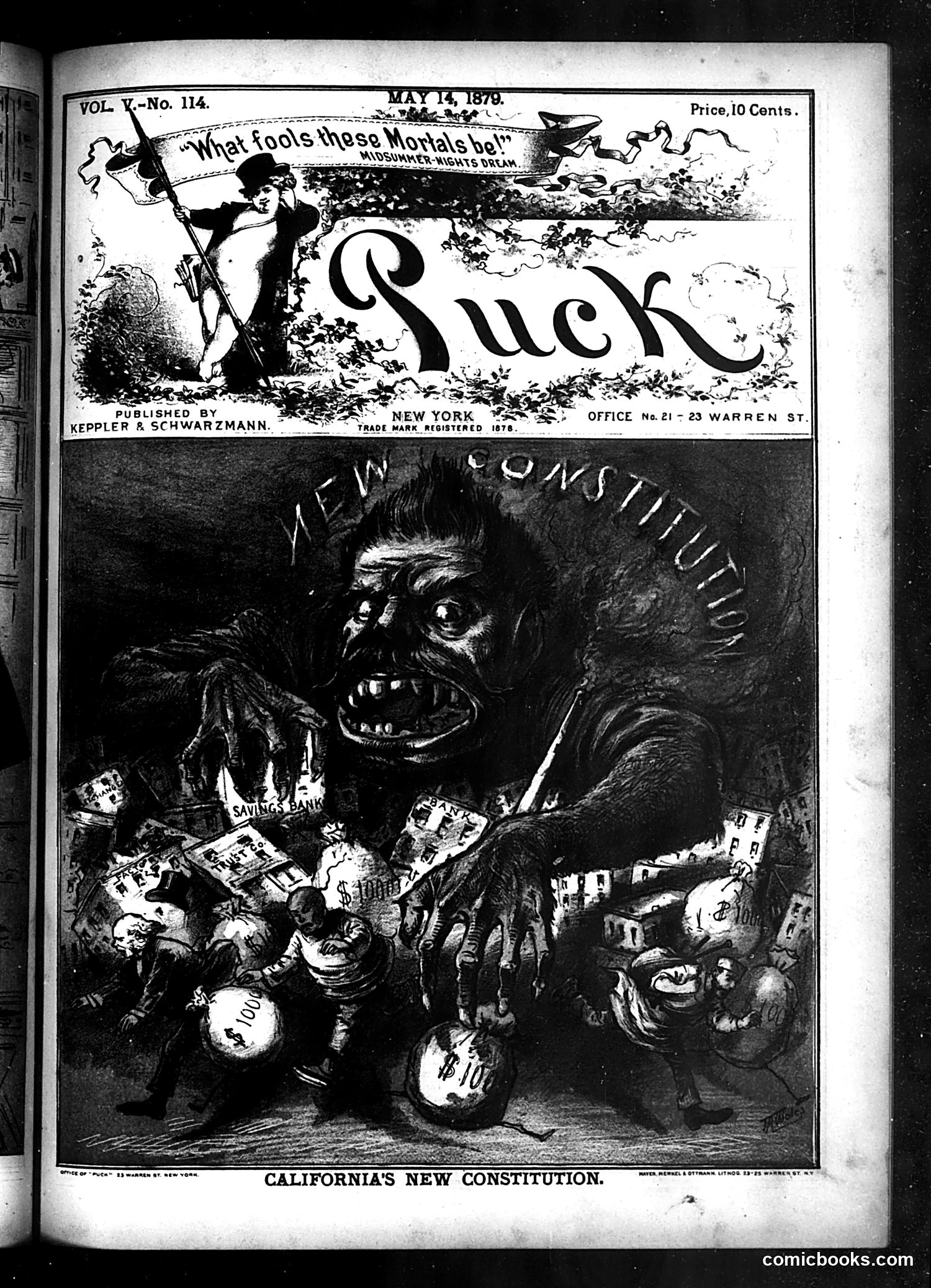
This page features two cartoons. The top banner, "What fools these Mortals be!" references Shakespeare and appears to be the magazine's masthead. The main cartoon, titled "California's New Constitution," depicts a grotesque demon or monster labeled "NEW CONSTITUTION" greedily clutching money and property (marked with dollar signs and "LAND"). Tiny human figures scatter around it in alarm. The satire criticizes California's newly adopted 1879 constitution as a destructive, predatory force that threatens citizens' property and financial security. The monster imagery suggests the constitution was viewed by Puck's editors as monstrous or dangerous—likely referencing concerns about anti-Chinese provisions, labor protections, or corporate regulations that conservative critics found threatening to business interests and property rights.
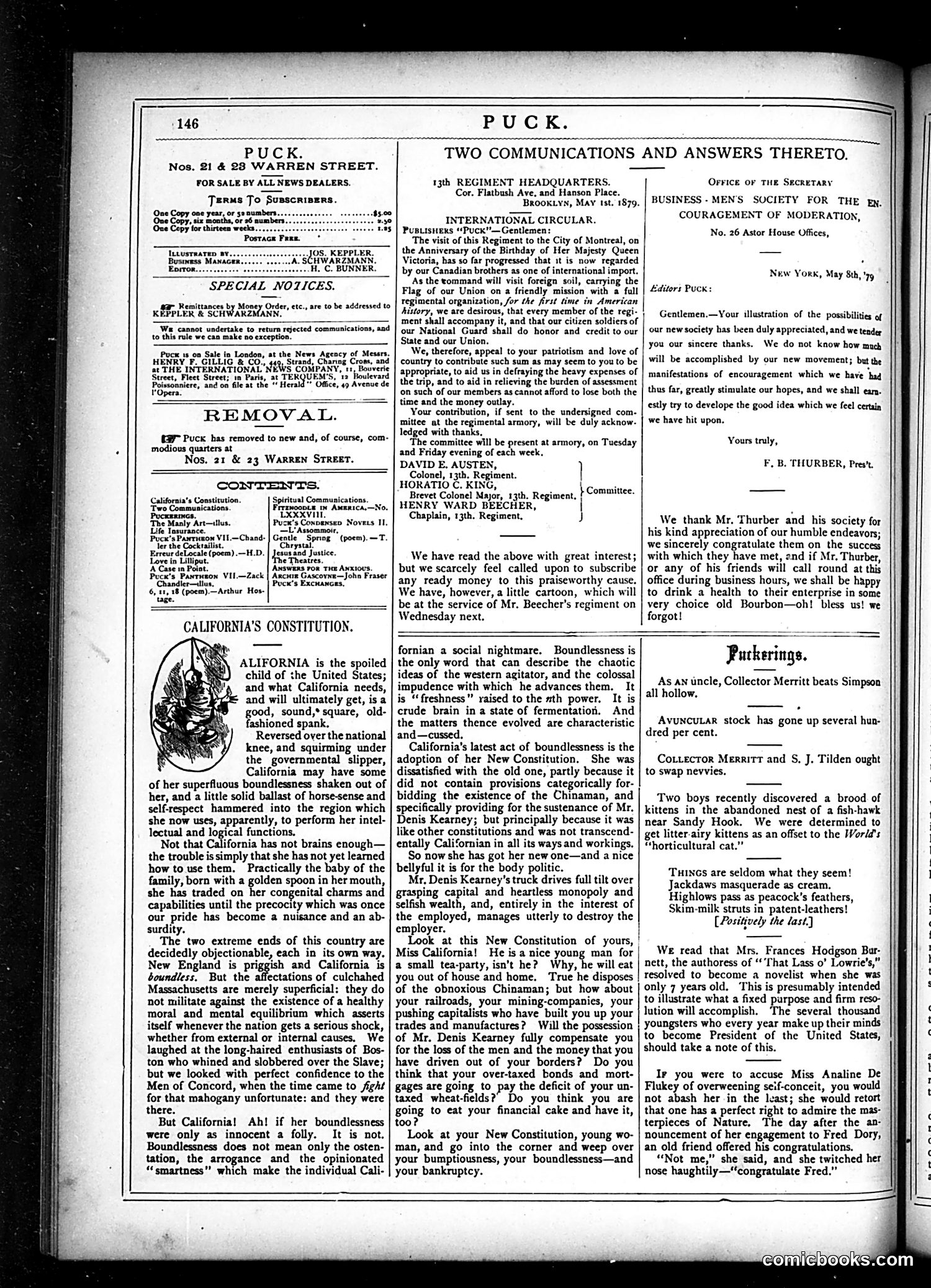
This page contains an editorial cartoon titled "California's Constitution" featuring a caricatured female figure labeled as California. The satire criticizes California's adoption of a new state constitution, depicting the state as a chaotic, ill-conceived entity. The accompanying text argues that California's "boundlessness" and "arrogance" reflect deeper problems—excessive wealth, selfish capitalism, and reckless railroad and mining interests that have corrupted the state's governance. The cartoon suggests California's new constitution fails to address these systemic issues, instead merely rearranging governmental structures without meaningful reform. The female personification appears disheveled or distressed, symbolizing the state's troubled condition despite constitutional revision. The satire targets California's economic elites and their influence over policy.
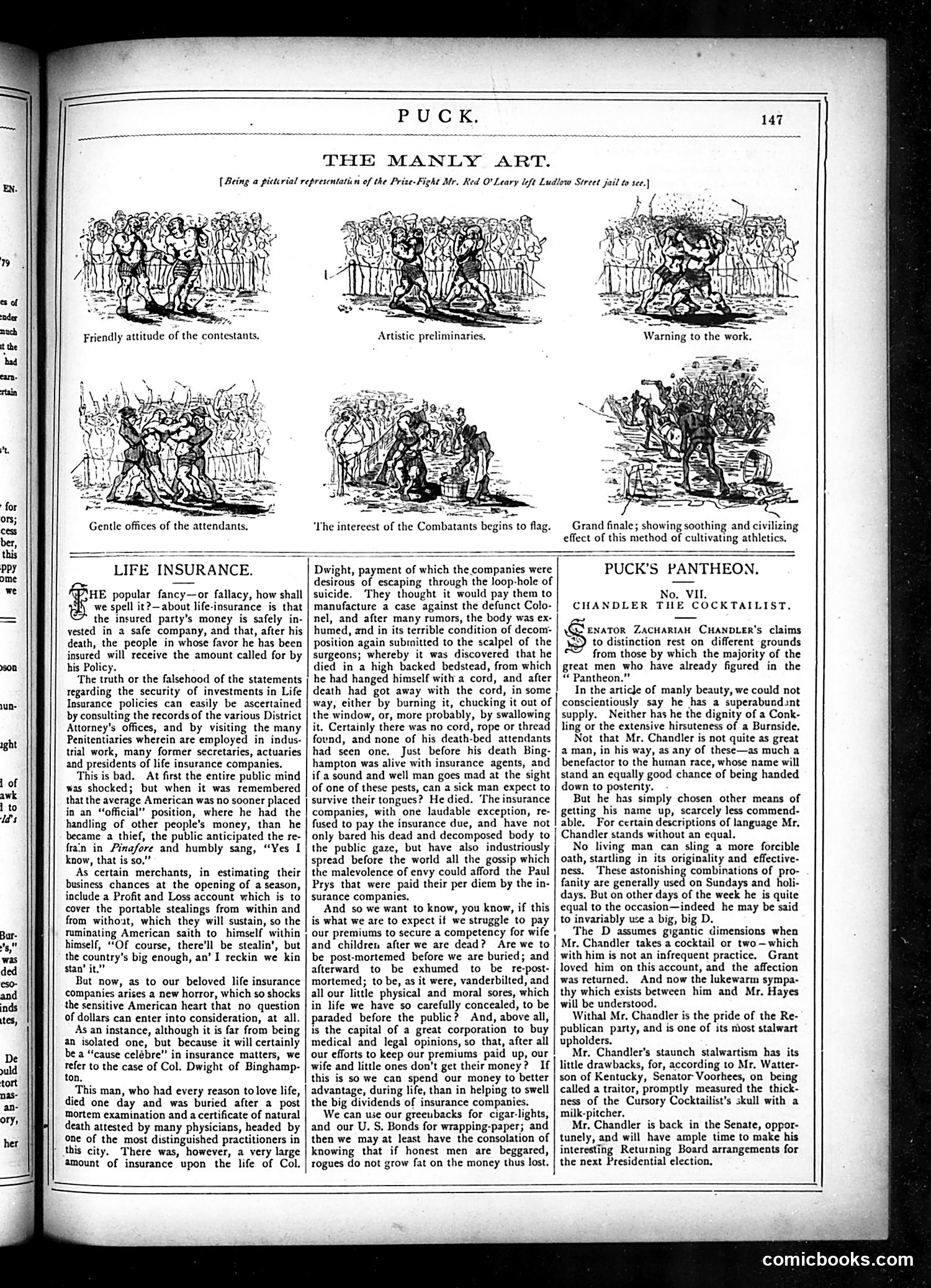
This six-panel cartoon mocks a boxing match held "jail to jail" on Ludlow Street. The sequential panels humorously depict the fight's progression: contestants' "friendly attitude," "artistic preliminaries," warning up, officials' "gentle offices," combatants flagging, and finally the "grand finale" with a "soothing and civilizing effect." The satire targets boxing as brutal spectacle disguised as athletic cultivation. The crowded, chaotic scenes suggest the sport attracts lowbrow audiences and reflects poorly on public morality. The final panel's claim about "civilizing effect" is clearly ironic—the cartoon argues boxing accomplishes the opposite. This reflects late-19th-century debates about whether boxing represented manly virtue or barbaric violence.
This page contains primarily **literary content rather than political cartoons**. The main sections are: 1. **"Erreur de Locale"** - A French poem about homesickness and longing for one's birthplace during springtime. 2. **"Love in Lilliput"** - A gossipy theater column discussing internal disputes at Wallack's Theatre in New York. It mentions specific actors (Ralph Rackstraw, Captain) and contains scandalous anecdotes about romantic entanglements and behavioral misconduct within the theatrical company. 3. **"A Case in Point"** - A dialogue about legal matters and social conventions regarding courtship and propriety. The page serves as **social commentary through theatrical gossip and humor** rather than explicit political satire. The content targets New York's theater world and social pretensions of the era.
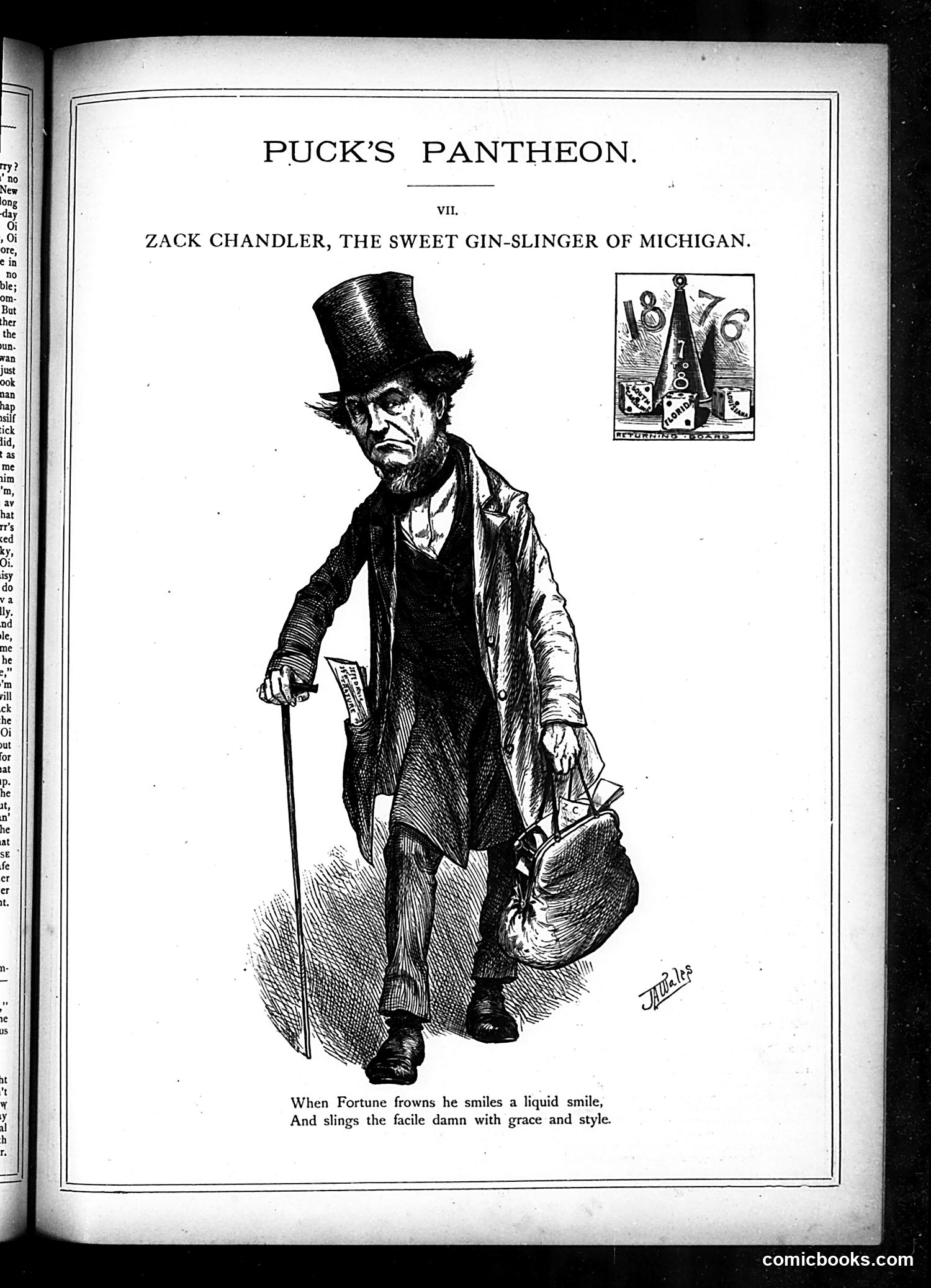
This page profiles **Zack Chandler**, described as "the sweet gin-slinger of Michigan"—a derisive reference to someone associated with liquor distribution or consumption. The caricature depicts a thin, shabby man in a top hat carrying a bottle and bag, suggesting poverty and dissipation despite pretensions to respectability. The accompanying verse—"When Fortune frowns he smiles a liquid smile, / And slings the facile damn with grace and style"—mocks his resort to alcohol and facile speech when facing hardship. The satire targets Chandler's character, portraying him as a figure of disrepute whose charm and eloquence are undermined by his dependency and low station. The small heraldic emblem suggests mock-heroic treatment typical of Puck's irreverent style.
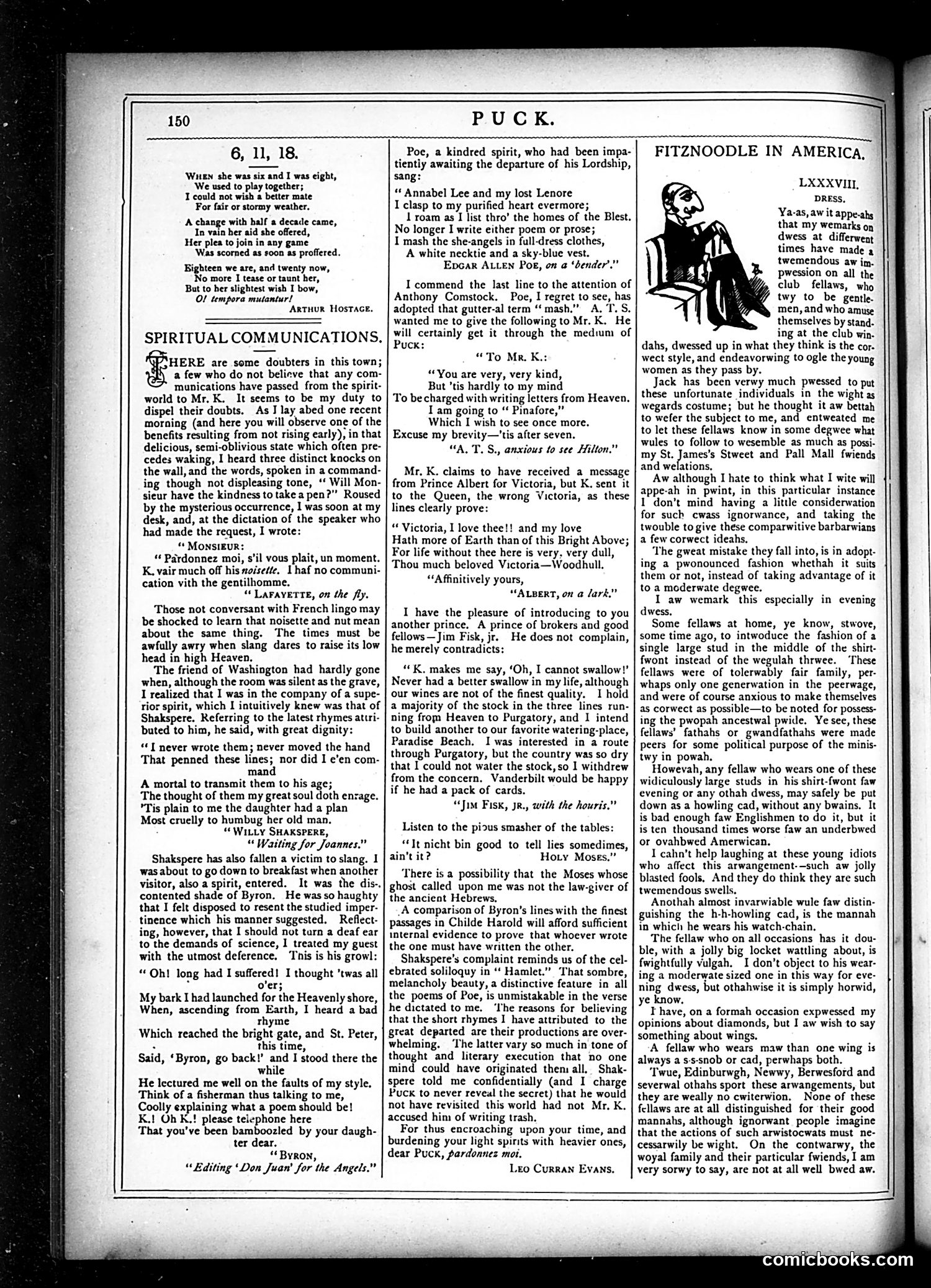
The page contains multiple sections of satirical content and reader correspondence, rather than a single cartoon. The main visual element shows a figure in Victorian dress seated in a chair, illustrating the article "FITZNOODLE IN AMERICA." The content includes: **"Spiritual Communications"** — satire mocking spiritualism and séances, popular Victorian phenomena. It ridicules people claiming to receive messages from deceased spirits and the gullibility of believers. **"Fitznoodle in America"** — appears to satirize pretentious British social customs and attitudes toward American fashion and behavior, criticizing both American social climbers and British snobbery. The page also features reader letters discussing literary matters and social commentary, typical of Puck's format mixing visual satire with written humor about contemporary American society and cultural trends of the period.
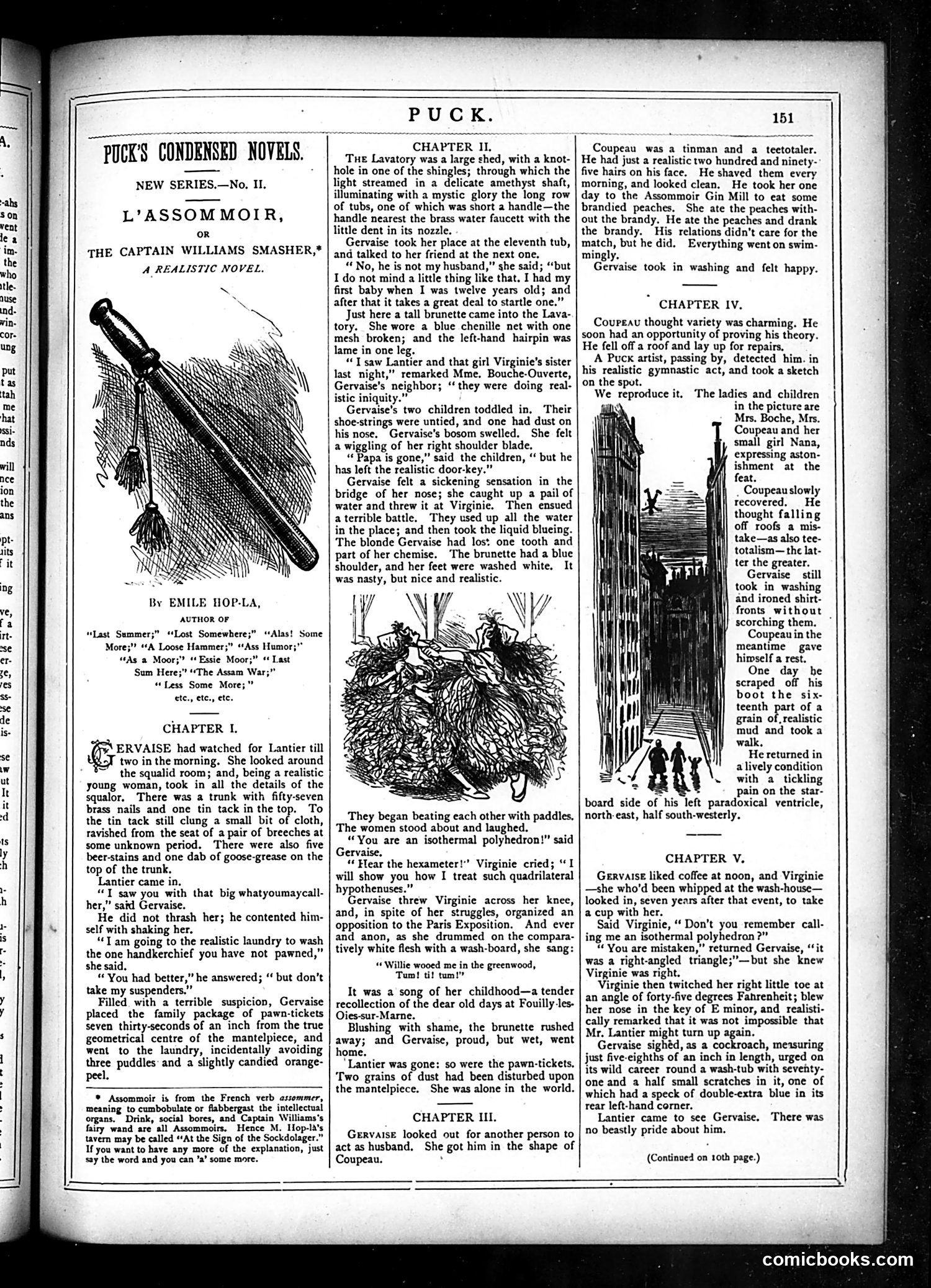
This page presents Chapter II of Émile Zola's serialized novel "L'Assommoir" (translated as "The Captain Williams Smasher"), adapted for Puck magazine's "Condensed Novels" series. The illustrations depict scenes from the story: one shows what appears to be laundry equipment or a washing apparatus; another illustrates characters in domestic turmoil. The narrative concerns working-class characters—Gervaise and others—dealing with poverty, domestic violence, and hardship in Paris. This was not political satire but rather serialized literary content, likely included to attract readers who enjoyed Zola's naturalistic fiction depicting lower-class French life. The magazine combined satirical cartoons with literary serialization as entertainment.
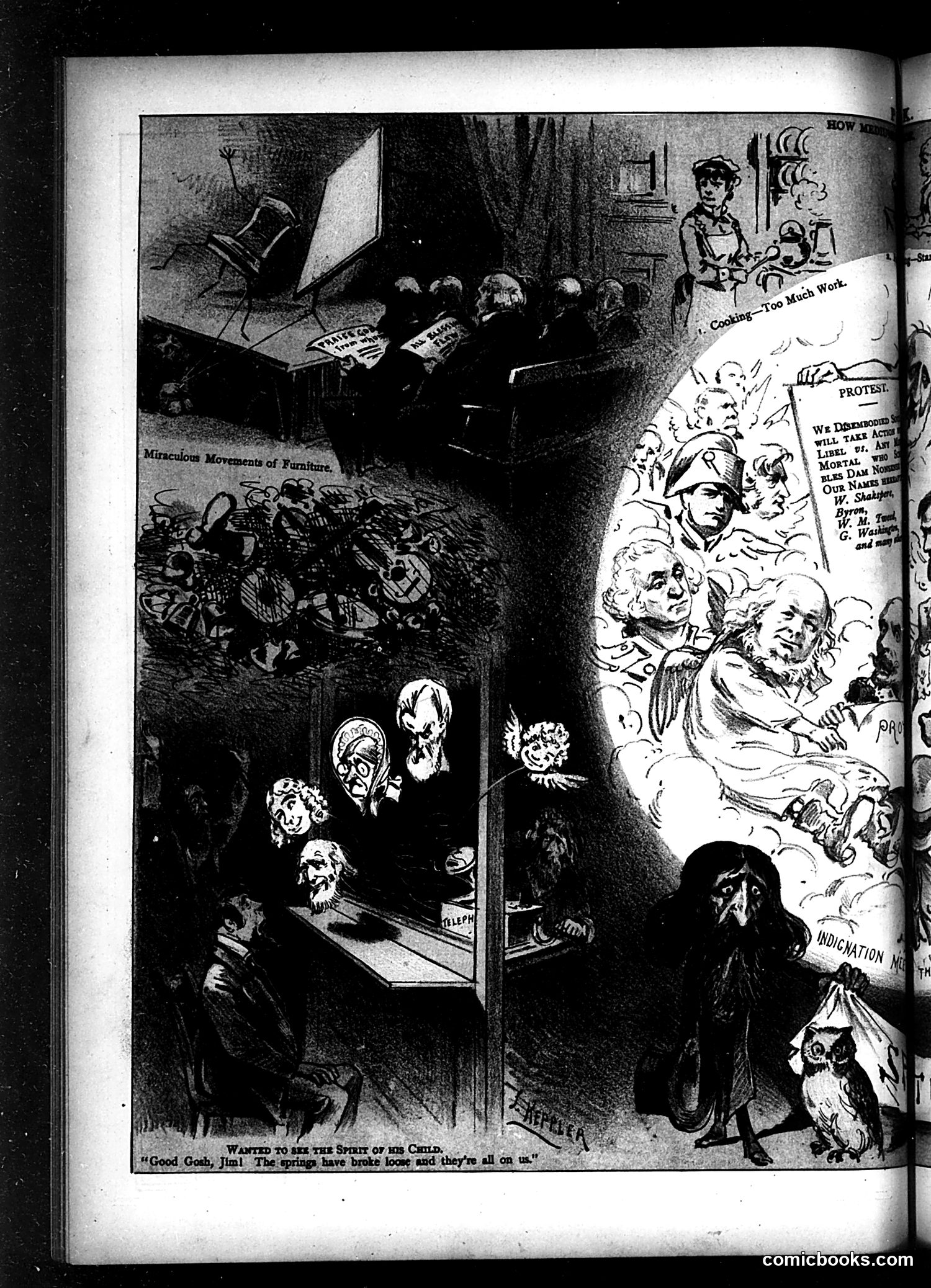
This page contains multiple cartoons satirizing spiritualism and séances, popular phenomena in late 19th-century America. The top cartoon titled "Miraculous Movements of Furniture" depicts a séance where spirits allegedly move objects—here shown as chaotic, levitating furniture. The satire mocks spiritualist claims of supernatural communication. The lower cartoon, "Wanted to See the Spirit of his Child," shows a grieving man at a séance window viewing ghostly faces. The caption's reference to "springs" breaking loose suggests the cartoonist is exposing séance tricks as mechanical fraud rather than genuine spiritual contact. These cartoons ridicule spiritualism as deceptive entertainment exploiting people's grief and credulity—a common Puck theme mocking pseudoscientific fads of the era.
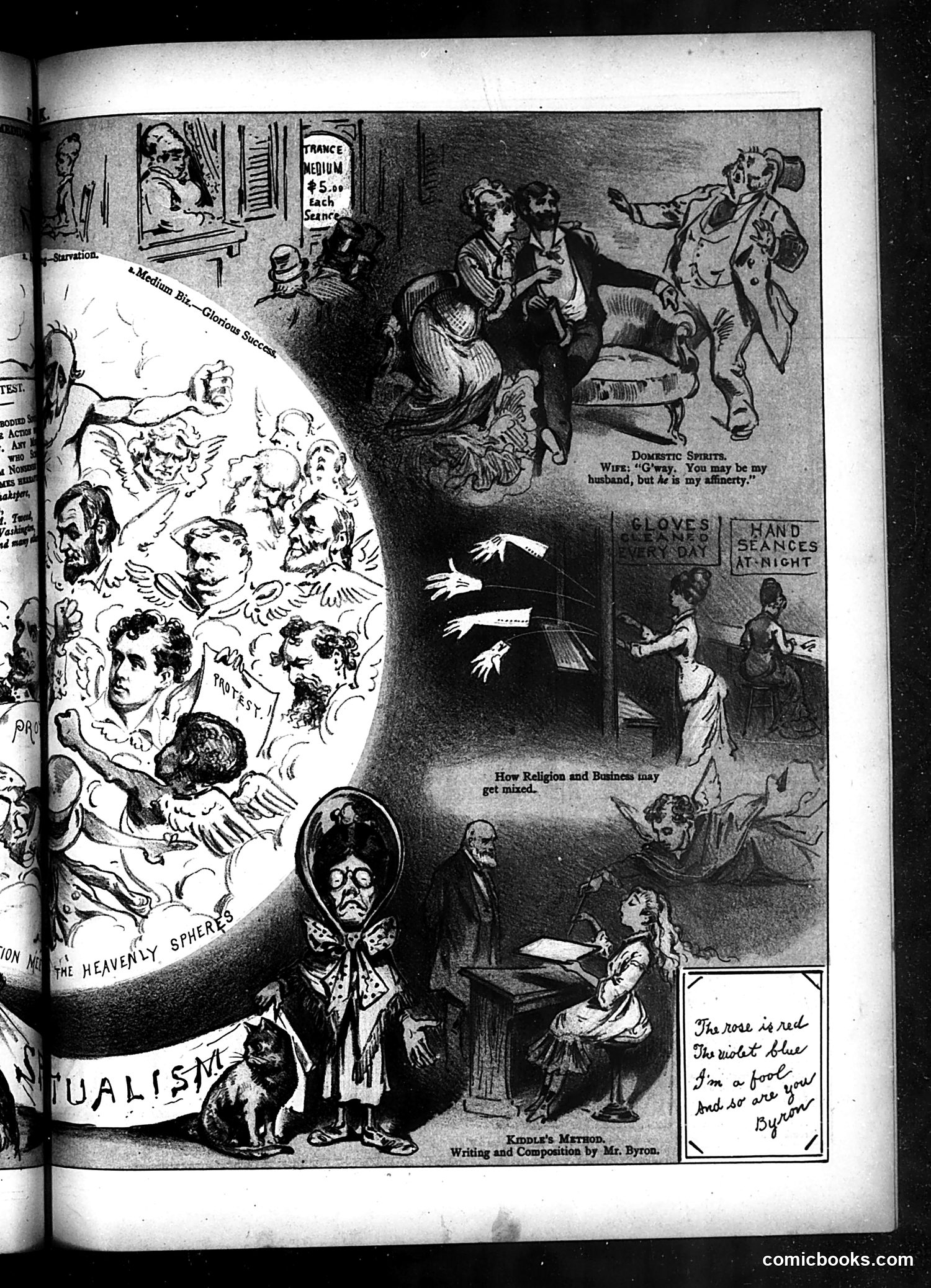
This page contains multiple satirical sketches mocking various social pretensions and behaviors: **"A Medium Bit—Glorious Success"** (left): Depicts spiritualism as fraudulent. A "medium" operates from a window while cherubs labeled "THE HEAVENLY SPHERES" appear—clearly fake props designed to deceive gullible clients seeking contact with the dead. **"Domestic Spirits"** (top right): A woman tells her husband "Of way, You may be my husband, but as is sincerity"—mocking marital discord and hypocrisy about love. **"Loves Glances Every Day Except at Night"** and **"How Religion and Business may get mixed"** (right panels): Satirize the disconnect between public morality and private behavior, and the corruption of religious principles by commercial interests. **"Dualism"** (bottom): Features a figure with a cat, likely criticizing philosophical or spiritual pretension. The overall theme critiques Victorian-era fraud, hypocrisy, and false spirituality.
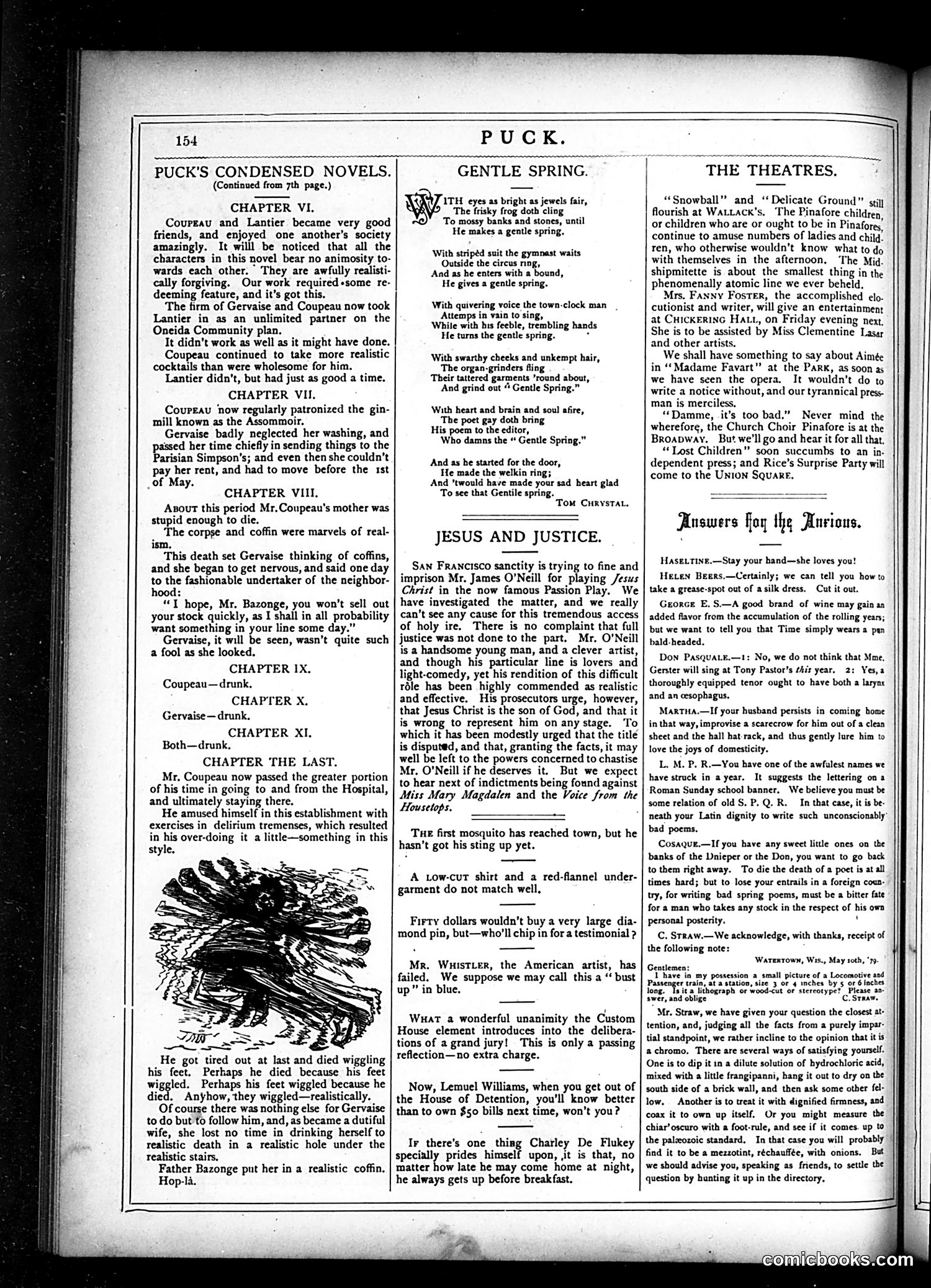
This page contains serialized fiction ("Puck's Condensed Novels"), poetry ("Genteel Spring"), theater reviews, and an advice column ("Answers for the Anxious"). The central illustration depicts a grotesque, ape-like creature — likely a caricature used for satirical commentary, though the specific target is unclear from this excerpt. The text mentions social situations, marital advice, and theatrical performances. The advice column addresses relationship troubles and cultural critiques, including a reference to a "Passion Play" controversy involving actor James O'Neill and accusations of blasphemy — a genuine 1880s-90s cultural debate about theatrical propriety. The page reflects Puck's mix of entertainment, social commentary, and humor aimed at educated readers familiar with contemporary theater and domestic scandals.
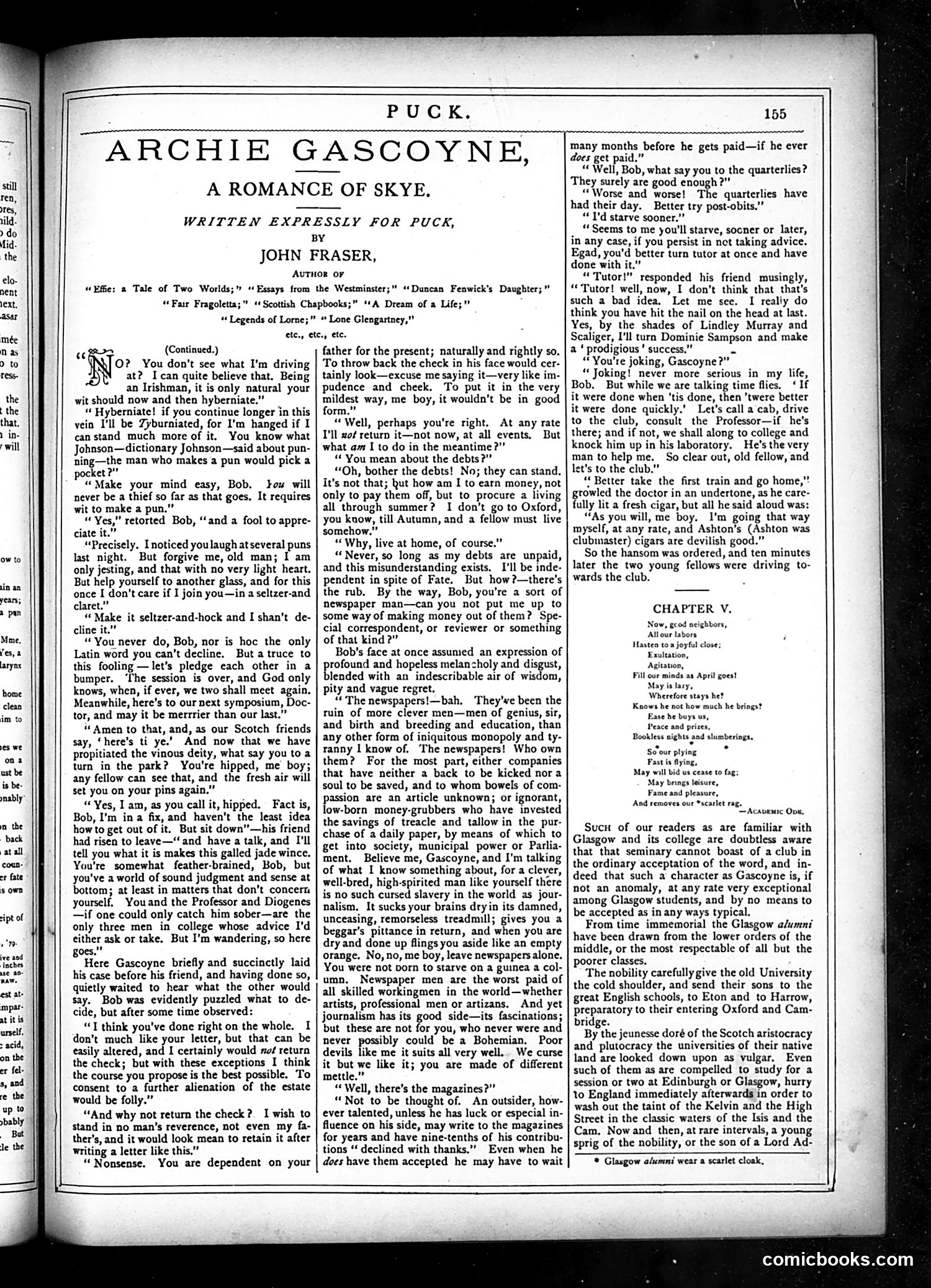
This page is primarily TEXT rather than a political cartoon. It contains "Archie Gascoyne, A Romance of Skye," a serialized story by John Fraser written for Puck magazine. The visible content shows dialogue between characters discussing financial troubles, debts, newspapers, and journalism work. One character (Bob) appears to be struggling financially and considering newspaper work or journalism as income. There is a footnote reference to "Glasgow student wear a scarlet clash," suggesting Scottish university context. This is a literary serialization rather than satirical commentary. The page contains no identifiable political figures or caricatures, and appears to be entertainment content rather than political satire typical of Puck's usual offerings.
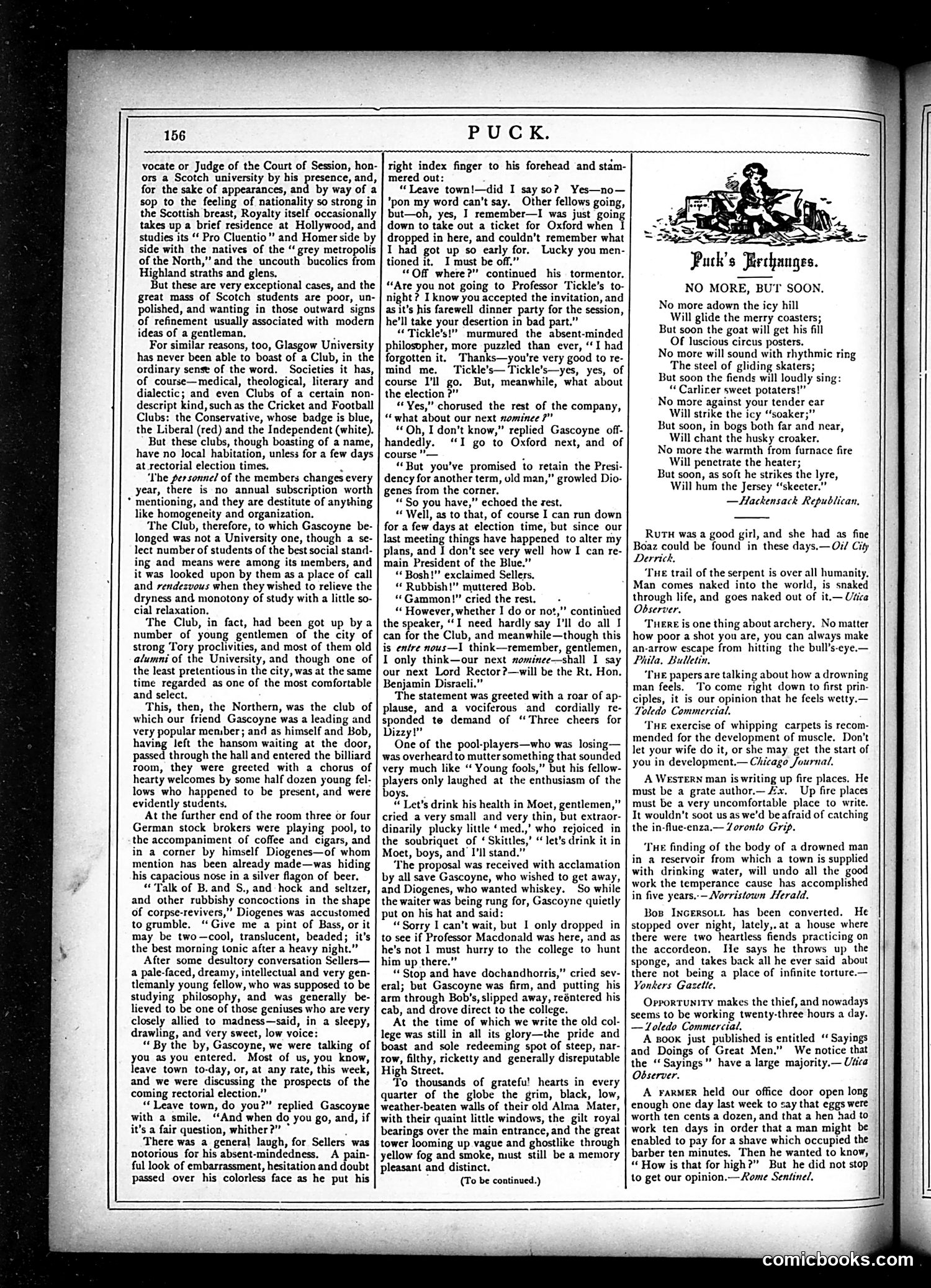
This page contains primarily text articles and humor pieces rather than political cartoons. The small illustration at the top right titled "Puck's Birthings" shows a circus scene with posters and performers—likely satirizing sensational entertainment. The main content includes commentary on Scottish university traditions, Club membership practices, and various social observations. One piece jokes about someone avoiding an Oxford election; another discusses archery and drowning prevention. The humor is gentle and social rather than explicitly political—poking fun at Victorian-era academic life, club culture, and self-improvement fads. Without clearer identification of specific contemporary figures or events referenced in the dense text, the precise satirical targets remain somewhat unclear, though the overall tone mocks pretension and social conventions of the era.
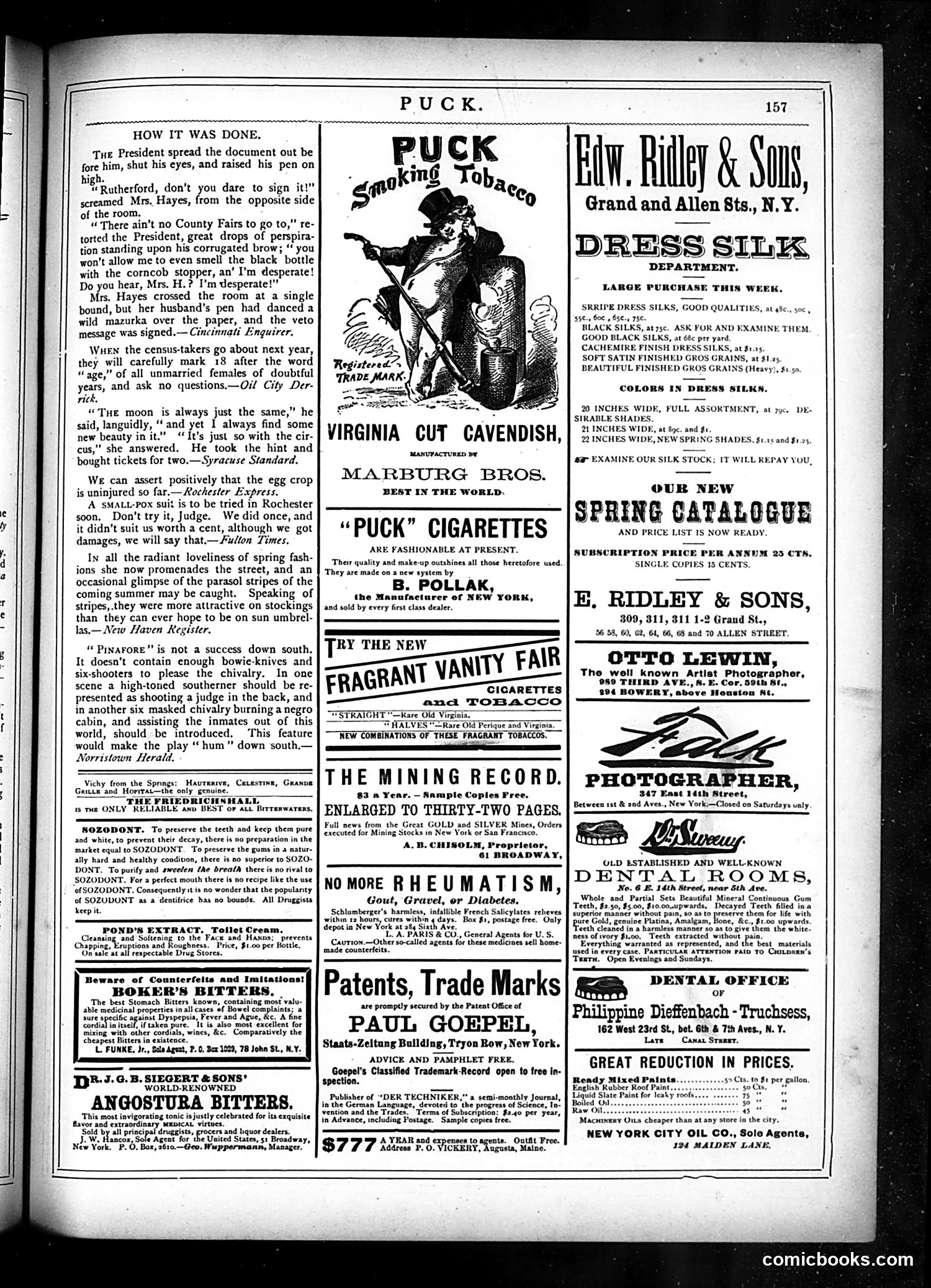
This page is primarily **advertising and commercial content** rather than political satire. The dominant features are advertisements for tobacco products (Puck Smoking Tobacco, Virginia Cut Cavendish cigarettes), silk dress goods, photography services, patent/trademark registration, and various patent medicines and bitters. The only cartoon element visible is a **small illustration of a figure smoking**, which appears to be a **logo or mascot for Puck tobacco** rather than editorial political commentary. The text section "HOW IT WAS DONE" contains anecdotal humor about county fairs and moonlight, but this is light social commentary rather than political satire. This appears to be a typical late 19th-century magazine page where editorial content shared space equally with advertising revenue.
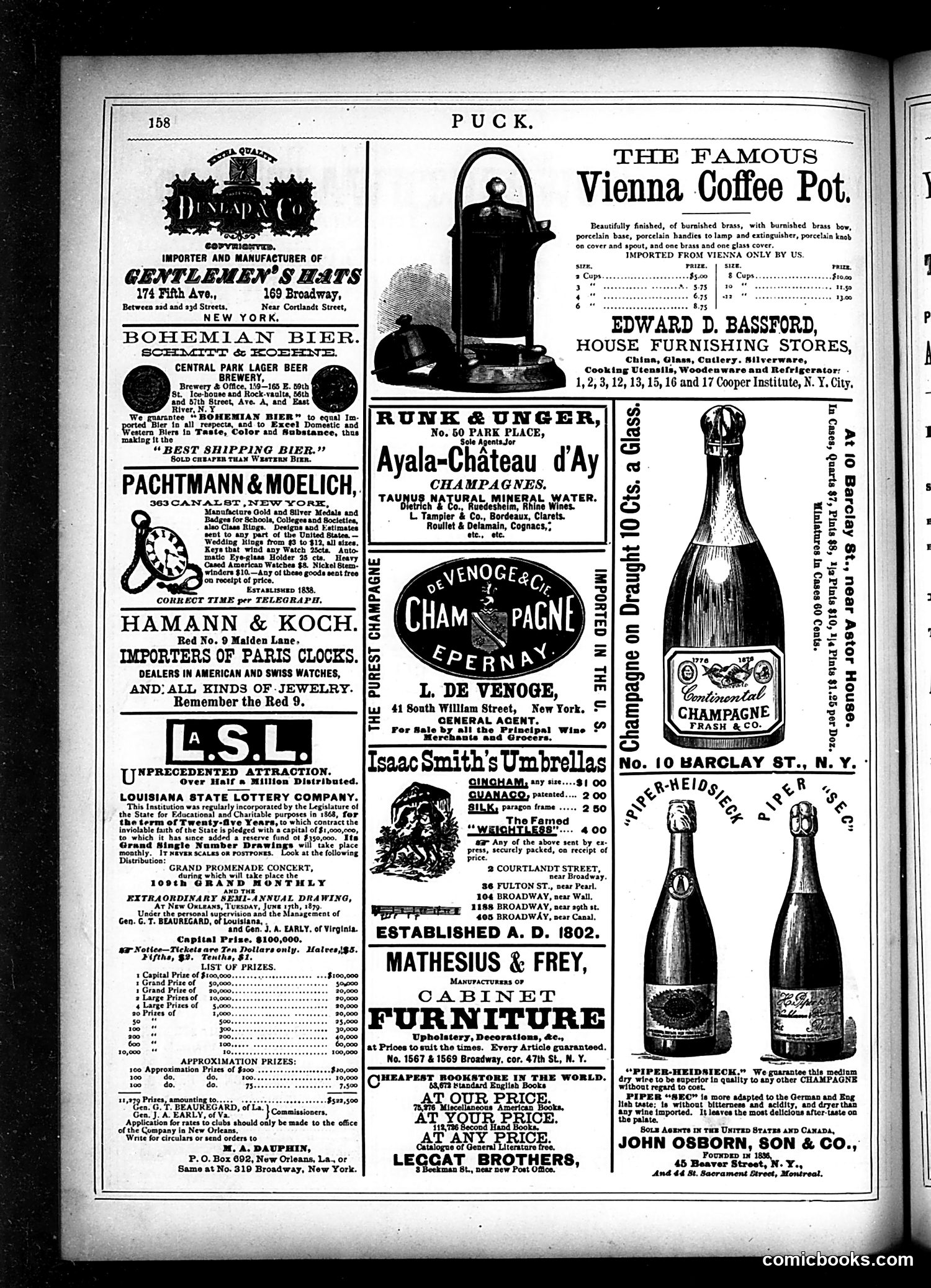
This is primarily an **advertising page** from Puck magazine (page 158), not a political cartoon page. It contains commercial advertisements for various products and services popular in late 19th-century New York, including: - German beer and Bohemian beverages - Vienna coffee pots and house furnishings - French champagne and wines - Swiss watches and clocks - Umbrellas - Cabinet furniture - A lottery advertisement The only notable satirical content is a **Louisiana State Lottery advertisement**, which humorously promotes itself as an "unprecedented attraction" despite lotteries being widely condemned as fraudulent schemes during this era. This reflects Puck's tendency to mock dubious enterprises through advertising parody. The page primarily reflects the commercial interests and consumer goods of affluent 1890s urban America.
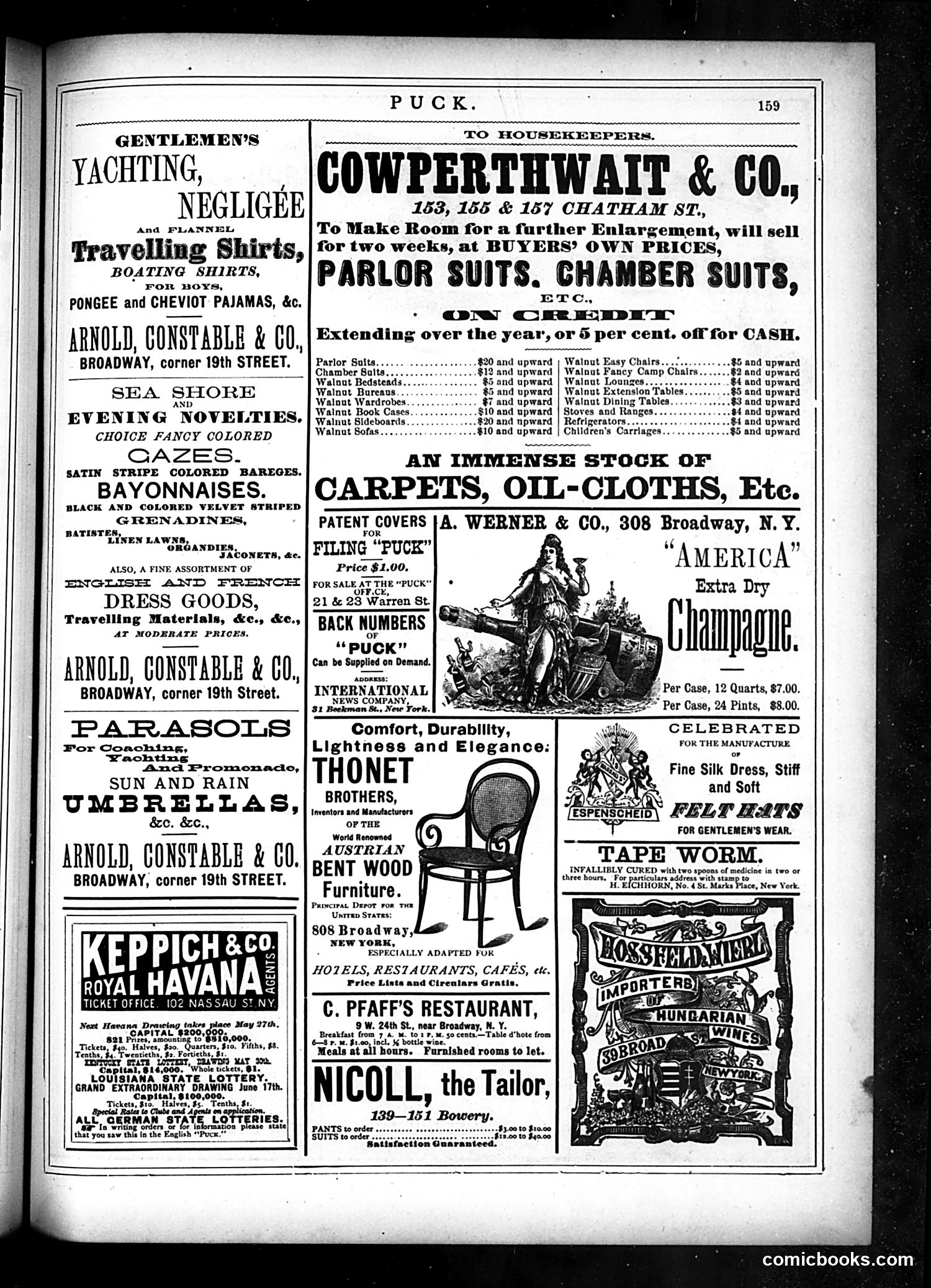
This page is primarily **advertising**, not editorial content or political satire. It contains commercial advertisements from the 1880s-1890s era for various products and services: - Clothing retailers (Arnold, Constable & Co.) - Furniture (Thonet bent-wood chairs) - Champagne and wine importers - A tailor's shop - Carpets and home furnishings - Lottery tickets and cigars The only illustration with potential satirical content is the **Thonet chair advertisement**, which features a classical allegorical female figure (possibly representing industry or commerce) alongside a bentwood chair. However, this appears to be straightforward product marketing rather than political commentary. The page represents typical Puck magazine filler—revenue-generating advertisements rather than the satirical cartoons the magazine was known for.
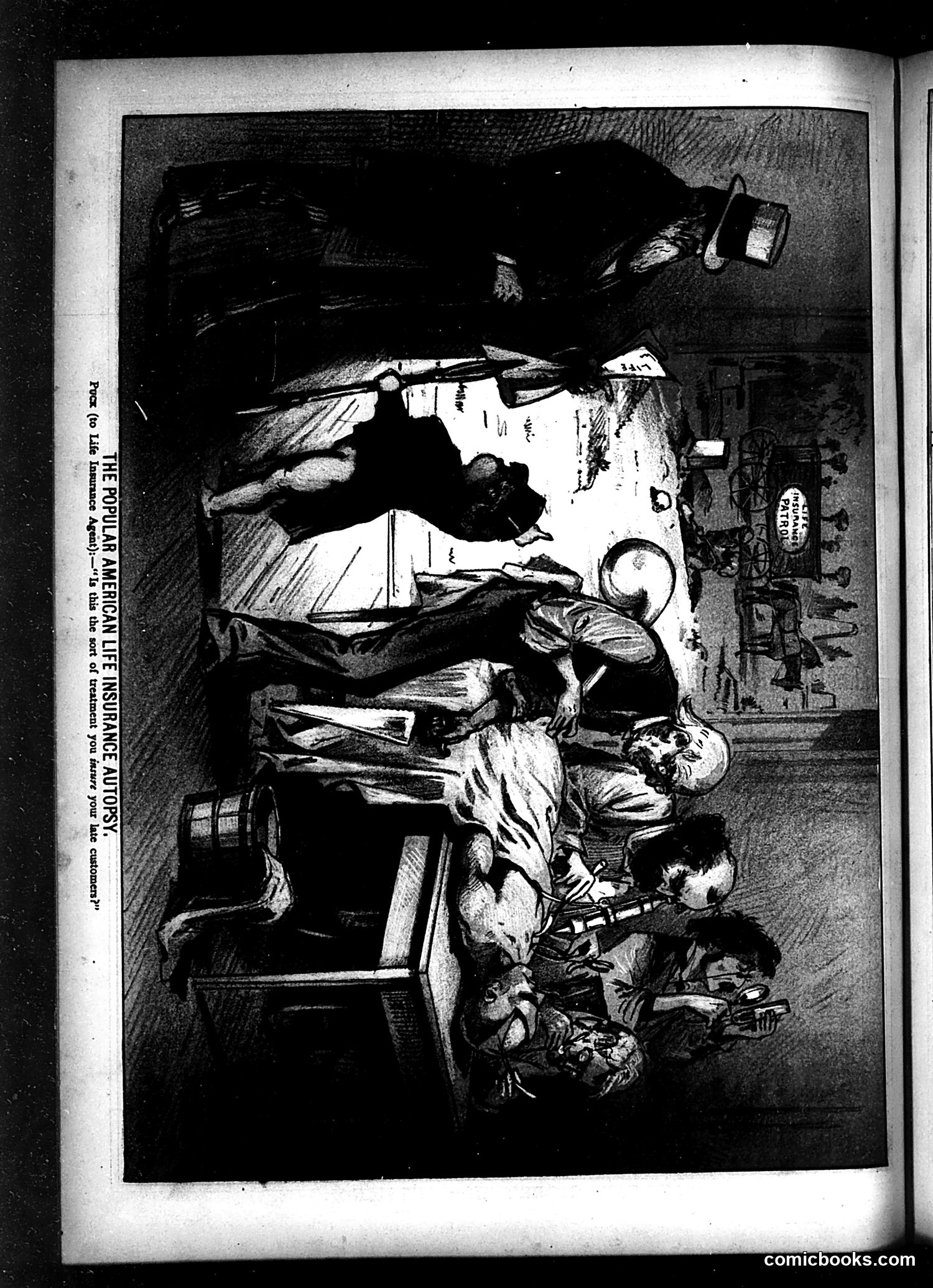
This page shows "The Popular American Insurance Swindle" — a satirical cartoon criticizing insurance fraud schemes targeting ordinary Americans. The image depicts a deceptive scenario: a well-dressed man (likely an insurance agent or swindler) stands over a poor family in cramped, modest living quarters. The composition suggests the agent is exploiting vulnerable people by selling them insurance policies they likely cannot afford or that offer false promises. The satire targets predatory insurance practices of the era, when unscrupulous agents targeted working-class and immigrant populations with misleading policies. Puck's message: insurance companies were perpetrating organized fraud against Americans who could least afford to be cheated, presenting it as legitimate business. The "swindle" in the title makes the satirical intent explicit — this isn't honest commerce but systematic exploitation.