
Puck, 1879-05-14 · page 6 of 16
Puck — May 14, 1879 — page 6: what you’re looking at
What you’re looking at
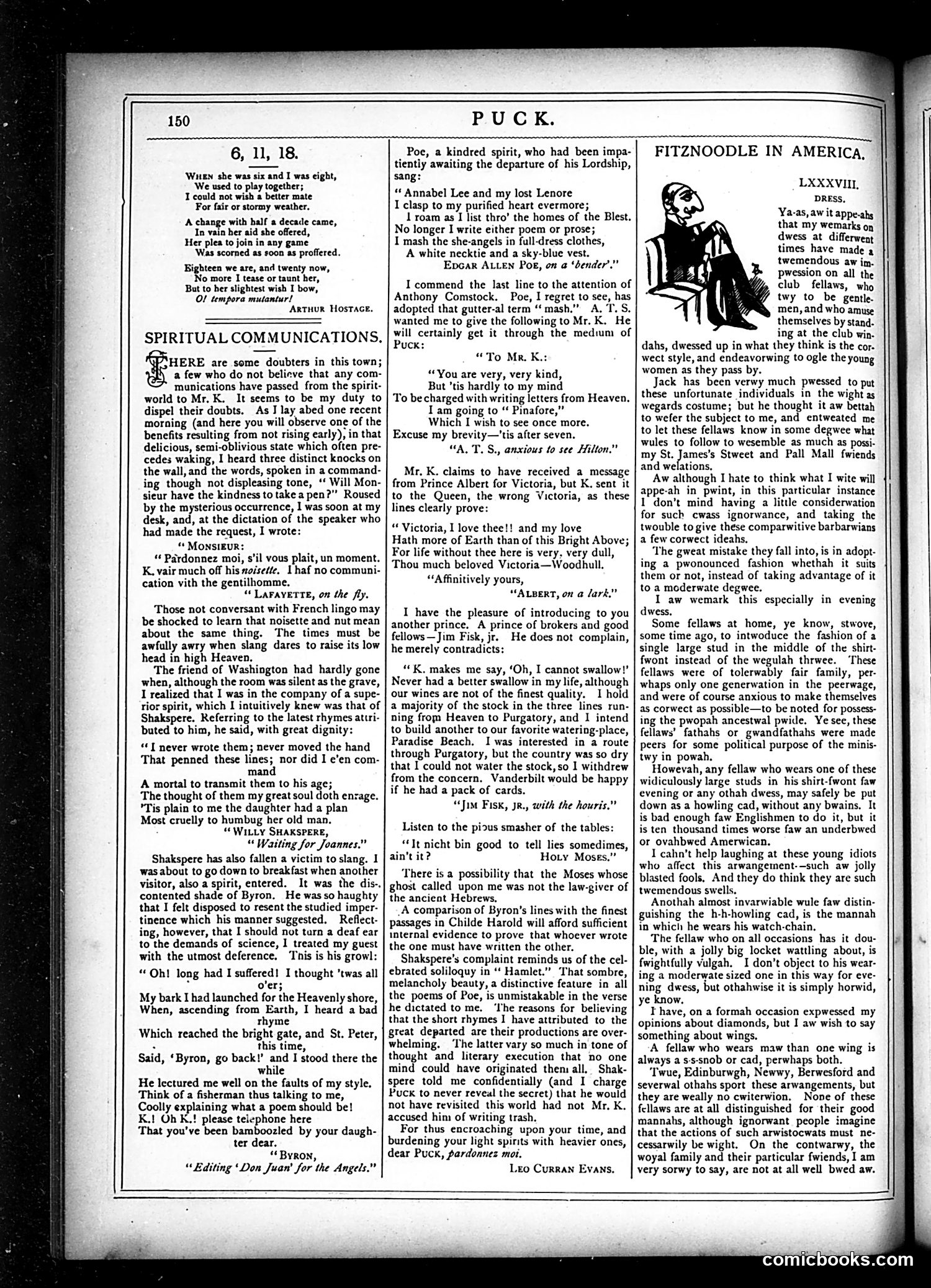
The page contains multiple sections of satirical content and reader correspondence, rather than a single cartoon. The main visual element shows a figure in Victorian dress seated in a chair, illustrating the article "FITZNOODLE IN AMERICA." The content includes: **"Spiritual Communications"** — satire mocking spiritualism and séances, popular Victorian phenomena. It ridicules people claiming to receive messages from deceased spirits and the gullibility of believers. **"Fitznoodle in America"** — appears to satirize pretentious British social customs and attitudes toward American fashion and behavior, criticizing both American social climbers and British snobbery. The page also features reader letters discussing literary matters and social commentary, typical of Puck's format mixing visual satire with written humor about contemporary American society and cultural trends of the period.
📄 Transcribed text from this page (OCR, searchable)
Machine-transcribed from the original scan — historical spelling and the odd misread are preserved.
PUCK. 6, 1, 18. ‘Wnen she was six and I was eight, We used to play together; I could not wish a better mate For fair or stormy weather. A change with half a decade came, In vain her aid she offered, Her plea to join in any game ‘Was scorned as soon as proffered. Bighteen we are, and twenty now, No more I tease or taunt her, But to her slightest wish I bow, OF tempora mutantur! ARTHUR HosTace. SPIRITUAL COMMUNICATIONS. ee are some doubters in this town; a few who do not believe that any com- munications have passed from the spirit- world to Mr. K. It seems to be my duty to dispel their doubts. As I lay abed one recent morning (and here you will observe one of the benefits resulting from not rising early), in that delicious, semi-oblivious state which often pre- cedes waking, I heard three distinct knocks on the wall, and the words, spoken in a command- ing though not displeasing tone, “ Will Mon- sieur have the kindness to take a pen?” Roused by the mysterious occurrence, I was soon at my desk, and, at the dictation of the speaker who had made the request, I wrote: ‘ MONSIEUR: “ Pardonnez moi, s'il vous plait, un moment. K. vair much off his no/seéle, [haf no communi- cation vith the gentilhomme. “ LAFAYETTE, on the fly. ‘Those not conversant with French lingo may be shocked to learn that noisette and nut mean about the same thing. The times must be awfully awry when slang dares to raise its low head in high Heaven. The friend of Washington had hardly gone when, although the room was silent as the grave, I realized that I was in the company of a supe- rior spirit, which I intuitively knew was that of Shakspere. Referring to the latest rhymes attri- buted to him, he said, with great dignity: “IT never wrote them; never moved the hand That penned these lines; nor did 1 c’en com- mand A mortal to transmit them to his age; The thought of them my great soul doth enzage. "Tis plain to me the daughter had a plan Most cruelly to humbug her old man. “WILLY SHAKSPERE, “ Waiting for Joannes.” Shakspere has also fallen a victim to slang. 1 was about to go down to breakfast when another visitor, also a spirit, entered. It was the dis-. contented shade of Byron. He was so haughty that I felt disposed to resent the studied imper- tinence which his manner suggested. Reflect- ing, however, that I should not turn a deaf ear to the demands of science, 1 treated my guest with the utmost deference, This is his growl: “Oh! long had I suffered! I thought ‘twas all o'er; My bark I had launched for the Heavenly shore, When, ascending from Earth, I heard a bad rhyme Which reached the bright gate, and St. Peter, 2 this time, Said, ‘Byron, go back!’ and I stood there the while He lectured me well on the faults of my style. Think of a fisherman thus talking to me, Coolly explaining what a poem should be! K.! Oh K.! please telephone here That you've been bamboozled by your daugh- ter dear. “Byron, “Editing ‘Don Juan’ for the Angels.” Poe, a kindred spirit, who had been impa- tientiy awaiting the departure of his Lordship, sang: ‘Annabel Lee and my lost Lenore I clasp to my purified heart evermore; 1 roam as I list thro’ the homes of the Blest. No longer I write either poem or prose; I mash the she-angels in full-dress clothes, A white necktie and a sky-blue vest. Epcar ALLEN Poe, on a ‘bender’.” I commend the last line to the attention of Anthony Comstock. Poe, I regret to see, has adopted that gutter-al term “mash.” A. T. S. wanted me to give the following to Mr. K. He will certainly get it through the medium of Puck: “To Mr. K.: “You are very, very kind, But ’tis hardly to my mind To becharged with writing letters from Heaven, I am going to “ Pinafore,” Which I wish to see once more. Excuse my brevity—'tis after seven. “A. T.S., anxious to see Hilton.” Mr. K. claims to have received a message from Prince Albert for Victoria, but K. sent it to the Queen, the wrong Victoria, as these lines clearly prove: “ Victoria, I love thee!! and my love Hath more of Earth than of this Bright Above; For life without thee here is very, very dull, Thou much beloved Victoria—Woodhull. “Affinitively yours, “ALBERT, on a lark,” I have the pleasure of introducing to you another prince. A prince of brokers and good fellows —Jim Fisk, jr. He does not complain, he merely contradicts: “K, makes me say, ‘Oh, I cannot swallow! Never had a better swallow in my life, although our wines are not of the finest quality. I hold a majority of the stock in the three lines run- ning from Heaven to Purgatory, and | intend to build another to our favorite watering-place, Paradise Beach. I was interested in a route through Purgatory, but the country was so dry that I could not water the stock, so I withdrew from the concern. Vanderbilt would be happy if he had a pack of cards. “Jim Fisk, jr., with the houris.”” Listen to the pious smasher of the tables: “It nicht bin good to tell lies somedimes, ain't it? Hoty Moses,” ‘There is a possibility that the Moses whose ghost called upon me was not the law-giver of the ancient Hebrews, A comparison of Byron’s lines with the finest passages in Childe Harold will afford sufficient internal evidence to prove that whoever wrote the one must have written the other. Shakspere’s complaint reminds us of the cel- ebrated soliloquy in “‘ Hamlet.” That sombre, melancholy beauty, a distinctive feature in all the poems of Poe, is unmistakable in the verse he dictated to me. ‘T'he reasons for believing that the short rhymes I have attributed to the great departed are their productions are over- whelming. ‘The latter vary so much in tone of thought and literary execution that no one mind could have originated them all. Shak- spere told me confidentially (and I charge Puck to never reveal the secret) that he would not have revisited this world had not Mr. K. accused him of writing trash. For thus encroaching upon your time, and burdening your light spirits with heavier ones, dear Puck, pardonnez mot, Leo Curran Evans, FITZNOODLE IN AMERICA, LXXXVIII, DRESS, Ya-as, aw it appe-ahs that my wemarks on dwess at differwent times have made a twemendous aw im. pwession on all the club fellaws, who twy to be gentle. men, and who amuse themselves by stand. ing at the club win. dahs, dwessed up in what they think is the cor. wect style, and endeavorwing to ogle the young women as they pass by. Jack has been verwy much pwessed to put these unfortunate individuals in the wight as wegards costume; but he thought it aw bettah to wefer the subject to me, and entweated me to let these fellaws know in some degwee what wules to follow to wesemble as much as possi- my St. janes Stweet and Pall Mall fwiends and welations. Aw although I hate to think what I wite will appe-ah in pwint, in this particular instance 1 don’t mind having a little considerwation for such cwass ignorwance, and taking the twouble to give these comparwitive barbarwians a few corwect ideahs, The gweat mistake they fall into, is in adopt- ing a pwonounced fashion whethah it suits them or not, instead of taking advantage of it to a moderwate degwee. I aw wemark this especially in evening dwess, Some fellaws at home, ye know, stwove, some time ago, to intwoduce the fashion of a single large stud in the middle of the shirt- fwont instead of the wegulah thrwee. ‘These fellaws were of tolerwably fair family, per- whaps only one generwation in the peerwage, and were of course anxious to make themselves as corwect as possible—to be noted for possess- ing the pwopah ancestwal pwide. Ye see, these fellaws’ fathahs or gwandfathahs were made peers for some political purpose of the minis- twy in powah, Howevah, any fellaw who wears one of these widiculously large studs in his shirt-fwont faw evening or any othah dwess, may safely be put down as a howling cad, without any bwains. It is bad enough faw Englishmen to do it, but it is ten thousand times worse faw an underbwed or ovahbwed Amerwican. I cahn’t help laughing at these young idiots who affect this arwangement-—such aw jolly blasted fools, And they do think they are such twemendous swells, Anothah almost invarwiable wule faw distin- guishing the h-h-howling cad, is the mannah in which he wears his watch-chain, The fellaw who on all occasions has it dou- ble, with a jolly big locket wattling about, is fwightfully vulgah. I don’t object to his wear- ing a moderwate sized one in this way for eve- ning dwess, but othahwise it is simply horwid, ye know. I have, on a formah occasion expwessed my opinions about diamonds, but I aw wish to say something about wings. A fellaw who wears maw than one wing is always a ss-snob or cad, perwhaps both. ‘Twue, Edinburwgh, Newwy, Berwesford and severwal othahs sport these arwangements, but they are weally no cwiterwion. None of these fellaws are at all distinguished for their good mannahs, although ignorwant people imagine that the actions of such arwistocwats must ne- cessarwily be wight. On the contwarwy, the woyal family and their particular fwiends, I am very sorwy to say, are not at all well bwed aw.