
Puck, 1879-05-14 · page 11 of 16
Puck — May 14, 1879 — page 11: what you’re looking at
What you’re looking at
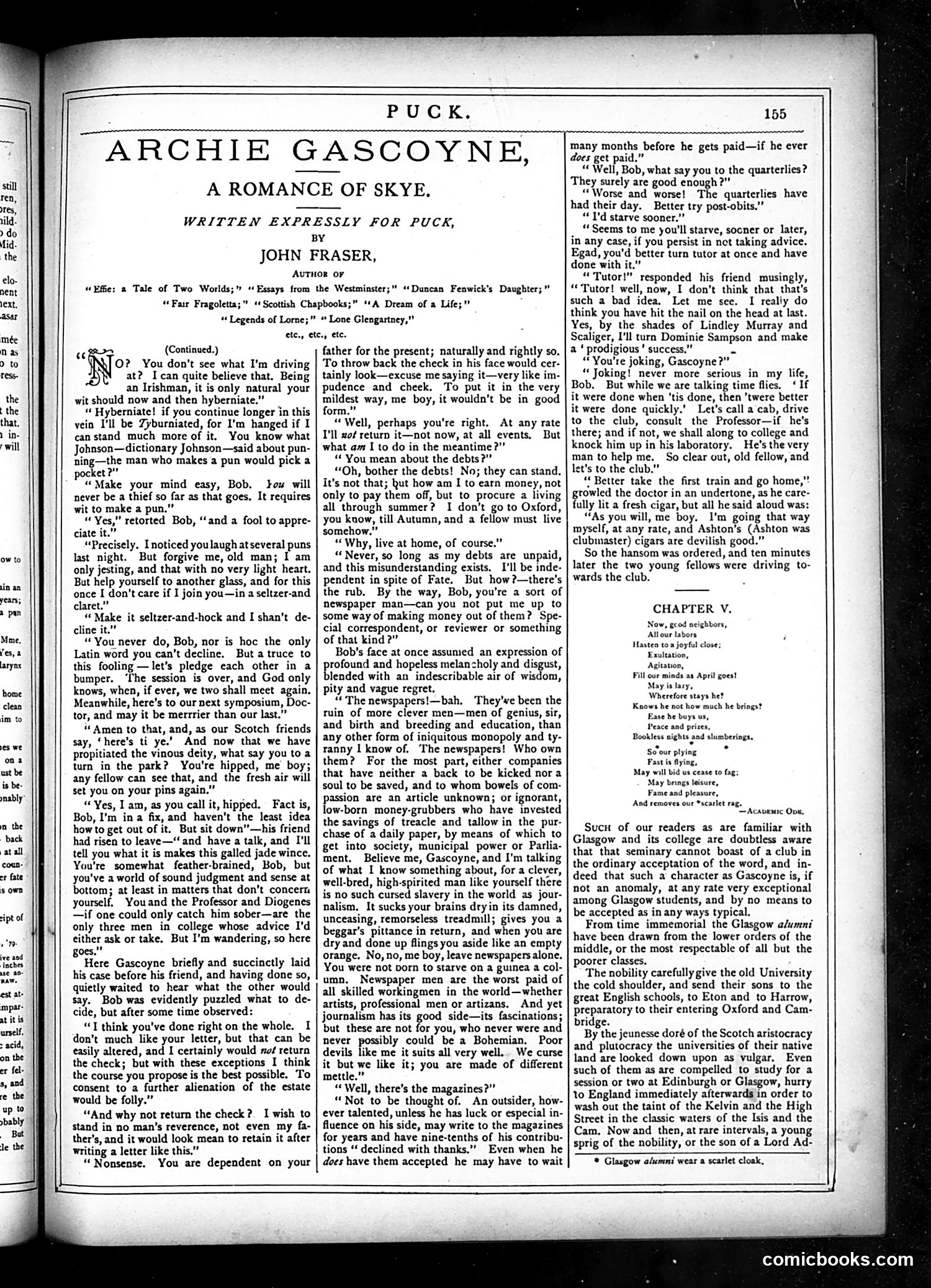
This page is primarily TEXT rather than a political cartoon. It contains "Archie Gascoyne, A Romance of Skye," a serialized story by John Fraser written for Puck magazine. The visible content shows dialogue between characters discussing financial troubles, debts, newspapers, and journalism work. One character (Bob) appears to be struggling financially and considering newspaper work or journalism as income. There is a footnote reference to "Glasgow student wear a scarlet clash," suggesting Scottish university context. This is a literary serialization rather than satirical commentary. The page contains no identifiable political figures or caricatures, and appears to be entertainment content rather than political satire typical of Puck's usual offerings.
📄 Transcribed text from this page (OCR, searchable)
Machine-transcribed from the original scan — historical spelling and the odd misread are preserved.
PUCK. 155 ARCHIE GASCOYNE, A ROMANCE OF SKYE. WRITTEN EXPRESSLY FOR PUCK, BY JOHN FRASER, AUTHOR OF “Effie: a Tale of Two Worlds; «Essays from the Westminster; “Duncan Fenwick's Daughter; ” «Fair Fragoletta;" ‘Scottish Chapbooks;” “A Dream of a Life;” “ Legends of Lorne “ Lone Glengartney,”” etc., etc. etc. (Continued) ‘ “O70? You don't see what I'm driving YW at? Ican quite believe that. Being an Irishman, it is only natural your wit should now and then hyberniate.” “ Hyberniate! if you continue longer in this vein I'll be Zyburniated, for I’m hanged if I can stand much more of it. You know what Johnson—dictionary Johnson—said about pun- ning—the man who makes a pun would pick a pocket ?”” “Make your mind easy, Bob. You will never be a thief so far as that goes. It requires wit to make a pun.” "retorted Bob, “and a fool to appre- “Precisely. I noticed you laugh at several puns last night. But forgive me, old man; I am only jesting, and that with no very light heart. But help yourself to another glass, and for this once I don’t care if I join you—in a seltzer-and claret.” “ Make it seltzer-and-hock and I shan’t de- cline it.” “You never do, Bob, nor is hoc the only Latin word you can’t decline. But a truce to this fooling — let's pledge each other in a bumper. ‘The session is over, and God only knows, when, if ever, we two shall meet again. Meanwhile, here’s to our next symposium, Doc- tor, and may it be merrrier than our last.” “ Amen to that, and, as our Scotch friends say, ‘here’s ti ye.’ And now that we have propitiated the vinous deity, what say you to a turn in the park? You're hipped, me boy; any fellow can see that, and the fresh air will set you on your pins again.” “Yes, Lam, as you call it, hipped. Fact is, Bob, I'm ina fix, and haven't the least idea how to get out of it. But sit down”—his friend had risen to leave— and have a talk, and I'll tell you what it is makes this galled jade wince. You're somewhat feather-brained, Bob, but you've a world of sound judgment and sense at bottom; at least in matters that don’t concern yourself, Youand the Professor and Diogenes —if one could only catch him sober—are the only three men in college whose advice I'd either ask or take. But I’m wandering, so here oes,” ; Here Gascoyne briefly and succinctly laid his case before his friend, and having done so, quietly waited to hear what the other would say. Bob was evidently puzzled what to de- cide, but after some time observed: “T think you've done right on the whole. I don’t much like your letter, but that can be easily altered, and I certainly would nf return the check; but with these exceptions I think the course you propose is the best possible. To consent to a further alienation of the estate would be folly.” “And why not return the check? I wish to stand in no man’s reverence, not even my fa- ther’s, and it would look mean to retain it after writing a letter like this.” “ Nonsense. You are dependent on your father for the present; naturally and rightly so. To throw back the check in his face would cer- tainly look—excuse me saying it—very like im- pudence and cheek. To put it in the very mildest way, me boy, it wouldn’t be in good form.” “Well, perhaps you're right. At any rate I'll zo¢ return it—not now, at all events. But what am I to do in the meantime?” “ You mean about the debts?” “Oh, bother the debts! No; they can stand, It's not that; hut how am I to earn money, not only to pay them off, but to procure a living all through summer? I don’t go to Oxford, you kaow, till Autumn, and a fellow must live somehow.” “Why, live at home, of course.” “Never, so long as my debts are unpaid, and this misunderstanding exists. I'll be i1 pendent in spite of Fate. But how?—there’s the rub. By the way, Bob, you're a sort of newspaper man—can you not put me up to some way of making money out of them? Spe- cial correspondent, or reviewer or something of that kind ?” Bob's face at once assumed an expression of rofound and hopeless melancholy and disgust, blended with an indescribable air of wisdom, pity and vague regret. “The newspapers!—bah. ‘They've been the ruin of more clever men—men of genius, sir, and birth and breeding and education, than any other form of iniquitous monopoly and ty- ranny I know of. The newspapers! Who own them? For the most part, either companies that have neither a back to be kicked nora soul to be saved, and to whom bowels of com- passion are an article unknown; or ignorant, low-born money-grubbers who have invested the savings of treacle and tallow in the pur- chase of a daily paper, by means of which to get into society, municipal power or Parlia- ment. Believe me, Gascoyne, and I'm talking of what I know something about, for a clever, well-bred, high-spirited man like yourself there is no such cursed slavery in the world as jour- nalism. It sucks your brains dry in its damned, unceasing, remorseless treadmill; gives you a beggar’s pittance in return, and when you are dry and done up flings you aside like an empty orange. No, no, me boy, leave newspapers alone. You were not porn to starve on a guinea a col- umn, Newspaper men are the worst paid of all skilled workingmen in the world—whether artists, professional men or artizans. And yet journalism has its good side—its fascinations; but these are not for you, who never were and never possibly could be a Bohemian, Poor devils like me it suits all very well. We curse it but we like it; you are made of different mettle.” “Well, there’s the magazines?” “Not to be thought of. An outsider, how- ever talented, unless he has luck or especial in- fluence on his side, may write to the magazines for years and have nine-tenths of his contribu- tions “‘ declined with thanks,” Even when he does have them accepted he may have to wait many months before he gets paid—if he ever does get paid.” “ Well, Bob, what say you to the quarterlies? They surely are good enough ?” “Worse and worse! The quarterlies have had their day. Better try post-obits.”” “I'd starve sooner.” ,_ ‘Seems to me you'll starve, socner or later, in any case, if you persist in net taking advice. Egad, you'd better turn tutor at once and have done with it.” “Tutor!” responded his friend musingly, “Tutor! well, now, I don’t think that that’s such a bad idea. Let me see. I realiy do think you have hit the nail on the head at last. Yes, by the shades of Lindley Murray and Scaliger, I'l turn Dominie Sampson and make a ‘prodigious’ success,”" - “You're joking, Gascoyne?” “ Joking! never more serious in my life, Bob, But while we are talking time flies. ‘If it were done when ’tis done, then 'twere better it were done quickly.’ Let’s call a cab, drive to the club, consult the Professor—if he's there; and if not, we shall along to college and knock him up in his laboratory. He's the very man to help me. So clear out, old fellow, and let's to the club,” “Better take the first train and go home," rowled the doctor in an undertone, as he care- fully lit a fresh cigar, but all he said aloud was: “As you will, me boy. I’m going that way myself, at any rate, and Ashton’s (Ashton was clubmaster) cigars are devilish good.” So the hansom was ordered, and ten minutes later the two young fellows were driving to- wards the club. CHAPTER V. Now, gcod neighbors, Allour labors Hasten toa joyful close; Exultation, Agitanon, Fill our minds as April goes! May is lay, Wherefore stays he? Knows he not how much he brings? Ease he buys us, Peace and prizes, Bookless nights and slumberings, So'our plying Fast is fying, May will bid us cease to fag: May brings leisure, Fame and pleasure, And removes our *scarlet rag. ‘Acavemic Ove, Sucu of our readers as are familiar with Glasgow and its college are doubtless aware that that seminary cannot boast of a club in the ordinary acceptation of the word, and in- deed that such a character as Gascoyne is, if not an anomaly, at any rate very exceptional among Glasgow students, and by no means to be accepted as in any ways typical. From time immemorial the Glasgow alumni have been drawn from the lower orders of the middle, or the most respectable of all but the poorer classes, ‘The nobility carefully give the old University the cold shoulder, and send their sons to the great English schools, to Eton and to Harrow, preparatory to their entering Oxford and Cam- bridge. By the jeunesse doré of the Scotch aristocracy and plutocracy the universities of their native land are looked down upon as vulgar. Even such of them as are compelled to study for a session or two at Edinburgh or Glasgow, hurry Yo England immediately afterwards in order to wash out the taint of the Kelvin and the High Street in the classic waters of the Isis and the Cam, Now and then, at rare intervals, a young sprig of the nobility, or the son of a Lord Ad- * Glasgow alumni wear a scarlet cloak, comicbooks.com