
Puck, 1879-05-14 · page 3 of 16
Puck — May 14, 1879 — page 3: what you’re looking at
What you’re looking at
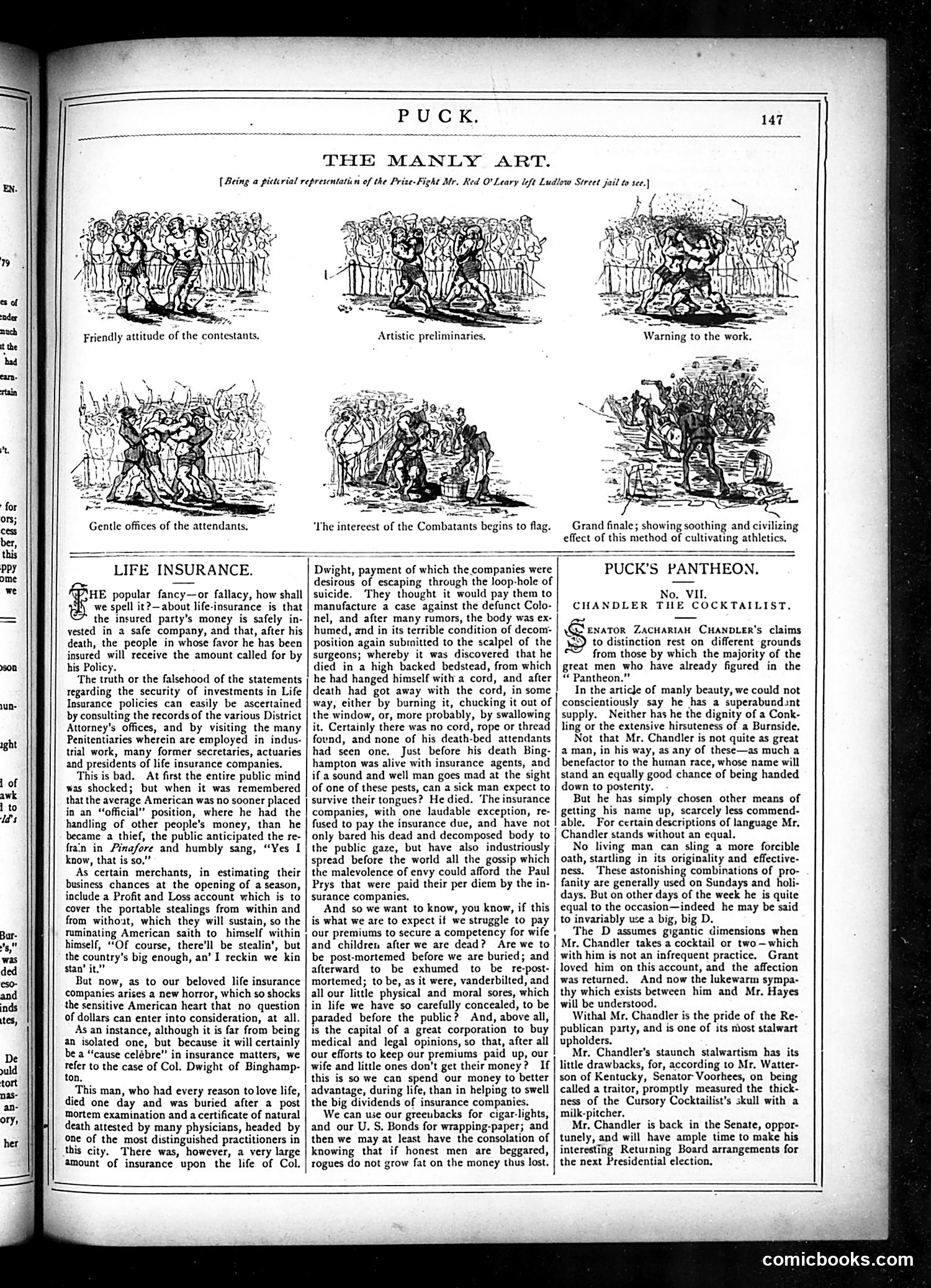
This six-panel cartoon mocks a boxing match held "jail to jail" on Ludlow Street. The sequential panels humorously depict the fight's progression: contestants' "friendly attitude," "artistic preliminaries," warning up, officials' "gentle offices," combatants flagging, and finally the "grand finale" with a "soothing and civilizing effect." The satire targets boxing as brutal spectacle disguised as athletic cultivation. The crowded, chaotic scenes suggest the sport attracts lowbrow audiences and reflects poorly on public morality. The final panel's claim about "civilizing effect" is clearly ironic—the cartoon argues boxing accomplishes the opposite. This reflects late-19th-century debates about whether boxing represented manly virtue or barbaric violence.
📄 Transcribed text from this page (OCR, searchable)
Machine-transcribed from the original scan — historical spelling and the odd misread are preserved.
cea neneaeee mer iaameearnaaaaaas PUCK. THE MANLY ART. [Being a picterial representation of the Prize-Fight Mr. Red O'Leary left Ludlow Street jait to see.] ‘rhe intereest of the Combatants begins to flag. EG Grand finale; showing soothing and civilizing effect of this method of cultivating athletics. “LIFE INSURANCE. ee popular fancy—or fallacy, how shall we spell it?—about life-insurance is that the insured party's money is safely in- vested in a safe company, and that, after his death, the people in whose favor he has been insured will receive the amount called for by his Policy. ‘The truth or the falsehood of the statements regarding the security of investments in Life Insurance policies can easily be ascertained by consulting the records of the various District Attorney's offices, and by visiting the many Penitentiaries wherein are employed in indus- trial work, many former secretaries, actuaries and presidents of life insurance companies. This is bad. At first the entire public mind was shocked; but when it was remembered that the average American was no sooner placed in an “official” position, where he had the handling of other people's money, than he became a thief, the public anticipated the re- fran in Pinafore and humbly sang, “Yes I know, that is so.”” As certain merchants, in estimating their business chances at the opening of a season, include a Profit and Loss account which is to cover the portable stealings from within and from without, which they will sustain, so the ruminating American saith to himself within himself, “‘Of course, there'll be stealin’, but the country’s big enough, an’ I reckin we kin stan’ it.” But now, as to our beloved life insurance companies arises a new horror, which so shocks the sensitive American heart that no question of dollars can enter into consideration, at all. As an instance, although it is far from being an isolated one, but because it will certainly bea “cause celébre” in insurance matters, we refer to the case of Col. Dwight of Binghamp- ton, _This man, who had every reason to love life, died one day and was buried after a post Mortem examination and a certificate of natural death attested by many physicians, headed by one of the most distinguished practitioners in this city. There was, however, a very large amount of insurance upon the life of Col. Dwight, payment of which the companies were desirous of escaping through the loop-hole of suicide. They thought it would pay them to manufacture a case against the defunct Colo- nel, and after many rumors, the body was ex- humed, and in its terrible condition of decom: position again submitted to the scalpel of the surgeons; whereby it was discovered that he died in a high backed bedstead, from which he had hanged himself with a cord, and after death had got away with the cord, in some way, either by burning it, chucking it out of the window, or, more probably, by swallowing it. Certainly there was no cord, rope or thread fovnd, and none of his death-bed attendants had seen one. Just before his death Bing- hampton was alive with insurance agents, and if a sound and well man goes mad at the sight of one of these pests, can a sick man expect to survive their tongues? He died. The insurance companies, with one laudable exception, re- fused to pay the insurance due, and have not only bared his dead and decomposed body to the public gaze, but have also industriously spread before the world all the gossip which the malevolence of envy could afford the Paul Prys that were paid their per diem by the in- surance companies. And so we want to know, you know, if this is what we are to expect if we struggle to pay our premiums to secure a competency for wife and children after we are dead? Are we to be post-mortemed before we are buried; and afterward to be exhumed to be _re-post- mortemed; to be, as it were, vanderbilted, and all our little physical and moral sores, which in life we have so carefully concealed, to be paraded before the public? And, above all, is the capital of a great corporation to buy medical and legal opinions, so that, after all our efforts to keep our premiums paid up, our wife and little ones don’t get their money? If this is so we can spend our money to better advantage, during life, than in helping to swell the big dividends of insurance companies. We can use our greeubacks for cigar-lights, and our U. S. Bonds for wrapping-paper; and then we may at least have the consolation of knowing that if honest men are beggared, rogues do not grow fat on the money thus lost. ~ PUCK'S PANTHEON. No. VII. CHANDLER THE COCKTAILIST, ENATOR ZACHARIAH CHANDLER'S claims to distinction rest on different grounds from those by which the majority of the great men who have already figured in the * Pantheon.” In the article of manly beauty, we could not conscientiously say he has a superabundant supply. Neither has he the dignity of a Conk- ling or the extensive hirsuteness of a Burnside, Not that Mr. Chandler is not quite as great a man, in his way, as any of these—as much a benefactor to the human race, whose name will stand an equally good chance of being handed down to postenty, But he has simply chosen other means of getting his name up, scarcely less commend- able. For certain descriptions of language Mr. Chandler stands without an equal. No living man can sling a more forcible oath, startling in its originality and effective- ness. These astonishing combinations of pro- fanity are generally used on Sundays and holi- days. But on other days of the week he is quite equal to the occasion—indeed he may be said to invariably use a big, big D. The D assumes gigantic dimensions when Mr. Chandler takes a cocktail or two—which with him is not an infrequent practice. Grant loved him on this account, and the affection was returned, And now the lukewarm sympa- thy which exists between him and Mr, Hayes will be understood. Withal Mr, Chandler is the pride of the Re- publican party, and is one of its niost stalwart upholders. Mr. Chandler's staunch stalwartism has its little drawbacks, for, according to Mr. Watter- son of Kentucky, Senator Voorhees, on being called a traitor, promptly measured the thick- ness of the Cursory Cocktailist’s skull with a milk-pitcher. Mr. Chandler is back in the Senate, oppor- tunely, and will have ample time to make his interesting Returning Board arrangements for the next Presidential election, comicbooks.com