
Puck, 1879-05-14 · page 7 of 16
Puck — May 14, 1879 — page 7: what you’re looking at
What you’re looking at
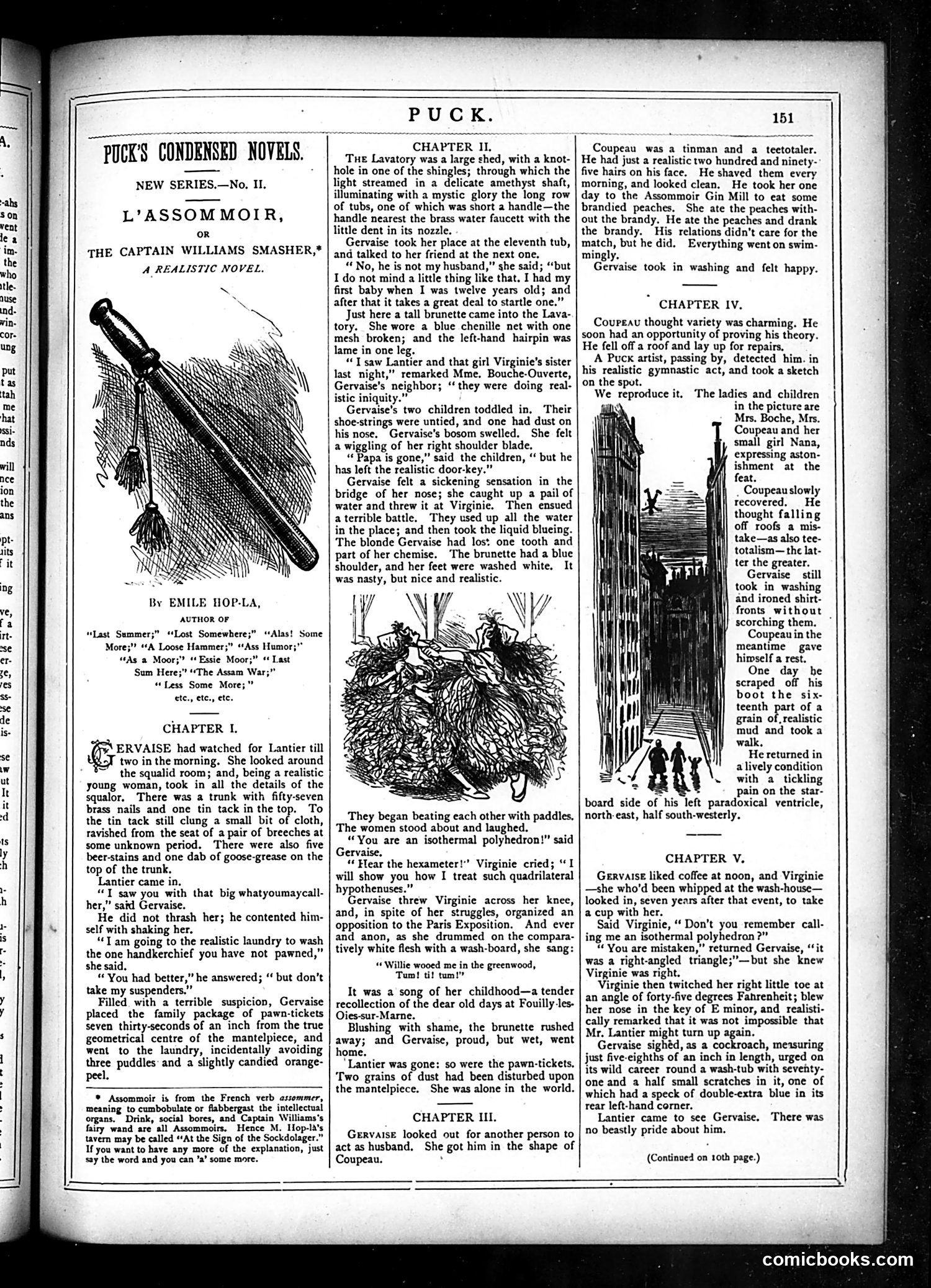
This page presents Chapter II of Émile Zola's serialized novel "L'Assommoir" (translated as "The Captain Williams Smasher"), adapted for Puck magazine's "Condensed Novels" series. The illustrations depict scenes from the story: one shows what appears to be laundry equipment or a washing apparatus; another illustrates characters in domestic turmoil. The narrative concerns working-class characters—Gervaise and others—dealing with poverty, domestic violence, and hardship in Paris. This was not political satire but rather serialized literary content, likely included to attract readers who enjoyed Zola's naturalistic fiction depicting lower-class French life. The magazine combined satirical cartoons with literary serialization as entertainment.
📄 Transcribed text from this page (OCR, searchable)
Machine-transcribed from the original scan — historical spelling and the odd misread are preserved.
CK’S CONDENSED NOVELS. NEW SERIES.—No, II. L’ASSOMMOIR, OR THE CAPTAIN WILLIAMS SMASHER,* A REALISTIC NOVEL. I, \\ AY NNN, ANS By EMILE HOP-LA, AUTHOR OF “Last Summer;” “Lost Somewh: More;” ‘*A Loose Hammer;” “As a Moor;’? ‘Essie Moor;” * Last Sum Here; “The Assam War;” “Less Some More;"” ete., ete., ete. 3” “Alas! Some CHAPTER | ERVAISE had watched for Lantier till oJ two in the morning. She looked around the squalid room; and, being a realistic young woman, took in all the details of the squalor, There was a trunk with fifty-seven brass nails and one tin tack inthe top. To the tin tack still clung a small bit of cloth, ravished from the seat of a pair of breeches at some unknown period. There were also five beer-stains and one dab of goose-grease on the top of the trunk, Lantier came in. “T saw you with that big whatyoumaycall- her,” satd Gervaise. He did not thrash her; he contented him- self with shaking her. “‘T am going to the realistic laundry to wash the one handkerchief you have not pawned,” she said, “ You had better,” he answered; “ but don’t take my suspenders.” Filled with a terrible suspicion, Gervaise placed the family package of pawn-tickets seven thirty-seconds of an inch from the true geometrical centre of the mantelpiece, and went to the laundry, incidentally avoiding three puddles: and a slightly candied orange- peel, * Assommoir is from the French verb assommer, meaning to cumbobulate or flabbergast the intellectual organs. Drink, social bores, and Captain Williams's fairy wand are all Assommoirs. Hence M. Hop-la's tavern may be called “At the Sign of the Sockdolager.” Ifyou want to have any more of the explanation, just say the word and you can ’a’ some more. PUCK. CHAPTER II, Tue Lavatory was a large shed, with a knot- hole in one of the shingles; through which the light streamed in a delicate amethyst shaft, illuminating with a mystic glory the long row of tubs, one of which was short a handle—the handle nearest the brass water faucett with the little dent in its nozzle. Gervaise took her place at the eleventh tub, and talked to her friend at the next one, “No, he is not my husband,” she said; ‘but I do not mind a little thing like that. I had my first baby when I was twelve years old; and after that it takes a great deal to startle one.” Just here a tall brunette came into the Lava- tory. She wore a blue chenille net with one mesh broken; and the left-hand hairpin was lame in one leg. “T saw Lantier and that girl Virginie’s sister last night,” remarked Mme. Bouche-Ouverte, Gervaise's neighbor; ‘they were doing real- istic iniquity.” Gervaise’s two children toddled in. Their shoe-strings were untied, and one had dust on his nose, Gervaise’s bosom swelled. She felt a wiggling of her right shoulder blade. “Papa is gone,” said the children, “ but he has left the realistic door-key.”” Gervaise felt a sickening sensation in the bridge of her nose; she caught up a pail of water and threw it at Virginie. Then ensued a terrible battle. They used up all the water in the place; and then took the liquid blueing. The blonde Gervaise had los: one tooth and part of her chemise. The brunette had a blue shoulder, and her feet were washed white. It was nasty, but nice and realistic. V’ ‘They began beating each other with paddles, The women stood about and laughed. “You are an isothermal polyhedron!” said Gervaise. “ Hear the hexameter!’’ Virginie cried; “1 will show you how I treat such quadrilateral hypothenuses.”” Gervaise threw Virginie across her knee, and, in spite of her struggles, organized an opposition to the Paris Exposition. And ever and anon, as she drummed on the compara- tively white flesh with a wash-board, she sang: « Willie wooed me in the greenwood, Tum! ti! tum!” It was a song of her childhood—a tender recollection of the dear old days at Fouilly-les- Oies-sur-Marne. Blushing with shame, the brunette rushed away; and Gervaise, proud, but wet, went home, “Lantier was gone: so were the pawn-tickets. ‘Two grains of dust had been disturbed upon the mantelpiece. She was alone in the world. CHAPTER III. GervalsE looked out for another person to act as husband. She got him in the shape of Coupeau. . 151 Coupeau was a tinman and a teetotaler. He had just a realistic two hundred and ninety- five hairs on his face. He shaved them every morning, and looked clean. He took her one day to the Assommoir Gin Mill to eat some brandied peaches. She ate the peaches with- out the brandy. He ate the peaches and drank the brandy, His relations didn’t care for the match, but he did. Everything went on swim- mingly. Gervaise took in washing and felt happy. ” CHAPTER IV. Coupeau thought variety was charming. He soon had an opportunity of proving his theory. He fell off a roof and lay up for repairs. A Puck artist, passing by, detected him. in his realistic gymnastic act, and took a sketch on the spot. We reproduce it, The ladies and children a in the picture are r Mrs. Boche, Mrs. Coupeau and her small girl Nana, expressing aston- ishment at the feat. . Coupeau slowly recovered. He thought falling off roofs a mis- take—as also tee- totalism—the lat- ter the greater. Gervaise still took in washing and ironed shirt- fronts without scorching them. Coupeau in the meantime gave himself a rest. One day he scraped off his boot the six- teenth part of a grain of, realistic mud and took a walk, He returned in alively condition with a tickling pain on the star- board side of his left paradoxical ventricle, north-east, half south-westerly. CHAPTER V. Gervaise liked coffee at noon, and Virginie —she who'd been whipped at the wash-house— looked in, seven years after that event, to take a cup with her. Said Virginie, ‘ Don’t you remember call- ing me an isothermal polyhedron ?” “ You are mistaken,” returned Gervaise, ‘it was a right-angled triangle;’—but she knew Virginie was right. Virginie then twitched her right little toe at an angle of forty-five degrees Fahrenheit; blew her nose in the key of E minor, and _realisti- cally remarked that it was not impossible that Mr. Lantier might turn up again. Gervaise sighéd, as a cockroach, measuring just five-eighths of an inch in length, urged on its wild career round a wash-tub with seventy- one and a half small scratches in it, one of which had a speck of double-extra blue in its rear left-hand corner. Lantier came to see Gervaise. no beastly pride about him. ‘There was (Continued on 10th page.) comicbooks.com