
Puck, 1879-05-14 · page 4 of 16
Puck — May 14, 1879 — page 4: what you’re looking at
What you’re looking at
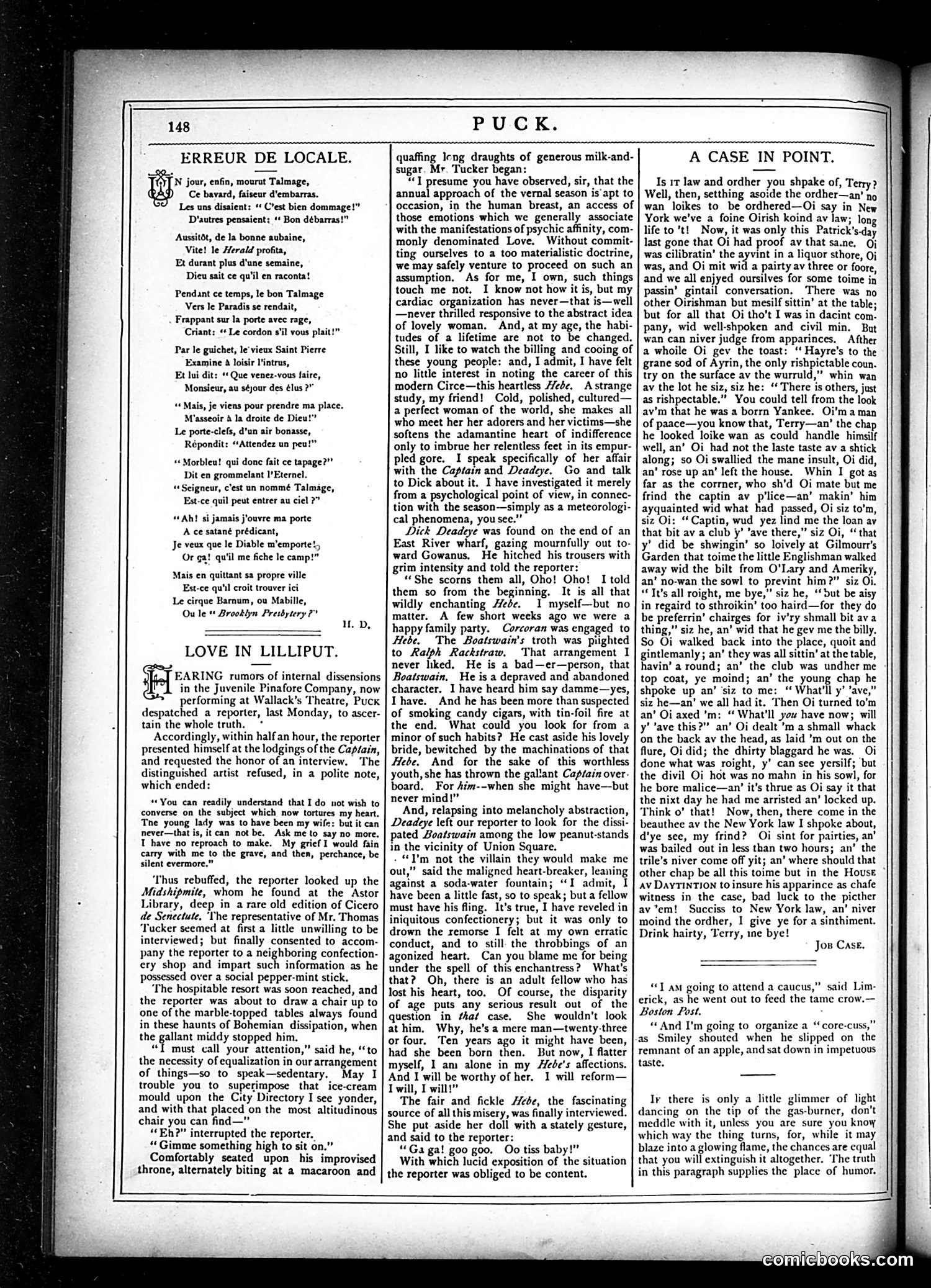
This page contains primarily **literary content rather than political cartoons**. The main sections are: 1. **"Erreur de Locale"** - A French poem about homesickness and longing for one's birthplace during springtime. 2. **"Love in Lilliput"** - A gossipy theater column discussing internal disputes at Wallack's Theatre in New York. It mentions specific actors (Ralph Rackstraw, Captain) and contains scandalous anecdotes about romantic entanglements and behavioral misconduct within the theatrical company. 3. **"A Case in Point"** - A dialogue about legal matters and social conventions regarding courtship and propriety. The page serves as **social commentary through theatrical gossip and humor** rather than explicit political satire. The content targets New York's theater world and social pretensions of the era.
📄 Transcribed text from this page (OCR, searchable)
Machine-transcribed from the original scan — historical spelling and the odd misread are preserved.
PUCK. ERREUR DE LOCALE. i i jour, enfin, mourut Talmage, Ce bavard, faiseur d’embarras. Les uns disaient: “ C'est bien dommage!” D’autres pensaient: “¢ Bon débarras!” Aussit6t, de la bonne aubaine, Vite! le Herald profita, Et durant plus d'une semaine, Dieu sait ce qu'il en raconta! Pendant ce temps, le bon Talmage Vers le Paradis se rendait, Frappant sur la porte avec rage, Criant: «Le cordon s'il vous plait!” Par le guichet, le'vieux Saint Pierre Examine & loisir l'intrus, Et lui dit: « Que venez-vous faire, Monsieur, au séjour des élus 2” « Mais, je viens pour prendre ma place. Miasseoir A la droite de Dieu!” Le porte-clefs, d'un air bonasse, Répondit: “Attendez un peu!” «+ Morbleu! qui done fait ce tapage?”” Dit en grommelant I'Eternel. «Seigneur, c'est un nommé Talmage, Est-ce quil peut entrer au ciel 2” “Abt si jamais jouvre ma porte A ce satané prédicant, Je veux que le Diable m'emporte!, Or ga! qu'il me fiche le camp!” Mais en quittant sa propre ville Est-ce qu'tl croit trouver ici Le cirque Barnum, ou Mabille, Ou le“ Brooklyn Presbytery ?* LOVE IN LILLIPUT. RING rumors of internal dissensions in the Juvenile Pinafore Company, now performing at Wallack’s Theatre, Puck despatched a reporter, last Monday, to ascer- tain the whole truth. Accordingly, within half an hour, the reporter presented himself at the lodgings of the Caprain, and requested the honor of an interview. The distinguished artist refused, in a polite note, which ended: “You can readily understand that I do not wish to converse on the subject which now tortures my heart. Tne young lady was to have been my wife: but it can never—that is, it can not be. Ask me to say no more. T have no reproach to make. My grief I would fain carry with me to the grave, and then, perchance, be silent evermore.” ‘Thus rebuffed, the reporter looked up the Midshipmite, whom he found at the Astor Library, deep in a rare old edition of Cicero de Senectute, ‘Vhe representative of Mr. Thomas ‘Tucker seemed at first a little unwilling to be interviewed; but finally consented to accom- pany the reporter to a neighboring confection- ery shop and impart such information as he possessed over a social pepper-mint stick. ‘The hospitable resort was soon reached, and the reporter was about to draw a chair up to one of the marble-topped tables always found in these haunts of Bohemian dissipation, when the gallant middy stopped him. “YT must call your attention,” said he, “to the necessity of equalization in our arrangement of things—so to speak—sedentary. May I trouble you to superimpose that ice-cream mould upon the City Directory I see yonder, and with that placed on the most altitudinous chair you can find—"” “Eh?” interrupted the reporter. “Gimme something high to sit on.” Comfortably seated upon his improvised throne, alternately biting at a macaroon and quaffing Icng draughts of generous milk-and- sugar. Mr. Tucker began: “1 presume you have observed, sir, that the annual approach of the vernal season is'apt to occasion, in the human breast, an access of those emotions which we generally associate with the manifestations of psychic affinity, com- monly denominated Love. Without commit- ting ourselves to a too materialistic doctrine, we may safely venture to proceed on such an assumption. As for me, I own, such things touch me not. I know not how it is, but my cardiac organization has never—that is—well —never thrilled responsive to the abstract idea of lovely woman. And, at my ages the habi- tudes of a lifetime are not to changed, Still, I like to watch the billing and cooing of these young people: and, I admit, I have felt no little interest in noting the career of this modern Circe—this heartless Hebe, A strange study, my friend! Cold, polished, cultured— a perfect woman of the world, she makes all who meet her her adorers and her victims—she softens the adamantine heart of indifference only to imbrue her relentless feet in its empur- pled gore. I speak specifically of her affair with the Capfain and Deadeye. Go and talk to Dick about it. I have investigated it merely from a psychological point of view, in connec- tion with the season—simply as a meteorologi- cal phenomena, you sec.” Dick Deadeye was found on the end of an East River wharf, gazing mournfully out to- ward Gowanus. He hitched his trousers with grim intensity and told the reporter: “She scorns them all, Oho! Oho! I told them so from the beginning. It is all that wildly enchanting Heée. 1 myself—but no matter. A few short weeks ago we were a happy family party. Corcoran was engaged to Hebe. The Boatswain's troth was piighted to Ralph Rackstraw, That arrangement I never liked. He is a bad—er—person, that Boatswain. He is a depraved and abandoned character. I have heard him say damme—yes, Ihave. And he has been more than suspected of smoking candy cigars, with tin-foil fire at the end. What could you look for from a minor of such habits? He cast aside his lovely bride, bewitched by the machinations of that Hebe. And for the sake of this worthless youth, she has thrown the gallant Cap/ain over- board. For Aim--when she might have—but never mind!” And, relapsing into melancholy abstraction, Deadeye \eft our reporter to look for the dissi- pated Boatswain among the low peanut-stands in the vicinity of Union Square. - “V'm not the villain they would make me out,” said the maligned heart-breaker, leaning against a soda-water fountain; “I admit, 1 have been a little fast, so to speak; but a fellow must have his fling. It’s true, I have reveled in iniquitous confectionery; but it was only to drown the remorse I felt at my own erratic conduct, and to still. the throbbings of an agonized heart. Can you blame me for being under the spell of this enchantress? What's that? Oh, there is an adult fellow who has lost his heart, too, Of course, the disparity of age puts any serious result out of the question in ¢haf case. She wouldn't look athim, Why, he’s a mere man—twenty-three or four. Ten years ago it might have been, had she been born then. But now, I flatter myself, I am alone in my Hede's affections. And I will be worthy of her. I will reform— I will, I will!” The fair and fickle Hebe, the fascinating source of all this misery, was finally interviewed. She put aside her doll with a stately gesture, and said to the reporter: “Ga ga! goo goo. Oo tiss baby!” With which lucid exposition of the situation the reporter was obliged to be content. A CASE IN POINT. Is rr law and ordher you shpake of, Terry? Well, then, setthing asoide the ordher—an’ no wan loikes to be ordhered—Oi say in New York we've a foine Oirish koind av law; lon, life to 't! Now, it was only this Patrick’s-day last gone that Oi had proof av that sa.ne. Oj was cilibratin’ the ayvint in a liquor sthore, Oj was, and Oi mit wid a pairty av three or fore, and we all enjyed oursilves for some toime in passin’ gintail conversation. There was no other Oirishman but mesilf sittin’ at the table; but for all that Oi tho’t I was in dacint com- pany, wid well-shpoken and civil min. Bat wan can niver judge from apparinces. Afther a whoile Oi gev the toast: ‘“ Hayre’s to the grane sod of Ayrin, the only rishpictable coun. try on the surface av the wurruld,” whin wan av the lot he siz, siz he: ‘ There is others, just as rishpectable.” You could tell from the look av'm that he was a borrn Yankee. Oi'm aman of paace—you know that, Terry—an’ the chap he looked loike wan as could handle himsilf well, an’ Oi had not the laste taste av a shtick along; so Oi swallied the mane insult, Oi did, an’ rose up an’ left the house. Whin I got as far as the corrner, who sh’d Oi mate but me frind the captin av p'lice—an’ makin’ him ayquainted wid what had passed, Oi siz tom, siz Oi: “Captin, wud yez lind me the loan av that bit av a club y’ ’ave there,” siz Oi, “that y’ did be shwingin’ so loively at Gilmourr’s Garden that toime the little Englishman walked away wid the bilt from O’Lary and Ameriky, an’ no-wan the sowl to prevint him?” siz Oi. “It's all roight, me bye,” siz he, ‘Dut be aisy in regaird to sthroikin’ too haird—for they do be preferrin’ chairges for iv’ry shmall bit ava thing,” siz he, an’ wid that he gev me the billy, So Oi walked back into the place, quoit and gintlemanly; an’ they was all sittin’ at the table, havin’ a round; an’ the club was undher me top coat, ye moind; an’ the young chap he shpoke up an’ ‘siz to me: “ What'll y’ ’ave,” siz he—an’ we all had it. Then Oi turned to'm an’ Oi axed 'm: “ What'll you have now; will y' ’ave this?” an’ Oi dealt ’m a shmall whack on the back av the head, as laid ’m out on the flure, Oi did; the dhirty blaggard he was. Oi done what was roight, y’ can see yersilf; but the divil Oi hot was no mahn in his sowl, for he bore malice—an’ it’s thrue as Oi say it that the nixt day he had me arristed an’ locked up. ‘Think o’ that! Now, then, there come in the beauthee av the New York law I shpoke about, d'ye see, my frind? i sint for pairties, an’ was bailed out in less than two hours; an’ the trile’s niver come off yit; an’ where should that other chap be all this toime but in the House av DayTINTION to insure his apparince as chafe witness in the case, bad luck to the picther av’em! Succiss to New York law, an’ niver moind the ordher, I give ye for a sinthiment. Drink hairty, Terry, ine bye! Jos Case. “T am going to attend a caucus,” said Lim- erick, as he went out to feed the tame crow.— Boston Post. “ And I’m going to organize a “core-cuss,” as Smiley shouted when he slipped on the remnant of an apple, and sat down in impetuous taste. Ir there is only a little glimmer of light dancing on the tip of the gas-burner, don’t meddle with it, unless you are sure you know which way the thing turns, for, while it may blaze into a glowing flame, the chances are equal that you will extinguish it altogether. ‘The truth in this paragraph supplies the place of humor.