
Puck, 1879-05-14 · page 12 of 16
Puck — May 14, 1879 — page 12: what you’re looking at
What you’re looking at
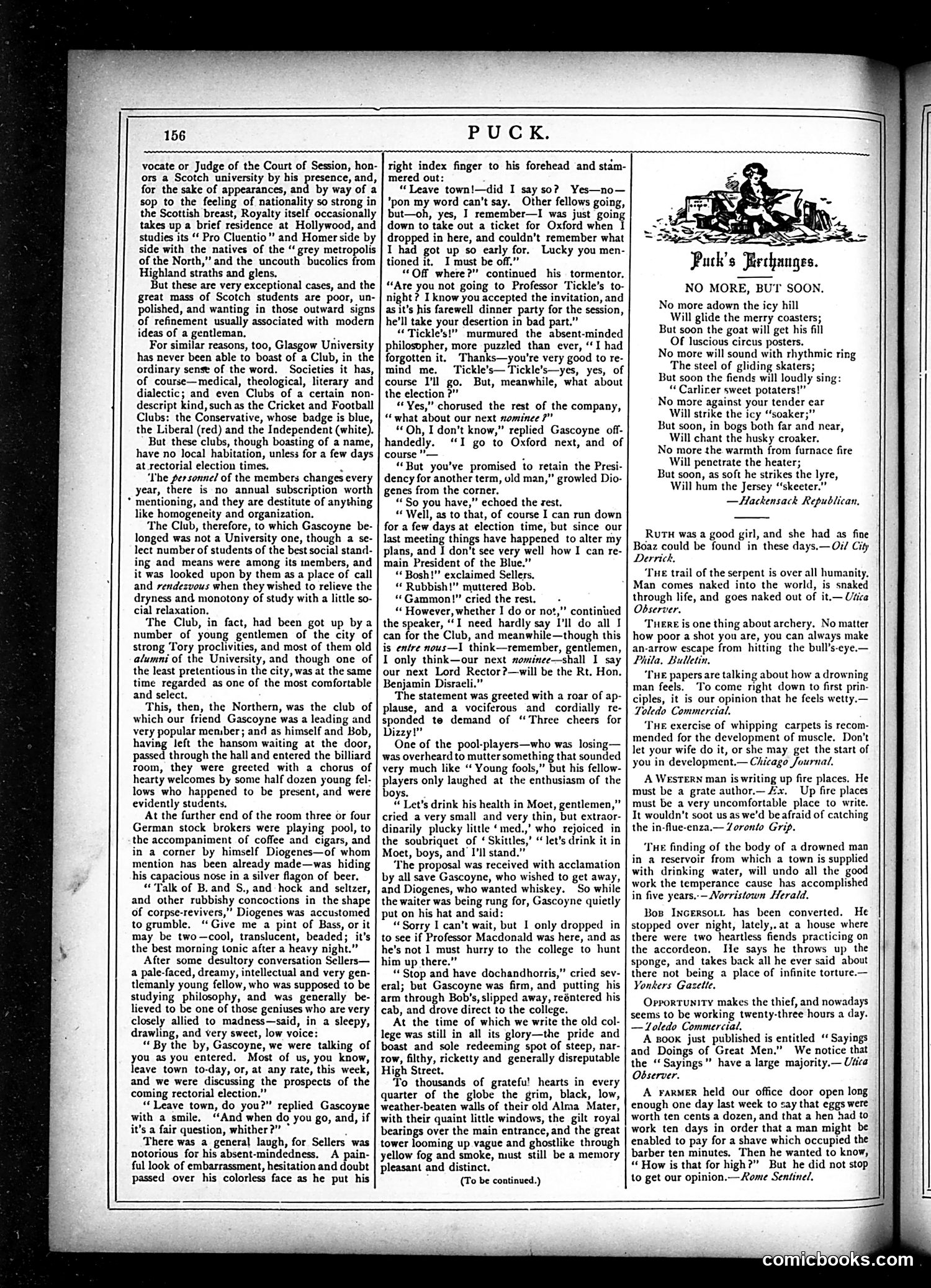
This page contains primarily text articles and humor pieces rather than political cartoons. The small illustration at the top right titled "Puck's Birthings" shows a circus scene with posters and performers—likely satirizing sensational entertainment. The main content includes commentary on Scottish university traditions, Club membership practices, and various social observations. One piece jokes about someone avoiding an Oxford election; another discusses archery and drowning prevention. The humor is gentle and social rather than explicitly political—poking fun at Victorian-era academic life, club culture, and self-improvement fads. Without clearer identification of specific contemporary figures or events referenced in the dense text, the precise satirical targets remain somewhat unclear, though the overall tone mocks pretension and social conventions of the era.
📄 Transcribed text from this page (OCR, searchable)
Machine-transcribed from the original scan — historical spelling and the odd misread are preserved.
156 vocate or Judge of the Court of Session, hon- ors a Scotch university by his presence, and, for the sake of appearances, and by way of a sop to the feeling of nationality so strong in the Scottish breast, Royalty itself occasionally takes up a brief residence at Hollywood, and studies its “ Pro Cluentio” and Homer side by side with the natives of the “grey metropolis of the North,” and the uncouth bucolics from Highland straths and glens. But these are very exceptional cases, and the great mass of Scotch students are poor, un- polished, and wanting in those outward signs of refinement usually associated with modern ideas of a gentleman, . For similar reasons, too, Glasgow University has never been able to boast of a Club, in the ordinary sense of the word. Societies it has, of course—medical, theological, literary and dialectic; and even Clubs of a certain non- descript kind, such as the Cricket and Football Clubs: the Conservative, whose badge is blue, the Liberal (red) and the Independent (white). But these clubs, though boasting of a name, have no local habitation, unless for a few days at rectorial election times. “ ‘Ihe personnel of the members changes every year, there is no annual subscription worth * mentioning, and they are destitute of anything like homogeneity and organization. The Club, therefore, to which Gascoyne be- longed was not a University one, though a se- lect number of students of the best social stand- ing and means were among its inembers, and it was looked upon by them as a place of call and rendezvous when they wished to relieve the dryness and monotony of study with a little so- cial relaxation. The Club, in fact, had been got up by a number of young gentlemen of the city of strong Tory proclivities, and most of them old alumni of the University, and though one of the least pretentious in the city, was at the same time regarded as one of the most comfortable and select. This, then, the Northern, was the club of which our friend Gascoyne was a leading and very popular member; and as himself and Bob, having left the hansom waiting at the door, passed through the hall and entered the billiard room, they were greeted with a chorus of hearty welcomes by some half dozen young fel- lows who happened to be present, and were evidently students, At the further end of the room three or four German stock brokers were playing pool, to the accompaniment of coffee and cigars, and in a corner by himself Diogenes—of whom mention nas been already made—was hiding his capacious nose in a silver flagon of beer. “Talk of B, and S,, and hock and seltzer, and other rubbishy concoctions in the shape of corpse-revivers,” Diogenes was accustomed to grumble. “Give me a pint of Bass, or it may be two—cool, translucent, beaded; it’s the best morning tonic after a heavy night.” After some desultory conversation Sellers— a pale-faced, dreamy, intellectual and very gen- tlemanly young fellow, who was supposed to be studying philosophy, and was generally be- lieved to be one of those geniuses who are very closely allied to madness—said, in a sleepy, drawling, and very sweet, low voice: «« By the by, Gascoyne, we were talking of you as you entered, Most of us, you know, leave town to-day, or, at any rate, this week, and we were discussing the prospects of the coming rectorial election.” “Leave town, do you?” replied Gascoyne with a smile, ‘And when do you go, and, if it's a fair question, whither?” . There was a general laugh, for Sellers was notorious for his absent-mindedness. A pain- ful look of embarrassment, hesitation and doubt passed over his colorless face as he put his right index finger to his forehead and stam- mered out: “Leave town!—did I say so? Yes—no— ‘pon my word can’t say. Other fellows going, but—oh, yes, I remember—I was just goin down to take out a ticket for Oxford when f dropped in here, and couldn't remember what I had got up so early for. Lucky you men- tioned it, I must be off,” “Off where?” continued his tormentor. “Are you not going to Professor Tickle’s to- night? I know you accepted the invitation, and as it’s his farewell dinner party for the session, he'll take your desertion in bad part.” “Tickle's!” murmured the absent-minded philosopher, more puzzled than ever, “I had forgotten it. Thanks—you’re very good to re- mind me. _ Tickle’s—Tickle’s—yes, yes, of course I'll go. But, meanwhile, what about the election ?” “Yes,” chorused the rest of the company, “‘what about our next nominee ?" “Oh, I don't know,” replied Gascoyne off- handed; “T go to Oxford next, and of course ?— . “But you've promised to retain the Presi- dency for another term, uld man," growled Dio- genes from the corner. “So you have,” echoed the zest. “Well, as to that, of course I can run down for a few days at election time, but since our last meeting things have happened to alter my plans, and I don’t see very well how I can re- main President of the Blue.” “ Bosh!" exclaimed Sellers. “ Rubbish!" muttered Bob. “Gammon!” cried the rest. “ However, whether I do or not,” continued the speaker, ‘I need hardly say I'll do all J can for the Club, and meanwhile—though this is entre nous—1 think—remember, gentlemen, I only think—our next nominee—shall 1 say our next Lord Rector ?—will be the Rt. Hon. Benjamin Disraeli.” The statement was greeted with a roar of ap- plause, and a vociferous and cordially re- sponded te demand of “Three cheers for Dizzy!” One of the pool-players—who was losing— was overheard to mutter something that sounded very much like “ Young fools,” but his fellow- players only laughed at the enthusiasm of the os. “ Let's drink his health in Moet, gentlemen,” cried a very small and very thin, but extraor- dinarily plucky little ‘med.,’ who rejoiced in the soubriquet of ‘ Skittles,’ “let's drink it in Moet, boys, and I'll stand.” ‘The proposal was received with acclamation by all save Gascoyne, who wished to get away, and Diogenes, who wanted whiskey. So while the waiter was being rung for, Gascoyne quietly put on his hat and said: “Sorry I can’t wait, but I only dropped in to see if Professor Macdonald was here, and as he's not 1 must hurry to the college to hunt him up there.” “Stop and have dochandhorris,” cried sev- eral; but Gascoyne was firm, and putting his arm through Bob's, slipped away, reéntered his cab, and drove direct to the college. At the time of which we write the old col- lege was still in all its glory—the pride and boast and sole redeeming spot of steep, nar- row, filthy, ricketty and generally disreputable High Street. To thousands of gratefu' hearts in every quarter of the globe the grim, black, low, weather-beaten walls of their old Alma Mater, with their quaint little windows, the gilt royal bearings over the main entrance, and the great tower looming up vague and ghostlike through yellow fog and smoke, must still be a memory pleasant and distinct. (To be continued.) anges. NO MORE, BUT SOON. No more adown the icy hill Will glide the merry coasters; But soon the goat will get his fill Of luscious circus posters. No more will sound with rhythmic ring ‘The steel of gliding skaters; But soon the fiends will loudly sing: “Carlirer sweet potaters!” No more against your tender ear Will strike the icy “‘soaker;” But soon, in bogs both far and near, Will chant the husky croaker. No more the warmth from furnace fire Will penetrate the heater; But soon, as soft he strikes the lyre, Will hum the Jersey “skeeter.” —Hackensack Republican, RutH was a good girl, and she had as fine Boaz could be found in these days.—Oi/ City Derrick, ‘Tue trail of the serpent is over all humanity, Man comes naked into the world, is snaked through life, and goes naked out of it.— Utica Observer. ‘Tere is one thing about archery, No matter how poor a shot you are, you can always make an-arrow escape from hitting the bull’s-eye.— Phila, Bulletin, ‘Tue papers are talking about how a drowning man feels. To come right down to first prin- ciples, it is our opinion that he feels wetty.— Toledo Commercial. ‘Tue exercise of whipping carpets is recom- mended for the development of muscle. Don’t let your wife do it, or she may get the start of you in development.— Chicago Journal. A WESTERN man is writing up fire places. He must be a grate author.— x. Up fire places must be a very uncomfortable place to write. It wouldn't soot us as we'd be afraid of catching the in-flue-enza.— Zoronto Grip. ‘Tne finding of the body of a drowned man in a reservoir from which a town is supplied with drinking water, will undo all the good work the temperance cause has accomplished in five years.-—Norristown Herald. Bos Incersout has been converted. He stopped over night, lately,,at a house where there were two heartless fiends practicing on the accordeon, He says he throws up the sponge, and takes back all he ever said about there not being a place of infinite torture.— Yonkers Gazette, Opportunity makes the thief, and nowadays seems to be working twenty-three hours a day. —oledo Commercial. A Book just published is entitled ‘ Sayings and Doings of Great Men.” We notice that the “Sayings” have a large majority.— Utica Observer. A FarMER held our office door open long enough one day last week to say that eggs were worth ten cents a dozen, and that a hen had to work ten days in order that a man might be enabled to pay for a shave which occupied the barber ten minutes, Then he wanted to know, “ How is that for high?” But he did not stop to get our opinion.— Rome Sentinel,