
A complete issue · 16 pages · 1879
Puck — April 16, 1879
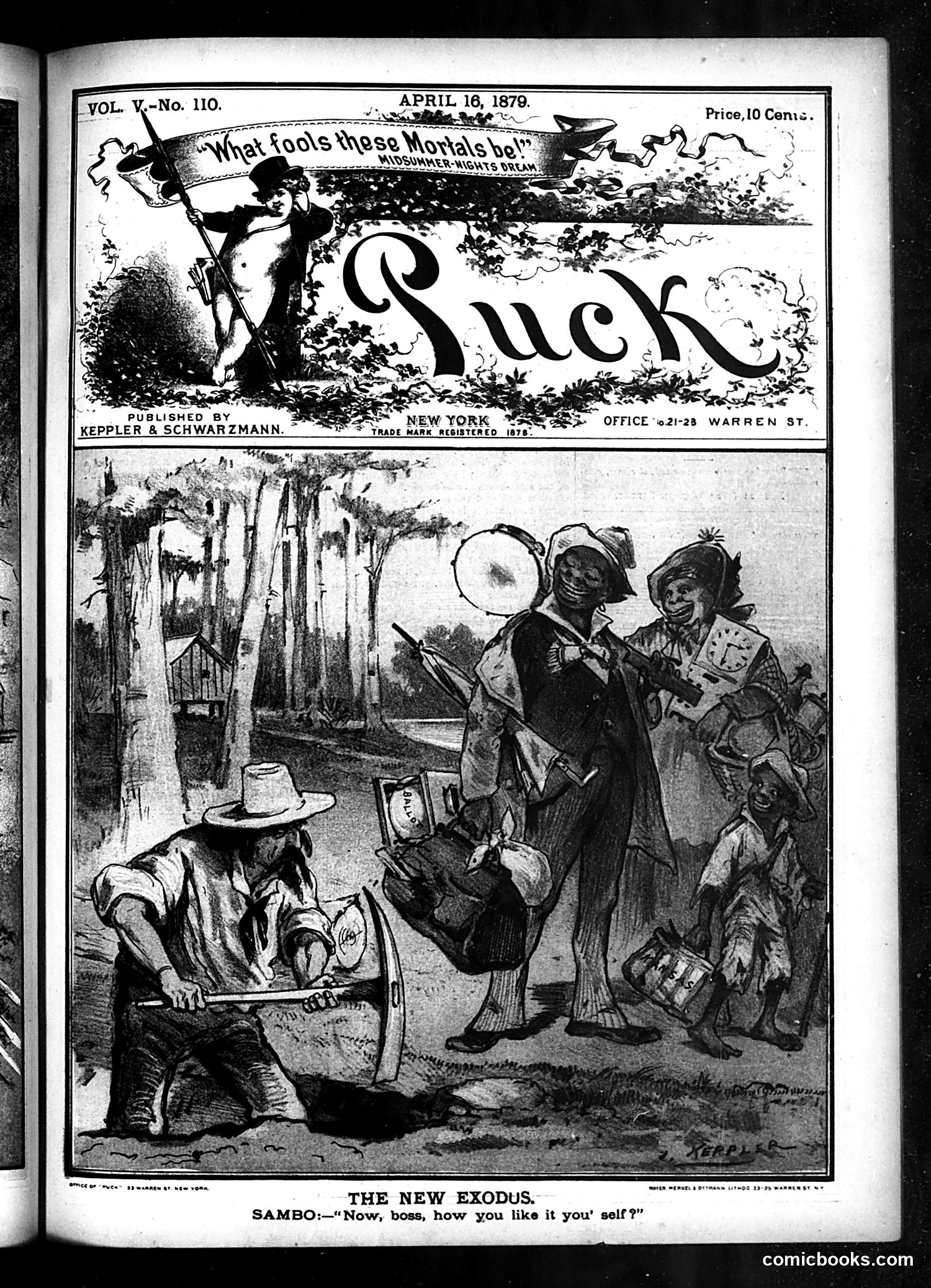
This cartoon satirizes the "Exodus" of African Americans from the South to Kansas during 1879. The title references the Biblical exodus, comparing the mass migration to slaves fleeing Egypt. The scene shows what appears to be a Black emigration agent (center, with net and materials) recruiting Southern African Americans to relocate northward. The figure labeled "Sambo" sits left, while potential migrants gather right with their belongings. The caption "Now, boss, how you like it yourself?" suggests irony: the agent is using persuasive tactics similar to those slavers once employed, now toward freedom rather than bondage. The cartoon critiques both the desperation driving Black migration and the opportunistic recruitment methods—presenting emigration as exploitative despite its liberatory goal. The satire mocks how methods of coercion persist even in nominally progressive contexts.
This page is primarily **text content with no visible political cartoons**. It contains: 1. **Puckerings** (short satirical quips) mocking various targets: The Pope, a "brown dog" (unclear reference), Schneider, and others—typical of Puck's brief commentary style. 2. **"The New Exodus"** (main article)—a substantial piece criticizing post-Civil War Southern labor practices. It argues that freed slaves, despite nominal freedom, remain economically enslaved through exploitative wages and debt systems. The satire compares their condition unfavorably to actual freedom, suggesting the South has merely renamed rather than reformed slavery. 3. **Notices and advertisements** for back issues and subscription information. The page's satirical thrust targets Southern economic oppression of freed Black laborers during Reconstruction, using ironic comparison to mock the hollow nature of their liberation.
This page contains multiple satirical pieces rather than a single cartoon. "Our Thoroughfares" mocks pedestrian congestion and urban disorder in New York City, using a gentleman named Mr. Smith as an everyman figure to critique inadequate city management and working conditions for laborers. "For Doing His Duty" appears to satirize politicians' treatment of Captain Schevenson, who lost a ship. The piece criticizes how politicians and the Aaron Society gave him only a ceremonial reception rather than meaningful support, suggesting hypocrisy in public honors while ignoring practical needs. The "Rhymes of the Day" section contains light verse on matrimonial and clerical topics, typical of Puck's miscellaneous humor format. The overall theme critiques urban governance failures and political opportunism.
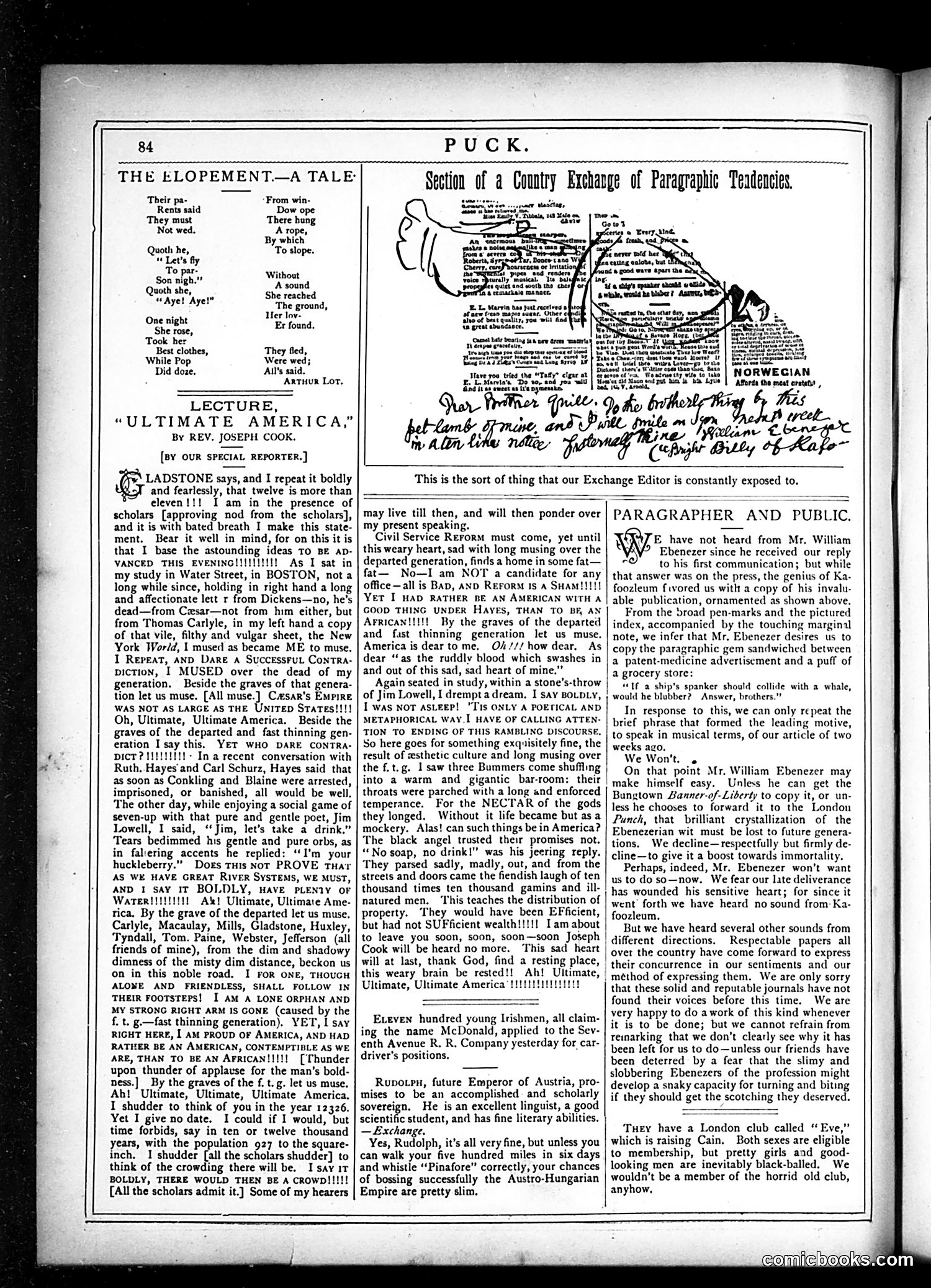
The main cartoon titled "Section of a Country Exchange of Paragraphic Tendencies" appears to satirize **verbose, overwrought newspaper writing**. The image shows a tangled mass of text emerging from what resembles a country mailbox or exchange, with handwritten annotations mocking the style. The accompanying editorial commentary by the "Exchange Editor" criticizes newspapers for publishing unnecessarily elaborate and flowery prose. The page also includes "The Elopement—A Tale," a brief poetic piece about a couple's scandalous departure, seemingly mocking melodramatic newspaper reporting of social events. The humor targets **journalistic excess and pretension**—the overly ornate writing style that characterized much 19th-century newspaper prose, which Puck presents as ridiculous and self-parody worthy.
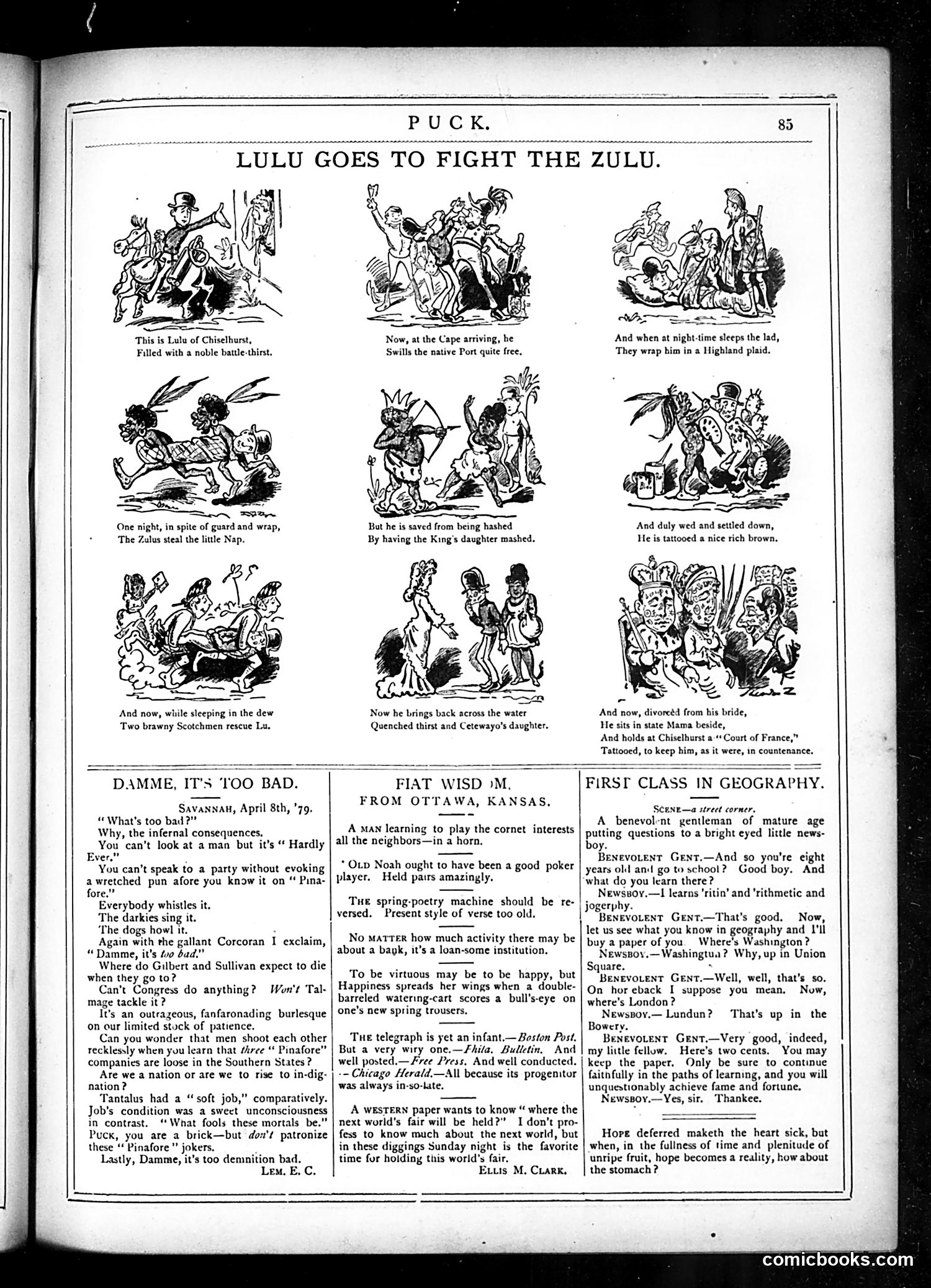
This nine-panel comic strip satirizes a contemporary figure—likely a well-known society woman or actress named "Lulu"—who ventures to fight the Zulu people in South Africa. The narrative mocks both colonial militarism and romantic adventure fantasies. The strip follows Lulu's journey from England ("Chiselhurst, filled with a noble battle-thirst") through Cape arrival, where she encounters Zulu warriors. The humor derives from subverting expectations: rather than military heroism, Lulu gets captured, rescued through romantic intervention (the King's daughter is "mashed"), tattooed, marries across cultural lines, and ultimately abandons her military pretense for domesticity. The satire targets 1880s-90s imperialist attitudes while mocking sensationalized newspaper accounts of colonial conflicts and the supposed "civilizing mission."
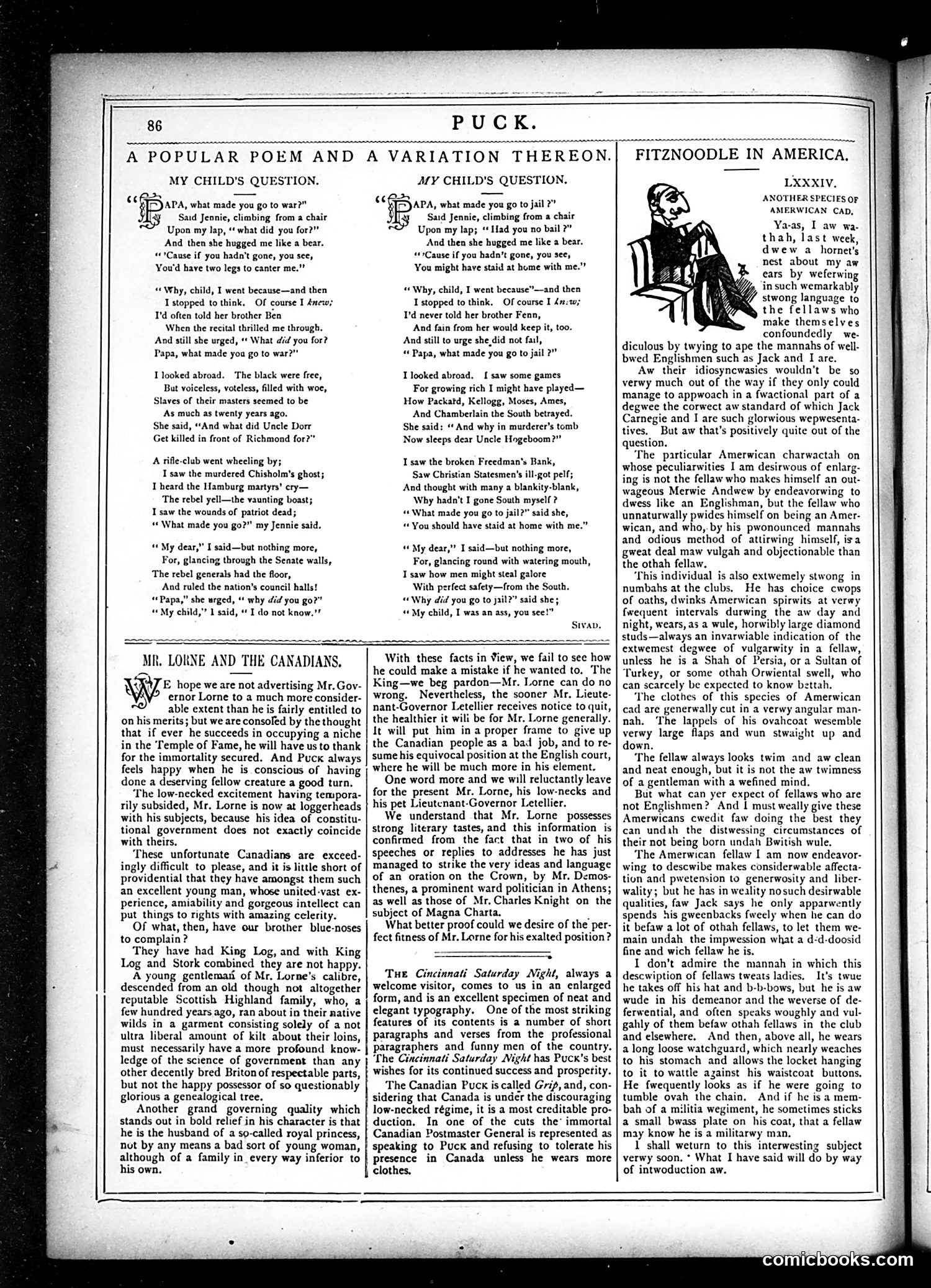
This page contains literary content rather than political cartoons. The main pieces are two variations of "My Child's Question"—poems contrasting a child asking a parent about going to war versus jail. Both poems use the child's innocent questions to critique political/military decisions. The right column features "Fitznoodle in America," which mocks a particular American character type—likely an Irish immigrant or buffoonish foreigner. The text describes him as vulgarly attempting to ape English mannerisms while embodying ridiculous pretensions. He's portrayed as looking "twin and aw clean" but fundamentally uncouth, with the piece satirizing his affected airs and social climbing. The "Mr. Lorne and the Canadians" section discusses Canadian political tensions, though specific figures aren't clearly identified in this excerpt.
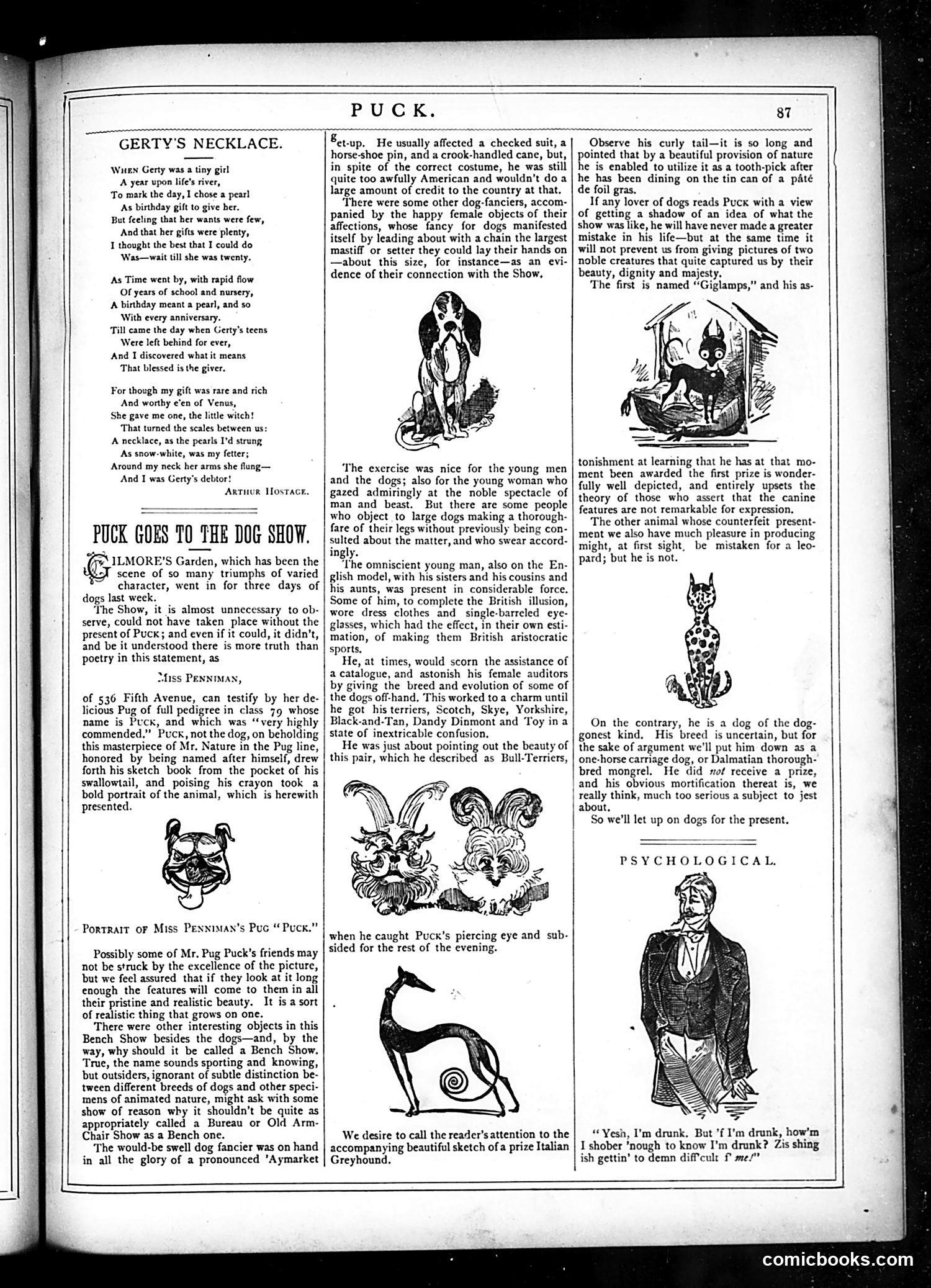
This page is primarily **not political satire** but rather **lifestyle/society content** about dog shows. The main article "Puck Goes to the Dog Show" humorously describes Gilmore's Garden hosting a dog exhibition, with illustrations of various breeds and show dogs. The satire is **social rather than political**: it mocks the pretensions of dog fanciers who obsess over pedigrees and breed standards, treating their dogs as status symbols. One passage ridicules men who "scorn the assistance of a catalogue" while confused about which terrier breeds they're discussing. The final cartoon "Psychological" appears to show a drunk man—unrelated to the dog show content—illustrating Puck's typical format of mixing multiple humorous pieces per page. This reflects **Gilded Age leisure culture** and the Victorian upper-class obsession with refined hobbies and pedigree.
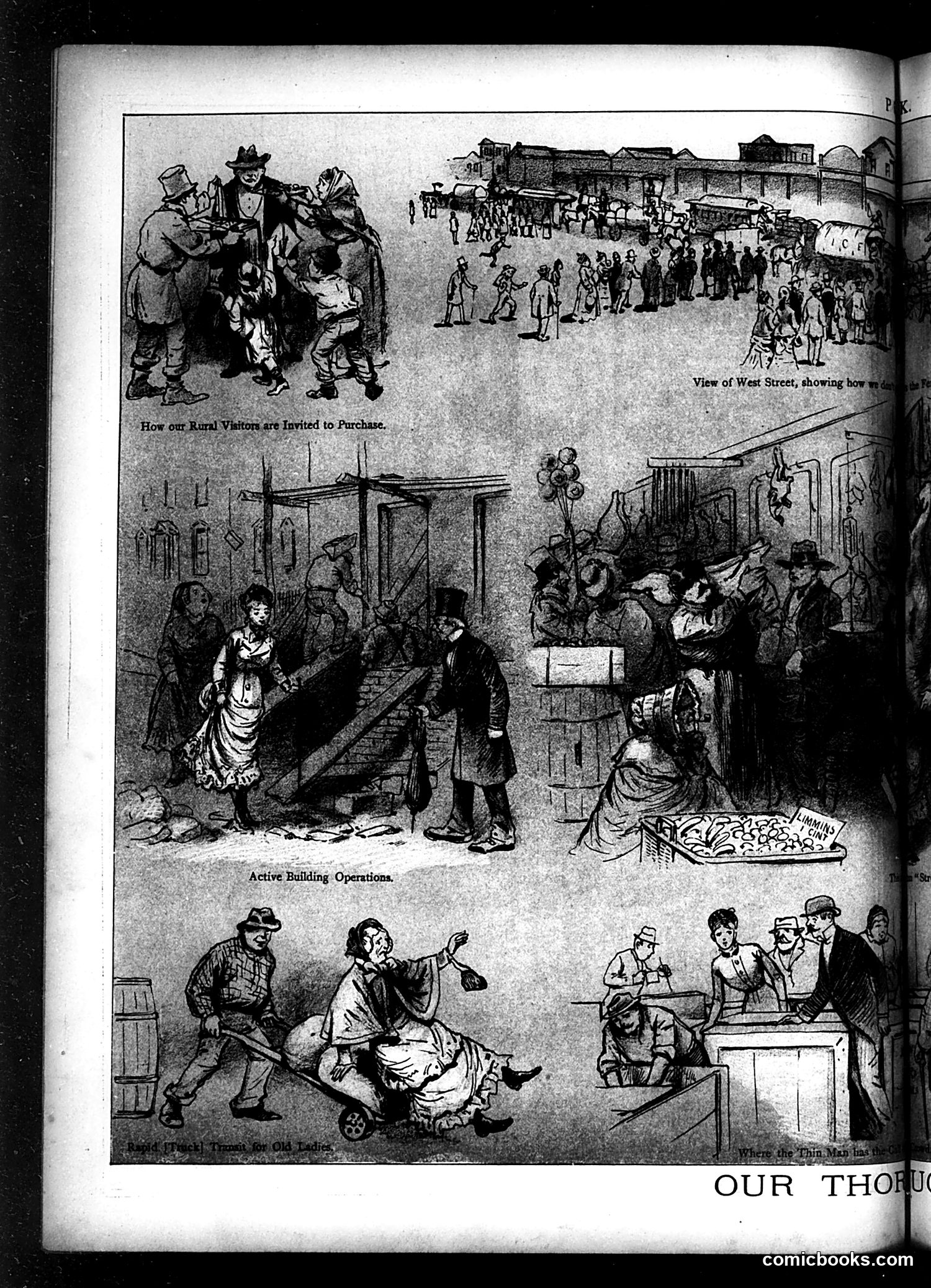
This page depicts scenes from an urban market or fair, satirizing the commercial interactions between rural visitors and city merchants. The top panel, "How our Rural Visitors are Invited to Purchase," shows a well-dressed con artist or merchant pressuring a naive rural couple into a transaction—likely a common urban swindle targeting unsophisticated country folk. The subsequent panels titled "Active Building Operations" and the bottom scene appear to show various street-level commerce and labor scenes, including what appears to be construction work and transactions at market stalls. The satire targets the exploitation of rural visitors by city merchants and hustlers, a common Gilded Age theme mocking both urban duplicity and rural naiveté. The crude, exaggerated caricatures emphasize class and cultural differences between urban and rural America.
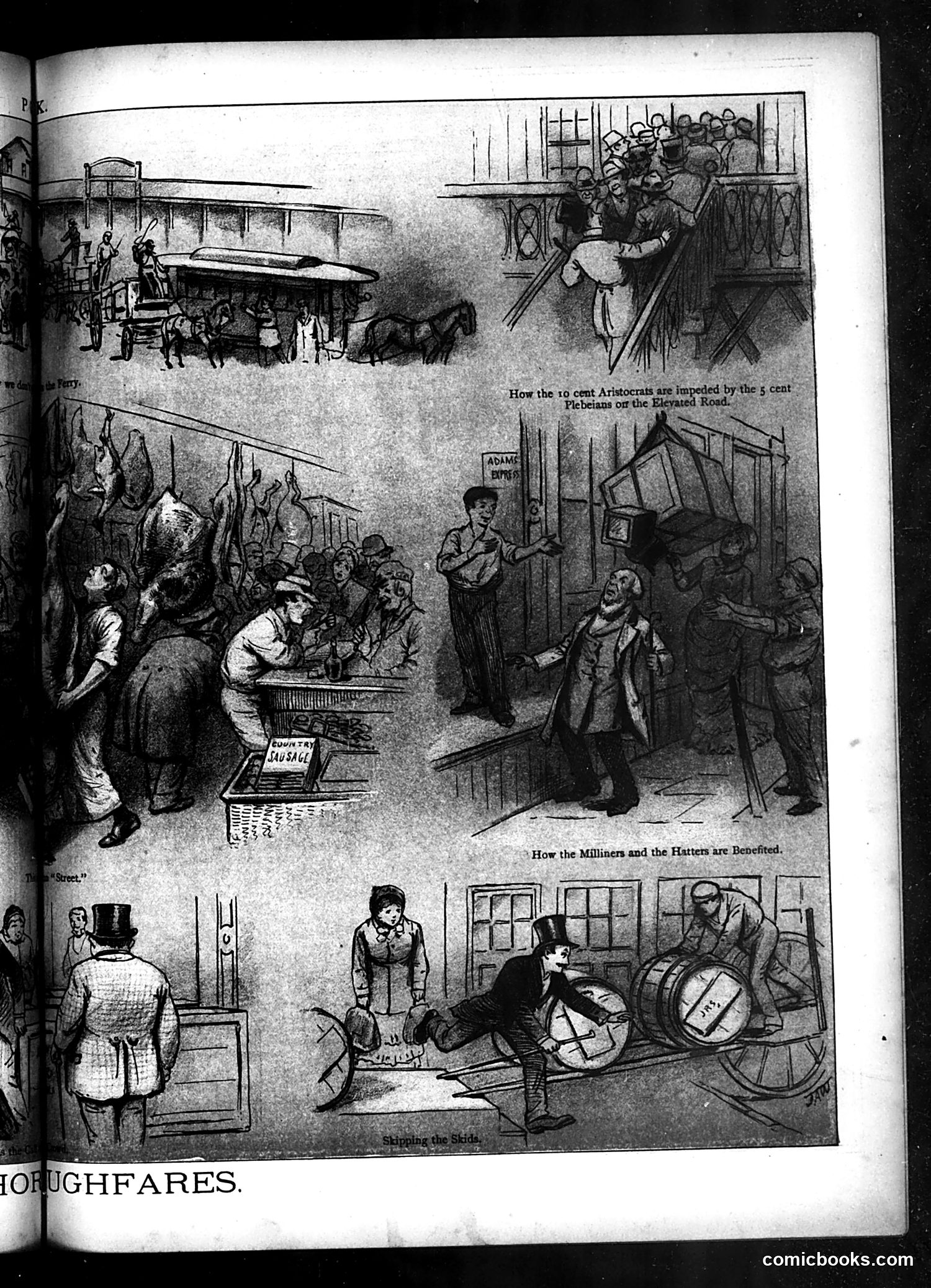
This Puck page satirizes corruption in New York City infrastructure and commerce, circa late 1800s. The top panel depicts "10 cent Aristocrats" being escorted by the 5 cent Tammany Hall machine on the Elevated Road—mocking wealthy elites' complicity with corrupt political boss rule. The middle section, "How the Milliners and the Hatters are Benefited," shows artisans gaining from kickback schemes tied to public works. The bottom panels titled "Skipping the Skids" depict workers literally moving heavy barrels, likely satirizing how ordinary laborers bear the physical burden while corrupt politicians and businessmen profit from graft and public contracts. The overall message: New York's infrastructure serves corruption rather than the public good.
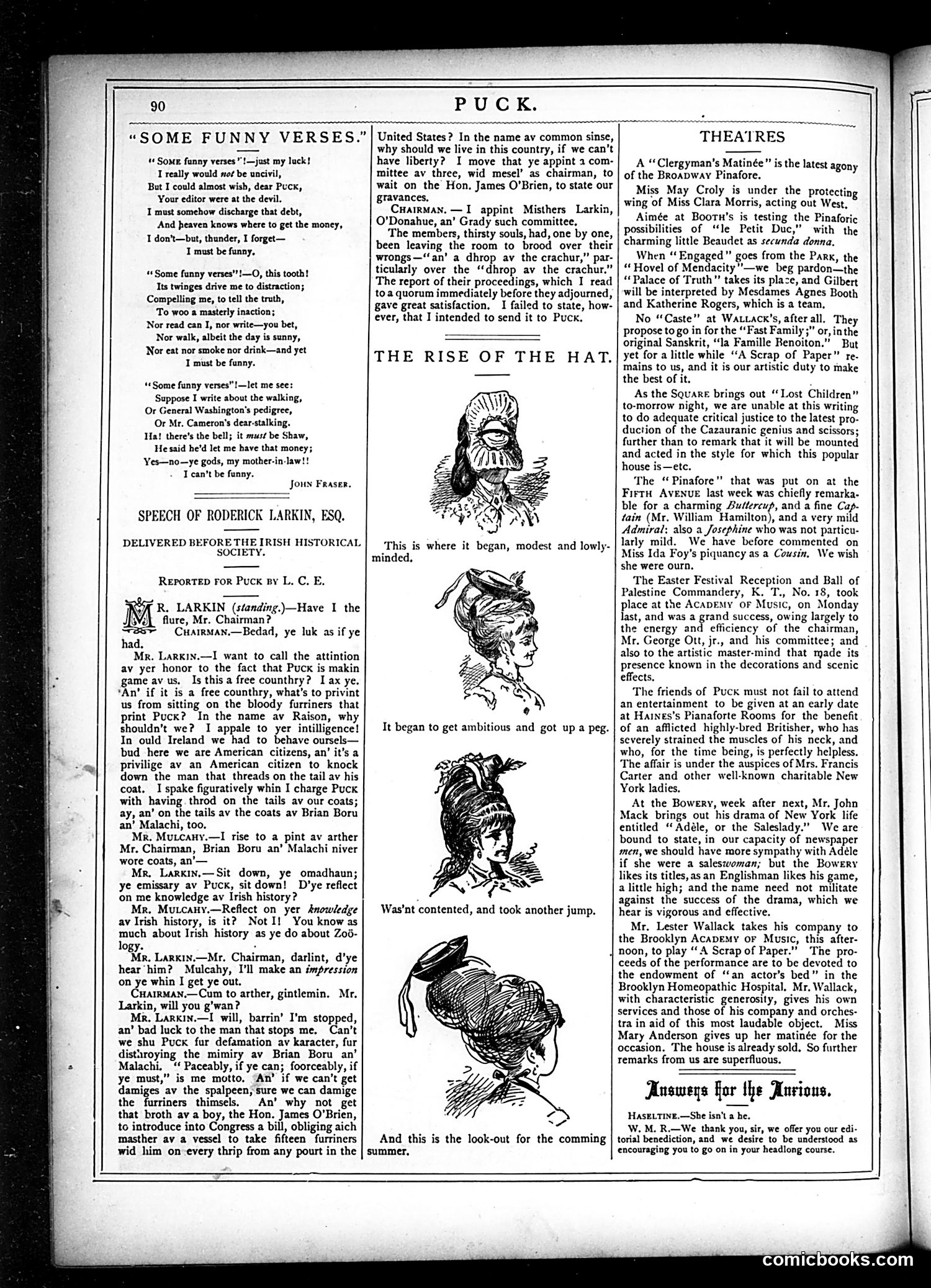
This page features a satirical sequence titled "The Rise of the Hat," showing a hat's progression from modest simplicity to increasingly elaborate, towering designs. The accompanying illustrations depict women's hats becoming progressively larger and more ornate—a commentary on the fashion excess of the Gilded Age. The satire targets the absurdity of women's millinery trends, where hat construction grew so ambitious it became unwieldy. The final image shows an exaggerated, towering confection, mocking how far fashion had departed from practicality. This reflects contemporary social criticism of women's fashion waste and the disconnect between elaborate decoration and actual utility—a recurring theme in late 19th-century American humor magazines.
This appears to be a serialized short story rather than a political cartoon. The narrative depicts urban London during a strike, focusing on Michael Grane and other characters caught in labor unrest. The story involves dramatic personal conflicts—a wife separated from her husband during the strike chaos, tension over whether to send a telegram, and working-class struggles during transportation strikes. The text references "engine-drivers and cabdrivers" being "on strike," suggesting this depicts actual labor disputes. The story emphasizes the human cost of industrial action: terror, separation, and moral dilemmas faced by ordinary Londoners. This reflects Puck's satirical interest in contemporary social issues, using melodramatic fiction to examine strike violence and its consequences on workers and families.
This page consists primarily of **short satirical items and poetry** rather than political cartoons. The centerpiece is "A Cigarette," a romantic poem about smoking. The scattered brief items mock various targets: - **Chicago Times** and **N.Y. Star** are criticized for editorial positions (one about women grocery shopping, another about theater attendance) - References to **Archbishop's Purcell** (likely about Catholic Church finances) - A **Tennessee doctor's** letter offering dubious writing advice - Various social commentary on pedestrian safety, theater etiquette, and newspaper columnists The page functions as **miscellaneous satirical commentary** on contemporary newspapers, social customs, and public figures rather than featuring identifiable political caricatures. The humor relies on wordplay and topical references that required readers' familiarity with specific newspapers and local scandals of the era.
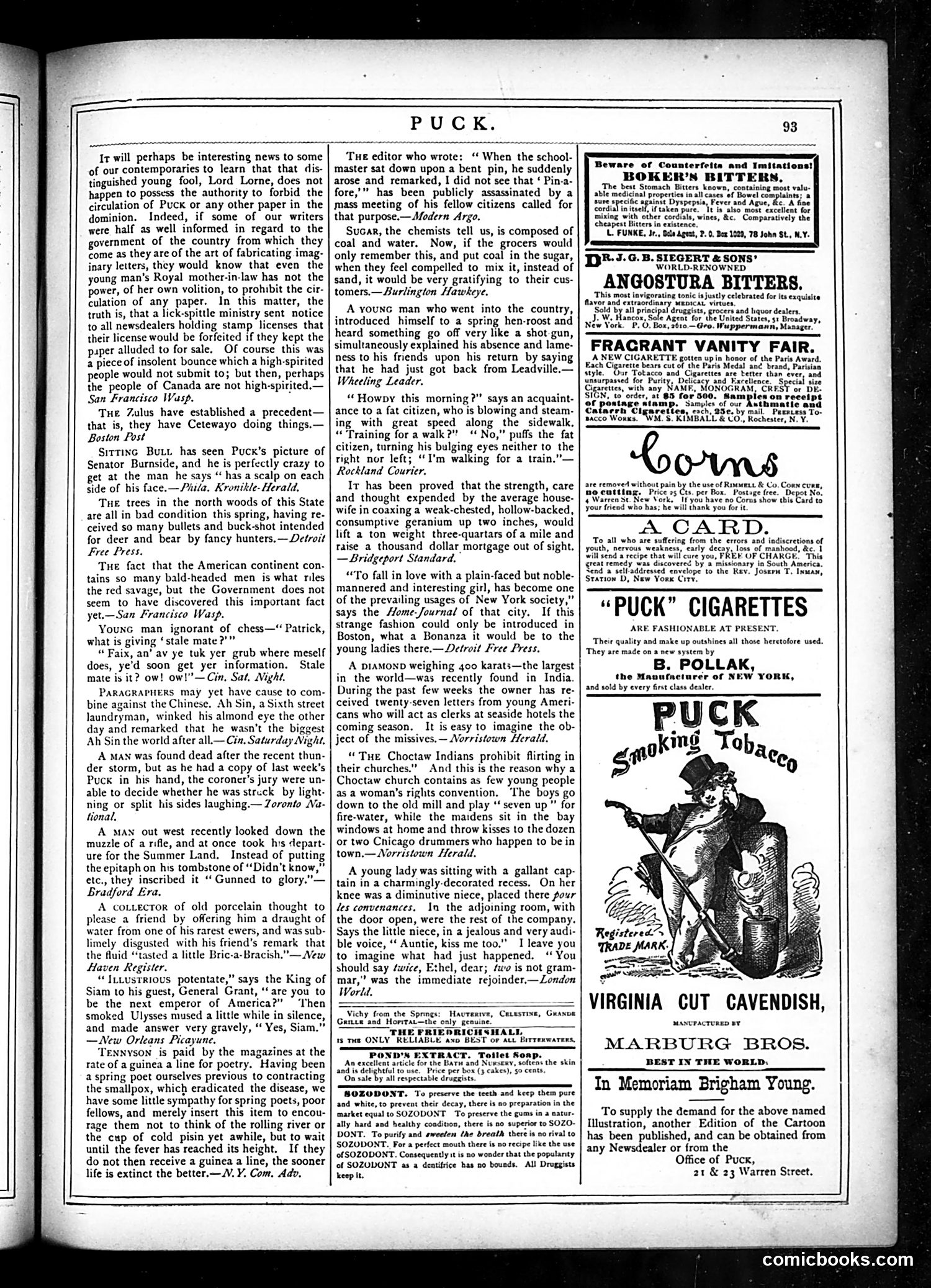
This page is primarily devoted to advertisements rather than political cartoons. The notable content includes: **Main Image**: A cartoon of a leprechaun-like figure sitting on a large tobacco barrel, advertising "Puck Smoking Tobacco" and "Virginia Cut Cavendish" by Marburg Bros. The whimsical character appears designed to make the product appealing. **Text Content**: Multiple short satirical pieces and jokes typical of Puck's humor—anecdotes mocking various social types (noblemen, citizens, housewives). These lack specific political references but reflect general turn-of-the-century American social commentary. **Advertisements**: Bitters, patent medicines, cigarettes, and other commercial products dominate the page, reflecting the magazine's revenue model. Without date information visible, the exact historical context remains unclear.
This is primarily an **advertising page** rather than a satirical cartoon page. It contains numerous advertisements for late 19th-century New York businesses, including: - **Carpets and home furnishings** (Lord & Taylor, Arnold Constable & Co.) - **Clothing and textiles** (linens, suits, undergarments) - **Professional services** (photographers, dentists, patent attorneys) - **Furniture** (Thonet Brothers' bentwood chairs) - **Novelty items and remedies** The ads reflect the magazine's audience: middle and upper-class New Yorkers interested in fashionable goods and services. Notable is an advertisement claiming to cure "NO MORE RHEUMATISM, Gout, Gravel, or Diabetes" through Schlimberger's harness—typical of era medical product marketing that would today be considered fraudulent.
This page is **primarily advertisements**, not editorial content. The page contains no political cartoons or satirical illustrations with clear historical references. The ads showcase period products: Piper-Heidsieck and other champagnes, Isaac Smith's umbrellas, Nicoll the tailor, Pachtmann & Moelich jewelry, and C. Pfaff's restaurant. The Louisiana State Lottery advertisement and Keppich & Co. cigar ads are notable. The only illustration with potential satirical intent is a clock face in the jewelry ad, but it lacks clear political meaning. The page primarily demonstrates how *Puck* monetized its pages through advertising while maintaining its entertainment brand. This reflects late 19th-century magazine economics rather than containing specific satirical commentary.
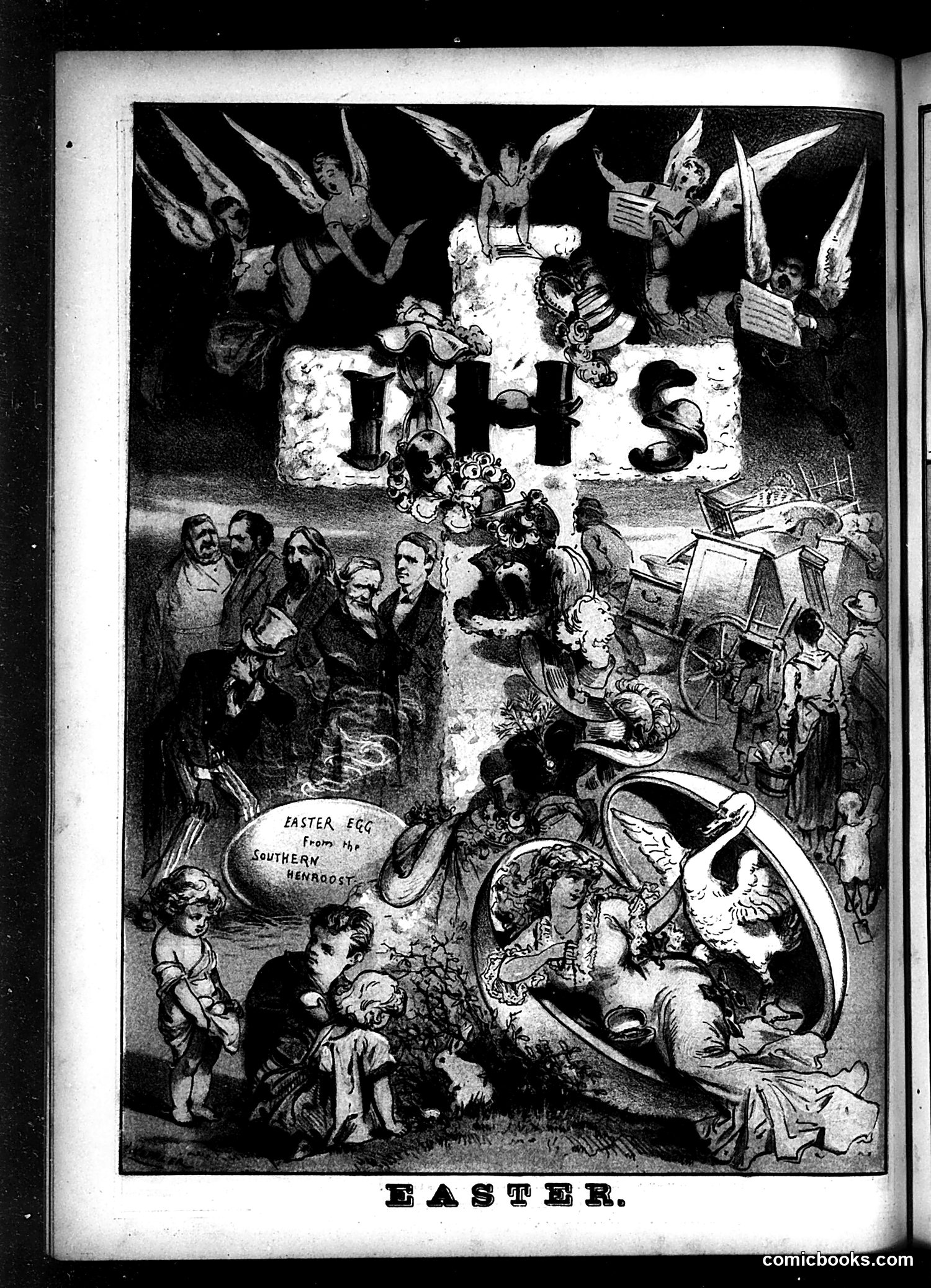
This Puck illustration satirizes Easter observances and religious hypocrisy. The central cross dominates a chaotic scene with "LHES" (likely "LIES") emblazoned across it. Winged demons hover above, while below crowds of people gather around an Easter egg labeled "from the Southern Henroost"—apparently mocking Southern claims or practices. Various figures examine goods and wares, suggesting commercialization of Easter. The satire appears to critique both the religious pretense surrounding Easter celebrations and, based on the "Southern Henroost" reference, likely contains commentary on antebellum American regional tensions, possibly regarding slavery or Southern economic practices being hidden beneath religious respectability. The chaotic composition and crude figures emphasize Puck's mocking tone toward these subjects.