
Puck, 1879-04-16 · page 11 of 16
Puck — April 16, 1879 — page 11: what you’re looking at
What you’re looking at
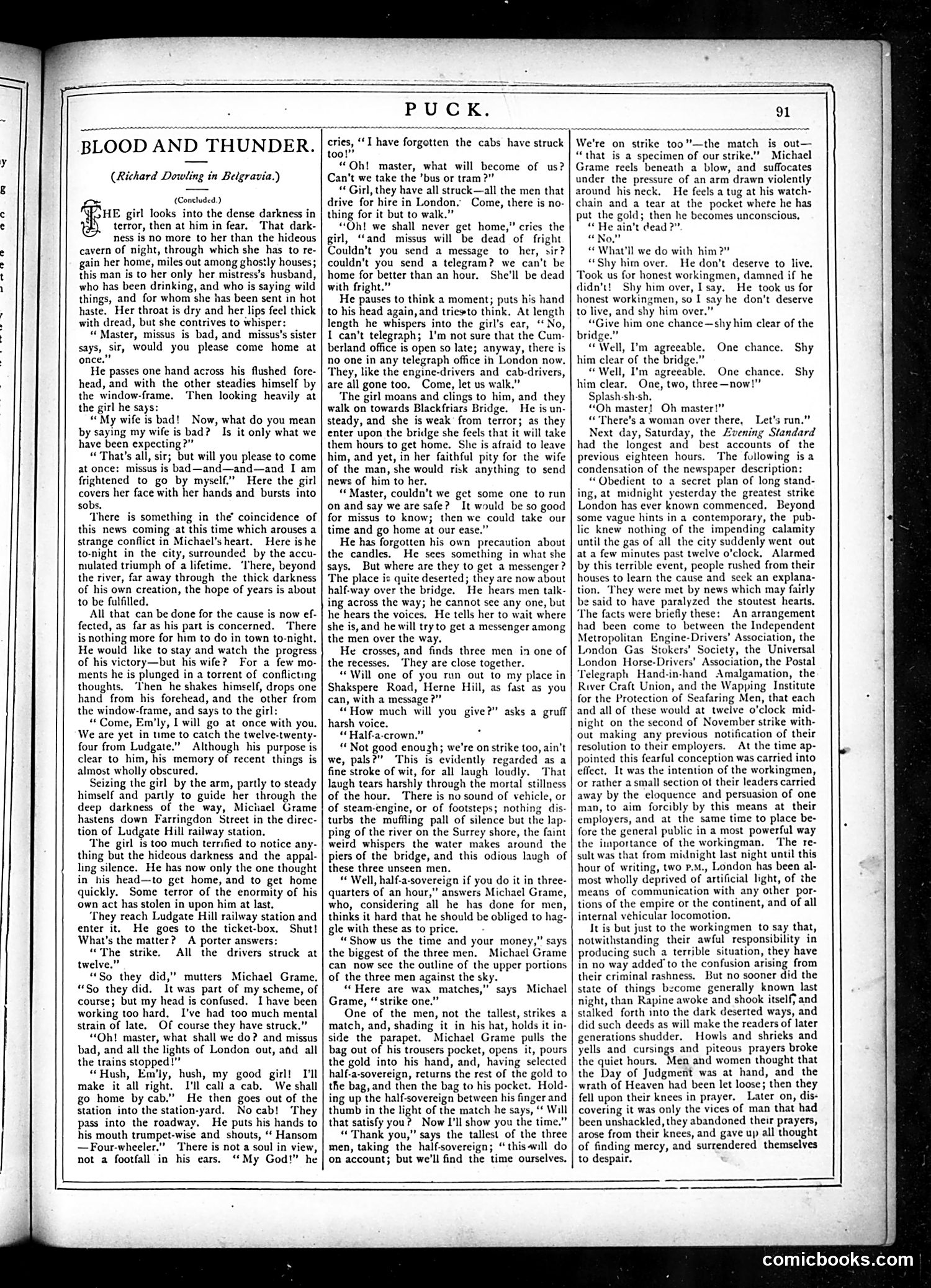
This appears to be a serialized short story rather than a political cartoon. The narrative depicts urban London during a strike, focusing on Michael Grane and other characters caught in labor unrest. The story involves dramatic personal conflicts—a wife separated from her husband during the strike chaos, tension over whether to send a telegram, and working-class struggles during transportation strikes. The text references "engine-drivers and cabdrivers" being "on strike," suggesting this depicts actual labor disputes. The story emphasizes the human cost of industrial action: terror, separation, and moral dilemmas faced by ordinary Londoners. This reflects Puck's satirical interest in contemporary social issues, using melodramatic fiction to examine strike violence and its consequences on workers and families.
📄 Transcribed text from this page (OCR, searchable)
Machine-transcribed from the original scan — historical spelling and the odd misread are preserved.
BLOOD AND THUNDER. (Richard Dowling in Belgravia.) (Concluded.) Yo HE gitl looks into the dense darkness in terror, then at him in fear, That dark- ness is no more to her than the hideous cavern of night, through which she has to re- gain her home, miles out among ghostly houses; this man is to her only her mistress’s husband, who has been drinking, and who is saying wild things, and for whom she has been sent in hot haste. Her throat is dry and her lips feel thick with dread, but she contrives to whisper: “Master, missus is bad, and missus’s sister says, sir, would you please come home at once.” He passes one hand across his flushed fore- head, and with the other steadies himself by the window-frame. ‘Then looking heavily at the girl he says: “My wife is bad! Now, what do you mean by saying my wife is bad? "Is it only what we have been expecting?” “ That's all, sir; but will you please to come at once: missus is bad—and—and—and I am frightened to go by myself.” Here the girl covers her face with her hands and bursts into sobs. ‘There is something in the’ coincidence of this news coming at this time which arouses a strange conflict in Michael’s heart. Here ishe to-night in the city, surrounded by the accu- nulated triumph of a lifetime. ‘Ihere, beyond the river, far away through the thick darkness of his own creation, the hope of years is about to be fulfilled. All that can be done for the cause is now ef- fected, as far as his part is concerned. ‘There is nothing more for him to do in town to-night. He would like to stay and watch the progress of his victory—but his wife? For a few mo- ments he is plunged in a torrent of conflicting thoughts. Then he shakes himself, drops one hand from his forehead, and the other from the window-frame, and says to the girl: “Come, Emly, I will go at once with you. We are yet in time to catch the twelve-twenty- four from Ludgate.” Although his purpose is clear to him, his memory of recent things is almost wholly obscured. Seizing the girl by the arm, partly to steady himself and partly to guide her through the deep darkness of the way, Michael Grame hastens down Farringdon Street in the direc- tion of Ludgate Hill railway station, ‘The girl is too much terrified to notice any- thing but the hideous darkness and the appal- ling silence. He has now only the one thought in his head—to get home, and to get home quickly, Some terror of the enormity of his own act has stolen in upon him at last. ‘They reach Ludgate Hill railway station and enter it. He goes to the ticket-box. Shut! What's the matter? A porter answers: “The strike. All the drivers struck at twelve.” “So they did,” mutters Michael Grame, “So they did. It was part of my scheme, of course; but my head is confused. Ihave been working too hard, I've had too much mental strain of late, Of course they have struck.” “Oh! master, what shall we do? and missus bad, and all the lights of London out, and all the trains stopped!” “Hush, Em'ly, hush, my good girl! I'll make it all right. I'll call a cab. We shall go home by cab.” He then goes out of the station into the station-yard. Nocab! ‘They pass into the roadway. He puts his hands to his mouth trumpet-wise and shouts, “‘ Hansom —Four-wheeler.” There is not a soul in view, not a footfall in his ears. ‘My God!” he PUCK. cries, “Thave forgotten the cabs have struck too!” “Oh! master, what will become of us? Can't we take the ‘bus or tram?” “ Girl, they have all struack—all the men that drive for hire in London. Come, there is no- thing for it but to walk.” “Oh! we shall never get home,” cries the girl, “and missus will be dead of fright Couldn't you send a message to her, sir? couldn't you send a telegram? we can't be home for better than an hour. She'll be dead with fright.” He pauses to think a moment; puts his hand to his head again, and triesto think. At length length he whispers into the girl’s ear, ‘No, I can’t telegraph; 1’m not sure that the Cum- berland office is open so late; anyway, there is no one in any telegraph office in London now, ‘They, like the engine-drivers and cab-drivers, are all gone too. Come, let us walk.” ‘The girl moans and clings to him, and they walk on towards Blackfriars Bridge. He is un- steady, and she is weak’ from terror; as they enter upon the bridge she feels that it will take them hours to get home. She is afraid to leave him, and yet, in her faithful pity for the wife of the man, she would risk anything to send news of him to her. ‘ Master, couldn’t we get some one to run on and say we are safe? It would be so good for missus to know; then we could take our time and go home at our ease.” He has forgotten his own precaution about the candles. He sees something in what she says. But where are they to get a messenger? ‘The place ic quite deserted; they are now about half-way over the bridge. He hears men talk- ing across the way; he cannot see any one, but he hears the voices. He tells her to wait where she is, and he will try to get a messenger among the men over the way. He crosses, and finds three men in one of the recesses. They are close together. “Will one of you run out to my place in Shakspere Road, Herne Hill, as fast as you can, with a message ?” “How much will you give?” asks a gruff harsh voice. “ Half-a-crown,”” “ Not good enouzh; we're on strike too, ain't we, pals?” This is evidently regarded as a fine stroke of wit, for all laugh loudly. That laugh tears harshly through the mortal stillness of the hour, There is no sound of vehicle, or of steam-engine, or of footsteps; nothing dis- turbs the mufiling pall of silence but the lap- ping of the river on the Surrey shore, the faint weird whispers the water makes around the piers of the bridge, and this odious laugh of these three unseen men. “ Well, half-a-sovereign if you do it in three- quarters of an hour,” answers Michael Grame, who, considering all he has done for men, thinks it hard that he should be obliged to hag- gle with these as to price. “ Show us the time and your money,” says the biggest of the three men. Michael Grame can now see the outline of the upper portions of the three men against the sky. “Here are wax matches,” says Michael Grame, “strike one.” One of the men, not the tallest, strikes a match, and, shading it in his hat, holds it in- side the parapet. Michael Grame pulls the bag out of his trousers pocket, opens it, pours the gold into his hand, and, having selected half-a-sovereign, returns the rest of the gold to the bag, and then the bag to his pocket. Hold- ing up the half-sovereign between his finger and thumb in the light of the match he says, ‘“ Will that satisfy you? Now I'll show you the time.” “ Thank you,” says the tallest of the three men, taking the half-sovereign; “thiswwill do on account; but we'll find the time ourselves. We're on strike too"—the match is out— “that is a specimen of our strike.” Michael Grame reels beneath a blow, and suffocates under the pressure of an arm drawn violently around his neck. He feels a tug at his watch- chain and a tear at the pocket whefe he has put the gold; then he becomes unconscious, “ He ain't dead 2”. “No.” “ What'll we do with him?” “Shy him over. He don’t deserve to live. Took us for honest workingmen, damned if he didn't! Shy him over, I say. He took us for honest workingmen, so I say he don't deserve to live, and shy him over “Give him one chance bridge.” “Well, I'm agreeable. him clear of the bridge.” “Well, I'm agreeable. One chance. him clear. One, two, three—now!” Splash-sh-sh. “Oh master! Oh master!” “ There’s a woman over there, Let's run.” Next day, Saturday, the Lvening Standard had the longest and best accounts of the previous eighteen hours. The fullowing is a condensation of the newspaper description: “Obedient to a secret plan of long stand- ing, at midnight yesterday the greatest strike London has ever known commenced, Beyond some vague hints in a contemporary, the pub- lic knew nothing of the impending calamity until the gas of all the city suddenly went out at a few minutes past twelve o'clock, Alarmed by this terrible event, people rushed from their houses to learn the cause and seck an explana- tion. They were met by news which may fairly be said to have paralyzed the stoutest hearts, ‘The facts were briefly these: An arrangement had been come to between the Independent Metropolitan Engine-Drivers’ Association, the London Gas Stokers’ Society, the Universal London Horse-Drivers’ Association, the Postal Telegraph Hand-in-hand Amalgamation, the River Craft Union, and the Wapping Institute for the Protection of Seafaring Men, that each and all of these would at twelve o'clock mid- night on the second of November strike with- out making any previous notification of their resolution to their employers. At the time ap- pointed this fearful conception was carried into effect, It was the intention of the workingmen, or rather a small section of their leaders carried away by the eloquence and persuasion of one man, to aim forcibly by this means at their employers, and at the same time to place be- fore the general public in a most powerful way the importance of the workingman. The re- sult was that from midnight last night until this hour of writing, two p.M., London has been al- most wholly deprived of artificial light, of the means of communication with any other por- tions of the empire or the continent, and of all internal vehicular locomotion. It is but just to the workingmen to say that, notwithstanding their awful responsibility in producing such a terrible situation, they have in no way added to the confusion arising from their criminal rashness. But no sooner did the state of things become generally known last night, than Rapine awoke and shook itself; and stalked forth into the dark deserted ways, and did such deeds as will make the readers of later generations shudder. Howls and shrieks and yells and cursings and piteous prayers broke the quiet hours. Men and women thought that the Day of Judgment was at hand, and the wrath of Heaven had been let loose; then they fell upon their knees in prayer, Later on, dis- covering it was only the vices of man that had been unshackled, they abandoned their prayers, arose from their knees, and gave up all thought of finding mercy, and surrendered themselves to despair. shy him clear of the One chance. Shy Shy comicbooks.com |