
Puck, 1879-04-16 · page 2 of 16
Puck — April 16, 1879 — page 2: what you’re looking at
What you’re looking at
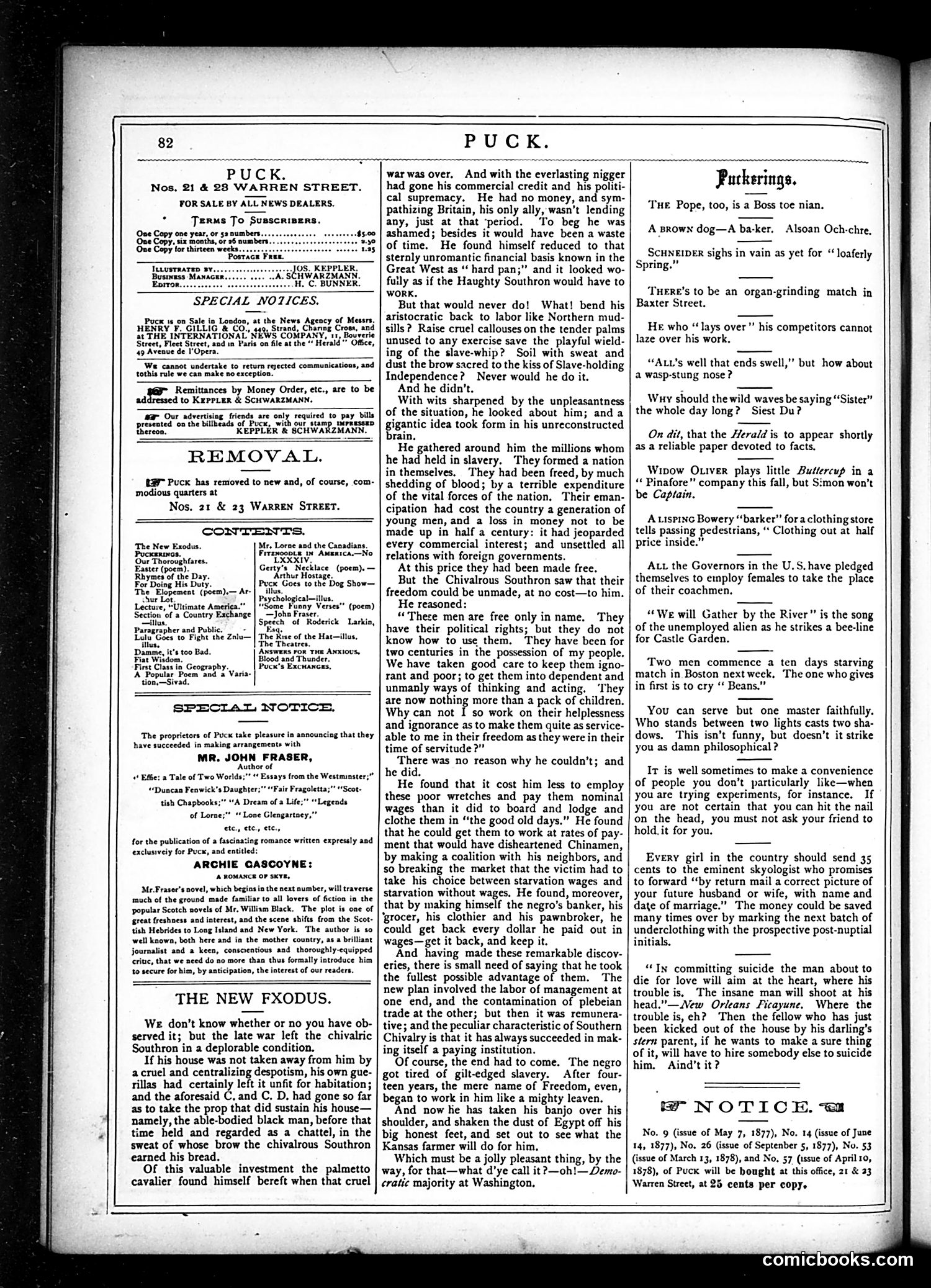
This page is primarily **text content with no visible political cartoons**. It contains: 1. **Puckerings** (short satirical quips) mocking various targets: The Pope, a "brown dog" (unclear reference), Schneider, and others—typical of Puck's brief commentary style. 2. **"The New Exodus"** (main article)—a substantial piece criticizing post-Civil War Southern labor practices. It argues that freed slaves, despite nominal freedom, remain economically enslaved through exploitative wages and debt systems. The satire compares their condition unfavorably to actual freedom, suggesting the South has merely renamed rather than reformed slavery. 3. **Notices and advertisements** for back issues and subscription information. The page's satirical thrust targets Southern economic oppression of freed Black laborers during Reconstruction, using ironic comparison to mock the hollow nature of their liberation.
📄 Transcribed text from this page (OCR, searchable)
Machine-transcribed from the original scan — historical spelling and the odd misread are preserved.
82 PUCK. PUCK. Nos. 21 & 28 WARREN STREET. FOR SALE BY ALL NEWS DEALERS. Terms To Suascripers, ~-H. C. BUNNER: SPECIAL NOTICES. Pucx 16 on Sale in Londo, at the News Agency of Messrs. HENRY F. GILLIG & CO., 44g, Strand, Chanog Cross, and at THE INTERNATIONAL NEWS COMPANY, 11, Bouverie Street, Fleet Street, and in Paris on file at the ** Herald” Office, 49 Avenue de Opera. ‘We cannot undertake to return reected communications, and tothis rule we can make no exception. Remittances by Money Order, etc., are to be adi to Kupper & SCHWARZMANN. x Out adverihing frende are only required to pay, bila ted on the billbe x, with out stamp IMPKESsED Se = REPPLER & SCHWARZMANN. REMOVAL. (T- Puck has removed to new and, of course, com- modious quarters at Nos. 21 & 23 WARREN STREET. CONTENTS. ‘The New Exodus. Mr. Lorne and the Canadian Puckaamnas. Our Thoroughfares. Easter (poem). Rhymes of the Day. For Doing His Duty. The Elopement (poem).— Ar-| illus : Sur Lot Psychological—illus. Lgetore, “Ultimate Amerga”_| “Some, Funny Verses” (poem) Section ‘of a Country Exchange | _—John Fraser. itlus ef S| specch of ‘Roderick Larkio, Paragrapher and Public. Esq. Lulu Goes to Fight the Znlu— | The Rise of the Hat—illus, The Theatres. ANSWERS FOR THE Arxious, Blood and Thunder. Puck’s Excnances, Gerty’s Necklace (poem). — ‘Arthur Hostage. Puck Goes to the Dog Show— First Class in Geography, ‘A Popular Poem and a Varia tion, —Sivad. SPECIAL NOTICE. ‘The proprietors of Puck take pleasure in announcing that they have succeeded ia making arrangements with MR, JOHN FRASER, ‘Author of «* Effie: a Tale of Two Worlds: “Duncan Feawick's Daughter; tish Chapbooks;"* “A Dream of a Life of Lorne;”* ‘* Lone Glengartney,”” tte, ete, ete, ys from the Westminster; Fragoletta;"* “Scot- ‘Legends lication of a fascina:ing romance written expressly and exclusively for Puc, and entitled: ARCHIE CASCOYNE: ‘A ROMANCE OF SKYE, Mr.Frasee’s novel, which begins ia the next number, will traverse much of the ground made familiar to all lovers of fiction in the popular Scotch novels of Mr. William Black. The plot is one of great freshness and interest, and the scene shifts from the Scot- tish Hebrides to Long Island and New York. The author is so well known, both here and in the mother country, as a brilliant journalist and a keen, conscientious and thoroughly-equipped ‘critic, that we need do no more than thus formally introduce him to secure for him, by anticipation, the interest of our readers. THE NEW FXODUS. We don’t know whether or no you have ob- served it; but the late war left the chivalric Southron in a deplorable condition, If his house was not taken away from him by acruel and centralizing despotism, his own gue- rillas had certainly left it unfit for habitation; and the aforesaid C. and C. D. had gone so far as to take the prop that did sustain his house— namely, the able-bodied black man, before that time held and regarded as a chattel, in the sweat of whose brow the chivalrous Southron earned his bread. war was over. And with the everlasting nigger had gone his commercial credit and his politi- cal supremacy. He had no money, and sym- pathizing Britain, his only ally, wasn't lending any, just at that ‘period. To beg he was ashamed; besides it would have been a waste of time. He found himself reduced to that sternly unromantic financial basis known in the Great West as ‘‘ hard pan;" and it looked wo- fully as if the Haughty Southron would have to WORK. But that would never do! What! bend his aristocratic back to labor like Northern mud- sills? Raise cruel callouses on the tender palms unused to any exercise save the playful wield- ing of the slave-whip? Soil with sweat and dust the brow sacred to the kiss of Slave-holding Independence? Never would he do it. And he didn’t. With wits sharpened by the unpleasantness of the situation, he looked about him; and a gigantic idea took form in his unreconstructed brain. He gathered around him the millions whom he had held in slavery. They formed a nation in themselves. They had been freed, by much shedding of blood; by a terrible expenditure of the vital forces of the nation, Their eman- cipation had cost the country a generation of young men, and a loss in money not to be made up in half a century: it had jeoparded every commercial interest; and unsettled all relations with foreign governments. At this price they had been made free. But the Chivalrous Southron saw that their freedom could be unmade, at no cost—to him. He reasoned: “These men are free only inname. They have their political rights; but they do not know how to use them. They have been for two centuries in the possession of my people. We have taken good care to keep them igno- rant and poor; to get them into dependent and unmanly ways of thinking and acting. ‘They are now nothing more than a pack of children. Why can not I so work on their helplessness and ignorance as to make them quite as service- able to me in their freedom as they were in their time of servitude?” ‘There was no reason why he couldn't; and he did. He found that it cost him less to employ these poor wretches and pay them nominal wages than it did to board and lodge and clothe them in “the good old days.” He found that he could get them to work at rates of pay- ment that would have disheartened Chinamen, by making a coalition with his neighbors, and so breaking the market that the victim had to take his choice between starvation wages and starvation without wages. He found, moreover, that by making himself the negro’s banker, his ‘grocer, his clothier and his pawnbroker, he could get back every dollar he paid out in wages—get it back, and keep it. And having made these remarkable discov- eries, there is small need of saying that he took the fullest possible advantage of them. The new plan involved the labor of management at one end, and the contamination of plebeian trade at the other; but then it was remunera- tive; and the peculiar characteristic of Southern Chivalry is that it has always succeeded in mak- ing itself a paying institution. Of course, the end had to come. The negro got tired of gilt-edged slavery. After four- teen years, the mere name of Freedom, even, began to work in him like a mighty leaven. And now lie has taken his banjo over shoulder, and shaken the dust of Egypt off his big honest feet, and set out to see what the Kansas farmer will do for him. Which must be a jolly pleasant thing, by the way, for that—what d’ye call it?—oh!—Demo- cratic majority at Washington, Puckerings. Tue Pope, too, is a Boss toe nian, A Brown dog—A ba-ker. Alsoan Och-chre, Scuneiper sighs in vain as yet for “ loaferly Spring.” ‘Tuere's to be an organ-grinding match in Baxter Street. HE who “lays over” his competitors cannot laze over his work, “ALL’s well that ends swell,” but how about a wasp-stung nose? Way should the wild waves be saying “Sister” the whole day long? Siest Du? On dit, that the Herald is to appear shortly as a reliable paper devoted to facts. Wivow Ouiver plays little Buttercup in a “ Pinafore” company this fall, but Simon won't be Captain. A ispinc Bowery “barker” foraclothing store tells passing pedestrians, “ Clothing out at half price inside.” ALL the Governors in the U.S. have pledged themselves to employ females to take the place of their coachmen, “We will Gather by the River” is the song of the unemployed alien as he strikes a bee-line for Castle Garden. Two men commence a ten days starving match in Boston next week, The one who gives in first is to cry ‘‘ Beans,” You can serve but one master faithfully. Who stands between two lights casts two sha- dows. ‘This isn’t funny, but doesn’t it strike you as damn philosophical ? It is well sometimes to make a convenience of people you don’t particularly like—when you are trying experiments, for instance. If you are not certain that you can hit the nail on the head, you must not ask your friend to hold. it for you. Every girl in the country should send 35 cents to the eminent skyologist who promises to forward ‘by return mail a correct picture of your future husband or wife, with name and date of marriage.” The money could be saved many times over by marking the next batch of underclothing with the prospective post-nuptial initials. “In committing suicide the man about to die for love will aim at the heart, where his trouble is, The insane man will shoot at his head."—New Orleans Ficayune, Where the trouble is, eh? Then the fellow who has just been kicked out of the house by his darling’s stern parent, if he wants to make a sure thing of it, will have to hire somebody else to suicide him. Aind’t it? ma NOTICE =a No. 9 (issue of May 7, 1877), No. 14 (issue of June 14, 1877), No, 26 (issue of Septenber 5, 1877), No. 53 (issue of March 13, 1878), and No, 57 (issue of April 10, 1878), of Puck will be bought at this office, 21 & 23 ‘Warren Street, at 25 cents per copy. Of this valuable investment the palmetto cavalier found himself bereft when that cruel comicbooks.com