
Puck, 1879-04-16 · page 3 of 16
Puck — April 16, 1879 — page 3: what you’re looking at
What you’re looking at
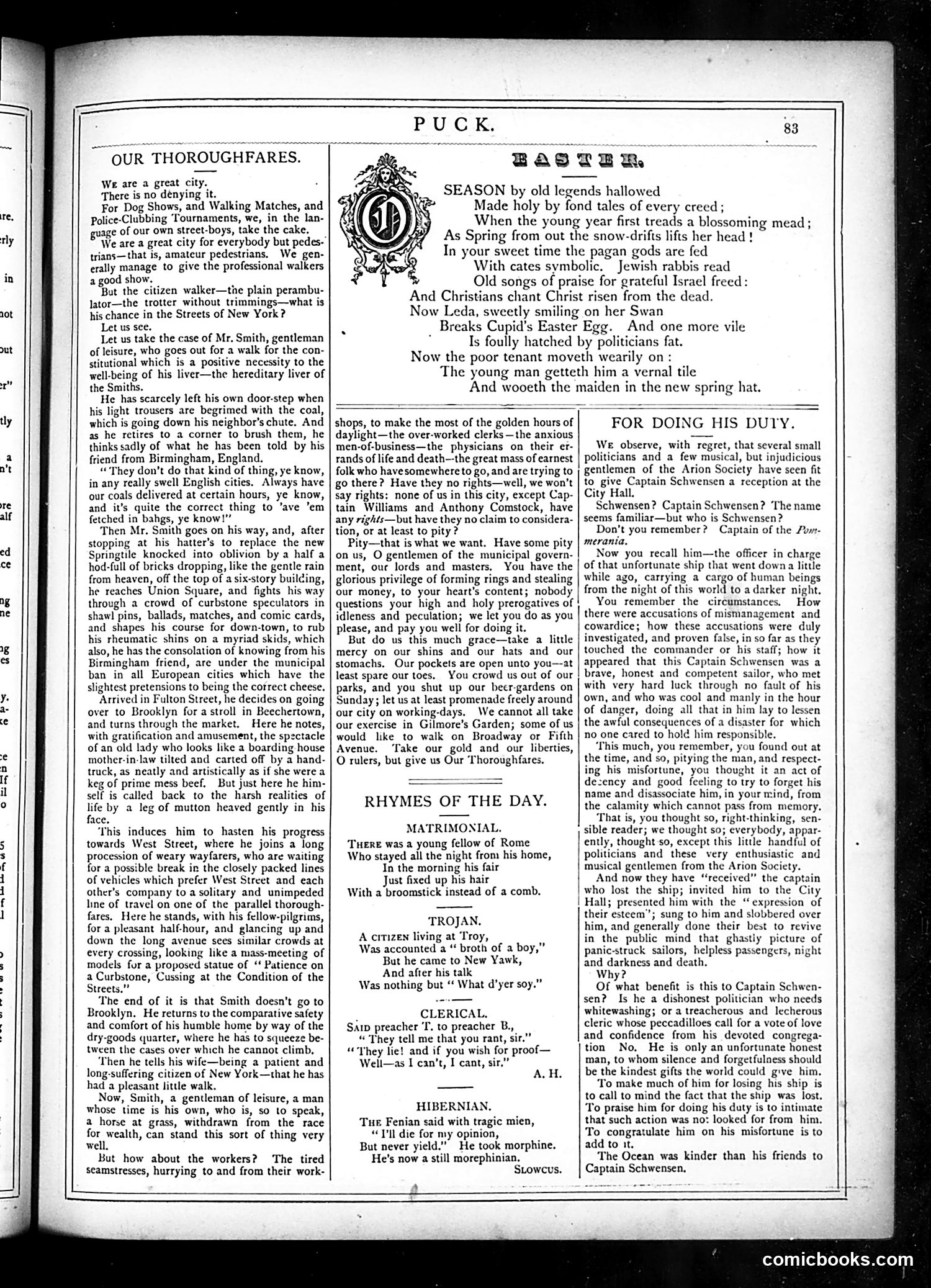
This page contains multiple satirical pieces rather than a single cartoon. "Our Thoroughfares" mocks pedestrian congestion and urban disorder in New York City, using a gentleman named Mr. Smith as an everyman figure to critique inadequate city management and working conditions for laborers. "For Doing His Duty" appears to satirize politicians' treatment of Captain Schevenson, who lost a ship. The piece criticizes how politicians and the Aaron Society gave him only a ceremonial reception rather than meaningful support, suggesting hypocrisy in public honors while ignoring practical needs. The "Rhymes of the Day" section contains light verse on matrimonial and clerical topics, typical of Puck's miscellaneous humor format. The overall theme critiques urban governance failures and political opportunism.
📄 Transcribed text from this page (OCR, searchable)
Machine-transcribed from the original scan — historical spelling and the odd misread are preserved.
OUR THOROUGHFARES. We are a great city. There is no dénying it. For Dog Shows, and Walking Matches, and Police-Clubbing Tournaments, we, in the lan- guage of our own street-boys, take the cake. We are a great city for everybody but pedes- trians—that is, amateur pedestrians. We gen- erally manage to give the professional walkers a good show. But the citizen walker—tae plain perambu- lator—the trotter without trimmings—what is his chance in the Streets of New York? Let us see. Let us take the case of Mr. Smith, gentleman of leisure, who goes out for a walk for the con- stitutional which is a positive necessity to the well-being of his liver—the hereditary liver of the Smiths. He has scarcely left his own door-step when his light trousers are begrimed with the coal, which is going down his neighbor's chute. And as he retires to a corner to brush them, he thinks sadly of what he has been told by his friend from Birmingham, England. “They don’t do that kind of thing, ye know, in any really swell English cities. Always have our coals delivered at certain hours, ye know, and it’s quite the correct thing to ’ave 'em fetched in bahgs, ye know!” Then Mr, Smith goes on his way, and, after stopping at his hatter’s to replace the new Springtile knocked into oblivion by a half a hod-full of bricks dropping, like the gentle rain from heaven, off the top of a six-story building, he reaches Union Square, and fights his way through a crowd of curbstone speculators in shawl pins, ballads, matches, and comic cards, and shapes his course for down-town, to rub his rheumatic shins on a myriad skids, which also, he has the consolation of knowing from his Birmingham friend, are under the municipal ban in all European cities which have the slightest pretensions to being the correct cheese. ‘Arrived in Fulton Street, he decides on going over to Brooklyn for a stroll in Beechertown, and turns through the market. Here he notes, with gratification and amusement, the spectacle of an old lady who looks like a boarding house mother-in-law tilted and carted off by a hand- truck, as neatly and artistically as if she were a keg of prime mess beef, But just here he him- self is called back to the harsh realities of life by a leg of mutton heaved gently in his face. ‘This induces him to hasten his progress towards West Street, where he joins a long procession of weary wayfarers, who are waiting for a possible break in the closely packed lines of vehicles which prefer West Street and each other's company to a solitary and unimpeded hne of travel on one of the parallel thorough- fares. Here he stands, with his fellow-pilgrims, for a pleasant half-hour, and glancing up and down the long avenue sces similar crowds at every crossing, looking like a mass-meeting of models for a proposed statue of ‘ Patience on a Curbstone, Cussing at the Condition of the Streets.” The end of it is that Smith doesn't go to Brooklyn. He returns to the comparative safety and comfort of his humble home by way of the dry-goods quarter, where he has to squeeze be- tween the cases over which he cannot climb, ‘Then he tells his wife—being a patient and long-suffering citizen of New York—that he has had a pleasant little walk. Now, Smith, a gentleman of leisure, a man whose time is his own, who is, so to speak, a horse at grass, withdrawn from the race sor realth, can stand this sort of thing very well, But how about the workers? The tired Seamstresses, hurrying to and from their work- SEASON by old legends hallowed Made holy by fond tales of every creed ; When the young year first treads a blossoming mead ; As Spring from out the snow-drifts lifts her head ! In your sweet time the pagan gods are fed With cates symbolic. Jewish rabbis read Old songs of praise for grateful Israel freed : And Christians chant Christ risen from the dead. Now Leda, sweetly smiling on her Swan Breaks Cupid’s Easter Egg. And one more vile , Is foully hatched by politicians fat. Now the poor tenant moveth wearily on : The young man getteth him a vernal tile And wooeth the maiden in the new spring hat. shops, to make the most of the golden hours of daylight—the over-worked clerks —the anxious men-of-business—the physicians on their er- rands of life and death—-the great mass of earnest folk who have somewhere to go, and are trying to go there? Have they no rights—well, we won’t say rights: none of us in this city, except Cap- tain Williams and Anthony Comstock, have any rights—but have they no claim to considera- tion, or at least to pity ? Pity—that is what we want. Have some pity on us, O gentlemen of the municipal govern- ment, our lords and masters, You have the glorious privilege of forming rings and stealing our money, to your heart’s content; nobody questions your high and holy prerogatives of idleness and peculation; we let you do as you please, and pay you well for doing it. But do us this much grace—take a little mercy on our shins and our hats and our stomachs, Our pockets are open unto you—at least spare our toes. You crowd us out of our parks, and you shut up our beer-gardens on Sunday; let us at least promenade freely around our city on working-days, We cannot all take our exercise in Gilmore’s Garden; some of us would like to walk on Broadway or Fifth Avenue. Take our gold and our liberties, O rulers, but give us Our Thoroughfares. RHYMES OF THE DAY. MATRIMONIAL. ‘Tuere was a young fellow of Rome Who stayed all the night from his home, In the morning his fair Just fixed up his hair With a broomstick instead of a comb. TROJAN. A citizen living at Troy, Was accounted a “ broth of a boy,” But he came to New Yawk, And after his talk Was nothing but “ What d’yer soy.” . CLERICAL, Sat preacher ‘I, to preacher B, “ They tell me that you rant, sir.” “They lie! and if you wish for proof— Well—as I can’t, I cant, sir.” ALH. HIBERNIAN, Tue Fenian said with tragic mien, “Yl die for my opinion, But never yield.” He took morphine. He's now a still morephinian, Stowcvs. 4 FOR DOING HIS DUTY. We observe, with regret, that several small politicians and a few musical, but injudicious gentlemen of the Arion Society have seen fit to give Captain Schwensen a reception at the City Hall. Schwensen? Captain Schwensen? The name seems familiar—but who is Schwensen? Don't you remember? Captain of the Jum merania. Now you recall him—the officer in charge of that unfortunate ship that went downa little while ago, carrying a cargo of human beings from the night of this world to a da i You remember the circumstances. there were accusations of mismanagement and cowardice; how these accusations were duly investigated, and proven false, in so far as they touched the commander or his staff; how it appeared that this Captain Schwensen was a brave, honest and competent sailor, who met with very hard luck through no fault of his own, and who was cool and manly in the hour of danger, doing all that in him lay to lessen the awful consequences of a disaster for which no one cared to hold him responsible. ‘This much, you remember, you found out at the time, and so, pitying the man, and respect- ing his misfortune, you thought it an act of decency and good feeling to try to forget his name and disassociate him, in your mind, from the calamity which cannot pass from memory. That is, you thought so, right-thinking, sen- sible reader; we thought so; everybody, appar- ently, thought so, except this little handful of politicians and these very enthusiastic and musical gentlemen from the Arion Society. And now they have “received” the captain who lost the ship; invited him to the City Hall; presented him with the “expression of their esteem”; sung to him and slobbered over him, and generally done their best to revive in the public mind that ghastly picture of panic-struck sailors, helpless passengers, night and darkness and death, Why? Of what benefit is this to Captain Schwen- sen? Is he a dishonest politician who needs whitewashing; or a treacherous and lecherous cleric whose peccadilloes call for a vote of love and confidence from his devoted congrega- tion No. He is only an unfortunate honest man, to whom silence and forgetfulness should be the kindest gifts the world could give him, To make much of him for losing his ship is to call to mind the fact that the ship was lost, To praise him for doing his duty is to intimate that such action was no: looked for from him. To congratulate him on his misfortune is to add to it, The Ocean was kinder than his friends to Captain Schwensen, comicbooks.com