
Puck, 1879-04-16 · page 12 of 16
Puck — April 16, 1879 — page 12: what you’re looking at
What you’re looking at
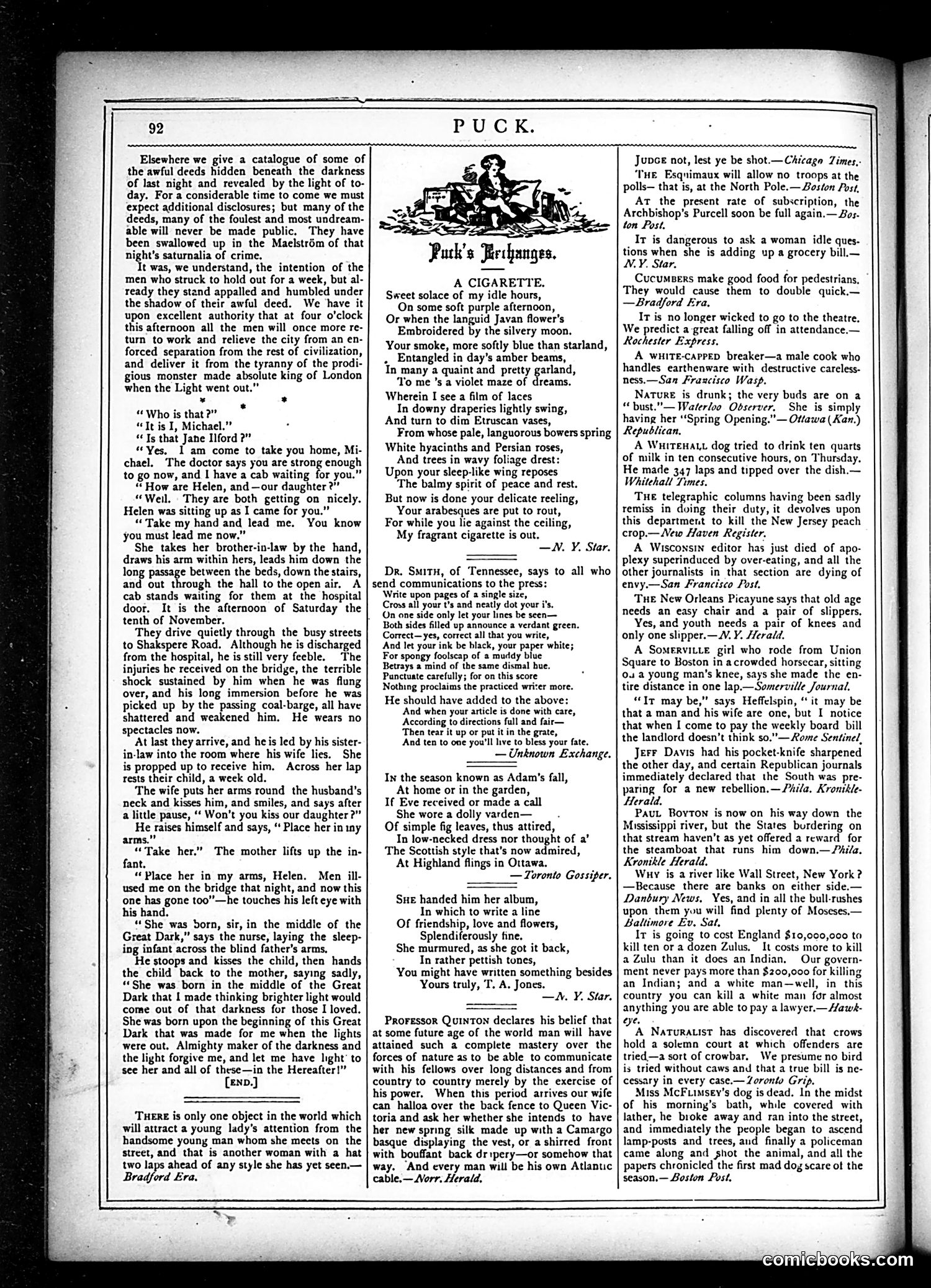
This page consists primarily of **short satirical items and poetry** rather than political cartoons. The centerpiece is "A Cigarette," a romantic poem about smoking. The scattered brief items mock various targets: - **Chicago Times** and **N.Y. Star** are criticized for editorial positions (one about women grocery shopping, another about theater attendance) - References to **Archbishop's Purcell** (likely about Catholic Church finances) - A **Tennessee doctor's** letter offering dubious writing advice - Various social commentary on pedestrian safety, theater etiquette, and newspaper columnists The page functions as **miscellaneous satirical commentary** on contemporary newspapers, social customs, and public figures rather than featuring identifiable political caricatures. The humor relies on wordplay and topical references that required readers' familiarity with specific newspapers and local scandals of the era.
📄 Transcribed text from this page (OCR, searchable)
Machine-transcribed from the original scan — historical spelling and the odd misread are preserved.
Elsewhere we give a catalogue of some of the awful deeds hidden beneath the darkness of last night and revealed by the light of to- day. For a considerable time to come we must expect additional disclosures; but many of the deeds, many of the foulest and most undream- able will never be made public, They have been swallowed up in the Maelstrém of that night's saturnalia of crime. it was, we understand, the intention of the men who struck to hold out for a week, but al- ready they stand appalled and humbled under the shadow of their awful deed. We ‘have it upon excellent authority that at four o'clock this afternoon all the men will once more re- turn to work and relieve the city from an en- forced separation from the rest of civilization, and deliver it from the tyranny of the prodi- gious monster made absolute king of London when the Light went out.” * . “Who is that?” “Te is I, Michael.” “Ts that Jane Ilford 2” “Yes. I am come to take you home, Mi- chael. The doctor says you are sree enough to go now, and I have a cab waiting for you.” “ How are Helen, and—our daughter 2” “Weil. They are both getting on nicely. Helen was sitting up as I came for you.” “Take my hand and lead me. You know you must lead me now.” She takes her brother-in-law by the hand, draws his arm within hers, leads him down the long passage between the beds, down the stairs, and out through the hall to the open air, A cab stands waiting for them at the hospital door. It is the afternoon of Saturday the tenth of November. They drive quietly through the busy streets to Shakspere Road. Although he is discharged from the hospital, he is still very feeble. The injuries he received on the bridge, the terrible shock sustained by him when he was flung over, and his long immersion before he was picked up by the passing coal-barge, all have shattered and weakened him. He wears no spectacles now. At last they arrive, and he is led by his sister- in-law into the room where his wife lies. She is propped up to receive him. Across her lap rests their child, a week old. The wife puts her arms round the husband’s neck and kisses him, and smiles, and says after a little pause, “ Won't you kiss our daughter 2” He raises himself and says, ‘* Place her in iny “Take her.” The mother lifts up the in- fant. “Place her in my arms, Helen. Men ill- used me on the bridge that night, and now this one has gone too”—he touches his left eye with his hand. “She was born, sir, in the middle of the Great Dark,” says the nurse, laying the sleep- ing infant across the blind father’s arms, He stoops and kisses the child, then hands the child back to the mother, saying sadly, “She was born in the middle of the Great Dark that 1 made thinking brighter light would come out of that darkness for those I loved. She was born upon the beginning of this Great Dark that was made for me when the lights were out. Almighty maker of the darkness and the light forgive me, and let me have light’ to see her and all of these—in the Hereafter!” [exp] Tuere is only one object in the world which will attract a young lady's attention from the handsome young man whom she mects on the street, and that is another woman with a hat two laps ahead of any style she has yet seen.— Bradford Era, A CIGARETTE, Sweet solace of my idle hours, On some soft purple afternoon, Or when the languid Javan flower's Embroidered by the silvery moon. Your smoke, more softly blue than starland, . Entangled in day’s amber beams, In many a quaint and Pretty garland, To me 's a violet maze of dreams. Wherein I see a film of laces In downy draperies lightly swing, And turn to dim Etruscan vases, From whose pale, languorous bowers spring White hyacinths and Persian roses, And trees in wavy foliage drest: Upon your sleep-like wing reposes The balmy spirit of peace and rest. But now is done your delicate reeling, Your arabesques are put to rout, For while you lie against the ceiling, My fragrant cigarette is out. —. Y. Star. Dr. Sait, of Tennessee, says to all who send communications to the press: Write upon pages of a single size, Cross all your t's and neatly dot your i's. On one side only let your lines be seen— Both sides filled up announce a verdant green. Correct—yes, correct all that you write, And let your ink be black, your paper white; For spongy foolscap of a muddy blue Betrays a mind of the same dismal hue. Punctuate carefully; for on this score Nothing proclaims the practiced writer more. He should have added to the above: And when your article is done with care, According to directions full and fair— ‘Then tear it up or put it in the grate, And ten to one you'll live to bless your fate. — Unknown Exchange. In the season known as Adam's fall, At home or in the garden, If Eve received or made a call She wore a dolly varden— Of simple fig leaves, thus attired, In low-necked dress nor thought of a’ The Scottish style that’s now admired, At Highland flings in Ottawa, —Toronto Gossiper. Sue handed him her album, In which to write a line Of friendship, love and flowers, Splendiferously fine, She murmured, as she got it back, In rather pettish tones, You might have written something besides Yours truly, T. A, Jones. —A”. Y. Star. Proressor Quinton declares his belief that at some future age of the world man will have attained such a complete mastery over the forces of nature as to be able to communicate with his fellows over long distances and from country to country merely by the exercise of his power. When this period arrives our wife can halloa over the back fence to Queen Vic- toria and ask her whether she intends to have her new spring silk made up with a Camargo basque displaying the vest, or a shirred front with bouffant back dripery—or somehow that way. ‘And every man will be his own Atlanuc cable.—Norr. Herald, Junce not, lest ye be shot.—Chicaga Zimes,- ‘THe Esqnimaux will allow no troops at the polls— that is, at the North Pole.— Boston Post, At the present rate of subscription, the Archbishop's Purcell soon be full again.— Bos. ton Post. Ir is dangerous to ask a woman idle ques- tions when she is adding up a grocery bill.— MY. Star. Cucumsers make good food for pedestrians, They would cause them to double quick.— —Bradford Era, Ir is no longer wicked to go to the theatre, We predict a great falling off in attendance.— Rochester Express, A _wHITE-cappeD breaker—a male cook who handles earthenware with destructive careless- ness.—San Fraxcisco Wasp. Nature is drunk; the very buds are on a “ bust.”"— Waterloo Observer, She is simply having her “Spring Opening.”— Ot/awa ( Kan.) Republican, A Wuirenatt dog tried to drink ten quarts of milk in ten consecutive hours, on Thursday. He made 347 laps and tipped over the dish.— Whitehall Times. Tue telegraphic columns having been sadly remiss in doing their duty, it devolves upon this department to kill the New Jersey peach crop.— New Haven Register. A Wisconsin editor has just died of apo- plexy superinduced by over-eating, and all the other journalists in that section are dying of envy.—San Francisco Post. Tne New Orleans Picayune says that old age needs an easy chair and a pair of slippers. Yes, and youth needs a pair of knees and only one slipper.—X. ¥. Herald. A Somervitte girl who rode from Union Square to Boston in a crowded horsecar, sitting Ou a young man’s knee, says she made the en- tire distance in one lap.—Somerville Journal, “It may be,” says Heffelspin, “it may be that a man and his wife are one, but I notice that when I come to pay the weekly board bill the landlord doesn’t think so."— ome Sentinel, Jerr Davis had his pocket-knife sharpened the other day, and certain Republican journals immediately declared that the South was pre- paring for a new rebellion.—/Aila. Krontkle- Herald. Paut Boyton is now on his way down the Mississippi river, but the States burdering on that stream haven't as yet offered a reward for the steamboat that runs him down,—/%i/a, Kronikle Herald. Wuy is a river like Wall Street, New York ? —Because there are banks on either side.— Danbury News, Yes, and in all the bull-rushes upon them you will find plenty of Moseses,— Baltimore Ev. Sat, Ir is going to cost England $10,000,000 ta kill ten or a dozen Zulus, It costs more to kill a Zulu than it docs an Indian, Our govern- ment never pays more than $200,000 for killing an Indian; and a white man—well, in this country you can kill a white man for almost anything you are able to pay a lawyer.— Hawk- oe. ar Naturatist has discovered that crows hold a solemn court at which offenders are tried—a sort of crowbar. We presume no bird is tried without caws and that a true bill is ne- cessary in every case.— Zoronto Grip. Miss McFiimsey’s dog is dead. In the midst of his morning’s bath, while covered with lather, he broke away and ran into the street, and immediately the people began to ascend lamp-posts and trees, aud finally a policeman came along and shot the animal, and all the papers chronicled the first mad dog scare of the season.— Boston Post,