
Puck, 1879-04-16 · page 6 of 16
Puck — April 16, 1879 — page 6: what you’re looking at
What you’re looking at
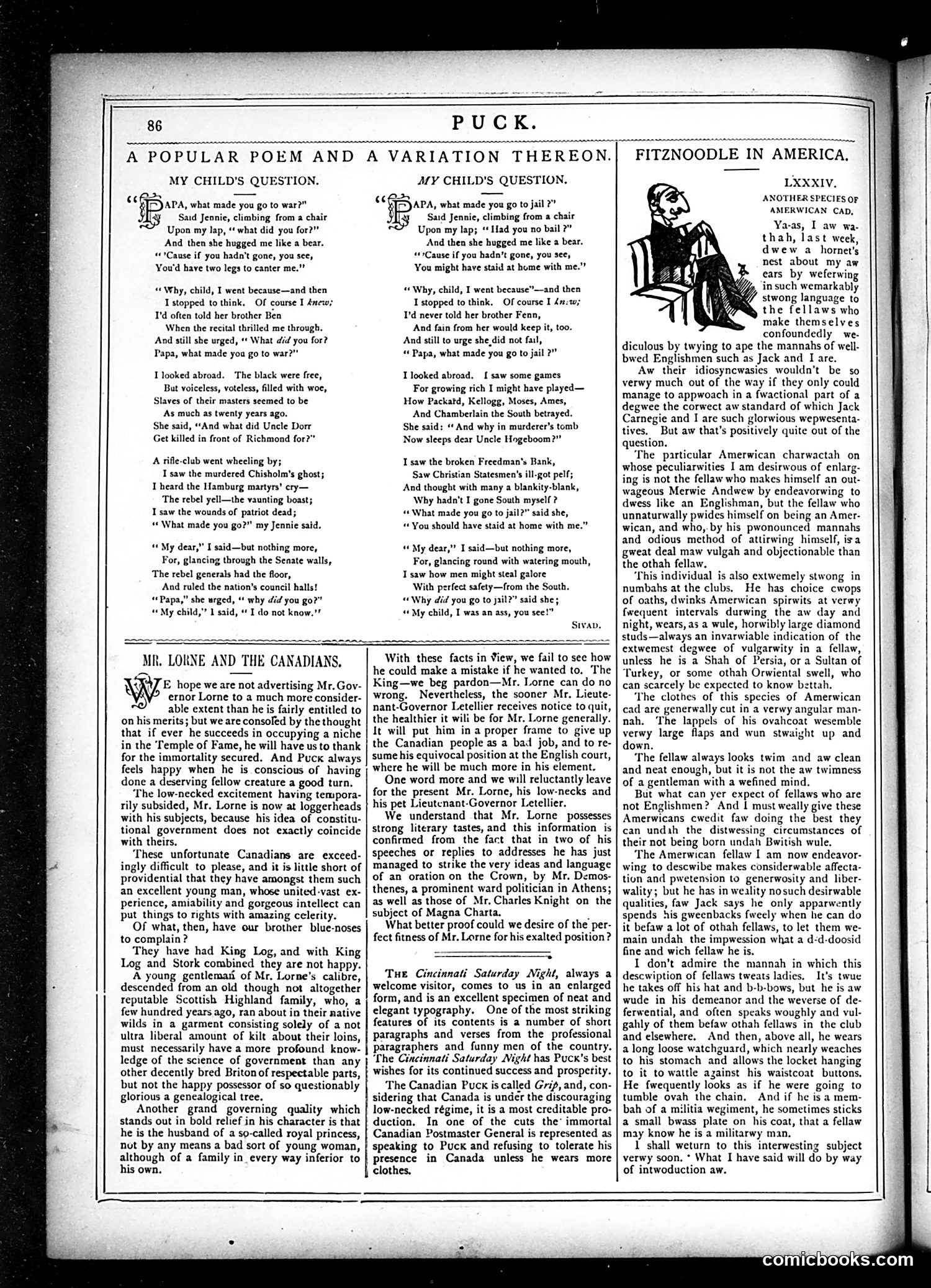
This page contains literary content rather than political cartoons. The main pieces are two variations of "My Child's Question"—poems contrasting a child asking a parent about going to war versus jail. Both poems use the child's innocent questions to critique political/military decisions. The right column features "Fitznoodle in America," which mocks a particular American character type—likely an Irish immigrant or buffoonish foreigner. The text describes him as vulgarly attempting to ape English mannerisms while embodying ridiculous pretensions. He's portrayed as looking "twin and aw clean" but fundamentally uncouth, with the piece satirizing his affected airs and social climbing. The "Mr. Lorne and the Canadians" section discusses Canadian political tensions, though specific figures aren't clearly identified in this excerpt.
📄 Transcribed text from this page (OCR, searchable)
Machine-transcribed from the original scan — historical spelling and the odd misread are preserved.
86 PUCK. A POPULAR POEM AND A VARIATION THEREON. MY CHILD'S QUESTION. 73 Pp aca = APA, what made you go to war? i Said Jennie, climbing from a chair Upon my lap, “ what did you for?” And then she hugged me like a bear. use if you hadn't gone, you see, You'd have two legs to canter me.”” “« Why, child, I went because—and then T stopped to think, Of course I Anew; I'd often told her brother Ben When the recital thrilled me through. And still she urged, “ What did you for? Papa, what made you go to war?” I looked abroad. The black were free, Bat voiceless, voteless, filled with woe, Slaves of their masters seemed to be As much as twenty years ago. She said, “And what did Uncle Dorr killed in front of Richmond for?” A rifle-club went wheeling by; I saw the murdered Chisholm’s ghost; I heard the Hamburg martyrs’ cry— The rebel yell—the vaunting boast; I saw the wounds of patriot dead; “What made you go2” my Jennie said. “« My dear,” I said—but nothing more, For, glancing through the Senate walls, The rebel generals had the floor, And ruled the nation’s council halls! “Papa,” she urged, “ why did you go?’ « My child,’” 1 said, «I do not know.’" MY CHILD'S QUESTION. “ee ae tosp ote ips what made you go to jail ? Y Said Jennie, climbing from a chair Upon my lap; “Had you no bail ?” And then she hugged me like a bear. ««*Cause if you hadn’t gone, you see, You might have staid at home with me.” “« Why, child, I went because”—and then I stopped to think. Of course I hv:t; I'd never told her brother Fenn, And fain from her would keep it, too. And still to urge she,did not fail, “Papa, what made you go to jail ?” T looked abroad. [ saw some games For growing rich I might have played— How Packatd, Kellogg, Moses, Ames, And Chamberlain the South betrayed. She said: “And why in murderer's tomb Now sleeps dear Uncle Hogeboom?”” I saw the broken Freedman’s Bank, Saw Christian Statesmen's ill-got pelf; ‘And thought with many a blankity-blank, ‘Why hadn't I gone South myself ? “What made you go to jail?" said she, “You should have staid at home with me.” «« My dear,” I said—but nothing more, For, glancing round with watering mouth, I saw how men might steal galore With perfect safety—from the South. “Why did you go to jail?” said she; «« My child, I was an ass, you see!” Sivav. hope we are not advertising Mr. Gov- MR. LORNE AND THE CANADIANS, Vv ernor Lorne to a much more consider- able extent than he is fairly entitled to on his merits; but we are consoled by the thought that if ever he succeeds in occupying a niche in the ‘Temple of Fame, he will have us to thank for the immortality secured. And Puck always feels happy when he is conscious of having done a deserving fellow creature a good turn. ‘The low-necked excitement having tempora- tily subsided, Mr. Lorne is now at loggerheads with his subjects, because his idea of constitu- tional government does not exactly coincide with theirs. These unfortunate Canadians are exceed- ingly difficult to please, and it is little short of providential that they have amongst them such an excellent young man, whose united-vast ex- perience, amiability and gorgeous intellect can put things to rights with amazing celerity. Of what, then, have our brother blue-noses to complain? They have had King Log, and with King Log and Stork combined they are not happy. A young gentlemai of Mr. Lorne’s calibre, descended from an old though not altogether reputable Scottish Highland family, who, a few hundred years ago, ran about in their native wilds in a garment consisting solely of a not ultra liberal amount of kilt about their loins, must necessarily have a more profound know- ledge of the science of government than any other decently bred Briton of respectable parts, but not the happy possessor of so questionably glorious a genealogical tree. Another grand governing quality which stands out in bold relief in his character is that he is the husband of a so-called royal princess, nut by any means a bad sort of young woman, although of a family in every way inferior to his own. With these facts in View, we fail to see how he could make a mistake if he wanted to. The King—we beg pardon—Mr. Lorne can do no wrong. Nevertheless, the sooner Mr. Lieute- nant-Governor Letellier receives notice to quit, the healthier it wili be for Mr. Lorne generally. It will put him ina proper frame to give up the Canadian people as a bad job, and to re- sume his equivocal position at the English court, where he will be much more in his element. One word more and we will reluctantly leave for the present Mr. Lorne, his low-necks and his pet Lieutenant-Governor Letellier. We understand that Mr. Lorne possesses strong literary tastes, and this information is confirmed from the fact that in two of his speeches or replies to addresses he has just managed to strike the very ideas and language of an oration on the Crown, by Mr. Demos- thenes, a prominent ward politician in Athens; as well as those of Mr. Charles Knight on the subject of Magna Charta. ; What better proof could we desire of the per- fect fitness of Mr. Lorne for his exalted position ? Tue Cincinnati Saturday Night, always a welcome visitor, comes to us in an enlarged form, and is an excellent specimen of neat and elegant typography. One of the most striking features of its contents is a number of short paragraphs and verses from the professional paragraphers and funny men of the country. ‘The Cincinnati Saturday Night has Puck's best wishes for its continued success and prosperity. The Canadian Puck is called Grif, and, con- sidering that Canada is under the discouraging low-necked régime, it is a most creditable pro- duction. In one of the cuts the’ immortal Canadian Postmaster General is represented as speaking to Puck and refusing to tolerate his presence in Canada unless he wears more clothes. FITZNOODLE IN AMERICA, LXXXIv. ANOTHER SPECIES OF AMERWICAN Cap, Ya-as, I aw wa. thah, last week, dwew a hornets nest about my aw ears by weferwing in such wemarkably stwong language to the fellaws who make themselves confoundedly we. diculous by twying to ape the mannahs of well- bwed Englishmen such as Jack and I are. Aw their idiosyncwasies wouldn't be so verwy much out of the way if they only could manage to appwoach in a fwactional part of a degwee the corwect aw standard of which Jack Carnegie and I are such glorwious wepwesenta- tives. But aw that’s positively quite out of the question, ‘The particular Amerwican charwactah on whose peculiarwities I am desirwous of enlarg- ing is not the fellaw who makes himself an out- wageous Merwie Andwew by endeavorwing to dwess like an Englishman, but the fellaw who unnaturwally pwides himself on being an Amer- wican, and who,.by his pwonounced mannahs and odious method of attirwing himself, isa gweat deal maw vulgah and objectionable than the othah fellaw, ‘This individual is also extwemely stwong in numbahs at the clubs. He has choice cwops of oaths, dwinks Amerwican spirwits at verwy fwequent intervals durwing the aw day and night, wears, as a wule, horwibly large diamond studs—always an invarwiable indication of the extwemest degwee of vulgarwity in a fellaw, unless he is a Shah of Persia, or a Sultan of Turkey, or some othah Orwiental swell, who can scarcely be expected to know bettah, ‘The clothes of this species of Amerwican cad are generwally cut in a verwy angular man- nah. The lappels of his ovahcoat wesemble verwy large flaps and wun stwaight up and down, ‘The fellaw always looks twim and aw clean and neat enough, but it is not the aw twimness of a gentleman with a wefined mind. But what can yer expect of fellaws who are not Englishmen? And L must weally give these Amerwicans cwedit faw doing the best they can undah the distwessing circumstances of their not being born undah Bwitish wule. [he Amerwican fellaw I am now endeavor- wing to descwibe makes considerwable affecta- tion and pwetension to generwosity and liber- wality; but he has in weality nosuch desirwable qualities, faw Jack says he only apparwently spends his gweenbacks fweely when he can do it befaw a lot of othah fellaws, to let them we- main undah the impwession what a d-d-doosid fine and wich fellaw he is, 1 don’t admire the mannah in which this descwiption of fellaws tweats ladies, It's twue he takes off his hat and b-b-bows, but he is aw wude in his demeanor and the weverse of de- ferwential, and often speaks woughly and vul- gahly of them befaw othah fellaws in the club and elsewhere. And then, above all, he wears a long loose watchguard, which nearly weaches to his stomach and allows the locket hanging to it to wattle against his waistcoat buttons, He fwequently looks as if he were going to tumble ovah the chain, And if he is a mem- bah of a militia wegiment, he sometimes sticks a small bwass plate on his coat, that a fellaw may know he is a militarwy man. I shall weturn to this interwesting subject verwy soon. * What I have said will do by way of intwoduction aw.