
A complete issue · 16 pages · 1879
Puck — February 19, 1879
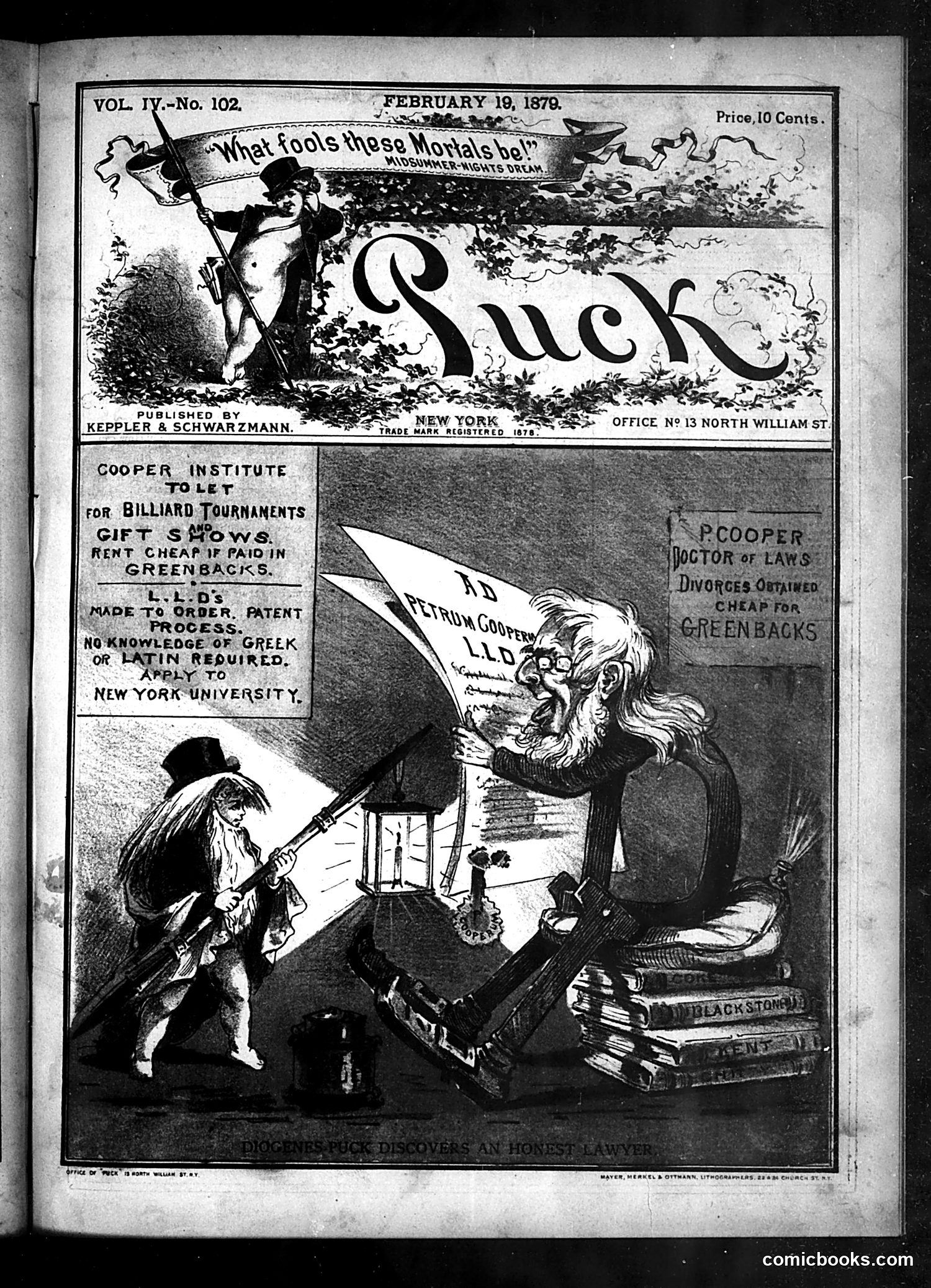
The main cartoon depicts an allegorical scene mocking the legal profession. A small figure (likely representing "Justice" or an honest person) confronts a large bearded man labeled "Pettifogging L.L.D." (a lawyer with questionable ethics). The figure carries a flag reading "Truth" while standing atop law books, suggesting an attempt to expose dishonest legal practices. The caption "Diogenes' Luck Discovers an Honest Lawyer" is satirical—referencing Diogenes' famous search for an honest man, implying honest lawyers are equally rare or impossible to find. The surrounding advertisements (divorce services, L.L.D. degrees requiring "no knowledge of Greek or Latin") reinforce the satire by highlighting actual contemporary legal abuses: easy credential-obtaining and divorce mill services that exploited customers without requiring genuine expertise.
This page is primarily **text-based content** rather than cartoons. It contains: 1. **"Puckerings"** - A humor column with short satirical quips about contemporary topics (gas bills, stage actresses, marriage, and social customs) 2. **"The Li-E-Derkranz"** - A lengthy article satirizing a German-American social club event, mocking its pretentious artistic presentation and the club's attempts to appear culturally sophisticated while maintaining "Anglo-American" business practices 3. **"Smiley's Gobbler"** - A humorous anecdote about winning a turkey at a saloon raffle 4. **Advertisements and notices** at the bottom The satire targets German-American social pretensions and the gap between Old World cultural aspirations and New World commercial realities—typical themes for Puck's immigrant community commentary. The overall tone is lighthearted mockery of social climbing and affectation.
This page contains two main articles: **"What We Eat and Drink"** critiques food safety in America, attacking politicians and customs officials for allowing adulterated and contaminated food into the national food supply. The author argues that inspection efforts are insufficient and sarcastically suggests poisoning government officials as a faster solution than relying on bureaucratic processes. The piece reflects Progressive-era concerns about food purity and corporate malfeasance. **"Cooper, LL.D."** celebrates P. Cooper's transition from glue-maker to lawyer and doctor of laws. The piece is celebratory, including Latin praise and congratulations from various contacts, mocking the ease with which honorary degrees could be obtained. The remainder consists of humorous "Rules in Rhymes for New Yorkers"—satirical verses about urban etiquette and behavior, likely poking fun at New York social conventions.
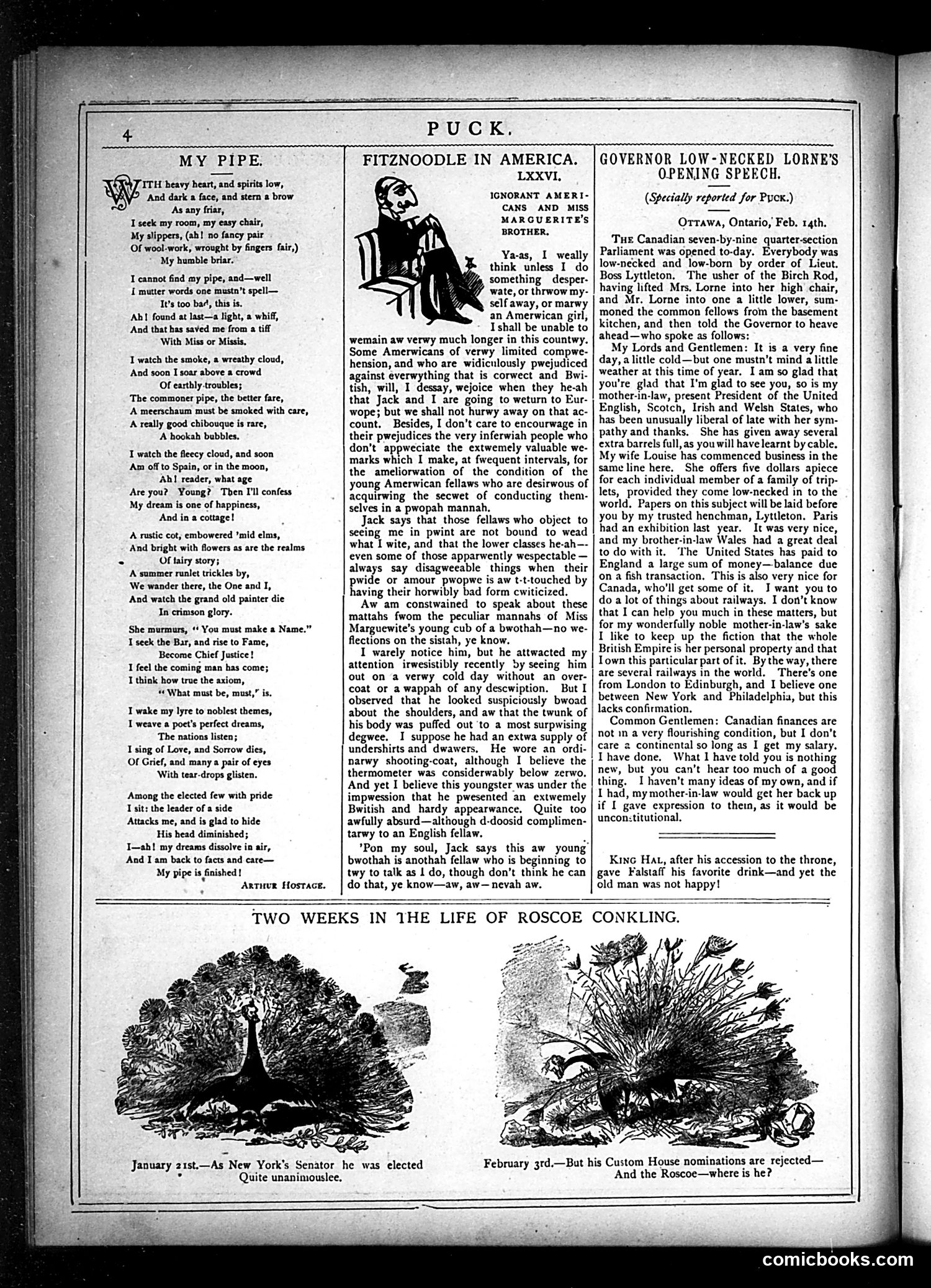
This page contains three satirical pieces from a late 19th-century issue: **"My Pipe"** (left): A poem by Arthur Horace, likely personal reflection rather than political satire. **"Fitznoodle in America"** (center): A humorous monologue by an Irishman visiting America, mocking both Irish immigrants and American pretensions. He complains about marrying an American girl, criticizes American manners and the lower classes, and expresses class anxiety—a common Puck theme targeting immigrant stereotypes. **"Governor Low-Necked Lorne's Opening Speech"** (right): Appears to reference a Canadian parliamentary opening, likely satirizing a specific politician or speech, though the exact historical figure requires verification. **"Two Weeks in the Life of Roscoe Conkling"** (bottom): Political cartoons about New York Senator Roscoe Conkling—January 21st shows his senatorial election; February 3rd shows his Custom House nominations rejected. This reflects real Gilded Age political conflict.
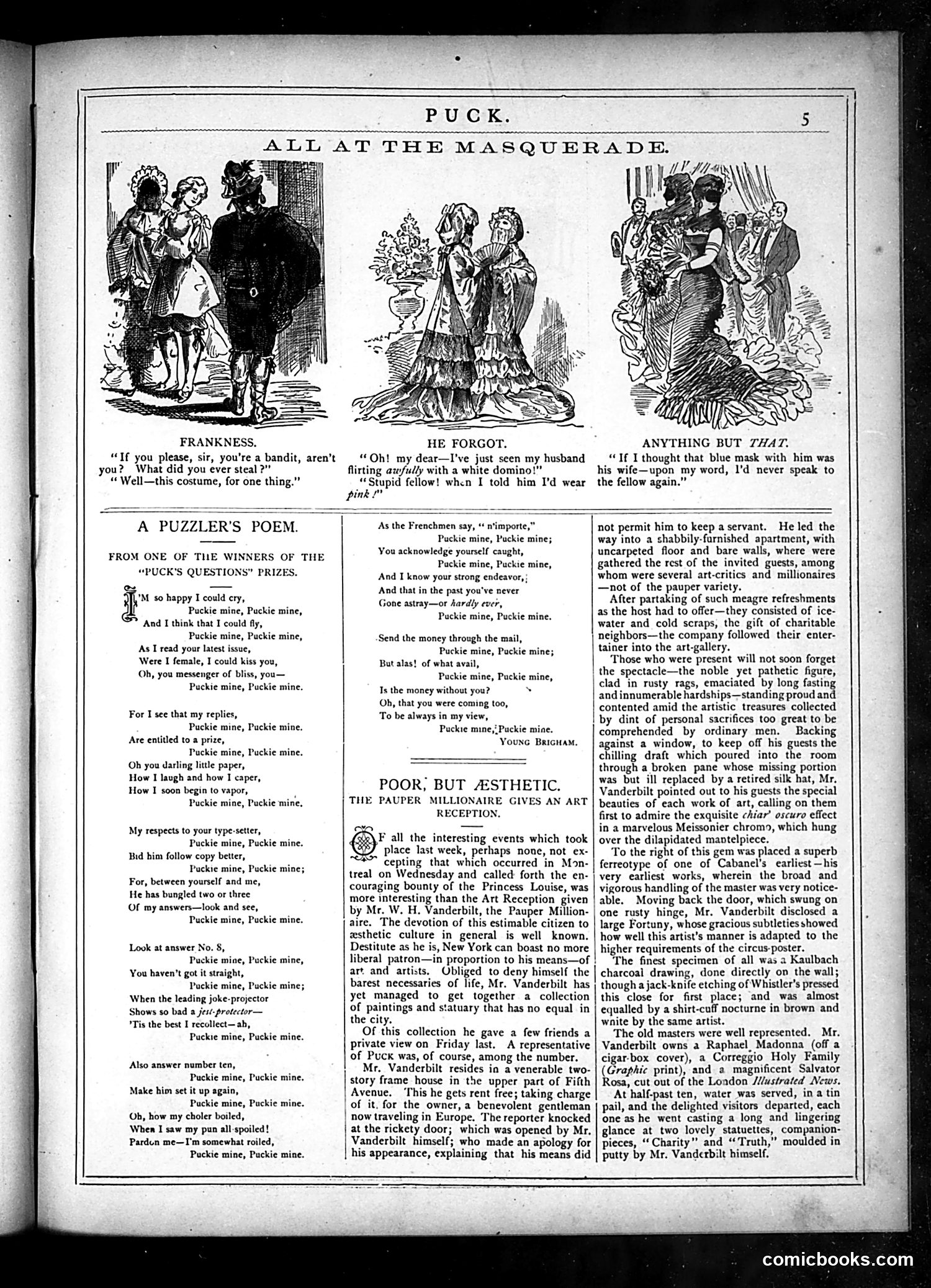
This page contains three satirical cartoons mocking attendees at a masquerade ball. The captions reveal social commentary: 1. **"Frankness"** - A bandit character boasts his costume is honest because he *is* a bandit, unlike masked guests hiding their true nature. 2. **"He Forgot"** - A husband arrives wearing a white domino mask, unaware his wife already knows about his infidelity. 3. **"Anything But That"** - A woman rejects a fellow wearing a blue mask, suggesting she recognizes him despite the disguise and wants to avoid his company. The cartoons satirize how masquerades supposedly conceal identity, yet social knowledge and reputation persist regardless. The humor targets hypocrisy and failed deceptions among the social elite attending such events.
This page contains political commentary and humor rather than visual cartoons. The main content is a "Speech of Hon. Esau Bulligatot on Negro Voters," a satirical piece mocking Republican political rhetoric during the 1880 election campaign. The satire ridicules Republican politicians who: - Claim credit for Black suffrage while offering nothing substantive - Use inflammatory language about Democrats and "the colored man" - Promise offices they cannot deliver - Dismiss Black voters' actual concerns The "Fiat Wisdom" section offers brief satirical observations on contemporary social issues. The overall tone suggests Puck's Democratic leanings, critiquing Republican hypocrisy toward Black constituents during the post-Reconstruction era.
This page from *Puck* magazine consists primarily of **"Puck's Questions"** — a reader-response column featuring humorous answers to submitted inquiries. Rather than political cartoons, the page contains illustrated vignettes accompanying witty responses to questions about social customs, animal behavior, and contemporary oddities. Notable examples include responses about: - The peculiar structure of a giraffe's neck - Why certain industries are "jocosely coupled with a purple field of gore" - Historical customs and their origins - Animal facts (rabbits being devoid of eyelids) The illustrations are small and decorative rather than the primary content. This appears to be a humor/advice column format typical of *Puck's* satirical approach—mocking pretension through absurdist answers to ostensibly earnest questions.
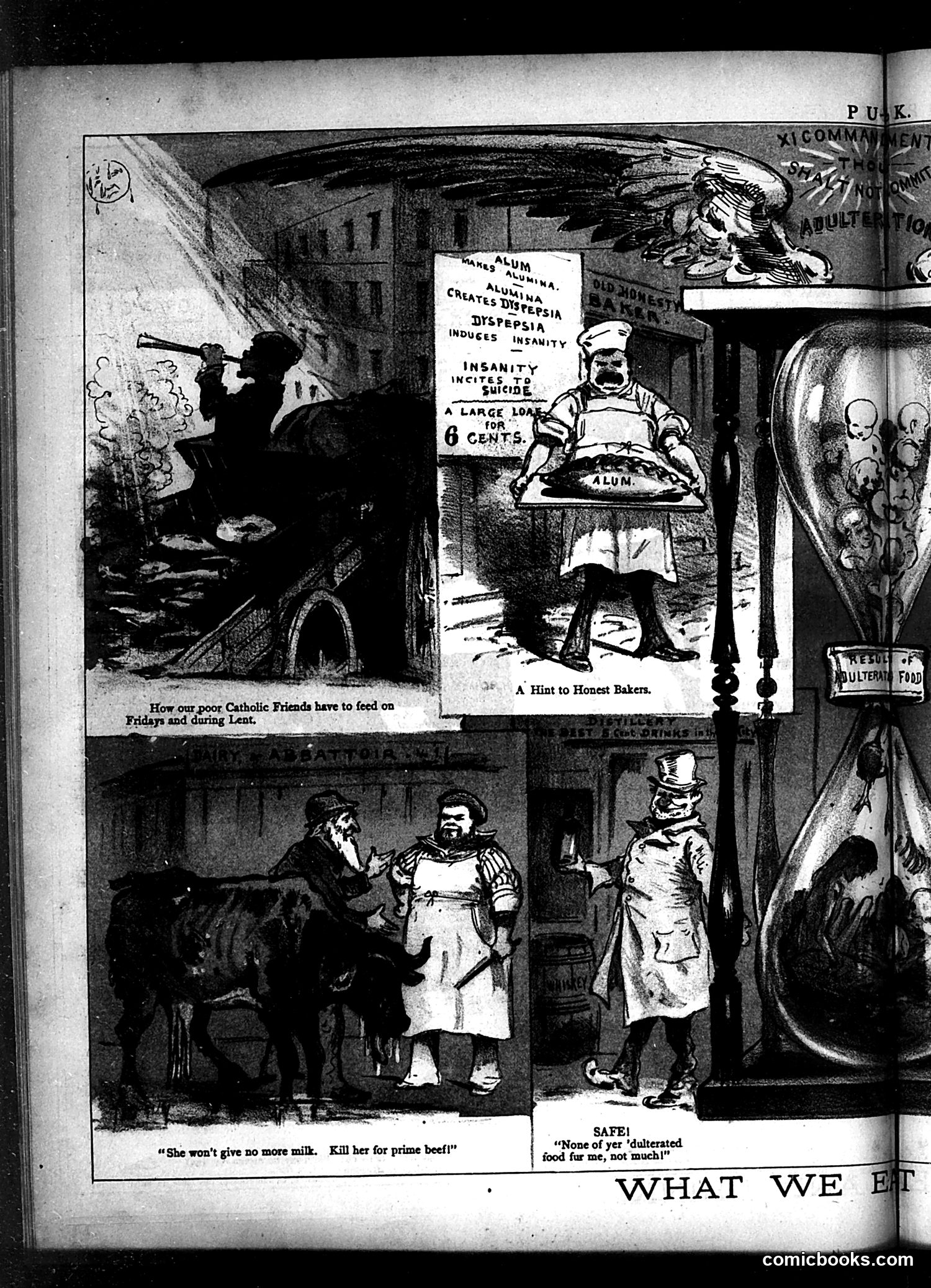
This page satirizes food adulteration and unsafe food practices in late 19th/early 20th-century America. The cartoons attack: 1. **Alum in bread**: The top panel mocks bakers adding alum (a chemical) to flour, which created health dangers including "dispepsia" and "insanity" according to period health concerns. 2. **Religious exploitation**: "How our poor Catholic friends have to feed on Fridays and during Lent" suggests sellers profited by marketing questionable products to Catholics observing dietary restrictions. 3. **Milk adulteration**: The bottom panel references concerns about contaminated or diluted milk, with the dark joke "kill her for prime beef." The page title "WHAT WE EAT" frames these as exposés of everyday food dangers. This reflects genuine Progressive Era concerns about food safety before federal regulation.
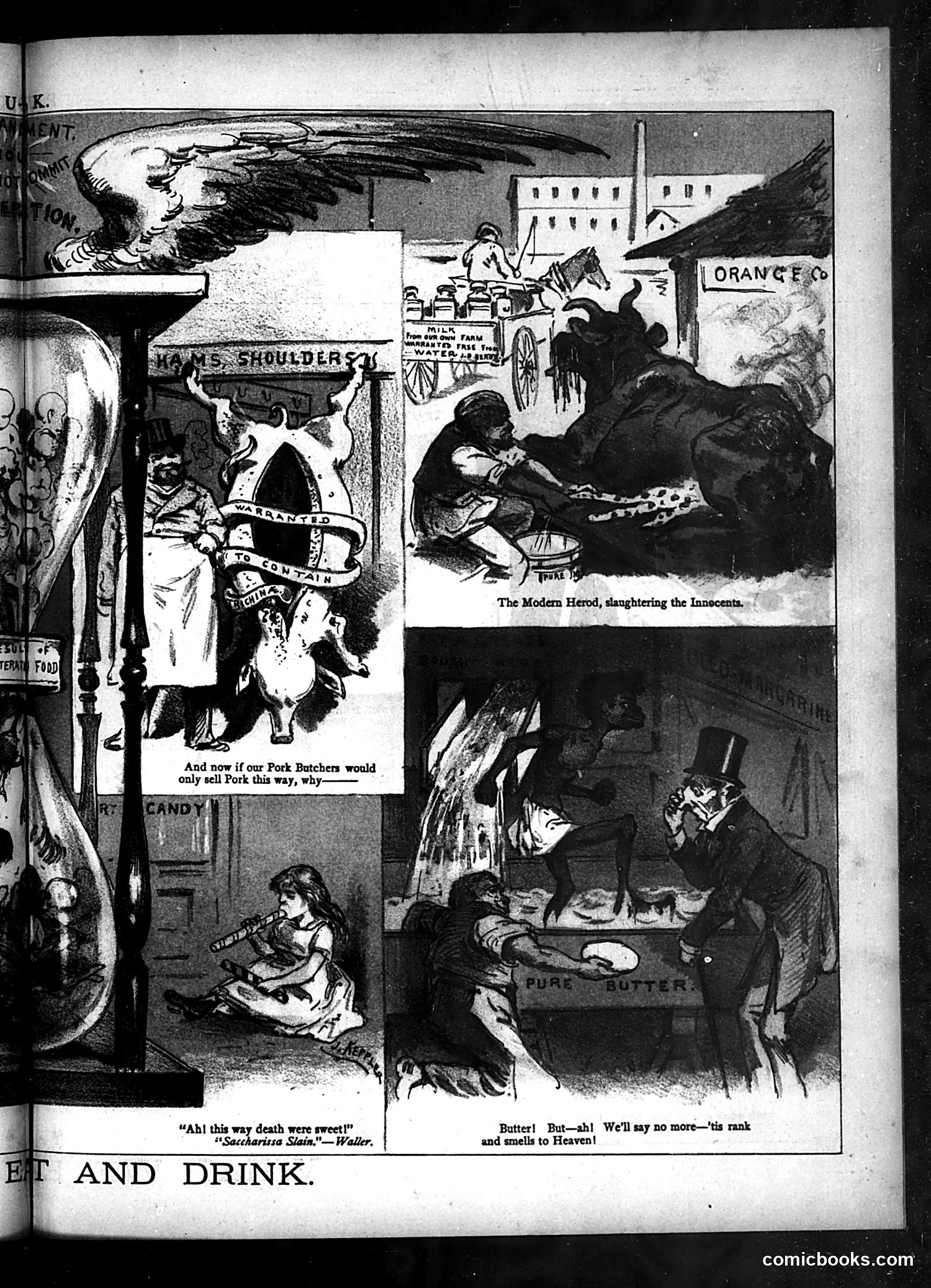
This page satirizes food safety and public health concerns, likely from the early 1900s. The top panel titled "The Modern Herod, slaughtering the Innocents" shows a figure brutally killing children—a biblical reference equating industrial food production to mass murder of innocents. The middle-left panel references "Pork Butchers" and contaminated meat sales, while lower panels show families consuming adulterated products labeled "Pure Butter," with a caption suggesting the butter's rank smell rivals death itself. The satire attacks unscrupulous food manufacturers and distributors who sold contaminated or mislabeled products to unsuspecting poor families. This appears connected to broader Progressive Era concerns about food safety and corporate exploitation of working-class consumers.
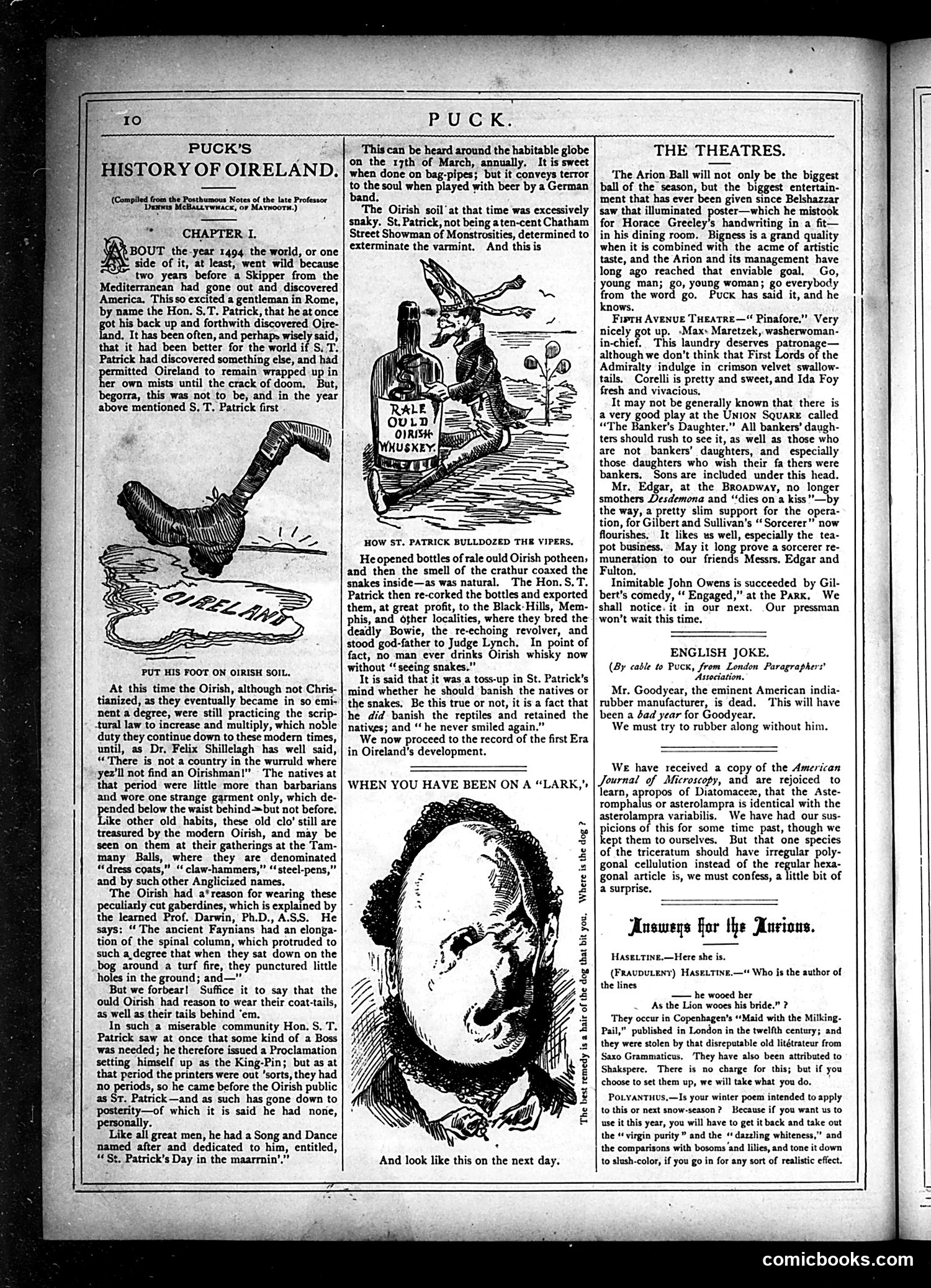
This page contains **"Puck's History of Ireland"** — a satirical historical article with illustrations. The main cartoon depicts **St. Patrick** driving snakes from Ireland, a legendary feat. The accompanying text ironically subverts this myth, claiming St. Patrick actually "bulldozed the vipers" by exporting bottles of Irish whiskey, which "coated the snakes" and made them drunk. The joke satirizes **Irish stereotypes about whiskey consumption** — suggesting the Irish themselves are the real "snakes" pacified by alcohol rather than miraculous intervention. The second illustration shows a hangover victim, captioned "And look like this on the next day," reinforcing the satirical point about whiskey's effects. The page also includes theater reviews and an "Answers for the Curious" section addressing unrelated topics.
This page contains the conclusion of a serialized short story rather than a political cartoon. The narrative follows Pascal Frénier, a man who has become a bankrupt and is psychologically deteriorated by his financial ruin and personal tragedies—particularly the murder of his lover, Marie, years earlier. The story explores how bankruptcy destroys a man's spirit and body. Pascal, now physically wasted and mentally tormented by memories, attempts suicide but survives. The text emphasizes how financial collapse and grief have reduced him to an almost living corpse—still breathing but spiritually dead, unable to escape the psychological chains of his past failures and losses.
This page is primarily text—a serialized story titled "The German Mission" by Sidney Lanier, appearing in Puck magazine. The story concerns a mysterious locked safe and financial intrigue involving characters named Marcel, Monsieur Pascal Fénis, and others in what appears to be a French household setting. The page contains no political cartoons or satirical imagery. Instead, it's a continuation of narrative fiction exploring themes of mystery, desperation, and hidden treasures. While Puck was known for satirical content, this particular page represents the magazine's literary section, offering serialized entertainment rather than political or social commentary. No specific historical figures or contemporary events are referenced in the visible text.
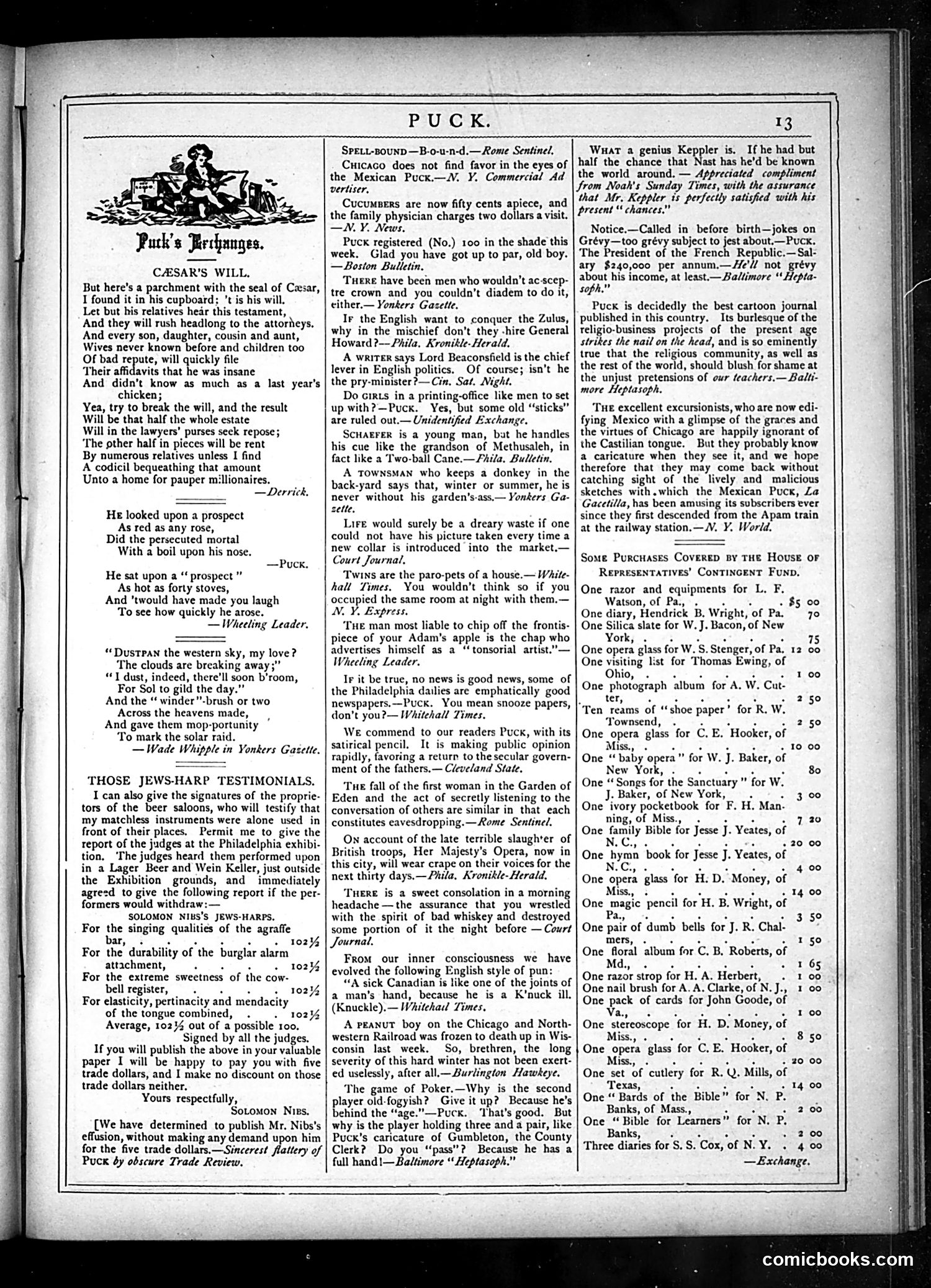
This page consists primarily of **"Puck's Persiflage,"** a humor column mixing jokes and satirical commentary, alongside extensive advertising sections. The main cartoon "Caesar's Will" appears to be a poem mocking inheritance and legal disputes—likely satirizing wealthy families squabbling over estates while hiring lawyers. The references to "relatives," "pauper millionaires," and legal complexities suggest Puck is ridiculing both the ultra-rich and the legal profession's role in their affairs. The remaining visible content is largely **classifieds and purchase notices** listing items ("opera glass," "slate," "dumb bells," "brush") donated to or purchased by the House of Representatives' Contingent Fund—suggesting either satire about congressional spending or actual administrative notices. The page's tone is typical Puck: irreverent, punching at wealth, lawyers, and presumably politicians.
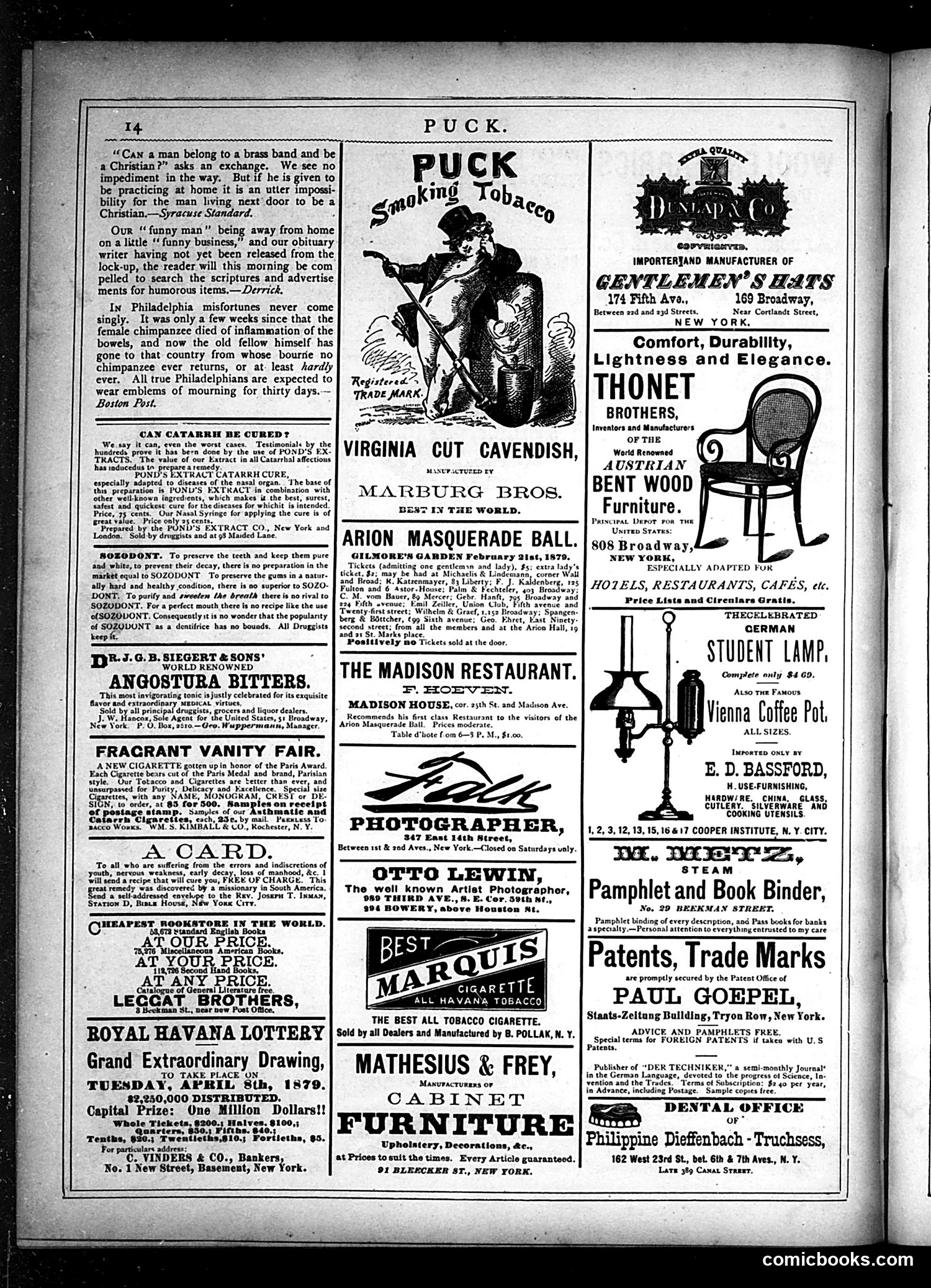
This is primarily an **advertisement page** rather than editorial content or political cartoons. The page features numerous commercial ads for products and services typical of late 19th-century New York, including: - Puck Smoking Tobacco (with a caricatured figure) - Dunlap & Co. gentlemen's hats - Thonet Brothers furniture - The Madison Restaurant - Photographers (Otto Lewin, Zack) - Best Marquis cigarettes - Mathesius & Frey cabinet furniture - Patent and trademark services - Various other vendors The decorative illustrations (a jaunty smoking figure, a bentwood chair, a student lamp) are typical commercial artwork of the era. There is no significant political or social satire visible on this page—it's a straightforward revenue page showcasing period advertisements.
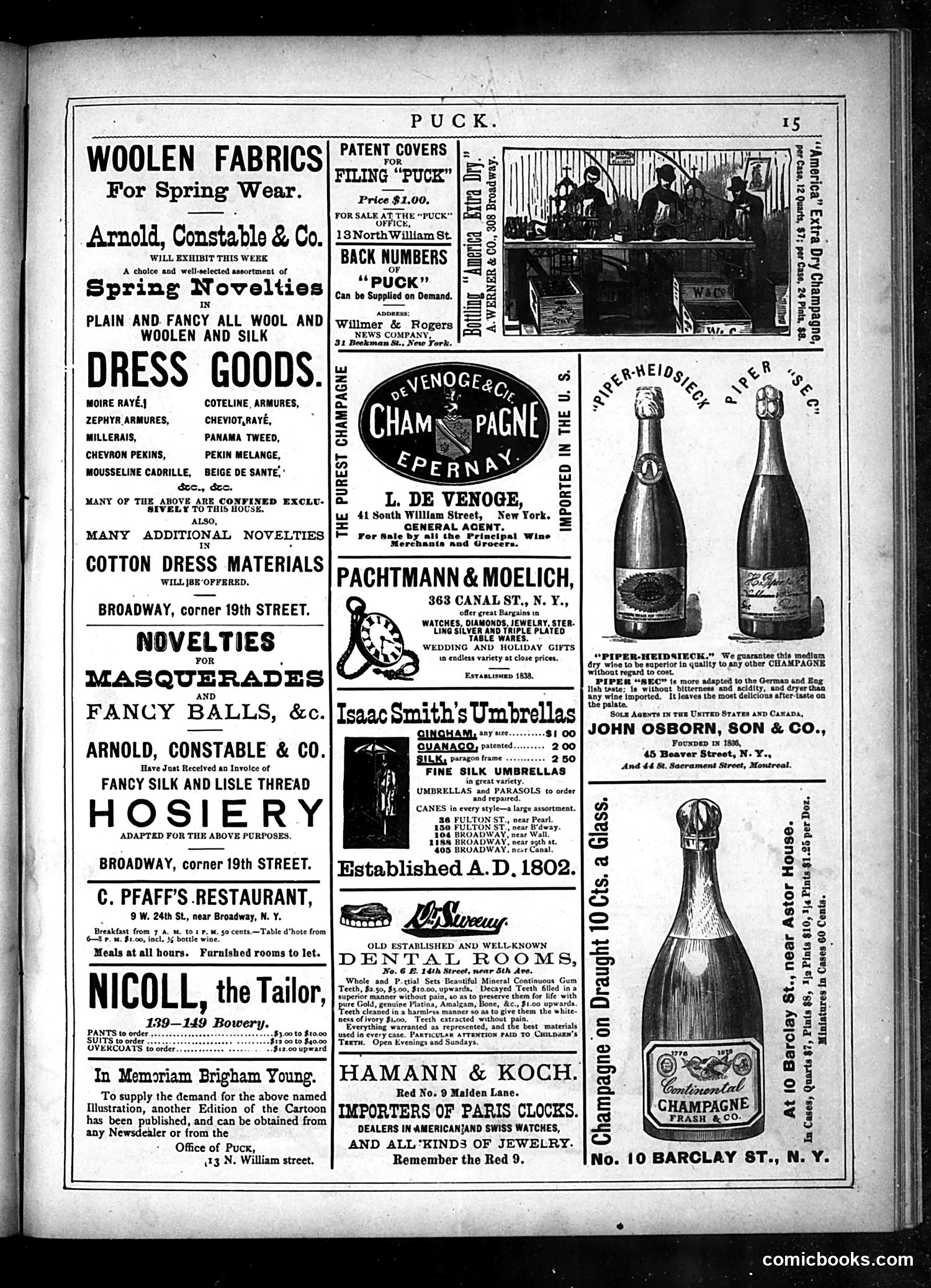
This is primarily an **advertising page** from Puck magazine, not a satirical cartoon page. It contains numerous commercial advertisements for late 19th-century products and services, including: - Woolen fabrics and dress goods (Arnold, Constable & Co.) - Champagne (Devenoge & Co.) - Umbrellas (Isaac Smith's) - Jewelry and watches (Pachtmann & Moelich, Hamann & Koch) - Dental services (Dr. Delehanty's Dental Rooms) - A tailor shop (Nicoll) - Various restaurants and other businesses The page also includes a note about a Brigham Young memorial cartoon edition. There are no obvious political satires or caricatures visible—this appears to be a standard advertising section from the magazine's back pages.
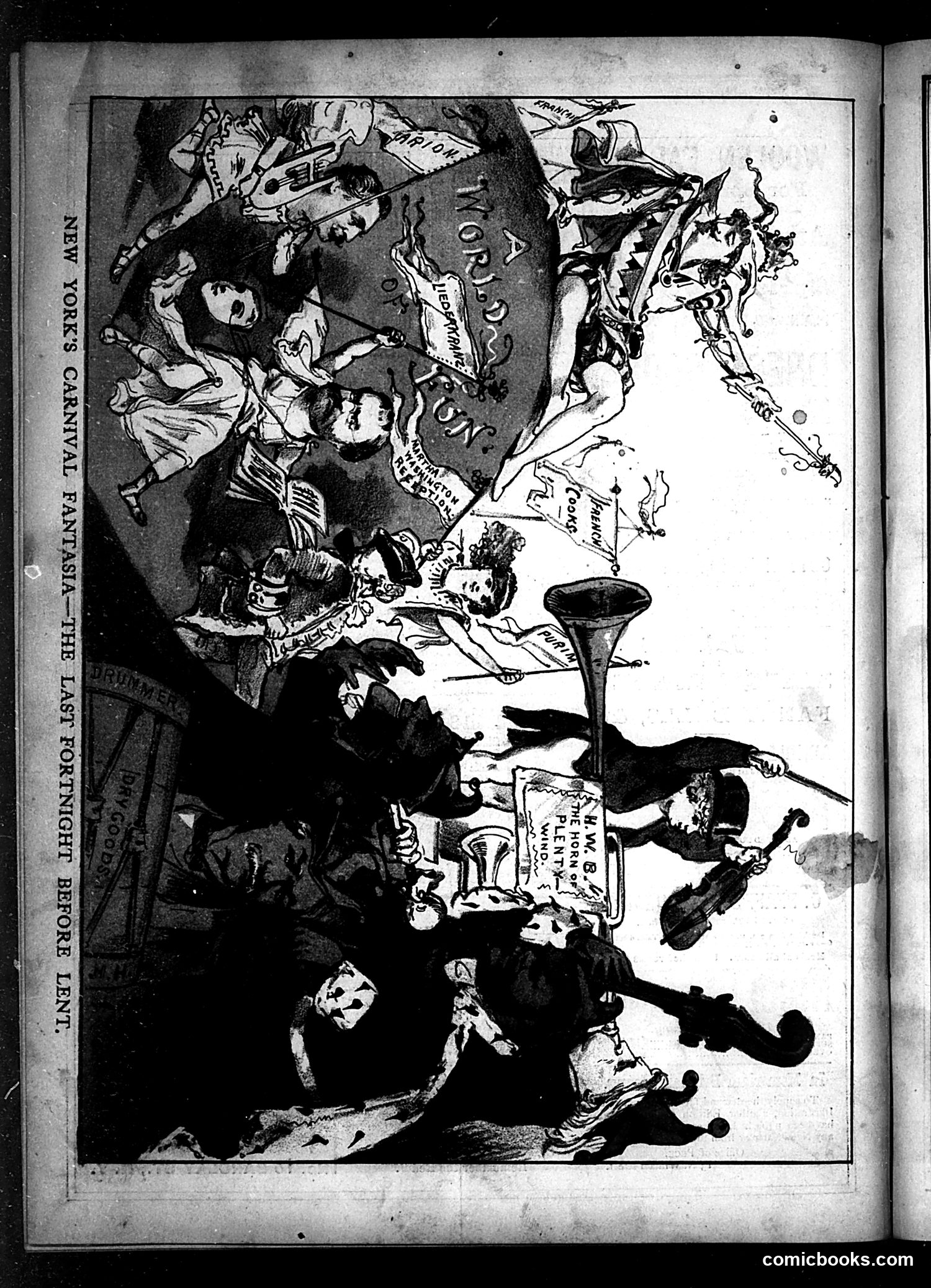
This is a satirical cartoon titled "New York's Carnival Fantasies: The Last Fortnight Before Lent" (text visible on left margin). The image depicts a chaotic carnival scene with multiple figures in revelry and excess. The composition is intentionally disorganized, showing people in various states of intoxication and merrymaking—drinking from glasses, playing musical instruments, and engaging in wild behavior. The satire appears to target New York's pre-Lenten carnival culture, mocking the city's wealthy and fashionable classes for their indulgent, frivolous behavior during this period. The crowded, hedonistic scene suggests criticism of excess and moral laxity before the supposed spiritual restraint of Lent. The caricatured figures and exaggerated poses emphasize the satirist's disapproval of such unconstrained celebration, likely appealing to Puck's readers who valued moral or social criticism.