
Puck, 1879-02-19 · page 11 of 16
Puck — February 19, 1879 — page 11: what you’re looking at
What you’re looking at
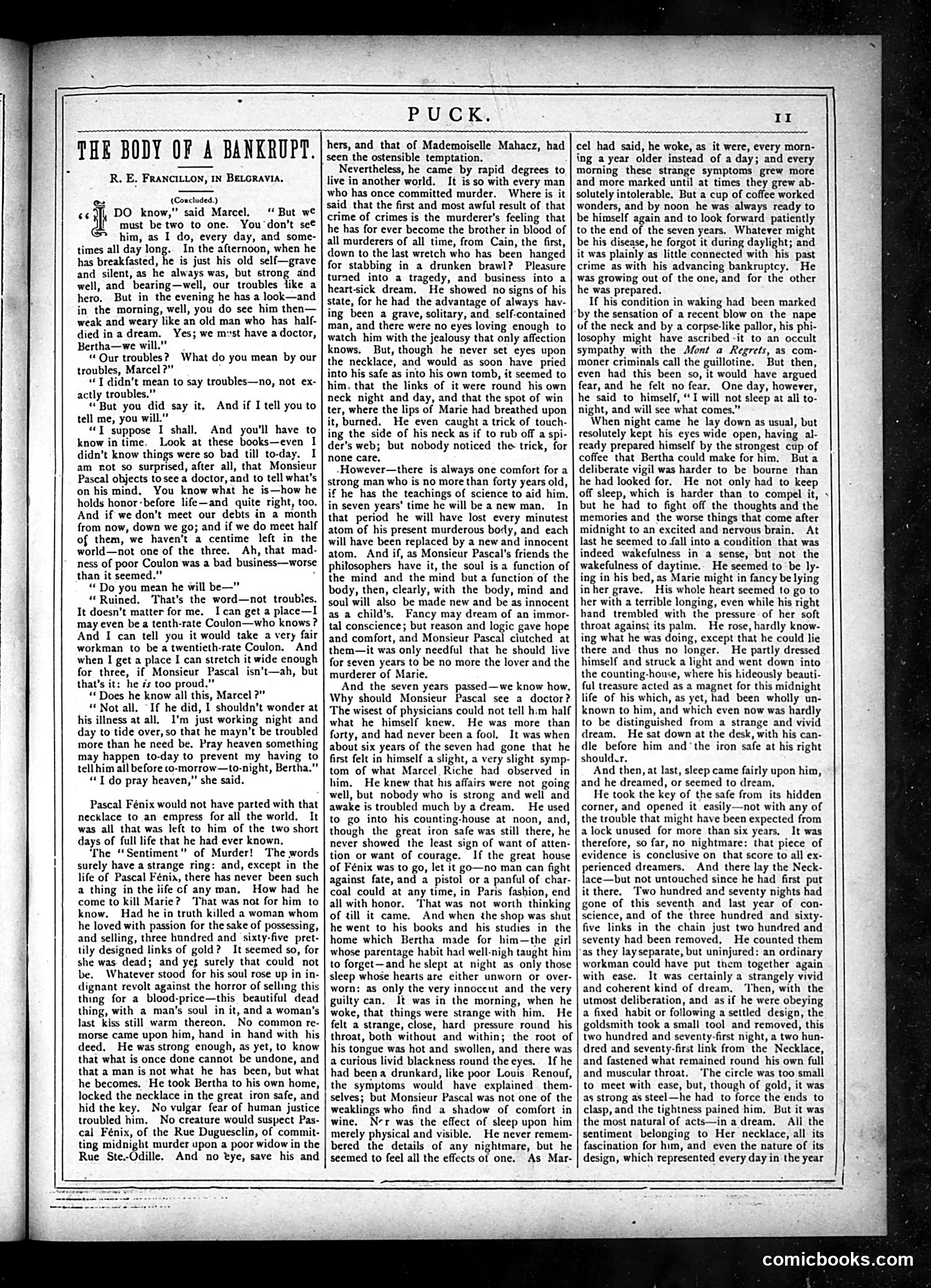
This page contains the conclusion of a serialized short story rather than a political cartoon. The narrative follows Pascal Frénier, a man who has become a bankrupt and is psychologically deteriorated by his financial ruin and personal tragedies—particularly the murder of his lover, Marie, years earlier. The story explores how bankruptcy destroys a man's spirit and body. Pascal, now physically wasted and mentally tormented by memories, attempts suicide but survives. The text emphasizes how financial collapse and grief have reduced him to an almost living corpse—still breathing but spiritually dead, unable to escape the psychological chains of his past failures and losses.
📄 Transcribed text from this page (OCR, searchable)
Machine-transcribed from the original scan — historical spelling and the odd misread are preserved.
PUCK. It THE BODY OF A BANKRUPT. R. E. FRANCILLON, IN BELGRAVIA, (Concluded.) ci DO know,” said Marcel, ‘ But we Bi must be two to one. You'don'’t se€ him, as I do, every day, and some- times all day dong In the afternoon, when he has breakfasted, he is just his old self—grave and silent, as he always was, but strong and well, and bearing—well, our troubles jike a hero. But in the evening he has a look—and in the morning, well, you do see him then— weak and weary like an old man who has half- died ina dream. Yes; we mst have a doctor, Bertha—we will.” “Our troubles? What do you mean by our troubles, Marcel ?” “I didn’t mean to say troubles—no, not ex- actly troubles.” «But you did say it. tell me, you will.” “1 suppose I shall, And you'll have to know in time. Look at these books—even I didn’t know things were so bad till to-day, I am not so surprised, after all, that Monsieur Pascal objects to see a doctor, and to tell what's on his mind, You know what he is—how he holds honor-before life—and quite right, too. And if we don’t meet our debts in a month from now, down we go; and if we do meet half of them, we haven't a centime left in the world—not one of the three. Ah, that mad- ness of poor Coulon was a bad business—worse than it seemed.” “Do you mean he will be—” “Ruined. ‘That's the word—not troubies. It doesn’t matter for me. I can get a place—I may even be a tenth-rate Coulon—who knows? And I can tell you it would take a very fair workman to be a twentieth-rate Coulon, And when I get a place I can stretch it wide enough for three, if Monsieur Pascal isn't—ah, but that's it: he #s too proud.” “Does he know all this, Marcel ?” “Not all. “If he did, I shouldn’t wonder at his illness at all. I'm just working night and day to tide over, so that he mayn’t be troubled more than he need be. Pray heaven something may happen to-day to prevent my having to tell him all before co-morrow—to-night, Bertha.” “I do pray heaven,” she said. And if I tell you to Pascal Fénix would not have parted with that necklace to an empress for all the world. It was all that was left to him of the two short days of full life that he had ever known, ‘The “Sentiment” of Murder! The words surely have a strange ring: and, except in the life of Pascal Fénia, there has never been such a thing in the life cf any man, How had he come to kill Marie? That was not for him to know. Had he in truth killed a woman whom he loved with passion for the sake of possessing, and selling, three hundred and sixty-five pret- tily designed links of gold? It seemed so, for she was. dead; and yeg surely that could not be. Whatever stood for his soul rose up in in- dignant revolt against the horror of selling this thing for a blood-price—this beautiful dead thing, with a man’s soul in it, and a woman's last kiss still warm thereon, No common re- morse came upon him, hand in hand with his deed. He was strong enough, as yet, to know that what is once done cannot be undone, and that a man is not what he has been, but what he becomes. He took Bertha to his own home, locked the necklace in the great iron safe, and hid the key. No vulgar fear of human justice troubled him. No creature would suspect Pas- cal Fénix, of the Rue Duguesclin, of commit- ting midnight murder upon a poor widow in the Rue Ste.-Odille. And no tye, save his and hers, and that of Mademoiselle Mahacz, had seen the ostensible temptation. Nevertheless, he came by rapid degrees to live in another world. It is so with every man who has once committed murder. Where is it said that the first and most awful result of that crime of crimes is the murderer’s feeling that he has for ever become the brother in blood of all murderers of all time, from Cain, the first, down to the last wretch who has been hanged for stabbing in a drunken brawl? Pleasure turned into a tragedy, and business into a heart-sick dream. He showed no signs of his state, for he had the advantage of always hav- ing been a grave, solitary, and self-contained man, and there were no eyes loving enough to watch him with the jealousy that only affection knows. But, though he never set eyes upon the necklace, and would as soon have pried into his safe as into his own tomb, it seemed to him. that the links of it were round his own neck night and day, and that the spot of win ter, where the lips of Marie had breathed upon it, burned. He even caught a trick of touch- ing the side of his neck as if to rub off a spi- der’s web; but nobody noticed the trick, for none care. However—there is always one comfort for a strong man who is no more than forty years old, if he has the teachings of science to aid him. in seven years’ time he will be a new man. In that period he will have lost every minutest atom of his present murderous body, and each will have been replaced by a new and innocent atom, And if, as Monsieur Pascal's friends the phitosophers have it, the soul isa function of the mind and the mind but a function of the body, then, clearly, with the body, mind and soul will also be made new and be as innocent as a child's. Fancy may dream of an immor- tal conscience; but reason and logic gave hope and comfort, and Monsieur Pascal clutched at them—it was only needful that he should live for seven years to be no more the lover and the murderer of Marie. And the seven years passed—we know how. Why should Monsieur Pascal see a doctor? The wisest of physicians could not tell him half what he himself knew. He was more than forty, and had never been a fool. It was when about six years of the seven had gone that he first felt in himself a slight, a very slight symp- tom of what Marcel Riche had observed in him. He knew that his affairs were not going well, but nobody who is strong and well and awake is troubled much by a cream. He used to go into his counting-house at noon, and, though the great iron safe was still there, he never showed the least sign of want of atten- tion or want of courage. If the great house of Fénix was to go, let it go—no man can fight against fate, and a pistol or a panful of char- coal could at any time, in Paris fashion, end all with honor. ‘That was not worth thinking of till it came. And when the shop was shut he went to his books and his studies in the home which Bertha made for him—the girl whose parentage habit had well-nigh taught him to forget—and he slept at night as only those sleep whose hearts are either unworn or over- worn: as only the very innoceut and the very guilty can. it was in the morning, when he woke, that things were strange with him. He felt a strange, close, hard pressure round his throat, both without and within; the root of his tongue was hot and swollen, and there was a curious livid blackness round the eyes. If he had beena drunkard, like poor Louis Renouf, the symptoms would have explained them- selves; but Monsieur Pascal was not one of the weaklings who find a shadow of comfort in wine. Ner was the effect of sleep upon him merely physical and visible. He never remem- bered the details of any nightmare, but he seemed to feel all the effects of one. As Mar- cel had said, he woke, as it were, every morn- ing a year older instead of a day; and every morning these strange symptoms grew more and more marked until at times they grew ab- solutely intolerable, But a cup of coffee worked wonders, and by noon he was always ready to be himself agnin and to look forward patiently to the end of the seven years. Whatever might be his disease, he forgot it during daylight; and it was plainly as little connected with his past crime as with his advancing bankruptcy. He was growing out of the one, and for the other he was prepared. If his condition in waking had been marked by the sensation of a recent blow on the nape of the neck and by a corpse-like pallor, his phi- losophy might have ascribed -it to an occult sympathy with the Afont a Regrets, as com- moner criminals call the guillotine. But then, even had this been so, it would have argued fear, and he felt no fear. One day, however, he said to himself, “I will not sleep at all to- night, and will see what comes.” When night came he lay down as usual, but resolutely kept his eyes wide open, having al- ready prepared himself by the strongest cup of coffee that Bertha could make for him, Buta deliberate vigil was harder to be bourne than he had looked for. He not only had to keep off sleep, which is harder than to compel it, but he had to fight off the thoughts and the memories and the worse things that come after midnight to an excited and nervous brain. At last he seemed to fall into a condition that was indeed wakefulness in a sense, but not the wakefulness of daytime. He seemed to be ly- ing in his bed, as Marie might in fancy be lying inher grave. His whole heart seemed to go to her with a terrible longing, even while his right hand trembled with the pressure of her soft throat against its palm. He rose, hardly know- ing what he was doing, except that he could lie there and thus no longer. He partly dressed himself and struck a light and went down into the counting-house, where his hideously beauti- ful treasure acted as a magnet for this midnight life of his which, as yet, had been wholly un- known to him, and which even now was hardly to be distinguished from a strange and vivid dream. He sat down at the desk, with his can- dle before him and ‘the iron safe at his right shoulder, And then, at last, sleep came fairly upon him, and he dreamed, or seemed to dream, He took the key of the safe from its hidden corner, and opened it easily—not with any of the trouble that might have been expected from a lock unused for more than six years, It was therefore, so far, no nightmare: that piece of evidence is conclusive on that score to all ex- perienced dreamers. And there lay the Neck- lace—but not untouched since he had first put it there, Two hundred and seventy nights had gone of this seventh and last year of con- science, and of the three hundred and sixty- five links in the chain just two hundred and seventy had been removed, He counted them as they layseparate, but uninjured: an ordinary workman could have put them together again with ease. It was certainly a strangely vivid and coherent kind of dream, ‘hen, with the utmost deliberation, and as if he were obeying a fixed habit or following a settled design, the goldsmith took a small tool and removed, this two hundred and seventy-first night, a two hun- dred and seventy-first link from the Necklace, and fastened what remained round his own full and muscular throat. ‘The circle was too small to meet with ease, but, though of gold, it was as strong as steel—he had to force the ends to clasp, and the tightness pained him, But it was the most natural of acts—in a dream, All the sentiment belonging to Her necklace, all its fascination for him, and even the nature of its design, which represented every day in the year comicbooks.com