
Puck, 1879-02-19 · page 5 of 16
Puck — February 19, 1879 — page 5: what you’re looking at
What you’re looking at
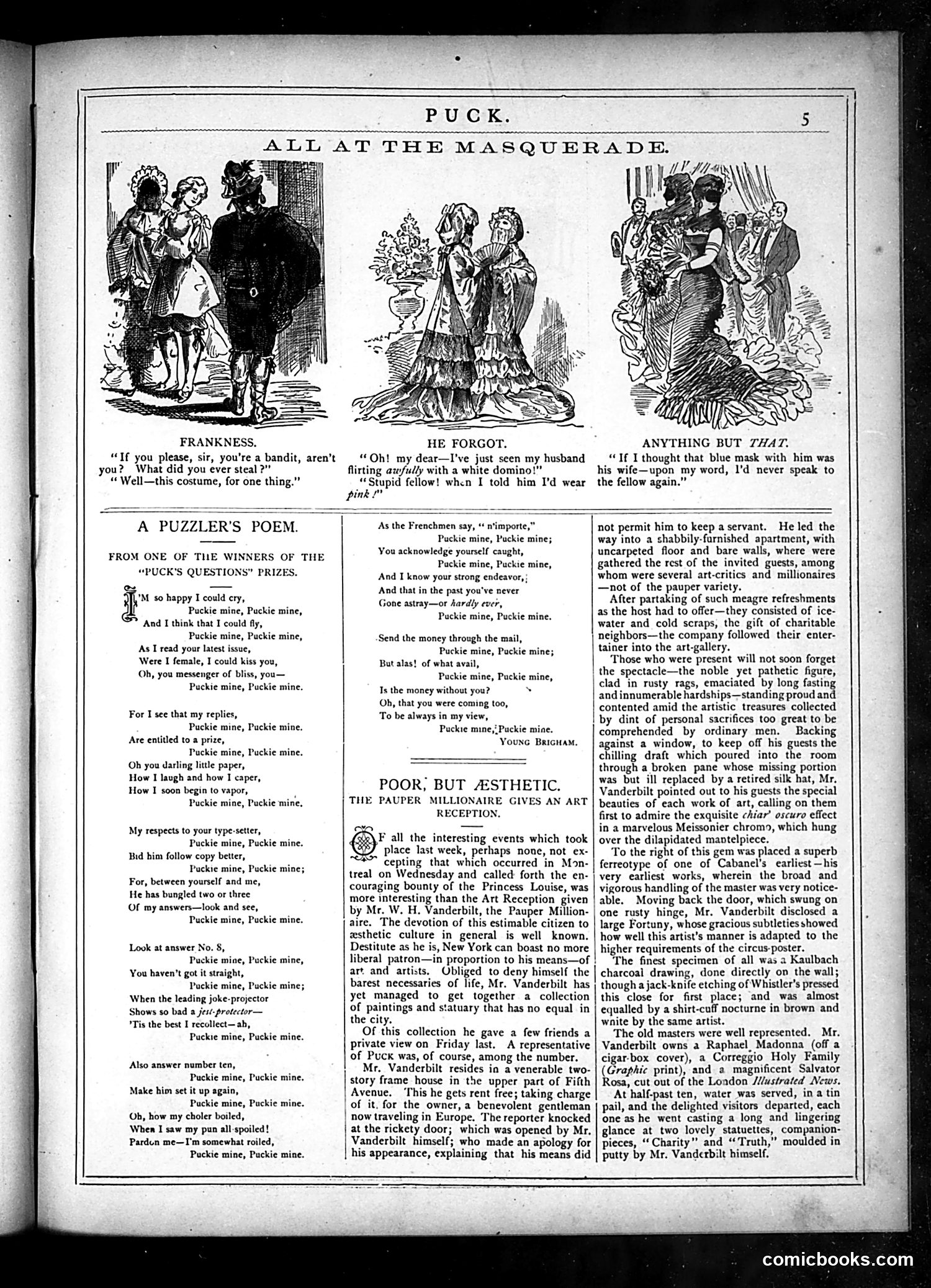
This page contains three satirical cartoons mocking attendees at a masquerade ball. The captions reveal social commentary: 1. **"Frankness"** - A bandit character boasts his costume is honest because he *is* a bandit, unlike masked guests hiding their true nature. 2. **"He Forgot"** - A husband arrives wearing a white domino mask, unaware his wife already knows about his infidelity. 3. **"Anything But That"** - A woman rejects a fellow wearing a blue mask, suggesting she recognizes him despite the disguise and wants to avoid his company. The cartoons satirize how masquerades supposedly conceal identity, yet social knowledge and reputation persist regardless. The humor targets hypocrisy and failed deceptions among the social elite attending such events.
📄 Transcribed text from this page (OCR, searchable)
Machine-transcribed from the original scan — historical spelling and the odd misread are preserved.
ALL AT THE MASQUERADE. FRANKNESS, “If you please, sir, you're a bandit, aren't you? What did you ever steal ?” “ Well—this costume, for one thing.” A PUZZLER’S POEM. | FROM ONE OF THE WI ‘RS OF THE “PUCK'S QUESTIONS” PRIZES. as i so happy I could cry, Puckie mine, Puckie mine, And I think that I could fly, Packie mine, Puckie mine, As I read your latest issue, Were I female, I could kiss you, Ob, you messenger of bliss, you— Packie mine, Puckie mine. For I see that my replies, Packie mine, Puckie mine. Are entitled to a prize, Puckie mine, Puckie mine. ‘Ob you darling little paper, How I laugh and how I caper, How I soon begin to vapor, : Puckie mine, Puckie mine, My respects to your type-setter, Puckie mine, Puckie mine. Bid him follow copy better, Puckie mine, Puckie mine; For, between yourself and me, He has bungled two or three Of my answers—look and see, Puckie mine, Puckie mine. Look at answer No. 8, Packie mine, Puckie mine, You haven't got it straight, Puckie mine, Puckie mine; When the leading joke: projector Shows so bad a jest-protector— ‘Tis the best I recollect—ab, Puckie mine, Puckie mine. Also answer number ten, Puckie mine, Puckie mine, Make him set it up again, Packie mine, Packie mine. Ob, how my choler boiled, ‘When I saw my pun all-spoiled! Pardon me—I'm somewhat roiled, Packie mine, Puckie mine. HE FORGOT. “Oh! my dear—I’ve just seen my husband flirting awfully with a white domino!” “Stupid fellow! when I told him I'd wear pink!” Le iM] ANYTHING BUT 7HAT7. “If I thought that blue mask with him was his wife—upon my word, l’d never speak to the fellow again.” As the Frenchmen say, “ n'importe,” Packie mine, Puckie mine; You acknowledge yourself caught, Packie mine, Puckie mine, And I know your strong endeavor, And that in the past you've never Gone astray—or hardly ever, Packie mine, Puckie mine. Send the money through the mail, Puckie mine, Packie mine; But alas! of what avail, Packie mine, Puckie mine, Is the money without you? . Oh, that you were coming too, To be always in my view, Puckte mine,:Puckie mine. Younc BricHam. POOR, BUT AESTHETIC. THE PAUPER MILLIONAIRE GIVES AN ART RECEPTION, of F all the interesting events which took place last week, perhaps none, not ex- 4 cepting that which occurred in Mon- treal on Wednesday and called: forth the en- couraging bounty of the Princess Louise, was more interesting than the Art Reception given by Mr. W. H. Vanderbilt, the Pauper Million- aire. The devotion of this estimable citizen to wsthetic culture in general is well known. Destitute as he is, New York can boast no more liberal patron—in proportion to his means—of ! art and artists. Obliged to deny himself the barest necessaries of life, Mr. Vanderbilt has yet managed to get together a collection of paintings and statuary that has no equal in the city. Of this collection he gave a few friends a private view on Friday last. A representative of Puck was, of course, among the number. Mr. Vanderbilt resides in a venerable two- story frame house in the upper part of Fifth Avenue. ‘This he gets rent free; taking charge of it, for the owner, a benevolent gentleman now traveling in Europe. The reporter knocked at the rickety door; which was opened by Mr. Vanderbilt himself; who made an apology for his appearance, explaining that his means did not permit him to keep aservant. He led the way into a shabbily-farnished apartment, with uncarpeted floor and bare walls, where were gathered the rest of the invited guests, among whom were several art-critics and millionaires —not of the pauper variety. After partaking of such meagre refreshments as the host had to offer—they consisted of ice- water and cold scraps, the gift of charitable neighbors—the company followed their enter- tainer into the art-gallery. Those who were present will not soon forget | the spectacle—the noble yet pathetic figure, clad in rusty rags, emaciated by long fastin, and innumerabletardships--standing proud and contented amid the artistic treasures collected by dint of personal sacrifices too great to be comprehended by ordinary men. Backing against a window, to keep off his guests the chilling draft which poured into the room through a broken pane whose missing portion was but ill replaced by a retired silk hat, Mr, Vanderbilt pointed out to his guests the special beauties of each work of art, calling on them first to admire the exquisite chiar’ oscuro effect in a marvelous Meissonier chromo, which hung over the dilapidated mantelpiece. To the right of this gem was placed a superb ferreotype of one of Cabanel’s earliest —his very earliest works, wherein the broad and vigorous handling of the master was very notice- able. Moving back the door, which swung on one rusty hinge, Mr. Vanderbilt disclosed a large Fortuny, whose gracious subtleties showed how well this artist’s manner is adapted to the higher requirements of the circus-poster. ‘The finest specimen of all was a Kaulbach charcoal drawing, done directly on the wall; though a jack-knife etching of Whistler's pressed this close for first place; and was almost equalled by a shirt-cuff nocturne in brown and wnite by the same artist. The old masters were well represented. Mr. Vanderbilt owns a Raphael, Madonna (off a cigar-box cover), a Correggio Holy Family (Graphic print), and a magnificent Salvator Rosa, cut out of the London //ustrated News. At half-past ten, water was served, ina tin pail, and the delighted visitors departed, each one as he went casting a long and lingering glance at two lovely statuettes, companion- pieces, “Charity” and “Truth,” moulded in putty by Mr. Vanderbilt himself. comicbooks.com