
Puck, 1879-02-19 · page 12 of 16
Puck — February 19, 1879 — page 12: what you’re looking at
What you’re looking at
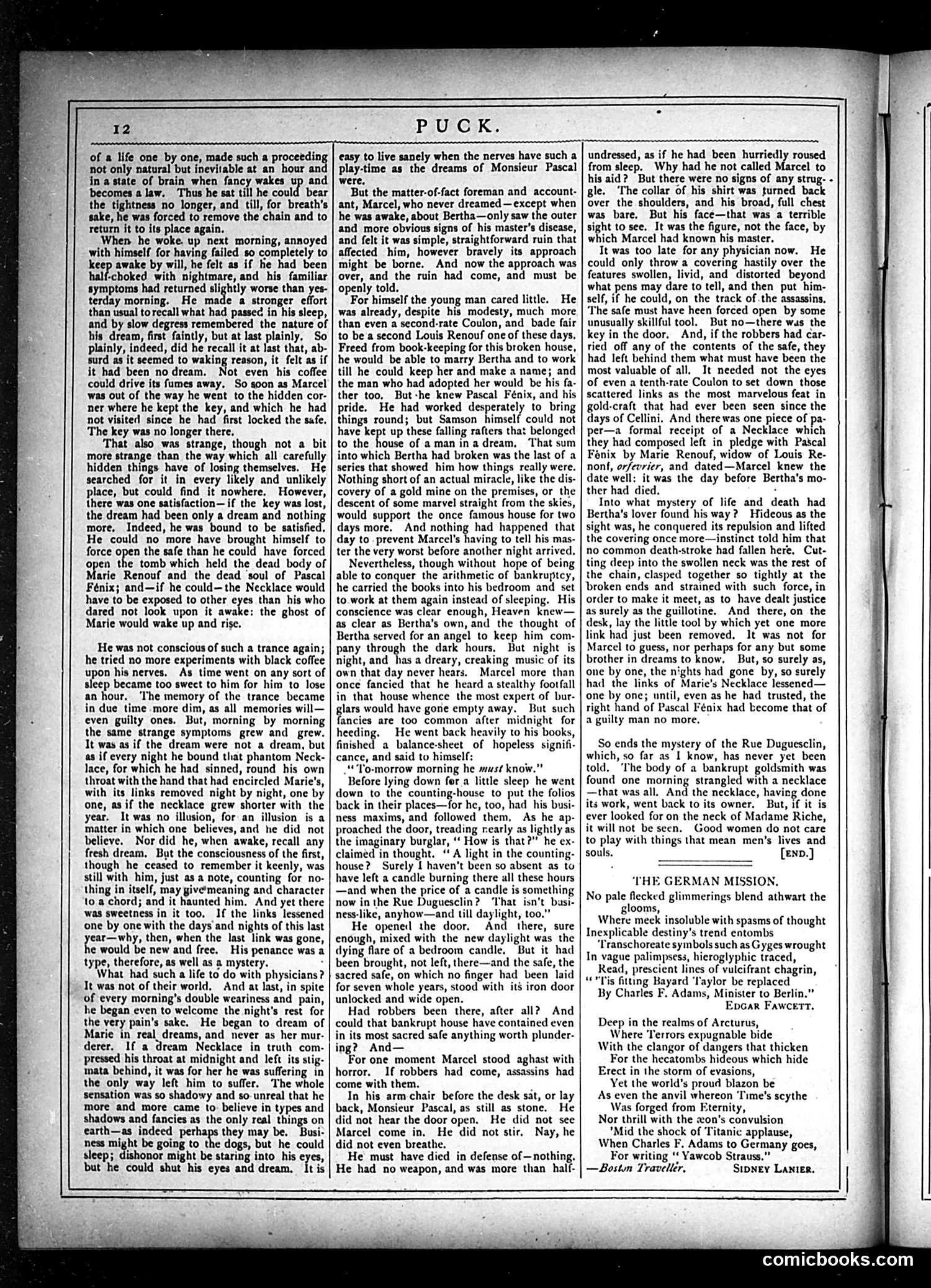
This page is primarily text—a serialized story titled "The German Mission" by Sidney Lanier, appearing in Puck magazine. The story concerns a mysterious locked safe and financial intrigue involving characters named Marcel, Monsieur Pascal Fénis, and others in what appears to be a French household setting. The page contains no political cartoons or satirical imagery. Instead, it's a continuation of narrative fiction exploring themes of mystery, desperation, and hidden treasures. While Puck was known for satirical content, this particular page represents the magazine's literary section, offering serialized entertainment rather than political or social commentary. No specific historical figures or contemporary events are referenced in the visible text.
📄 Transcribed text from this page (OCR, searchable)
Machine-transcribed from the original scan — historical spelling and the odd misread are preserved.
of a life one by one, made such a proceedin; not only natural but inevitable at an hour ani ina state of brain when fancy wakes up and becomes a law. Thus he sat till he could bear the tightness no longer, and till, for breath's sake, he was forced to remove the chain and to return it to its place again. When he woke. up next morning, annoyed with himself for having failed so completely to keep awake by will, he felt as if he had been half-choked with nightmare, and his familiar symptoms had returned slightly worse than yes- terday morning. He made a stronger effort than usual torecall what had passed in his sleep, and by slow degress remembered the nature of his dream, first faintly, but at last plainly, So plainly, indeed, did he recall it at last that, ab- surd as it seemed to waking reason, it felt as if it had been no dream. Not even his coffee could drive its fumes away. So soon as Marcel was out of the way he went to the hidden cor- ner where he kept the key, and which he had not visited since he had first locked the safe. The key was no longer there, That also was strange, though not a bit more strange than the way which all carefully hidden things have of losing themselves. He searched for it in every likely and unlikely place, but could find it nowhere. However, there was one satisfaction—if the key was lost, the dream had been only a dream and nothing more. Indeed, he was bound to be satisfied. He could no more have brought himself to force open the safe than he could have forced open the tomb which held the dead body of larie Renouf and the dead ‘soul of Pascal Fénix; and—if he could—the Necklace would have to be exposed to other eyes than his who dared not look upon it awake: the ghost of Marie would wake up and rise, He was not conscious of such a trance again; he tried no more experiments with black coffee upon his nerves. As time went on any sort of sleep became too sweet to him for him to lose an hour. ‘The memory of the trance became in due time more dim, as all memories will— even guilty ones. But, morning by morning the same strange symptoms grew and grew, Tt was as if the dream were not a dream, but as if every night he bound that phantom Neck- lace, for which he had sinned, round his own throat with the hand that had encircled Marie's, with its links removed night by night, one by one, as if the necklace grew shorter with the year. It was no illusion, for an illusion is a matter in which one believes, and he did not believe. Nor did he, when awake, recall any fresh dream. But the consciousness of the first, though he ceased to remember it keenly, was still with him, just as a note, counting for no- thing in itself, may give’meaning and character to a chord; and it haunted him. And yet there was sweetness in it too. If the links lessened one by one with the days and nights of this last ear—why, then, when the last link was gone, ie would be new and free, His penance was a type, therefore, as well as a mystery. : What had such a life to do with physicians? Tt was not of their world. And at last, in spite of every morning's double weariness and pain, he began even to welcome the night’s rest for the very pain’s sake, He began to dream of Marie in real dreams, and never as her mur- derer. If a dream Necklace in truth com- pressed his throat at midnight and left its stig- mata behind, it was for her he was suffering in the only way left him to suffer. The whole sensation was so shadowy and so-unreal that he more and more came to: believe in types and shadows and fancies as the only real things on earth—as indeed perhaps they may be. Busi- ness might be going to the dogs, but he could sleep; dishonor might be staring into his eyes, PUCK. easy to live sanely when the nerves have such a play-time as the dreams of Monsieur Pascal were, But the matter-of-fact foreman and account- ant, Marcel, who never dreamed —except when he was awake, about Bertha—only saw the outer and more obvious signs of his master’s disease, and felt it was simple, straightforward ruin that affected him, however bravely its approach might be borne. And now the approach was over, and the ruin had come, and must be openly told. For himself the young man cared little. He was already, despite his modesty, much more than even a second-rate Coulon, and bade fair to bea second Louis Renouf one of these days, Freed from book-keeping for this broken house, he would be able to marry Bertha and to work till he could keep her and make a name; and the man who had adopted her would be his fa- ther too, But-he knew Pascal Fénix, and his pride. He had worked desperately to bring things round; but Samson himself could not have kept up these falling rafters that belonged to the house of a man inadream, That sum into which Bertha had broken was the last of a series that showed him how things really were. Nothing short of an actual miracle, like the dis- covery of a gold mine on the premises, or the descent of some marvel straight from the skies, would support the once famous house for two days more. And nothing had happened that day to. prevent Marcel's having to tell his mas- ter the very worst before another night arrived. Nevertheless, though without hope of being able to conquer the arithmetic of bankruptcy, he carried the books into his bedroom and set to.work at them again instead of sleeping. His conscience was clear enough, Heaven knew— as clear as Bertha’s own, and the thought of Bertha served for an angel to keep him com- pany through the dark hours, But night is night, and has a dreary, creaking music of its own that day never hears. Marcel more than once fancied that he heard a stealthy footfall in that house whence the most expert of bur- lars would have gone empty away. But such Fenciestare too cociuion after midnight for heeding. He went back heavily to his books, finished a balance-sheet of hopeless signifi- cance, and said to himself: “To-morrow morning he must know.” Before lying down fora little sleep he went down to the counting-house to put the folios back in their places—for he, too, had his busi- ness maxims, and followed them. As he ap- proached the door, treading nearly as lightly as the imaginary burglar, How is that?" he ex- claimed in thought. “A light in the counting- house? Surely [ haven't been so absent as to have left a candle burning there all these hours —and when the price of a candle is something now in the Rue Duguesclin? ‘That isn’t basi- ness-like, anyhow—and till daylight, too.” He opened the door. And _ there, sure enough, mixed with the new daylight was the dying flare of a bedroom candle, But it had been brought, not left, there—and the safe, the sacred safe, on which no finger had been laid for seven whole years, stood with its iron door unlocked and wide open. Had robbers been there, after all? And could that bankrupt house have contained even in its most sacred safe anything worth plunder- ing? And— For one moment Marcel stood aghast with horror. If robbers had come, assassins had come with them. : In his arm chair before the desk sat, or lay back, Monsieur Pascal, as still as stone. He did not hear the door open. He did not see Marcel come in. He did not stir, Nay, he did not even breathe. He must have died in defense of—nothing. but he could shut his eyes and dream. it is| He had no weapon, and was more than half- undressed, as if he had been hurriedly roused from sleep. Why had he not called Marcel to his aid? But there were no signs of any strug. - gle. ‘The collar of his shirt was turned back over the shoulders, and his broad, full chest was bare. But his face—that was a terrible sight to see. It was the figure, not the face, by which Marcel had known his master. Tt was too late for any physician now. He could only throw a covering hastily over the features swollen, livid, and distorted beyond what pens may dare to tell, and then put him- self, if he could, on the track of. the assassins, ‘The safe must have heen forced open by some unusually skillful tool. But no—there was the key in the door. And, if the robbers had car- tied off any of the contents of the safe, they had left behind them what must have been the most valuable of all. It needed not the eyes of even a tenth-rate Coulon to set down those scattered links as the most marvelous feat in gold-craft that had ever been seen since the days of Cellini. And there was one piece of pa- per—a formal receipt of a Necklace which they had composed left in pledge with Pascal Fonix by Marie Renouf, widow of Louis Re- nonf, orfevrier, and dated—Marcel knew the date well: it was the day before Bertha’s mo- ther had died. . Into what mystery of life and death had Bertha’s lover found his way? Hideous as the sight was, he conquered its repulsion and lifted the covering once more—instinct told him that no common death-stroke had fallen here, Cut- ting deep into the swollen neck was the rest of the chain, clasped together so tightly at the broken ends and strained with such force, in order to make it meet, as to have dealt justice as surely as the guillotine. And there, on the desk, lay the little tool by which yet one more link had just been removed, It was not for Marcel to guess, nor perhaps for any but some brother in dreams to know, But, so surely as, one by one, the nights had gone by, so surely had the links of Marie’s Necklace lessened— one by one; until, even as he had trusted, the right hand of Pascal Fénix had become that of a guilty man no more. So ends the mystery of the Rue Duguesclin, which, so far as I know, has never yet been told, “The body of a bankrupt goldsmith was found one morning strangled with a necklace —that was all. And the necklace, having done its work, went back to its owner. But, if it is ever looked for on the neck of Madame Riche, it will not be seen. Good women do not care to play with things that mean men's lives and souls, [env.] ‘THE GERMAN MISSION, No pale flecked glimmerings blend athwart the glooms, Where meck insoluble with spasms of thought Inexplicable destiny’s trend entombs ‘Transchoreate symbols such as Gyges wrought In vague palimpsess, hieroglyphic traced, Read, prescient lines of vulcifrant chagrin, “Tis fitting Bayard ‘Taylor be replaced By Charles F, Adams, Minister to Berlin.” Epoar Fawcett. Deep in the realms of Arcturus, Where ‘Terrors expugnable bide With the clangor of dangers that thicken For the hecatombs hideous which hide Erect in the storm of evasions, Yet the world’s proud blazon be As even the anvil whereon ‘Time's scythe Was forged from Eternity, Nor thrill with the won’'s convulsion 'Mid the shock of Titanic applause, When Charles F, Adams to Germany goes, For writing “ Yawcob Strauss.” —Bostun Traveller, Sipney Lanier. comicbooks.com