
A complete issue · 16 pages · 1879
Puck — February 5, 1879
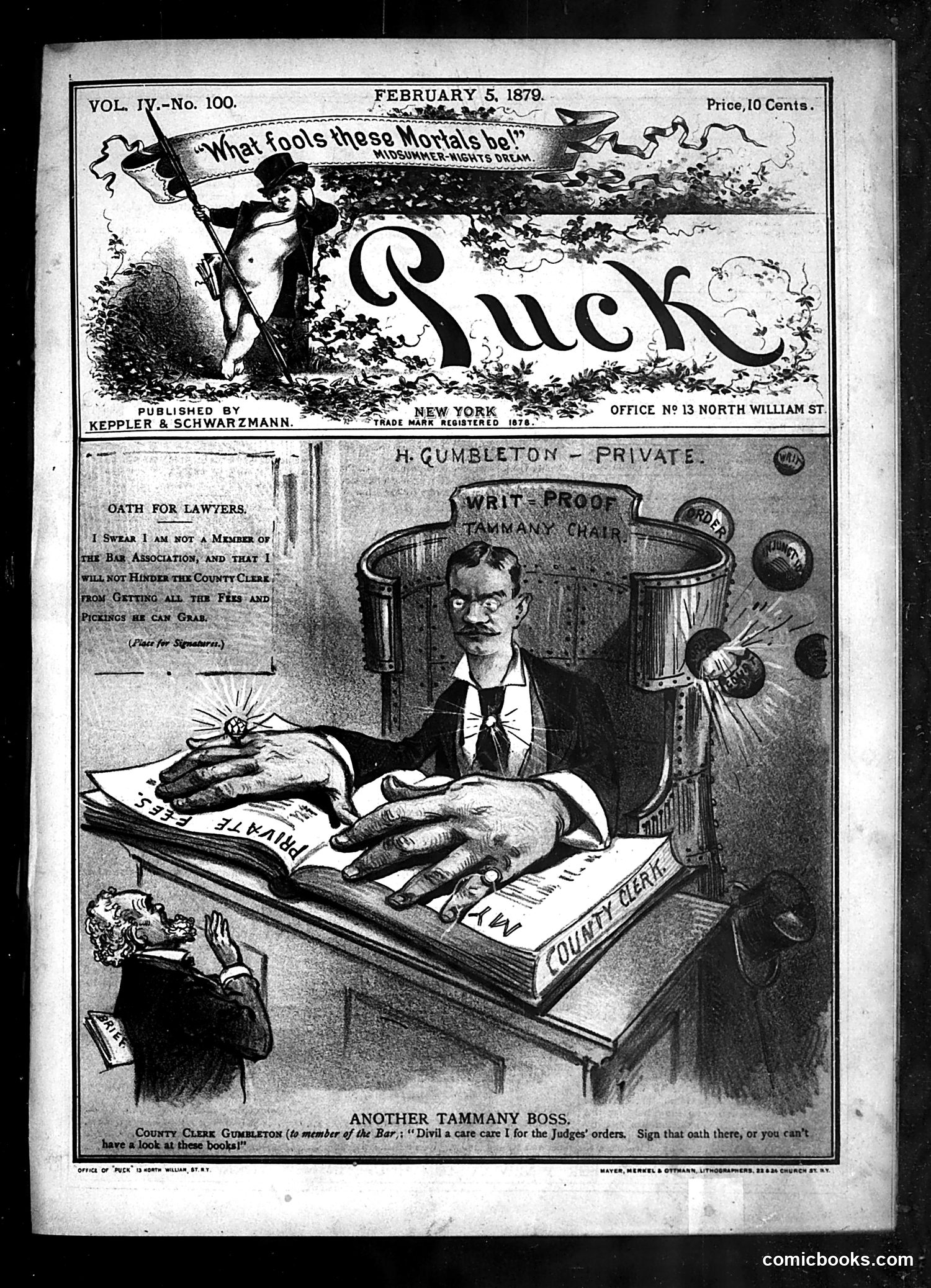
This cartoon satirizes **County Clerk H. Gumbleton**, identified as "a member of the Bar," depicting him as corrupt. The central image shows Gumbleton at a desk with law books labeled "SUIT" and "COUNTY CLERK," surrounded by spheres (likely representing bribes or corrupt dealings) exploding around him—suggesting financial impropriety. The accompanying "Oath for Lawyers" is a mock legal document parodying his claimed membership in the Bar Association while allegedly helping hide "the Country" from "getting all the fees and pickings he can grab." The title references **Tammany Hall**, the notoriously corrupt Democratic political machine dominating New York City. The cartoon accuses Gumbleton of being another example of Tammany's systemic corruption within the legal and administrative systems.
This page is primarily **textual content rather than political cartoons**—it consists of notices, subscription information, jokes ("Puckerings"), verse ("Rhymes of the Day"), and an article titled "Another Tammany Boss" about Gumbleton, apparently a New York political figure associated with Tammany Hall (the Democratic political machine). The article criticizes Gumbleton for abusing his office and making improper payments to county clerks. It references a legal case involving Judge No. 1 and accuses him of corruption—typical Puck satire targeting New York's political establishment. The page also includes a "Cable Message" from Valois, W. Prussia, discussing someone described as "left-handed" and "born so," though context is unclear. Without visible caricatures or cartoons, this represents Puck's **textual satirical journalism** rather than visual political cartooning.
This 1879 cartoon satirizes the Democratic and Republican parties as identical donkeys wearing different masks labeled "Brady" (likely referring to a contemporary political figure). The satire suggests both parties are hypocritical, engaging in underhanded political tactics like using ciphered telegrams and appealing to voters through deception rather than principle. The text criticizes both parties for their opportunism: Democrats and Republicans are portrayed as equally corrupt, using the same manipulative strategies despite their opposing rhetoric. Puck's point appears to be that voters choosing between the parties face no meaningful choice—both employ equally questionable methods to gain power. This reflects 1879 political disillusionment with party politics generally.
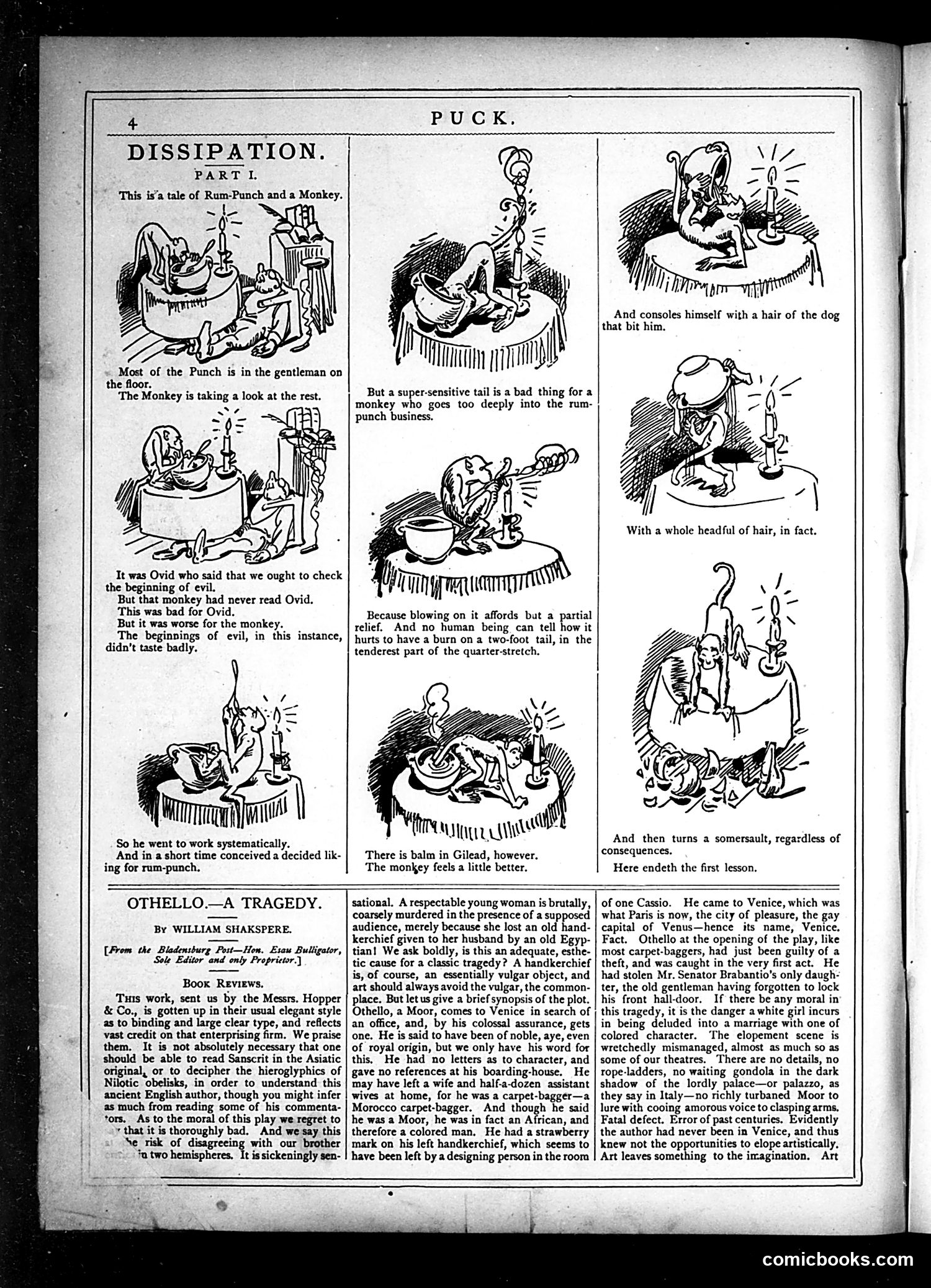
This Puck cartoon satirizes excess and moral decline through a monkey character who discovers rum-punch. The sequence depicts the monkey's progressive intoxication and deterioration: he first enjoys the drink, then suffers a "super-sensitive tail" injury (a humorous exaggeration of alcohol's effects), and eventually seeks relief by drinking more. The satire works on two levels: literally mocking a foolish animal's self-destructive behavior, and allegorically critiquing human alcoholism and dissipation. The reference to Ovid suggests intellectual pretense—the monkey can't read classical literature yet still falls prey to obvious vices. The cartoon reflects Victorian-era anxieties about drinking, presenting drunkenness as a inevitable spiral toward complete degradation, despite any temporary relief sought through continued indulgence.
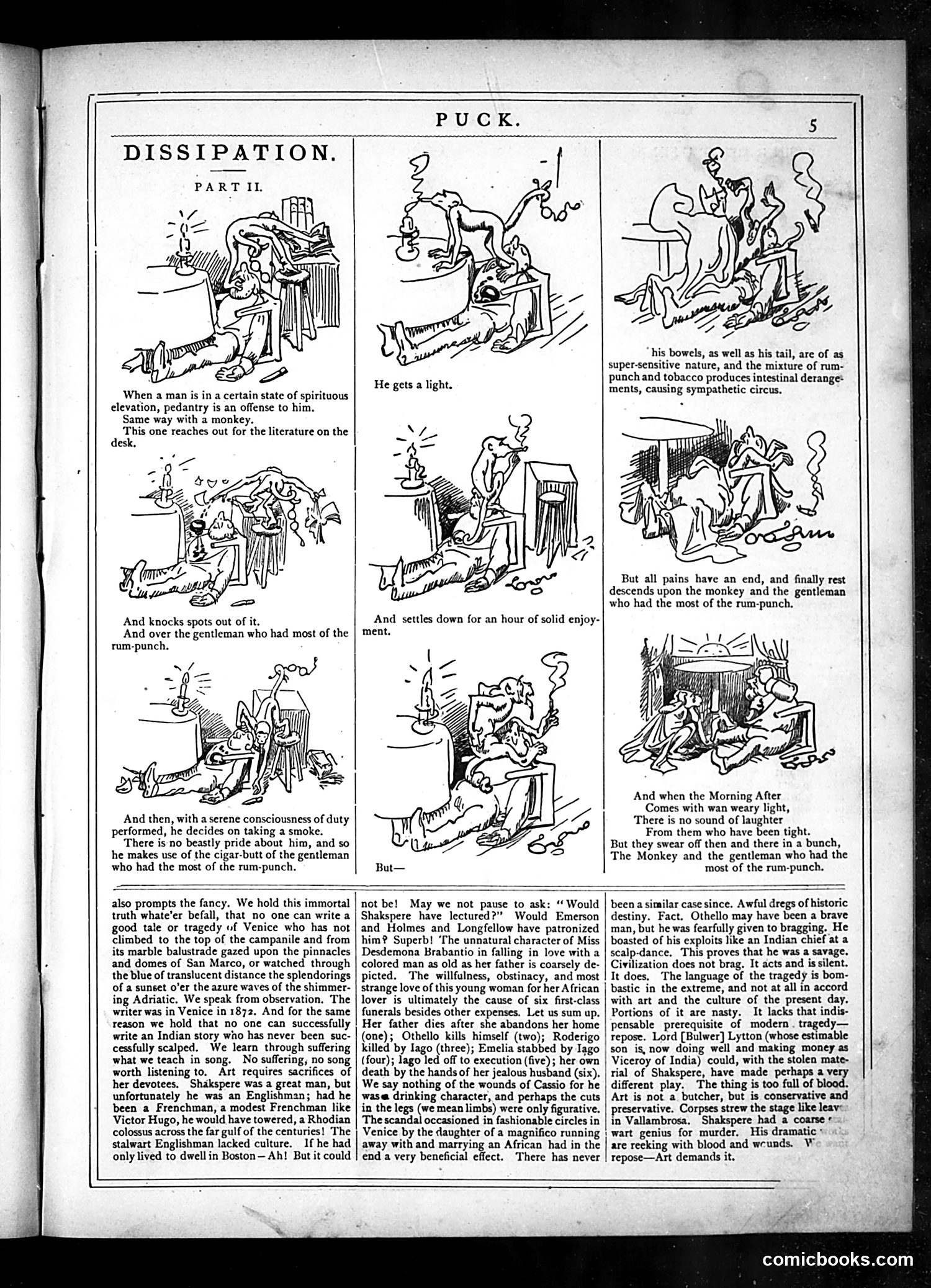
This satirical sequence depicts the moral and physical decline of a gentleman through alcohol abuse. The narrative shows: a drunk man collapsing at his desk; experiencing hallucinatory effects from rum punch; progressively losing consciousness and dignity; and eventually reaching complete debilitation. The accompanying text mocks Victorian assumptions about class and respectability, contrasting the gentleman's "super-sensitive nature" with his actual degradation. The final panels show his recovery next morning, suggesting temporary relief before inevitable relapse. The satire targets 19th-century attitudes toward male drinking culture and gentleman's clubs, where excessive alcohol consumption was socially tolerated despite obvious health consequences. The monkey character may represent base instincts or social hypocrisy.
This page contains two pieces of satirical content: **"Sing, Sisters, Sing!"** (top) appears to mock the Roman Catholic Church's practice of having women sing in choirs—presented as contradictory to church doctrine that typically restricted women's roles. The satire criticizes this inconsistency. **"Mr. Muggins as Pedagogue"** (main article) is a longer narrative satirizing an incompetent schoolteacher. The piece describes Muggins' misadventures attempting to teach German to pupils, with comedic emphasis on his poor qualifications, chaotic classroom management, and linguistic blunders. The satire targets both pretentious educators and the challenges of German-language instruction in American schools during this period. Both pieces exemplify Puck's typical approach: targeting institutional hypocrisy and social pretension through humor and exaggeration.
This page contains two separate articles with no visible political cartoon. The left column, "Puck and the Pedestrian," humorously documents Puck magazine's reporters following Miss Annie Bartell's wanderings through New York City streets and buildings over several days. The reporters document her movements in minute detail, including her visits to various locations and her interactions with other people. The right column, "Fitznoodle in America," appears to be a travel narrative or satirical commentary on American manners and customs, with a small illustration showing a figure observing American social behavior. The piece critiques American social conventions and customs through the observations of what appears to be a foreign visitor.
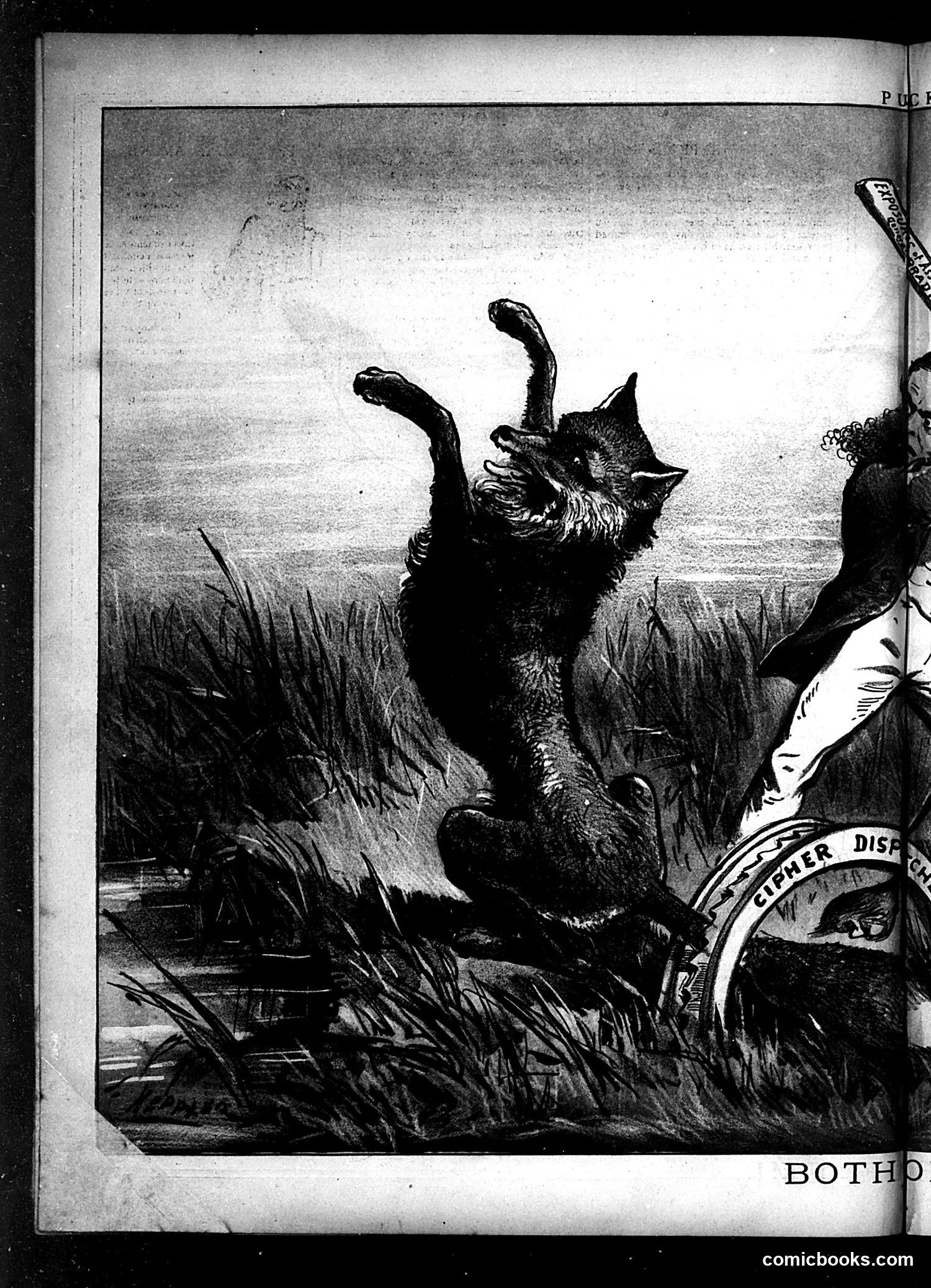
This Puck magazine illustration shows a cat standing upright in tall grass near water, with its front paws raised in a defensive or striking posture. The cat appears distressed or aggressive. Without clearer OCR text or visible caption, the specific political reference is uncertain. However, given Puck's satirical nature, this likely uses the cat as a symbolic figure—possibly representing a politician, nation, or social group responding to some threat or provocation. The aggressive posture suggests defiance or resistance. The artwork style and page layout are characteristic of late 19th or early 20th-century Puck illustrations. To identify the exact satirical target—whether this references a specific political event, scandal, or social issue—would require the complete, legible caption text and publication date, which aren't fully visible here.
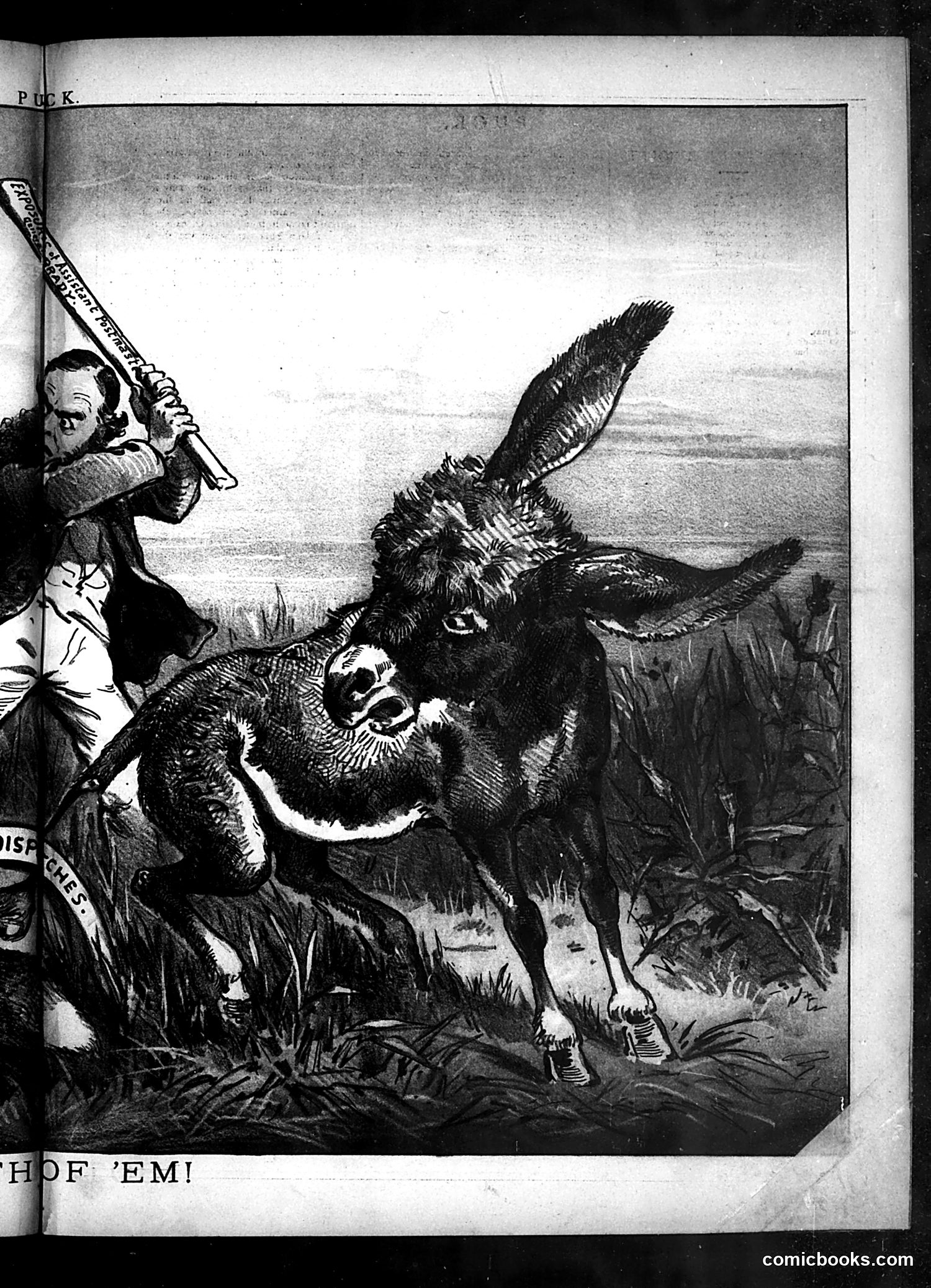
This political cartoon depicts a man wielding a club against a donkey wearing what appears to be a decorative collar or harness. The partial text visible at bottom reads "HOF 'EM!" (likely "KNOCK 'EM!"). The donkey is the traditional symbol of the Democratic Party in American political cartoons. The well-dressed man appears to represent a Republican or opponent attacking the Democrats. The aggressive stance and club suggest political combat or criticism. Without the complete caption or date, I cannot identify the specific political figures or event being referenced. However, the cartoon clearly uses the donkey symbol to satirize Democratic politics through a violent confrontation metaphor typical of Puck's partisan editorial commentary.
This page contains **text-heavy content rather than political cartoons**. The main elements are: 1. **"A Quintette of Triolets"** - five humorous poems in triolet form on topics like love, women, and wine 2. **"Talmage!!!"** advertisement - prominently promoting "Sermonizing Extraordinarily! 1,000 Quarter-Sermons in 1,000 Quarter Hours" and "The Texts," referencing Rev. Thomas De Witt Talmage, a famous Brooklyn preacher 3. **"The Theatres" section** - reviewing a production of "Lear" featuring George Edgar at the Broadway Theatre, critiquing the actor's performance as uninspired 4. **"Answers for the Anxious"** - humorous advice column with pseudonymous questioners The Talmage advertisement appears to mock the reverend's prolific preaching output, suggesting satirical commentary on religious bombast—typical Puck fare for the era.
This page presents a serialized story titled "The Body of a Bankrupt" by R.E. Francillon, set in Belgravia (an upscale London neighborhood). The narrative depicts a widow, Marie Renouf, negotiating with a goldsmith over a valuable necklace. The goldsmith attempts to secure the piece as collateral or payment for debts, while Marie resists, claiming it belonged to her late husband and holds sentimental value. The satirical humor targets wealthy Belgravian society's financial precariousness—even the affluent face bankruptcy and must bargain over heirlooms. The story mockingly explores class anxieties about maintaining appearances while concealing financial ruin, a common Puck theme critiquing Victorian upper-class hypocrisy and the desperation lurking beneath genteel surfaces.
This page contains primarily **text content rather than political cartoons**. The main features are: 1. **"An Inquirer Answered"** - A letters column where the editor responds to reader inquiries about humor and satire in Puck magazine. A correspondent signing as "Anxious" complains that Puck's humor is too harsh and insulting, particularly regarding references to "Fitz Noodle" and mockery of "Young Engineers." 2. **"Puck's Birthings"** - A short poem/verse section featuring whimsical breakfast-themed wordplay and puns (coddish balls, buckwheat, pancakes, etc.) The page demonstrates Puck's self-reflective nature—addressing reader complaints about editorial tone while maintaining the publication's satirical voice through playful language and humor.
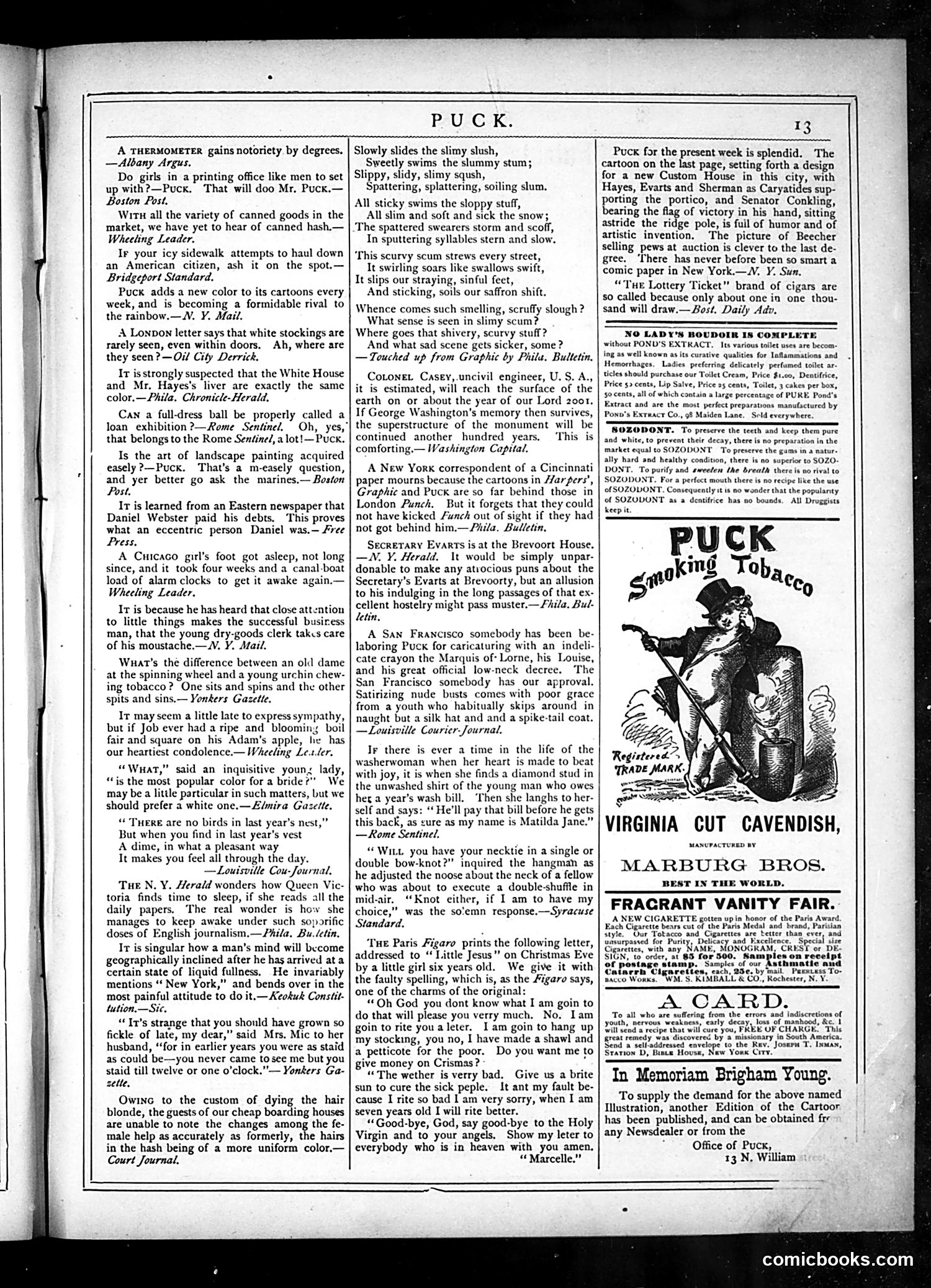
This page is primarily **text and advertisements** rather than political cartoons. The left column contains brief humorous observations ("Puck" section) commenting on contemporary society—thermometers, printing offices, ice, landscape painting, and other everyday topics. These are light satirical jabs at Victorian-era customs and absurdities. The right side features **product advertisements**: Ponds Extract (a patent medicine), Sozodont (toothpaste), and notably "Puck Smoking Tobacco" with an illustration of a jester figure. There's also an ad for "Virginia Cut Cavendish" tobacco by Marburg Bros., and a "Fragrant Vanity Fair" cigarette advertisement. The page concludes with a memorial notice for "Brigham Young," the Mormon leader, presented matter-of-factly.
This appears to be primarily an **advertising page** rather than a satirical cartoon page. The page is dominated by commercial advertisements for products and services typical of 1879 New York, including: - Coffee makers and furniture - Dental services - Clothing and fabric retailers - Billiard tables - Photographer services - Cigarettes The only potentially humorous element is a **small illustration of a bentwood chair** (likely promoting "Bent Wood Furniture"), which appears to be used as a decorative advertisement rather than political satire. There are no identifiable political figures or satirical cartoons visible on this page. The masthead identifies this as **Puck magazine**, but this particular page serves as a revenue-generating ad section rather than displaying the magazine's typical satirical content.
This is page 15 of Puck magazine, consisting almost entirely of period advertisements rather than editorial cartoons or satirical content. The ads promote various products and services typical of the era: Hungarian wines (D.A. Mayer), champagne and mineral water (Runk & Unger, L. De Venoge), furniture (Mathesius & Frey), umbrellas (Isaac Smith's), tailoring (Nicoli the Tailor), and the Louisiana State Lottery. There is one small illustrated vignette—a domestic interior scene—but it appears to be an advertisement rather than satirical commentary. The page demonstrates how Puck relied on advertising revenue to support its publication, interspersing commercial content throughout the magazine alongside its satirical editorial material found elsewhere in the issue.
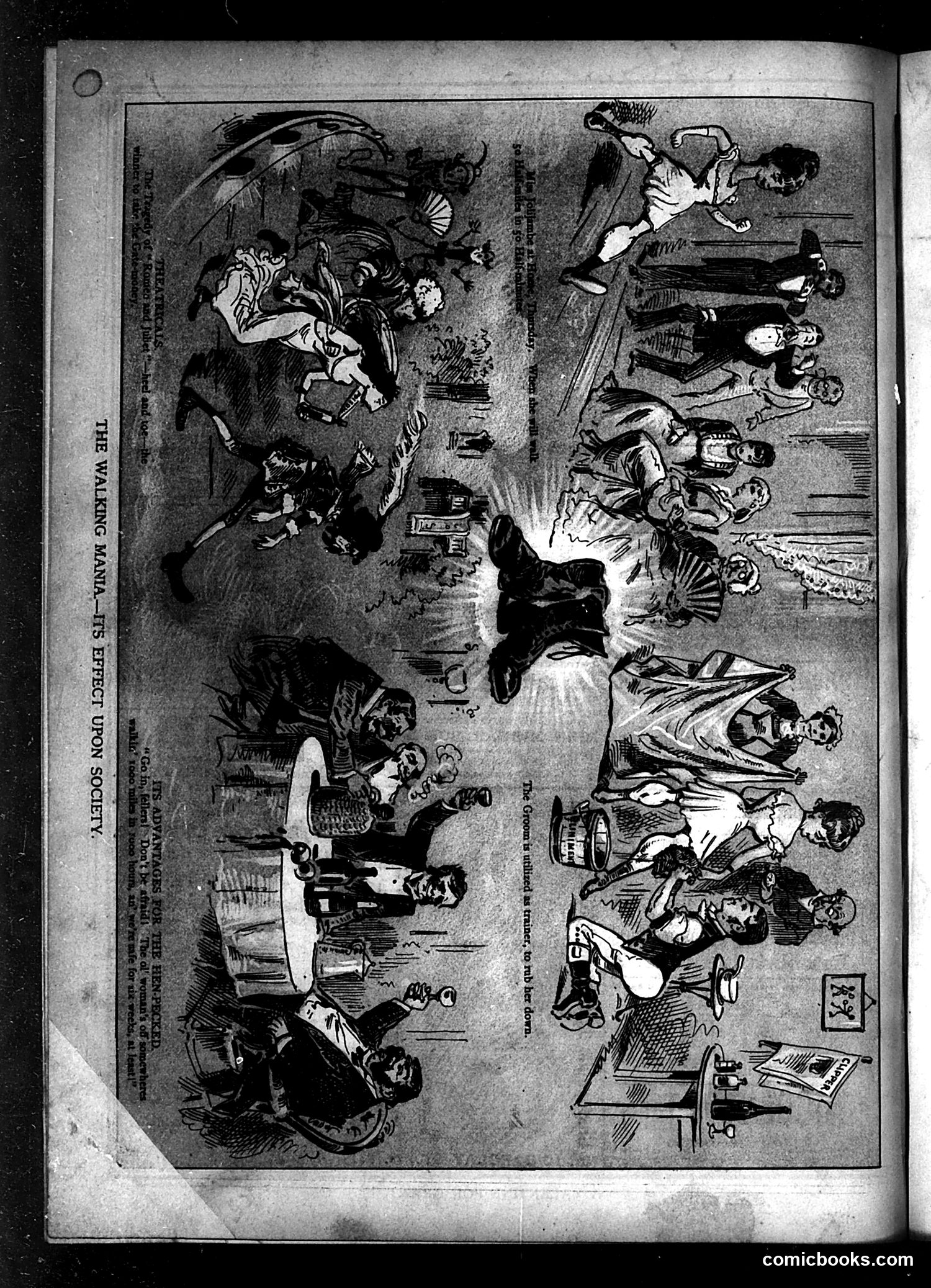
This Puck magazine page contains two satirical scenes presented upside-down relative to each other (a common Puck format). The **left panel** depicts chaotic domestic or social disorder—figures in disarray with what appears to be household items scattered about, suggesting domestic turmoil or social upheaval. The **right panel** shows multiple figures in formal dress arranged vertically, appearing to depict a social or political gathering, possibly a court or official proceeding. The page's title references "The Waning Lamp" and "Its Effects Upon Albions" (likely "Albion," a poetic name for Britain), suggesting this satirizes British political or social conditions. **However**, without clearer OCR text or visible date/caption information, I cannot definitively identify the specific political figures, events, or controversies being mocked. The quality and orientation make precise interpretation difficult.