
Puck, 1879-02-05 · page 5 of 16
Puck — February 5, 1879 — page 5: what you’re looking at
What you’re looking at
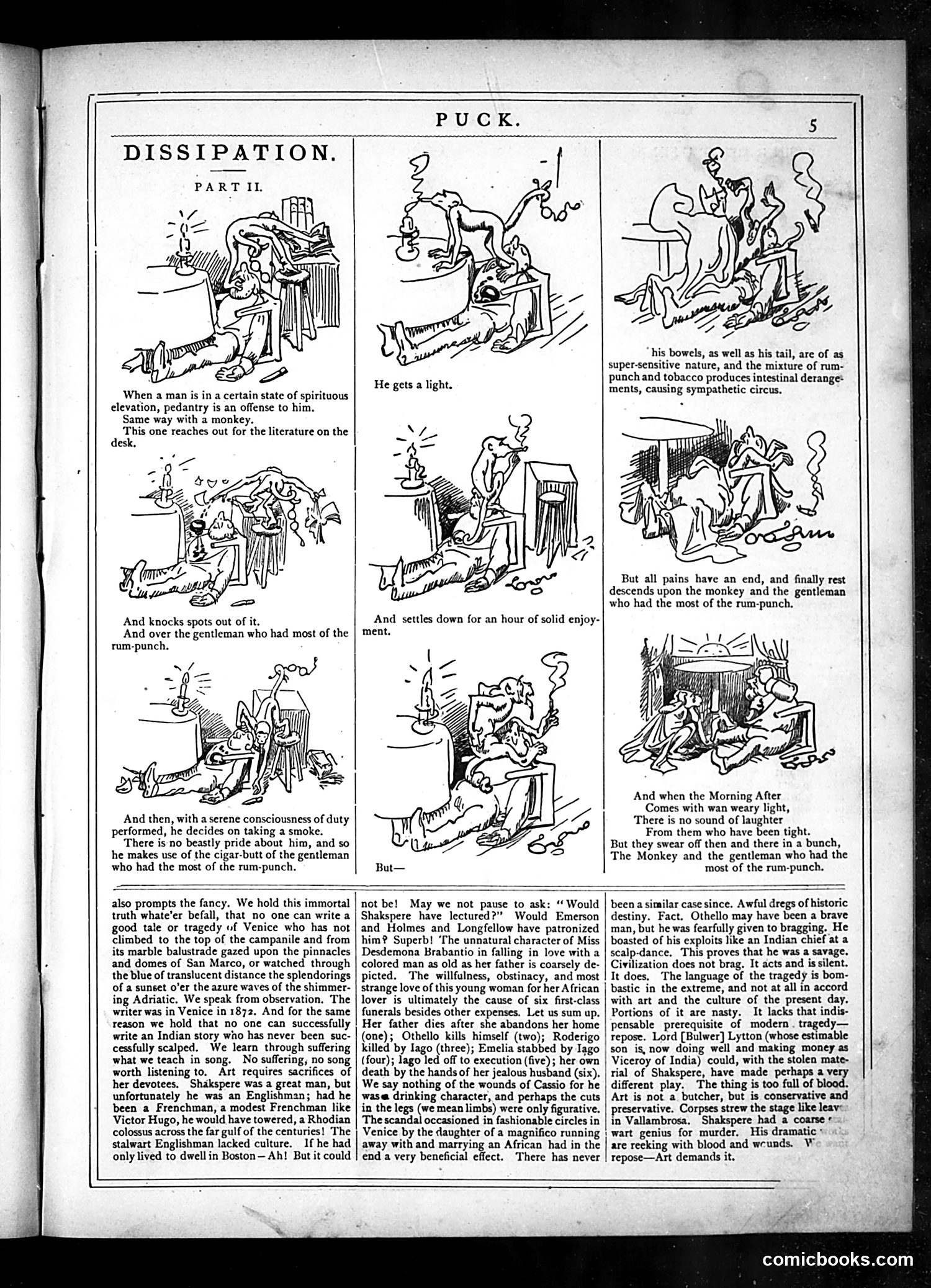
This satirical sequence depicts the moral and physical decline of a gentleman through alcohol abuse. The narrative shows: a drunk man collapsing at his desk; experiencing hallucinatory effects from rum punch; progressively losing consciousness and dignity; and eventually reaching complete debilitation. The accompanying text mocks Victorian assumptions about class and respectability, contrasting the gentleman's "super-sensitive nature" with his actual degradation. The final panels show his recovery next morning, suggesting temporary relief before inevitable relapse. The satire targets 19th-century attitudes toward male drinking culture and gentleman's clubs, where excessive alcohol consumption was socially tolerated despite obvious health consequences. The monkey character may represent base instincts or social hypocrisy.
📄 Transcribed text from this page (OCR, searchable)
Machine-transcribed from the original scan — historical spelling and the odd misread are preserved.
DISSIPATION. PARTIL When a man is in a certain state of spirituous elevation, pedantry is an offense to him. Same way with a monkey. This one reaches out for the literature on the And knocks spots out of it. And over the gentleman who had most of the And then, with a serene consciousness of duty performed, he decides on taking a smoke. There is no beastly pride about him, and so he makes use of the cigar-butt of the gentleman who had the most of che rum-punch. But— “his bowels, as well as his tail, are of as super-sensitive nature, and the mixture of rum- punch and tobacco produces intestinal derange= ments, causing sympathetic circus, But all pains have an end, and finally rest descends upon the monkey and the gentleman who had the most of the rum-punch, And when the Morning After Comes with wan weary light, There is no sound of laughter From them who have been tight. But they swear off then and there in a bunch, The Monkey and the gentleman who had the most of the rum-punch, also prompts the fancy. We hold this immortal truth whate’er befall, that no one can write a good tale or tragedy uf Venice who has not climbed to the top of the campanile and from its marble balustrade gazed upon the pinnacles and domes of San Marco, or watched through the blue of translucent distance the splendorings of a suneet o’er the azure waves of the shimmer- ing Adriatic. We speak from observation. The writer was in Venice in 1872. And for the same reason we hold that no one can successfully write an Indian story who has never been suc- cessfully scalped. We learn through suffering what we teach in song. No suffering, no song worth listening to. Art requires sacrifices of her devotees. Shakspere was a great man, but unfortunately he was an Englishman; had he been a Frenchman, a modest Frenchman like Victor Hugo, he would have towered, a Rhodian colossus across the far gulf of the centuries! The stalwart Englishman lacked culture. If he had only lived to dwell in Boston— Ah! But it could not be! May we not pause to ask: ‘ Would Shakspere have lectured?” Would Emerson and Holmes and Longfellow have patronized him? Superb! ‘The unnatural character of Miss Desdemona Brabantio in falling in love with a colored man as old as her father is coarsely de- picted. The willfulness, obstinacy, and most strange love of this young woman for her African lover is ultimately the cause of six first-class funerals besides other expenses. Let us sum up. Her father dies after she abandons her home (one); Othello kills himself (two); Roderigo | killed’ by Iago (three); Emelia stabbed by Iago | (four); lago led off to execution (five); her own death by the hands of her jealous husband (six). We say nothing of the wounds of Cassio for he wase drinking character, and perhaps the cuts in the legs (we mean limbs) were only figurative. The scandal occasioned in fashionable circles in been a similar case since. Awful dregs of historic destiny. Fact. Othello may have been a brave man, but he was fearfully given to bragging. He boasted of his exploits like an Indian chief at a scalp-dance, This proves that he was a savage. Civilization does not brag. It acts and is silent. It does, The language of the tragedy is bom- bastic in the extreme, and not at all in accord with art and the culture of the present day, Portions of it are nasty. It lacks that indis- pensable prerequisite of modern . tragedy— repose. Lord [Bulwer] Lytton (whose estimable son is, now doing well and making money as Viceroy of India) could, with the stolen mate- tial of Shakspere, have made perhaps a rey different play. The thing is too full of blood. Art is not a butcher, but is conservative and preservative. Corpses strew the stage like leav« in Vallambrosa. Shakspere had a coarse * Venice by the daughter of a magnifico running ; wart genius for murder. His dramatic» away with and marrying an African had in the are reeking with blood and weunds. W end a very beneficial effect. There has never repose—Art demands it. = comicbooks.com