
Puck, 1879-02-05 · page 11 of 16
Puck — February 5, 1879 — page 11: what you’re looking at
What you’re looking at
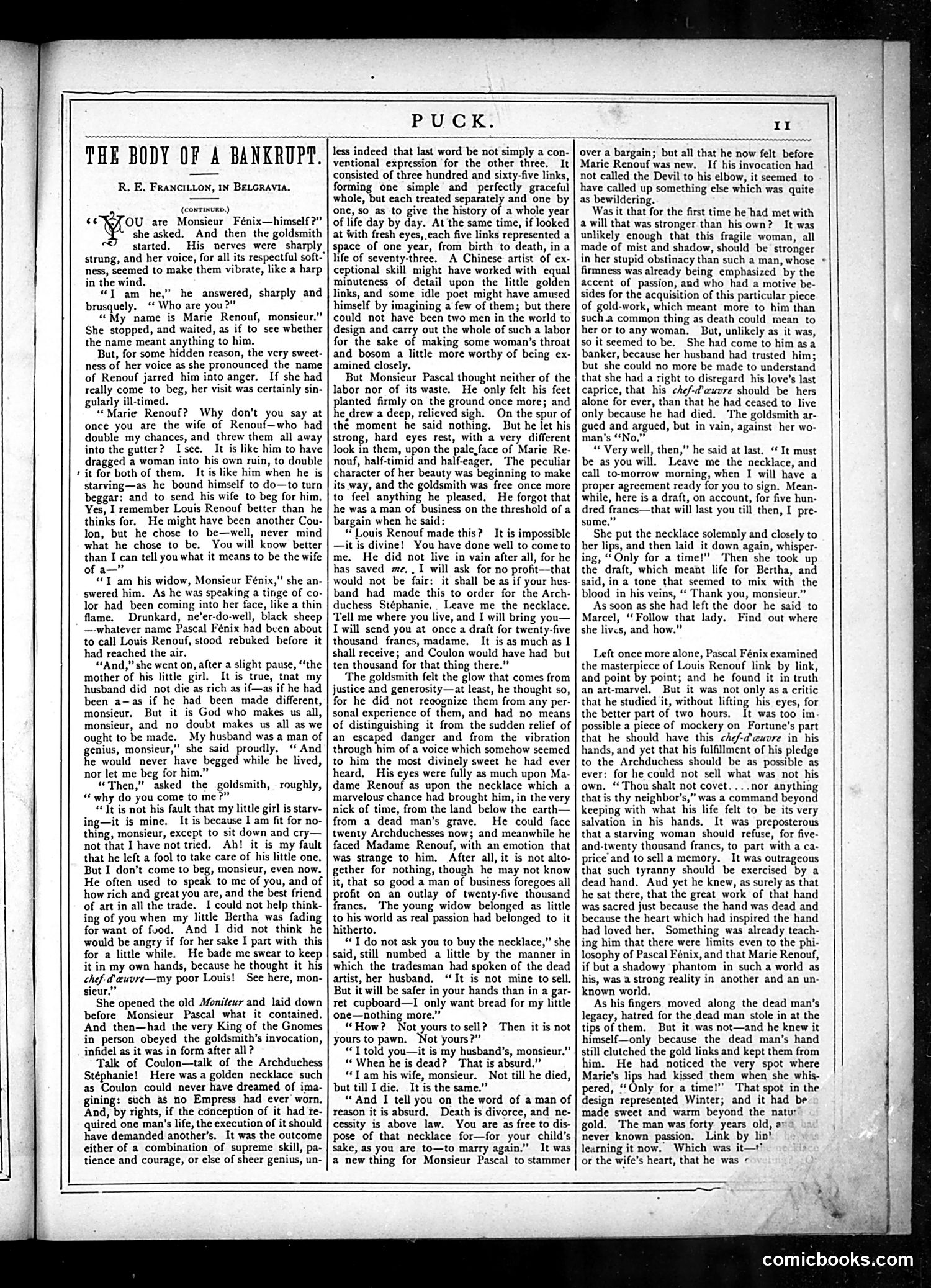
This page presents a serialized story titled "The Body of a Bankrupt" by R.E. Francillon, set in Belgravia (an upscale London neighborhood). The narrative depicts a widow, Marie Renouf, negotiating with a goldsmith over a valuable necklace. The goldsmith attempts to secure the piece as collateral or payment for debts, while Marie resists, claiming it belonged to her late husband and holds sentimental value. The satirical humor targets wealthy Belgravian society's financial precariousness—even the affluent face bankruptcy and must bargain over heirlooms. The story mockingly explores class anxieties about maintaining appearances while concealing financial ruin, a common Puck theme critiquing Victorian upper-class hypocrisy and the desperation lurking beneath genteel surfaces.
📄 Transcribed text from this page (OCR, searchable)
Machine-transcribed from the original scan — historical spelling and the odd misread are preserved.
PUCK. It THE BODY OF A BANKRUPT. R. E. FRANCILLON, IN BELGRAVIA. (conrinuro,) ss OU are Monsieur Fénix—himself?” she asked. And then the goldsmith 7 started. His nerves were sharply strung, and her voice, for all its respectful soft-" ness, seemed to make them vibrate, like a harp in the wind. “Tam he,” he answered, sharply and brusquely. ‘Who are you?” “My name is Marie Renouf, monsieur.” She stopped, and waited, as if to see whether the name meant anything to him. But, for some hidden reason, the very sweet- ness of her voice as she pronounced the name of Renouf jarred him into anger. If she had really come to beg, her visit was certainly sin- gularly ill-timed. “Marie Renouf? Why don’t you say at once you are the wife of Renouf—who had double my chances, and threw them all away into the gutter? Isee. It is like him to have dragged a woman into his own ruin, to double it for both of them. It is like him when he is starving—as he bound himself to do—to turn beggar: and to send his wife to beg for him. Yes, I remember Louis Renouf better than he thinks for. He might have been another Cou- lon, but he chose to be—well, never mind what he chose to be. You will know better than I can tell you what it means to be the wife of a—” “T am his widow, Monsieur Fénix,” she an- swered him. As he was speaking a tinge of co- lor had been coming into her face, like a thin flame. Drunkard, ne’er-do-well, black sheep —-whatever name Pascal Fénix had been about to call Louis Renouf, stood rebuked before it had reached the air. “And,” she went on, after a slight pause, “the mother of his little girl. It is true, tnat my husband did not die as rich as if—as if he had been a—as if he had been made different, monsieur. But it is God who makes us all, monsieur, and no doubt makes us all as we ought to be made. My husband was a man of genius, monsieur,” she said proudly. “ And he would never have begged while he lived, nor let me beg for him.” “Then,” asked the goldsmith, roughly, “ why do you come to me?” “Tt is not his fault that my little girl is starv- ing—it is mine. It is because 1 am fit for no- thing, monsieur, except to sit down and cry— not that I have not tried. Ah! it is my fault that he left a fool to take care of his little one. But I don’t come to beg, monsieur, even now. He often used to speak to me of you, and of how rich and great you are, and the best friend of art in all the trade. I could not help think- ing of you when my little Bertha was fading for want of food. And I did not think he would be angry if for her sake I part with this for a little while. He bade me swear to keep it in my own hands, because he thought it his chef.d'euvre—my poor Louis! See here, mon- sieur,” She opened the old Moniteur and laid down before Monsieur Pascal what it contained. And then—had the very King of the Gnomes in person obeyed the goldsmith’s invocation, infidel as it was in form after all? Talk of Coulon—talk of the Archduchess Stéphanie! Here was a golden necklace such as Coulon could never have dreamed of ima- gining: such as no Empress had ever worn. And, by rights, if the conception of it had re- quired one man’s life, the execution of it should have demanded another's. It was the outcome either of a combination of supreme skill, pa- tience and courage, or else of sheer genius, un- less indeed that last word be not simply a con- ventional expression for the other three. It consisted of three hundred and sixty-five links, forming one simple and perfectly graceful whole, but each treated separately and one by one, so as to give the history of a whole year of life day by day. At the same time, if looked at With fresh eyes, each five links represented a space of one year, from birth to death, ina life of seventy-three. A Chinese artist of ex- ceptional skill might have worked with equal minuteness of detail upon the little golden links, and some idle poet might have amused himself by imagining a few of them; but there could not have been two men in the world to design and carry out the whole of such a labor for the sake of making some woman’s throat and bosom a little more worthy of being ex- amined closely. But Monsicur Pascal thought neither of the labor nor of its waste. He only felt his feet planted firmly on the ground once more; and he drew a deep, relieved sigh. On the spur of thé moment he said nothing. But he let his strong, hard eyes rest, with a very different look in them, upon the pale.face of Marie Re- nouf, half-timid and half-eager. The peculiar character of her beauty was beginning to make its way, and the goldsmith was free once more to feel anything he pleased. He forgot that he was a man of business on the threshold of a bargain when he said: “ Louis Renouf made this? It is impossible —it is divine! You have done well to come to me. He did not live in vain after all, for he has saved me, ,1 will ask for no profit—that would not be fair: it shall be as if your hus- band had made this to order for the Arch- duchess Stéphanie. Leave me the necklace. Tell me where you live, and I will bring you— I will send you at once a draft for twenty-five thousand francs, madame. It is as much as I shall receive; and Coulon would have had but ten thousand for that thing there.” The goldsmith felt the glow that comes from justice and generosity—at least, he thought so, for he did not recognize them from any per- sonal experience of them, and had no means of distinguishing it from the sudden relief of an escaped danger and from the vibration through him of a voice which somehow seemed to him the most divinely sweet he had ever heard. His eyes were fully as much upon Ma- dame Renouf as upon the necklace which a marvelous chance had brought him, in the very nick of time, from the land below the earth— from a dead man’s grave. He could face twenty Archduchesses now; and meanwhile he faced Madame Renouf, with an emotion that was strange to him, After all, it is not alto- gether for nothing, though he may not know it, that so good a man of business foregoes all profit on an outlay of twenty-five thousand francs. The young widow belonged as little to his world as real passion had belonged to it hitherto. “T do not ask you to buy the necklace,” she said, still numbed a little by the manner in which the tradesman had spoken of the dead artist, her husband. “It is not mine to sell. But it will be safer in your hands than in a gar- ret cupboard—I only want bread for my little one—nothing more.” “How? Not yours to sell? Then it is not yours to pawn. Not yours?” “T told you—it is my husband’s, monsieur.”” “When he is dead? That is absurd.” “Tam his wife, monsieur. Not till he died, but till I die. It is the same.” “And I tell you on the word of a man of reason it is absurd. Death is divorce, and ne- cessity is above law. You are as free to dis- pose of that necklace for—for your child’s sake, as you are to—to marry again.” It was a new thing for Monsieur Pascal to stammer over a bargain; but all that he now felt before Marie Renouf was new. If his invocation had not called the Devil to his elbow, it seemed to have called up something else which was quite as bewildering. Was it that for the first time he had met with a will that was stronger than his own? It was unlikely enough that this fragile woman, all made of mist and shadow, should be’ stronger in her stupid obstinacy than such a man, whose firmness was already being emphasized ‘by the accent of passion, and who had a motive be- sides for the acquisition of this particular piece of gold-work, which meant more to him than such a common thing as death could mean to her or to any woman. But, unlikely as it was, so it seemed to be. She had come to him asa banker, because her husband had trusted him; but she could no more be made to understand that she had a right to disregard his love's last caprice, that his chef-d’euvre should be hers alone for ever, than that he had ceased to live only because he had died. The goldsmith ar- gued and argued, but in vain, against her wo- man’s “No.” “ Very well, then,” he said at last. “It must be as you will. Leave me the necklace, and call to-morrow morning, when I will have a proper agreement ready for you to sign. Mean- while, here is a draft, on account, for five hun- dred francs—that will last you till then, I pre- sume.” She put the necklace solemnly and closely to her lips, and then laid it down again, whisper- ing, “Only for a time!” ‘Then she took up the draft, which meant life for Bertha, and said, in a tone that seemed to mix with the blood in his veins, “‘ Thank you, monsieur.” As soon as she had left the door he said to Marcel, ‘Follow that lady. Find out where she lives, and how.” Left once more alone, Pascal Fénix examined the masterpiece of Louis Renouf link by link, and point by point; and he found it in truth an art-marvel, But it was not only asa critic that he studied it, without lifting his eyes, for the better part of two hours. It was too im possible a piece of mockery on Fortune's part that he should have this chef-duvre in his hands, and yet that his fulfillment of his pledge to the Archduchess should be as possible as ever: for he could not sell what was not his own. “Thou shalt not covet....nor anything that is thy neighbor’s,” was a command beyond keeping with what his life felt to be its very salvation in his hands. It was preposterous that a starving woman should refuse, for five- and-twenty thousand francs, to part with a ca- price’and to sell a memory. It was outrageous that such tyranny should be exercised by a dead hand. And yet he knew, as surely as that he sat there, that the great work of that hand was sacred just because the hand was dead and because the heart which had inspired the hand had loved her. Something was already teach- ing him that there were limits even to the phi- losophy of Pascal Fénix, and that Marie Renouf, if but a shadowy phantom in such a world as his, was a strong reality in another and an un- known world, As his fingers moved along the dead man’s legacy, hatred for the dead man stole in at the tips of them. But it was not—and he knew it himself—only because the dead man’s hand still clutched the gold links and kept them from him. He had noticed the very spot where Marie's lips had kissed them when she whis- pered, “Only for a time!” That spot in the design represented Winter; and it had be made sweet and warm beyond the natu: gold. The man was forty years old, ano never known passion, Link by lin’ learning it now. Which was it—t’ or the wife’s heart, that he was « comicbooks.com