
Puck, 1879-02-05 · page 6 of 16
Puck — February 5, 1879 — page 6: what you’re looking at
What you’re looking at
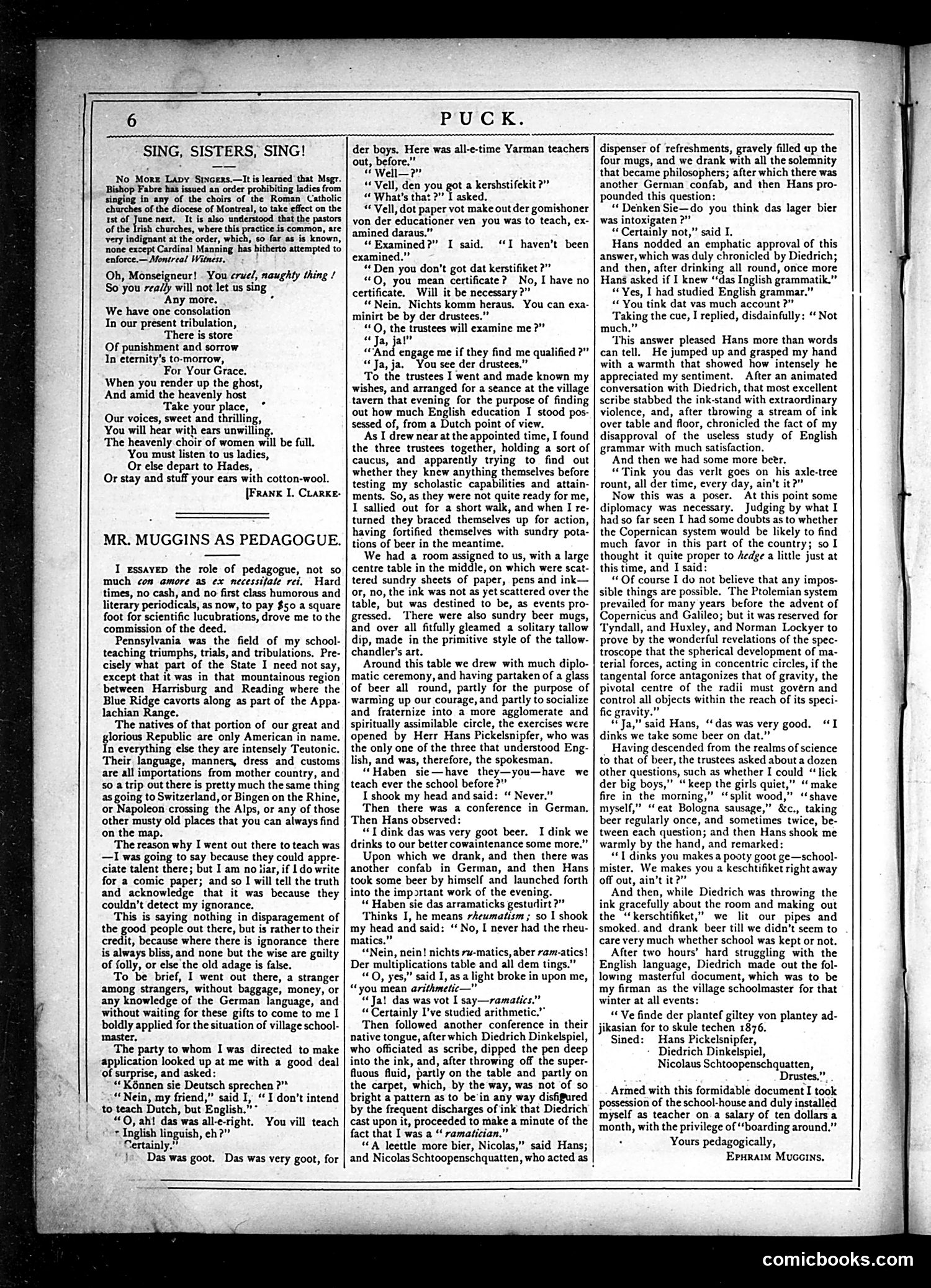
This page contains two pieces of satirical content: **"Sing, Sisters, Sing!"** (top) appears to mock the Roman Catholic Church's practice of having women sing in choirs—presented as contradictory to church doctrine that typically restricted women's roles. The satire criticizes this inconsistency. **"Mr. Muggins as Pedagogue"** (main article) is a longer narrative satirizing an incompetent schoolteacher. The piece describes Muggins' misadventures attempting to teach German to pupils, with comedic emphasis on his poor qualifications, chaotic classroom management, and linguistic blunders. The satire targets both pretentious educators and the challenges of German-language instruction in American schools during this period. Both pieces exemplify Puck's typical approach: targeting institutional hypocrisy and social pretension through humor and exaggeration.
📄 Transcribed text from this page (OCR, searchable)
Machine-transcribed from the original scan — historical spelling and the odd misread are preserved.
PUCK. = SING, SISTERS, SING! No More LApy Sincers.—It is learned that Msgr. Bishop Fabre has issued an order prohibiting ladies from singing in any of the choirs of the Roman Catholic churches of:the diocese of Montreal, to take effect on the Ist of June next, It is also understood that the pastors of the Irish churebes, where ths practice is common, are very indignant at the order, which, so far as is known, none except Cardinal Manning has hitherto attempted to enforce.—Montreal Witness, Oh, Monseigneur! You cruc/, naughty thing ! So you really will not let us sing Any more, * We have one consolation In our present tribulation, There is store Of punishment and sorrow In eternity's to-morrow, For Your Grace. When you render up the ghost, And amid the heavenly host ‘Take your place, Our voices, sweet and thrilling, You will hear with ears unwilling. The heavenly choir of women will be full. You must listen to us ladies, Or else depart to Hades, Or stay and stuff your ears with cotton-wool. [Frank I. Crarke- MR. MUGGINS AS PEDAGOGUE. I essavep the role of pedagogue, not so much ¢on amore as ex necessijate rei, Hard times, no cash, and no first class humorous and literary periodicals, as now, to pay $50 a square foot for scientific lucubrations, drove me to the commission of the deed. Pennsylvania was the field of my school- teaching triumphs, trials, and tribulations. Pre- cisely what part of the State I need not say, except that it was in that mountainous region between Harrisburg and Reading where the Blue Ridge cavorts along as part of the Appa- lachian Range. The natives of that portion of our great and lorious Republic are only American in name. in everything else they are intensely Teutonic. Their language, manners, dress and customs are all importations from mother country, and so a trip out there is pretty much the same thing as going to Switzerland, or Bingen on the Rhine, or Napoleon crossing the Alps, or any of those other musty old places that you can always find on the map. The reason why I went out there to teach was —I was going to say because they could appre- ciate talent there; but I am no tiar, if 1do write for a comic paper; and so | will tell the truth and acknowledge that it was because they couldn’t detect my ignorance. This is saying nothing in disparagement of the good people out there, but is rather to their credit, because where there is ignorance there is always bliss, and none but the wise are guilty of folly, or else the old adage is false. To be brief, 1 went out there, a stranger among strangers, without baggage, money, or any knowledge of the German language, and without waiting for these gifts to come to me I boldly applied for the situation of village school- master. The party to whom I was directed to make application looked up at me with a good deal ‘of surprise, and asked: “Kénnen sie Deutsch sprechen ?”* “Nein, my friend,” said I, I don’t intend to teach Dutch, but English.” * “O, ah! das was all-e-right. You vill teach + Inglish linguish, eh?” Certainly.” t> Das was goot. Das was very goot, for der boys. Here was all-e-time Yarman teachers out, before.” “ Well—?” “Vell, den you got a kershstifekit ?”” “ What's that ?” I asked. «Vell, dot paper vot make out der gomishoner von der educationer ven you was to teach, ex- amined daraus.” « Examined ?” examined.” “Den you don’t got dat kerstifiket ?” “O, you mean certificate? No, I have no certificate, Will it be necessary ?” “Nein. Nichts komm heraus. You can exa- minirt be by der drustees.” “O, the trustees will examine me?” “ Ja, jal” “And engage me if they find me qualified ?” “Ja, ja. You see der drustees,” To the trustees I went and made known my wishes, and arranged for a seance at the village tavern that evening for the purpose of finding out how much English education I stood pos- sessed of, from a Dutch point of view. As I drew near at the appointed time, I found the three trustees together, holding a sort of caucus, and apparently trying to find out whether they knew anything themselves before testing my scholastic capabilities and attain- ments. So, as they were not quite ready for me, I sallied out for a short walk, and when I re- turned they braced themselves up for action, having fortified themselves with sundry pota- tions of beer in the meantime. We had a room assigned to us, with a large centre table in the middle, on which were scat- tered sundry sheets of paper, pens and ink— or, no, the ink was not as yet scattered over the table, but was destined to be, as events pro- gressed. ‘There were also sundry beer mugs, and over all fitfully gleamed a solitary tallow dip, made in the primitive style of the tallow- chandler’s art. Around this table we drew with much diplo- matic ceremony, and having partaken of a glass of beer all round, partly for the purpose of warming up our courage, and partly to socialize and fraternize into a more agglomerate and spiritually assimilable circle, the exercises were opened by Herr Hans Pickelsnipfer, who was the only one of the three that understood Eng- lish, and was, therefore, the spokesman. “'Haben sie—have they—you—have we teach ever the school before I shook my head and sai Then there was a conference in German, Then Hans observed: “I dink das was very goot beer. I dink we drinks to our better cowaintenance some more.” Upon which we drank, and then there was another confab in German, and then Hans took some beer by himself and launched forth into the important work of the evening. “ Haben sie das arramaticks gestudirt ?” Thinks I, he means rheumatism ; so I shook my head and said: ‘‘ No, I never had the rheu- matics.”” “Nein, nein! nichts rz-matics, aber ram-atics! Der multiplications table and all dem tings.” “0, yes,” said I, as a light broke in upon me, “you mean arithmetic—" “Ja! das was vot I say—ramatics.” “Certainly I've studied arithmetic.” Then followed another conference in their native tongue, after which Diedrich Dinkelspiel, who officiated as scribe, dipped the pen deep into the ink, and, after throwing off the super- fluous fluid, partly on the table and partly on the carpet, which, by the way, was not of so bright a pattern as to be’in any way disfigured by the frequent discharges of ink that Diedrich cast upon it, proceeded to make a minute of the fact that I was a “‘ ramatician.” “A leettle more bier, Nicolas,” said Hans; I said. “I haven't been and Nicolas Schtoopenschquatten, who acted as | dispenser of refreshments, gravely filled up the four mugs, and we drank with all the solemnity that became philosophers; after which there was another German confab, and then Hans pro- pounded this question: “ Denken Sie—do you think das lager bier was intoxigaten 2” “Certainly not,” said I. Hans nodded an emphatic approval of this answer, which was duly chronicled by Diedrich; and then, after drinking all round, once more Hans asked if I knew ‘das Inglish grammatik.” “Yes, L had studied English grammar.” “You tink dat vas much account ?”” Taking the cue, I replied, disdainfully: “ Not much,”” ‘This answer pleased Hans more than words can tell, He jumped up and grasped my hand with a warmth that showed how intensely he appreciated my sentiment. After an animated conversation with Diedrich, that most excellent scribe stabbed the ink-stand with extraordinary violence, and, after throwing a stream of ink over table and floor, chronicled the fact of my disapproval of the useless study of English grammar with much satisfaction. And then we had some more beer. “Tink you das verlt goes on his axle-tree rount, all der time, every day, ain’t it?” Now this was a poser. At this point some diplomacy was necessary. Judging by what I had so far seen I had some doubts as to whether the Copernican system would be likely to find much favor in this part of the country; so I thought it quite proper to Aedge a little just at this time, and I said: “Of course I do not believe that any impos- sible things are possible. The Ptolemian system prevailed for many years before the advent of Copernicus and Galileo; but it was reserved for ‘Tyndall, and Huxley, and Norman Lockyer to prove by the wonderful revelations of the spec- troscope that the spherical development of ma- terial forces, acting in concentric circles, if the tangental force antagonizes that of gravity, the pivotal centre of the radii must govern and control all objects within the reach of its speci- fic gravity.” “Ja,” said Hans, “das was very good. dinks we take some beer on dat.” Having descended from the realms of science to that of beer, the trustees asked about a dozen other questions, such as whether I could “lick der big boys,” “keep the girls quiet,” “make fire in the morning,” “split wood,” “shave myself,” “eat Bologna sausage,” &c., taking beer regularly once, and sometimes twice, be- tween each question; and then Hans shook me warmly by the hand, and remarked: “I dinks you makes a pooty goot ge—school- mister. We makes you a keschtifiket right away off out, ain’t it?” And then, while Diedrich was throwing the ink gracefully about the room and making out the “‘kerschtifiket,” we lit our pipes and smoked. and drank beer till we didn’t seem to care very much whether school was kept or not. After two hours’ hard struggling with the English language, Diedrich made out the fol- lowing masterful document, which was to be my firman as the village schoolmaster for that winter at all events: “Ve finde der plantef giltey von plantey ad- jikasian for to skule techen 1876, Sined: Hans Pickelsnipfer, - Diedrich Dinkelspiel, Nicolaus Schtoopenschquatten, Drustes.”” Armed with this formidable document I took possession of the school-house and duly installed myself as teacher on.a salary of ten dollars a month, with the privilege of “boarding around.” ° Yours pedagogically, Epxram Mucoins, «] comicbooks.com