
Puck, 1879-02-05 · page 4 of 16
Puck — February 5, 1879 — page 4: what you’re looking at
What you’re looking at
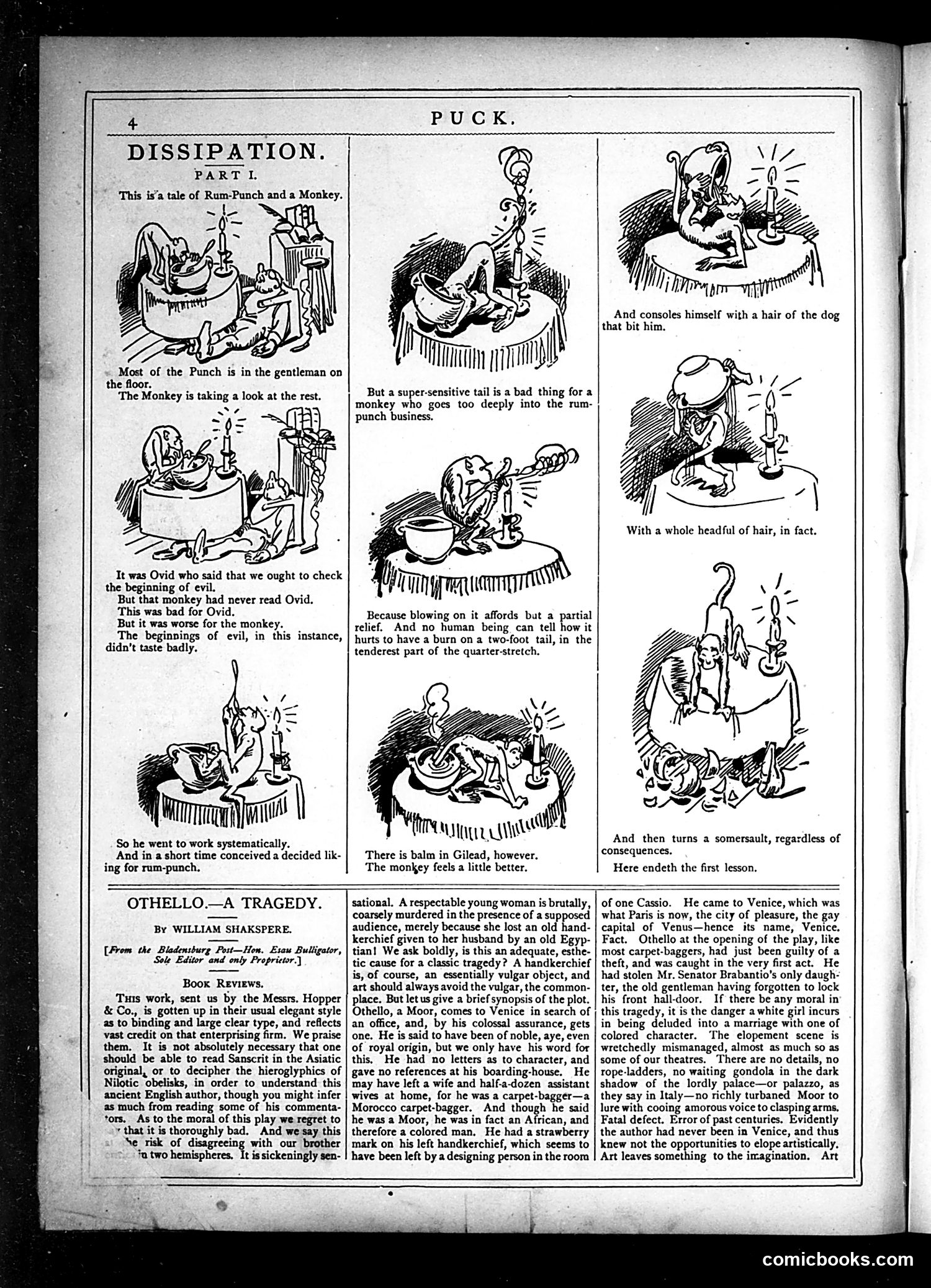
This Puck cartoon satirizes excess and moral decline through a monkey character who discovers rum-punch. The sequence depicts the monkey's progressive intoxication and deterioration: he first enjoys the drink, then suffers a "super-sensitive tail" injury (a humorous exaggeration of alcohol's effects), and eventually seeks relief by drinking more. The satire works on two levels: literally mocking a foolish animal's self-destructive behavior, and allegorically critiquing human alcoholism and dissipation. The reference to Ovid suggests intellectual pretense—the monkey can't read classical literature yet still falls prey to obvious vices. The cartoon reflects Victorian-era anxieties about drinking, presenting drunkenness as a inevitable spiral toward complete degradation, despite any temporary relief sought through continued indulgence.
📄 Transcribed text from this page (OCR, searchable)
Machine-transcribed from the original scan — historical spelling and the odd misread are preserved.
DISSIPATION. PART I. And consoles himself with a hair of the dog Most of the Punch is in the gentleman on itn mC | ii i But a super-sensitive tail is a bad thing for a Babe Monier taking 9 look, at the rest. monkey who goes too deeply into the rum- punch business. It was Ovid who said that we ought to check | J HH : the beginning of evil. AUD SMT But that monkey had never read Ovid. This was bad for Ovid. Because blowing on it affords but a partial But it was worse for the monkey. _ relief. And no human being can tell how it The beginnings of evil, in this instance, | hurts to have a burn on a two-foot tail, in the didn’t taste badly. tenderest part of the quarter-stretch. \ YEOH toute" And in a short time conceived a decided lik- There is balm in Gilead, however. ing for ram-punch, The monkey feels a little better. Here endeth the first lesson. And then turns a somersault, regardless of So he went to work systematically. consequences. OTHELLO.—A TRAGEDY. sational. A respectable young woman is brutally, | of one Cassio. He came to Venice, which was —— coarsely murdered in the presence of a supposed | what Paris is now, the city of pleasure, the gay By WILLIAM SHAKSPERE. audience, merely because she lost an old hand- | capital of Venus—hence its name, Venice. kerchief given to her husband by an old Egyp- | Fact. Othello at the opening of the play, like [From the Bladensburg Post—Hon. Esau Bulligator, | tian! We ask boldly, is this an adequate, esthe- | most carpet-baggers, had just been guilty of a Sole Editor and only Proprietor.) tic cause for a classic tragedy? A handkerchief | theft, and was caught in the very first act. He is, of course, an essentially vulgar object, and | had stolen Mr. Senator Brabantio’s only daugh- Book Reviews. art should always avoid the vulgar, the common: | ter, the old gentleman having forgotten to lock Tus work, sent us by the Messrs. Hopper | place. But let us give a brief synopsis of the plot. | his front hall-door. If there be any moral in & Co., is gotten up in their usual elegant style | Othello, a Moor, comes to Venice in search of ; this tragedy, it is the danger a white girl incurs as to binding and large clear type, and reflects | an office, and, by his colossal assurance, gets | in being deluded into a marriage with one of vast credit on that enterprising firm. We praise | one. He is said to have been of noble, aye, even | colored character. The elopement scene is them. It is not absolutely necessary that one | of royal origin, but we only have his word for | wretchedly mismanaged, almost as much so as should be able to read Sanscrit in the Asiatic | this. He had no letters as to character, and | some of our theatres. There are no details, no original, or to decipher the hieroglyphics of | gave no references at his boarding-house. He | rope-ladders, no waiting gondola in the dark Nilotic obelisks, in order to understand this | may have left a wife and half-a-dozen assistant | shadow of the lordly palace—or palazzo, as ancient English author, though you might infer | wives at home, for he was a carpet-bagger—a | they say in Italy—no richly turbaned Moor to as much from reading some of his commenta- | Morocco carpet-bagger. And though he said | lure with cooing amorous voice to clasping arms, tors. As to the moral of this play we regret to | he was a Moor, he was in fact an African, and | Fatal defect. Error of past centuries. Evidently * that it is thoroughly bad. And we say this | therefore a colored man. He had a strawberry | the author had never been in Venice, and thus Ne risk of disagrecing with our brother | mark on his left handkerchief, which seems to | knew not the Sppsceunities to elope artistically, ja two hemispheres. It is sickeningly sen- ! have been left by a designing person in the room | Art leaves something to the imagination. Art comicbooks.com