
Puck, 1879-02-05 · page 12 of 16
Puck — February 5, 1879 — page 12: what you’re looking at
What you’re looking at
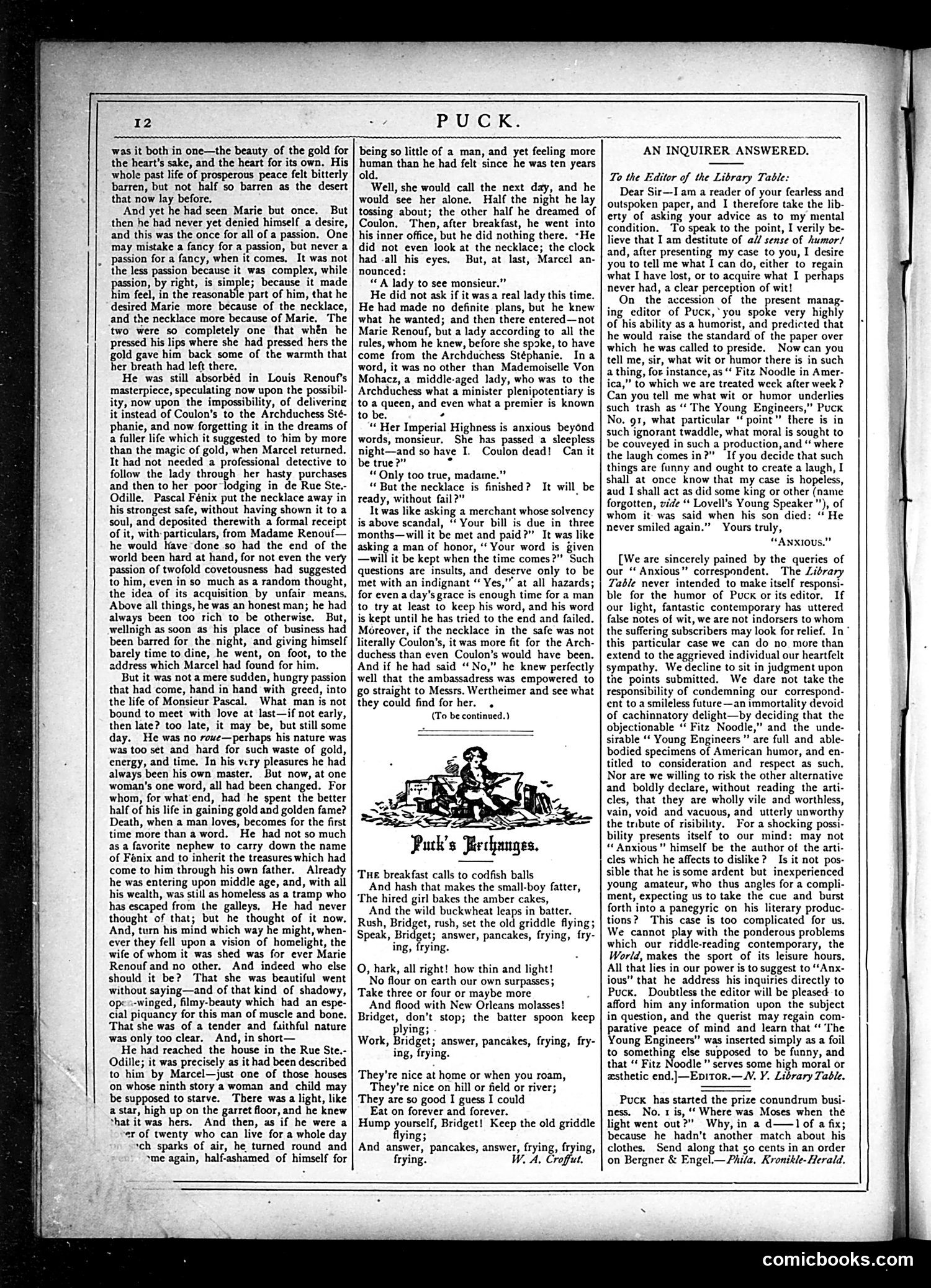
This page contains primarily **text content rather than political cartoons**. The main features are: 1. **"An Inquirer Answered"** - A letters column where the editor responds to reader inquiries about humor and satire in Puck magazine. A correspondent signing as "Anxious" complains that Puck's humor is too harsh and insulting, particularly regarding references to "Fitz Noodle" and mockery of "Young Engineers." 2. **"Puck's Birthings"** - A short poem/verse section featuring whimsical breakfast-themed wordplay and puns (coddish balls, buckwheat, pancakes, etc.) The page demonstrates Puck's self-reflective nature—addressing reader complaints about editorial tone while maintaining the publication's satirical voice through playful language and humor.
📄 Transcribed text from this page (OCR, searchable)
Machine-transcribed from the original scan — historical spelling and the odd misread are preserved.
12 PUCK. was it both in one—the beauty of the gold for the heart's sake, and the heart for its own. His whole past life of prosperous peace felt bitterly barren, but not half so barren as the desert that now lay before. And yet he had seen Marie but once. But then he had never yet denied himself _a desire, and this was the once for all of a passion. One may mistake a fancy for a passion, but never a passion for a fancy, when it comes, It was not the less passion because it was complex, while ion, by right, is sii mples because it made Fim feel, the reasonable part of him, that he desired Marie more because of the necklace, and the necklace more because of Marie. The two were so completely one that whén he pressed his lips where she had pressed hers the gold gave him back some of the warmth that her breath had left there. He was still absorbéd in Louis Renouf’s masterpiece, speculating now upon the possibil- ity, now upon the impossibility, of delivering it instead of Coulon’s to the Archduchess Sté- phanie, and now forgetting it in the dreams of a faller life which it suggested to him by more than the magic of gold, when Marcel returned. It had not needed a professional detective to follow the lady through her hasty purchases and then to her poor-lodging in de Rue Ste.- Odille. Pascal Fénix put the necklace away in his strongest safe, without having shown it to a soul, and deposited therewith a formal receipt of it, with: particulars, from Madame Renouf— he would Have done so had the end of the world been hard at hand, for not even the very passion of twofold covetousness had suggested to him, even in so much as a random thought, the idea of its acquisition by unfair means, Above all things, he was an honest man; he had always been too rich to be otherwise. But, wellnigh as soon as his place of business had been barred for the night, and giving himself barely time to dine, he went, on foot, to the address which Marcel had found for him. But it was not a mere sudden, hungry passion that had come, hand in hand with greed, into the life of Monsieur Pascal. What man is not bound to meet with love at last—if not early, then late? too late, it may be, but still some day. He was no rowe—perhaps his nature was was too set and hard for such waste of gold, energy, and time. In his very pleasures he had always been his own master. But now, at one woman's one word, all had been changed. For whom, for what'end, had he spent the better half of his life in gaining gold and golden fame? Death, when a man loves, becomes for the first time more than a word. He had not so much as a favorite nephew to carry down the name of Fénix and to inherit the treasures which had come to him through his own father. Already he was entering upon middle age, and, with all his wealth, was still as homeless as a tramp who has escaped from the galleys. He had never thought of that; but he thought of it now. And, turn his mind which way he might, when- ever they fell upon a vision of homelight, the wife of whom it was shed was for ever Marie Renouf and no other, And indeed who else should it be? That she was beautiful went without saying—and of that kind of shadowy, ope :-winged, filmy-beauty which had an espe- cial piquancy for this man of muscle and bone. That she was of a tender and faithful nature was only too clear, And, in short— He had reached the house in the Rue Ste.- Odile; it was precisely as it had been described to him by Marcel—just one of those houses ‘on whose ninth story a woman and child may be supposed to starve. There was a light, like a star, high up on the arret floor, and he knew shat it was hers. then, as ‘if he were a er of twenty ieligtcaallivestorlace tole day sch sparks of air, he turned round and yme again, half-ashamed of himself for being so little of a man, and yet feeling more pea than he had felt since he was ten years old. Well, she would call the next day, and he would see her alone. Half the night he lay tossing about; the other half he dreamed of Coulon, Then, after breakfast, he went into his inner office, but he did nothing there. -He did not even look at the necklace; the clock had -all his eyes. But, at last, Marcel an- nounced: “A lady to see monsieur.” He did not ask if it was a real lady this time. He had made no definite plans, but he knew what he wanted; and then there entered—not Marie Renouf, but a lady according to all the rules, whom he knew, before she spoke, to have come from the Archduchess Stéphanie. Ina word, it was no other than Mademoiselle Von Mohacz, a middle-aged lady, who was to the Archduchess what a minister plenipotentiary is to.a queen, and even what a premier is known to be. “Her Imperial Highness is anxious beyond words, monsieur. She has passed a sleepless night—and so have I. Coulon dead! Can it be true?” “Only too true, madame.” “ But the necklace is finished? ready, without fail?” It was like asking a merchant whose solvency is above scandal, ‘ Your bill is due in three months—will it be met and paid?” It was like asking a man of honor, “ Your word is given a will it be kept when the time comes?” Such questions are insults, and deserve only to be met with an indignant “Yes,’” at all hazards; for even a day'sgrace is enough time for a man to try at least to keep his word, and his word is kept until he has tried to the end and failed. Moreover, if the necklace in the safe was not literally Coulon's, it was more fit for the Arch- duchess than even Coulon’s would have been. And if he had said “No,” he knew perfectly well that the ambassadress was empowered to go straight to Messrs. Wertheimer and see what they could find for her. . (To be continued.) It will, be Pu Fs Trchmagen Tue breakfast calls to codfish balls And hash that makes the small-boy fatter, The hired girl bakes the amber cakes, And the wild buckwheat leaps in batter. Rush, Bridget, rush, set the old griddle flying; Speak, Bridget; answer, pancakes, frying, fry- ing, frying. O, hark, all right! how thin and light! No flour on earth our own surpasses; Take three or four or maybe more And flood with New Orleans molasses! Bridget, don’t stop; the batter spoon keep plying; Work, Bridget; answer, pancakes, frying, fry- ing, frying. They're nice at home or when you roam, They're nice on hill or field or river; They are so good I guess I could Eat on forever and forever. Hump yourself, Bridget! Keep the old griddle flying; And answer, pancakes, answer, frying, frying, frying. W. A, Croffut. AN INQUIRER ANSWERED. To the Editor of the Library Table: Dear Sir—I am a reader of your fearless and outspoken paper, and I therefore take the lib- erty of asking your advice as to my mental condition. To speak to the point, I verily be- lieve that I am destitute of a// sense of humor! and, after presenting my case to you, I desire you to tell me what I can do, cither to regain what I have lost, or to acquire what I perhaps never had, a clear perception of wit! On the accession of the present manag- ing editor of Puck,*you spoke very highly of his ability as a humorist, and predicted that he would raise the standard of the paper over which he was called to preside. Now can you tell me, sir, what wit or humor there is in such a thing, for instance, as ‘‘ Fitz Noodle in Amer- ica,” to which we are treated weck after week ? Can you tell me what wit or humor underlies such trash as ‘‘ The Young Engineers,” Puck No. 91, what particular “point” there is in such ignorant twaddle, what moral is sought to be couveyed in such a production, and “ where the laugh comes in?” If you decide that such things are funny and ought to create a laugh, I shall at once know that my case is hopeless, aud I shall act as did some king or other (name forgotten, vide “ Lovell’s Young Speaker”), of whom it was said when his son died: “ He never smiled again.” Yours truly, “ANXIOUS.” [We are sincerely pained by the queries of our “Anxious” correspondent. The Library Table never intended to make itself responsi- ble for the humor of Puck or its editor. If our light, fantastic contemporary has uttered false notes of wit, we are not indorsers to whom the suffering subscribers may look for relief. In* this particular case we can do no more than extend to the aggrieved individual our heartfelt sympathy. We decline to sit in judgment upon the points submitted. We dare not take the responsibility of condemning our correspond- ent to a smileless future—an immortality devoid of cachinnatory delight—by deciding that the objectionable “ Fitz Noodle,” and the unde- sirable ‘‘ Young Engineers" are full and able- bodied specimens of American humor, and en- titled to consideration and respect as such. Nor are we willing to risk the other alternative and boldly declare, without reading the arti- cles, that they are wholly vile and worthless, vain, void and vacuous, and utterly unworthy the tribute of risibility. For a shocking possi- bility presents itself to our mind: may not “Anxious” himself be the author of the arti- cles which he affects to dislike? Is it not pos- sible that he is some ardent but inexperienced young amateur, who thus angles for a compli- ment, expecting us to take the cue and burst forth into a panegyric on his literary produc- tions? This case is too complicated for us. We cannot play with the ponderous problems which our riddle-reading contemporary, the World, makes the sport of its leisure hours, All that lies in our power is to suggest to “Anx- ious” that he address his inquiries directly to Puck. Doubtless the editor will be pleased to afford him any information upon the subject in question, and the querist may regain com- parative peace of mind and learn that “ ‘The Young Engineers” was inserted simply as a foil to something else supposed to be funny, and that ‘‘ Fitz Noodle ” serves some high moral or zsthetic end.]—Epitor.—W. Y. Library Table. Puck has started the prize conundrum busi- ness. No. 1 is, “ Where was Moses when the light went out ?” Why, in a d—1of a fix; because he hadn’t another match about his clothes. Send along that 50 cents in an order on Bergner & Engel.— Phila. Kronikle- Herald. comicbooks.com