
A complete issue · 16 pages · 1878
Puck — May 29, 1878
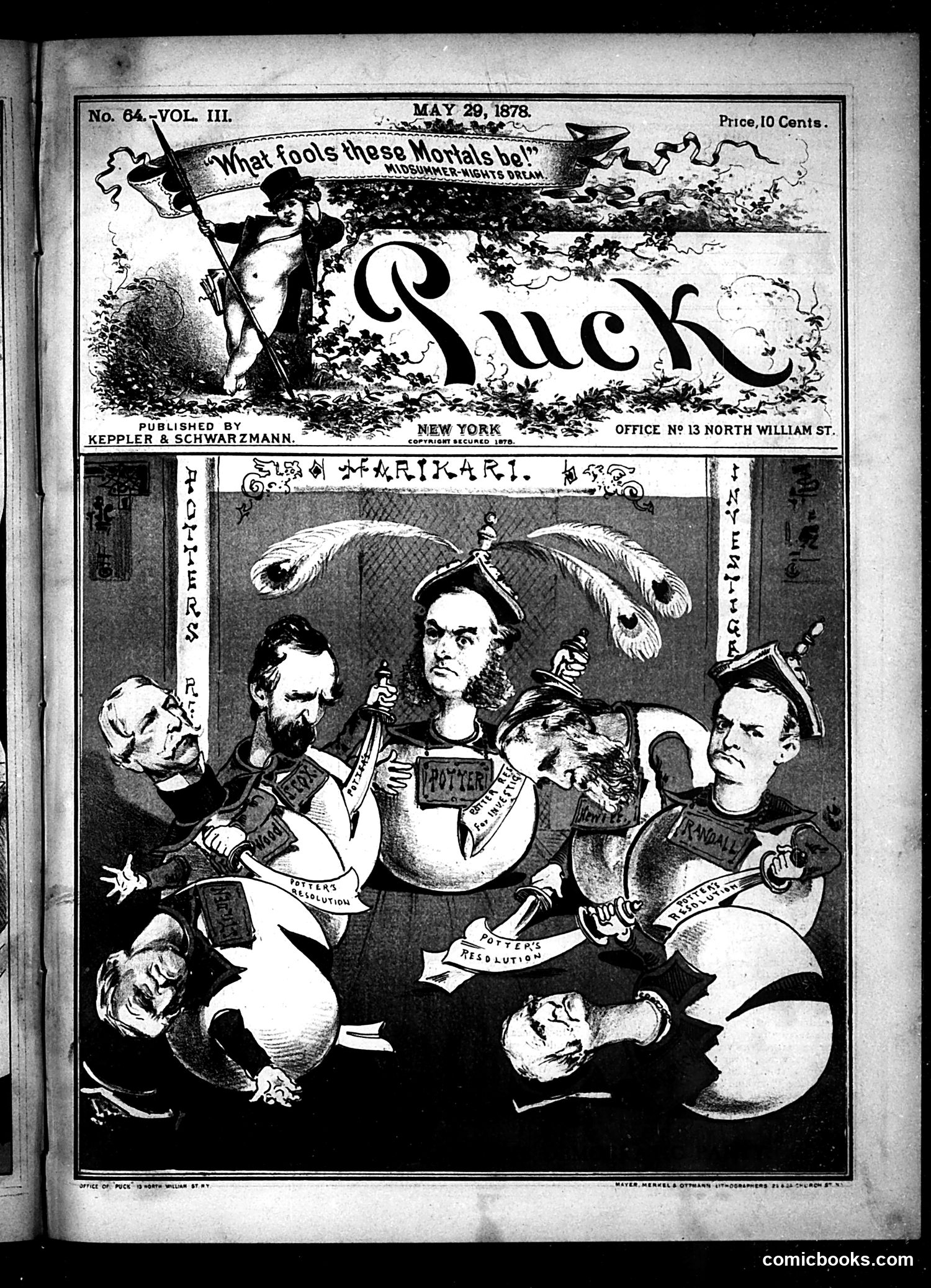
This cartoon, titled "Strikari" (a play on "Strike"), depicts five portly politicians or labor figures depicted as sumo wrestlers or rotund characters, each labeled with various political positions or resolutions. The central figure appears to be the main target of the satire. The title "What fools these Mortals be!" references Shakespeare's *A Midsummer Night's Dream*, suggesting the figures are acting foolishly. The imagery satirizes what appears to be labor disputes or political conflicts of 1878—likely strike-related controversies or failed political negotiations of that era. The exaggerated physiques and theatrical poses mock the subjects as simultaneously pompous and ridiculous. Without clearer label legibility, specific figures remain uncertain, but the satire clearly ridicules political incompetence during a contentious period of American labor history.
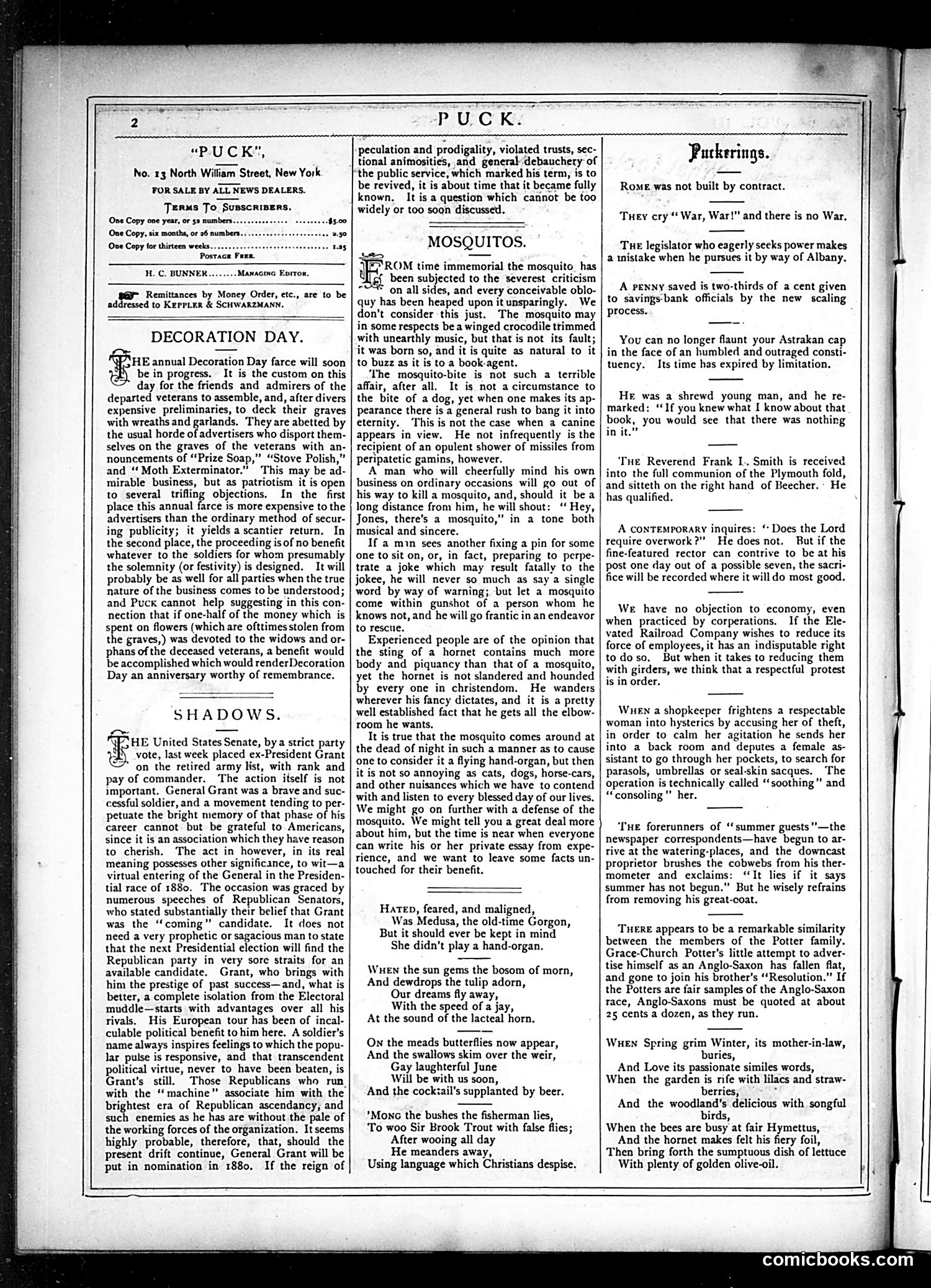
This page consists primarily of **editorial content and poetry**, not political cartoons. The main sections include: **"Decoration Day"** — discusses the annual Civil War memorial observance, noting how the holiday has become commercialized with expensive advertisements rather than genuine patriotic reflection. The editor criticizes this commodification. **"Shadows"** — commentary on General Grant's potential 1880 presidential nomination, suggesting Republican support for him represents political opportunism seeking his prestige rather than principle. **"Puckerings"** — a humor column with brief satirical quips on various topics (legislators, politicians, social behavior). **"Mosquitos"** and other sections contain light satirical essays rather than visual cartoons. The page functions as opinion journalism typical of Puck's format.
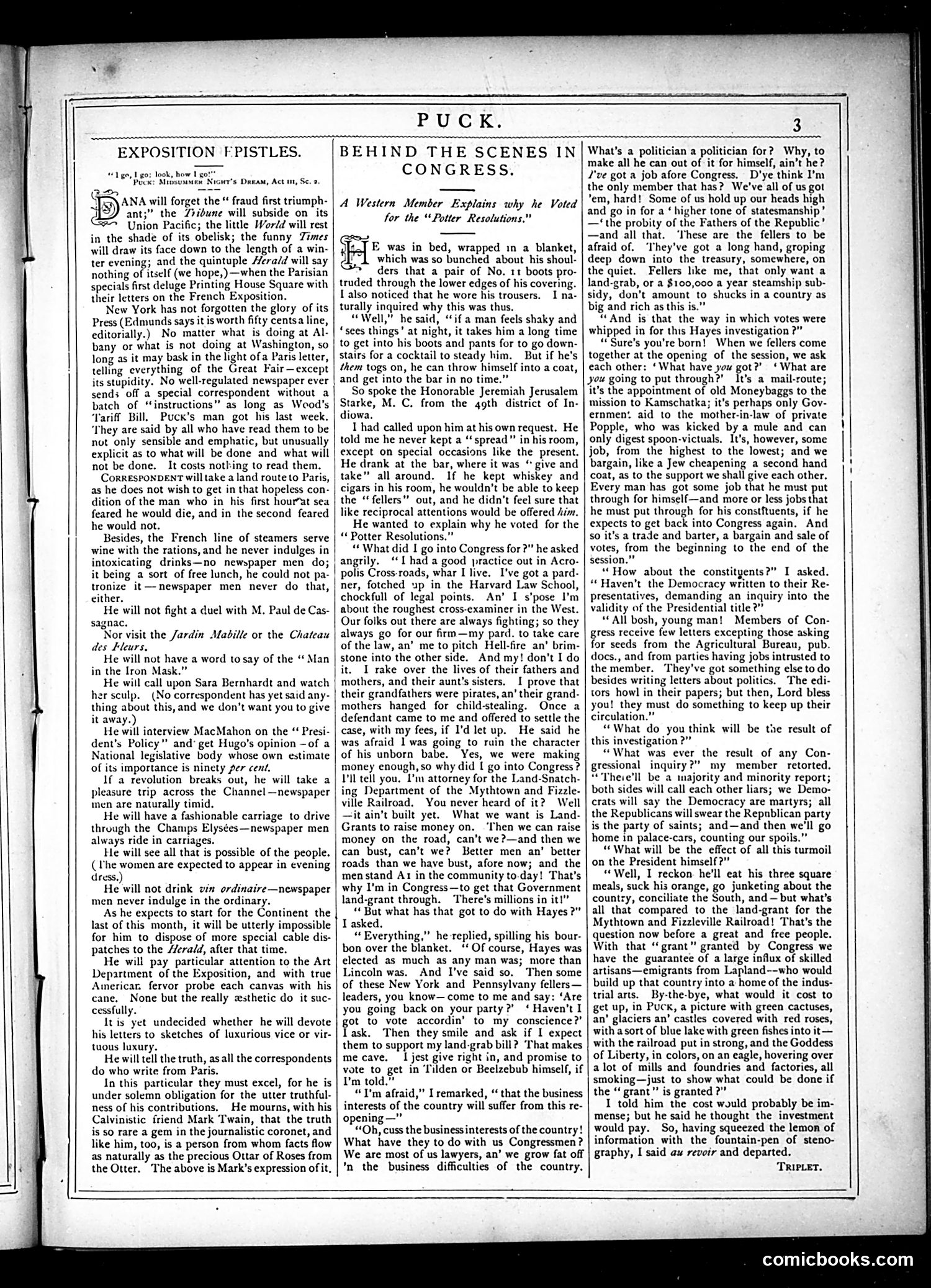
This page contains two sections: "Exposition Epistles" (newspaper parody) and "Behind the Scenes in Congress" (political commentary). **"Behind the Scenes in Congress"** features a Western congressman explaining his voting record to constituents. The satire targets congressmen who prioritize personal enrichment over public service—the politician admits voting based on which interests benefit him personally rather than constituent welfare. References include land-grab schemes, railroad investments, and the "Mythtown and Fizzleville Railroad," suggesting satirical critiques of corporate influence on Congress. The piece mocks elected officials' hypocritical justifications for corrupt votes and exposes how legislators abandon agricultural/labor constituencies to serve wealthy business interests. The congressman's candid admissions about voting for personal profit constitute the satire's core joke: exposing what politicians normally conceal.
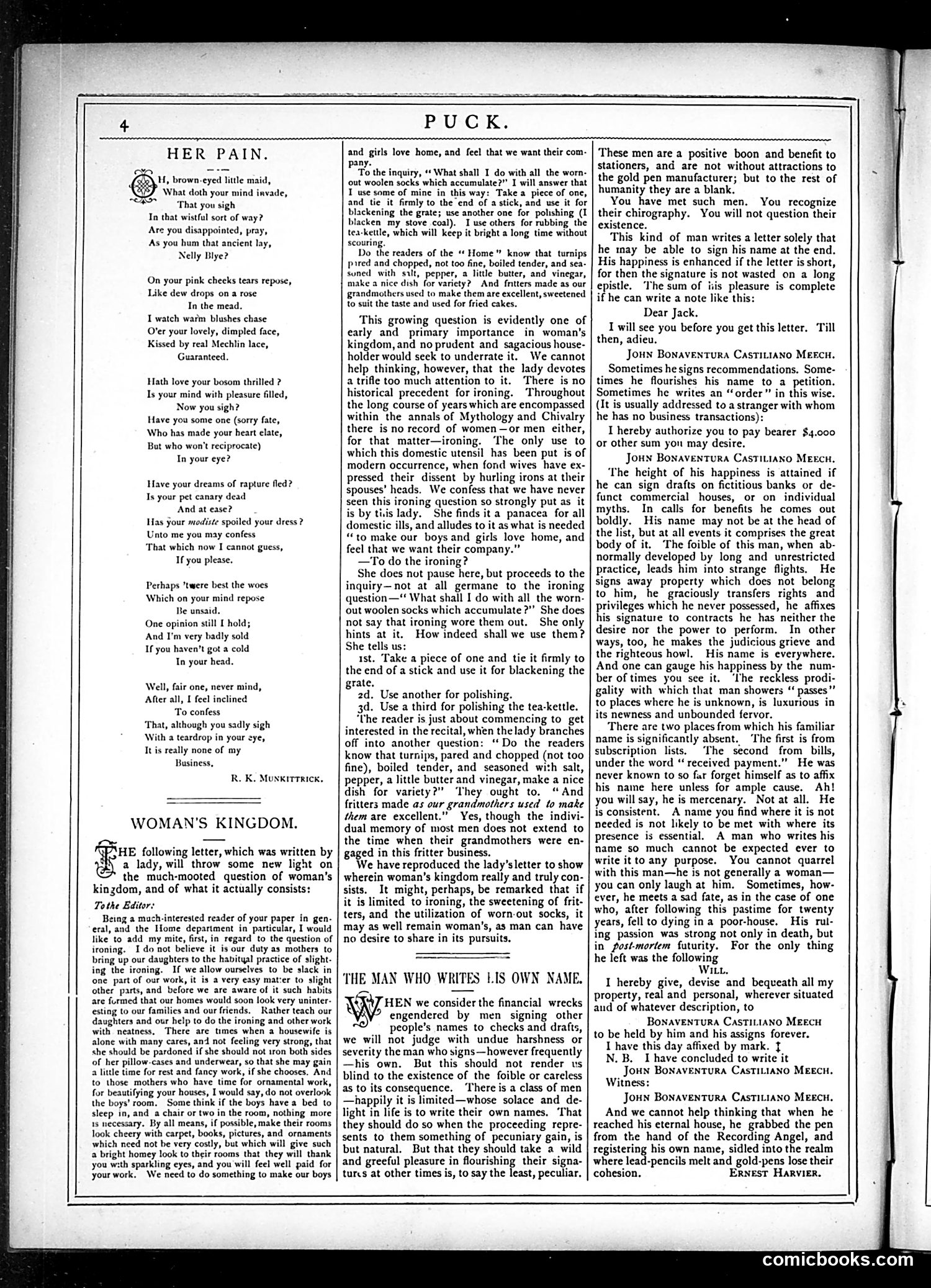
This Puck magazine page contains three distinct sections: a poem titled "Her Pain" (addressing domestic hardship), and two prose pieces on women's issues. The main satirical content is **"Woman's Kingdom,"** which addresses the impractical question of what wives should do with worn-out stockings and household textiles. The letter mocks the triviality of such domestic concerns by suggesting absurd solutions—using worn socks to polish tea kettles, for instance. The satire targets both the advice-column format and the limited scope of "woman's concerns" in Victorian society. **"The Man Who Writes His Own Name"** critiques men who sign financial documents themselves rather than hire professionals, viewing this as foolish pride. It satirizes masculine vanity and poor judgment in business matters. Together, these pieces mock gender roles and domestic preoccupations of the era.
This page contains two separate articles rather than political cartoons. **"A Word to Scientists"** critiques a professional gentleman (identified as "Thomas Jones") who claims expertise across multiple fields—violinist, orchestra member, scientist—despite lacking genuine credentials. The satire mocks dilettantes who dabble in specialized fields without real knowledge, particularly targeting those who make grand claims about scientific progress while misunderstanding the actual work involved. **"His Brother"** is a humorous anecdote about the author's sibling who, while visiting from out West, attempts to hunt game using improvised methods (a homemade cannon, rigged carriage). The story satirizes incompetent city-folk attempting frontier activities, poking fun at their ignorance of practical hunting techniques and wildlife behavior. Both pieces exemplify Puck's satirical approach to American social pretension and incompetence.
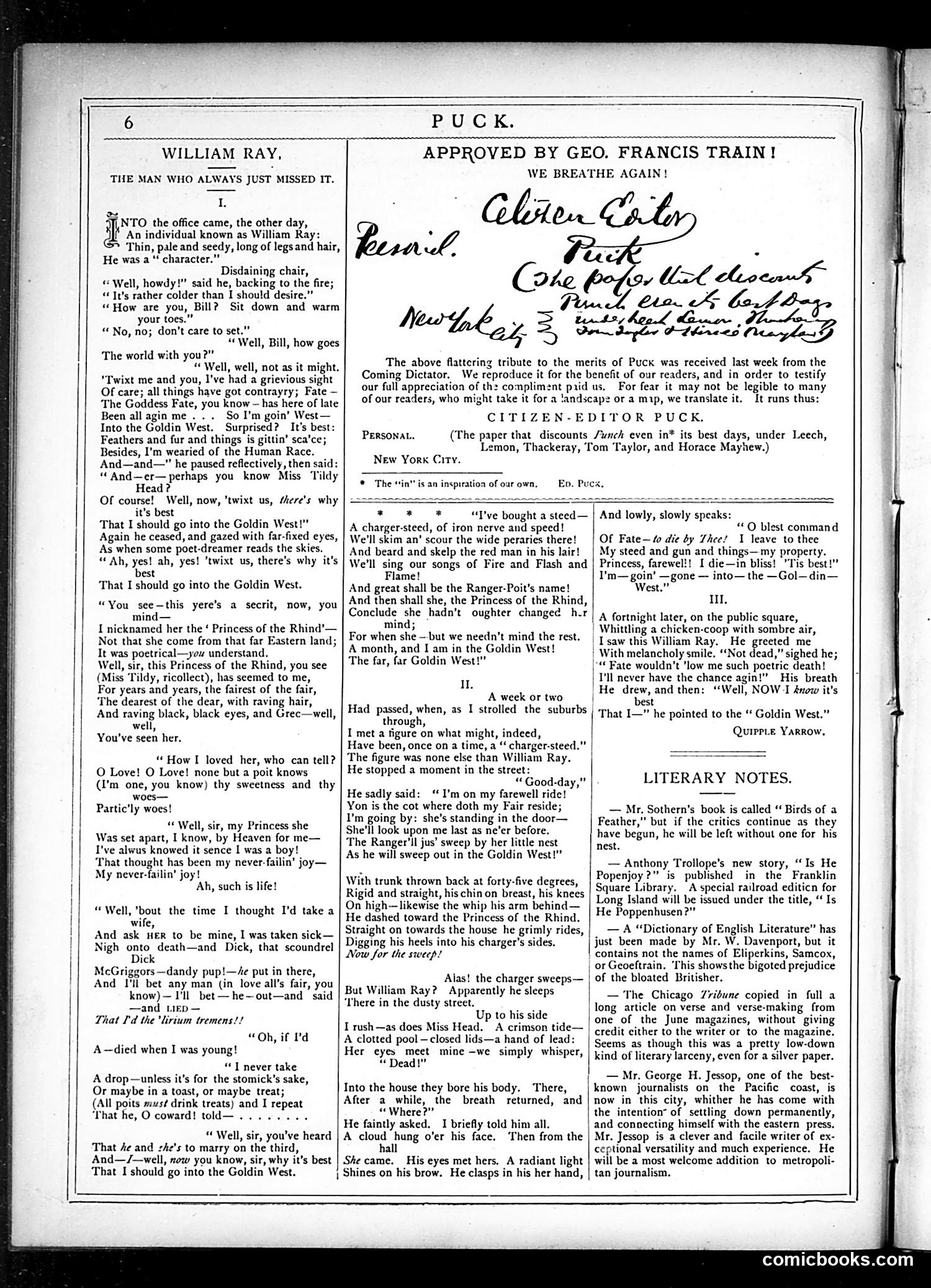
This page contains a poem titled "William Ray: The Man Who Always Just Missed It," accompanied by handwritten editorial approval and notes. The literary content satirizes a character named William Ray who repeatedly fails to achieve success—he "always just missed it." The poem's narrative follows Ray's romantic and financial misadventures, particularly his pursuit of "the Princess of the Rhind" and dreams of striking it rich in the "Golden West." The satire targets the archetypal unsuccessful American dreamer: perpetually on the verge of fortune and romance but perpetually thwarted by bad timing or poor judgment. The page also includes "Literary Notes" reviewing contemporary books and writers, suggesting this is a literary-focused issue. The overall tone mocks aspirational but hapless individuals common in Gilded Age American society.
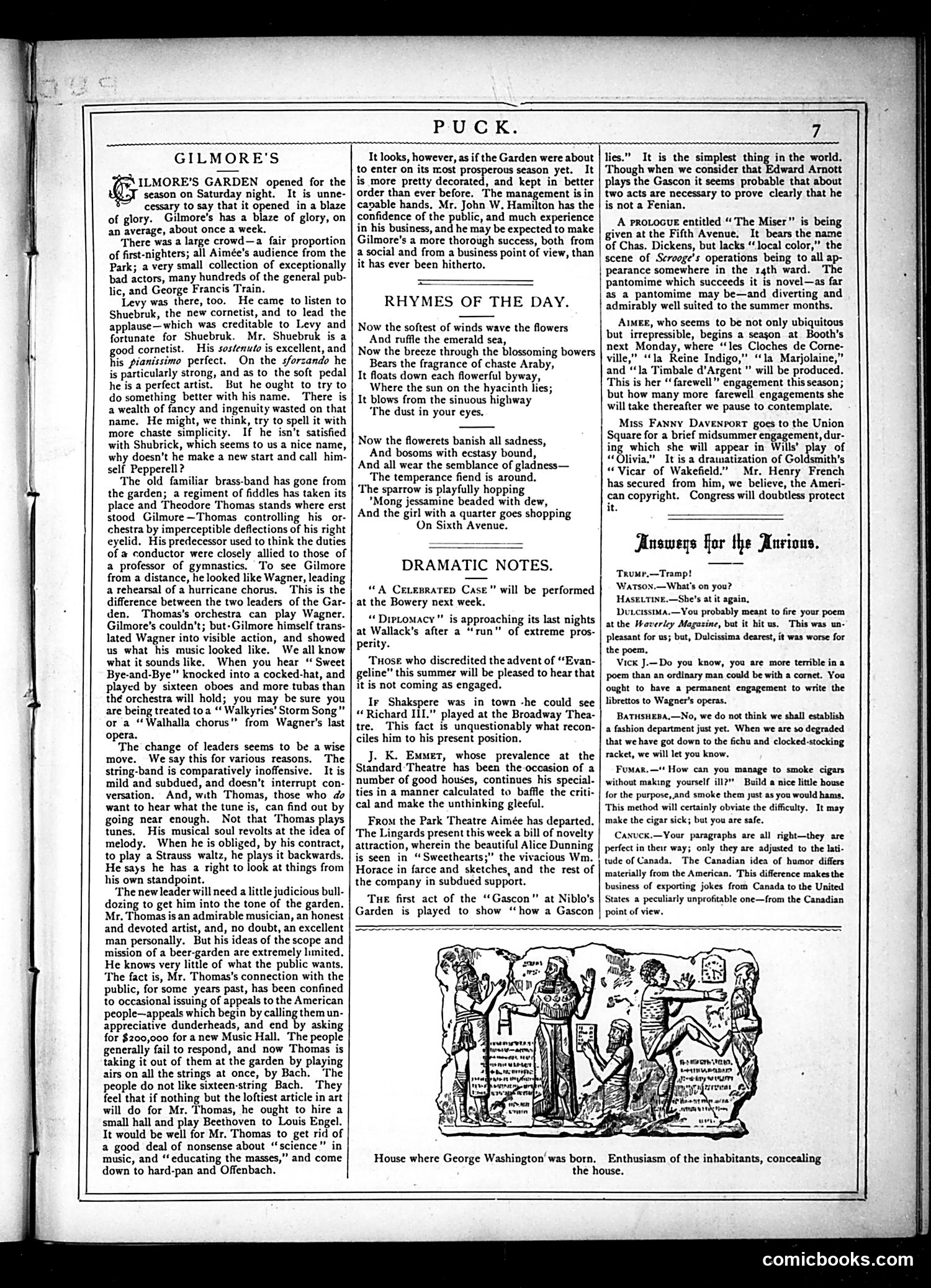
This page contains theatrical reviews and entertainment commentary rather than political satire. The main cartoon at the bottom depicts a colonial-era house with the caption "House where George Washington was born. Enthusiasm of the inhabitants, concealing the house." The joke appears to satirize American patriotic fervor—suggesting that locals' enthusiasm for the Washington birthplace is so excessive they're literally hiding or obscuring the actual historic structure. It's gentle mockery of overwrought nationalism and historical site promotion. The rest of the page covers theater productions ("A Celebrated Case," "Diplomacy") and discusses changes in theatrical leadership. The tone is critical commentary on theater management and artistic direction rather than political cartooning.
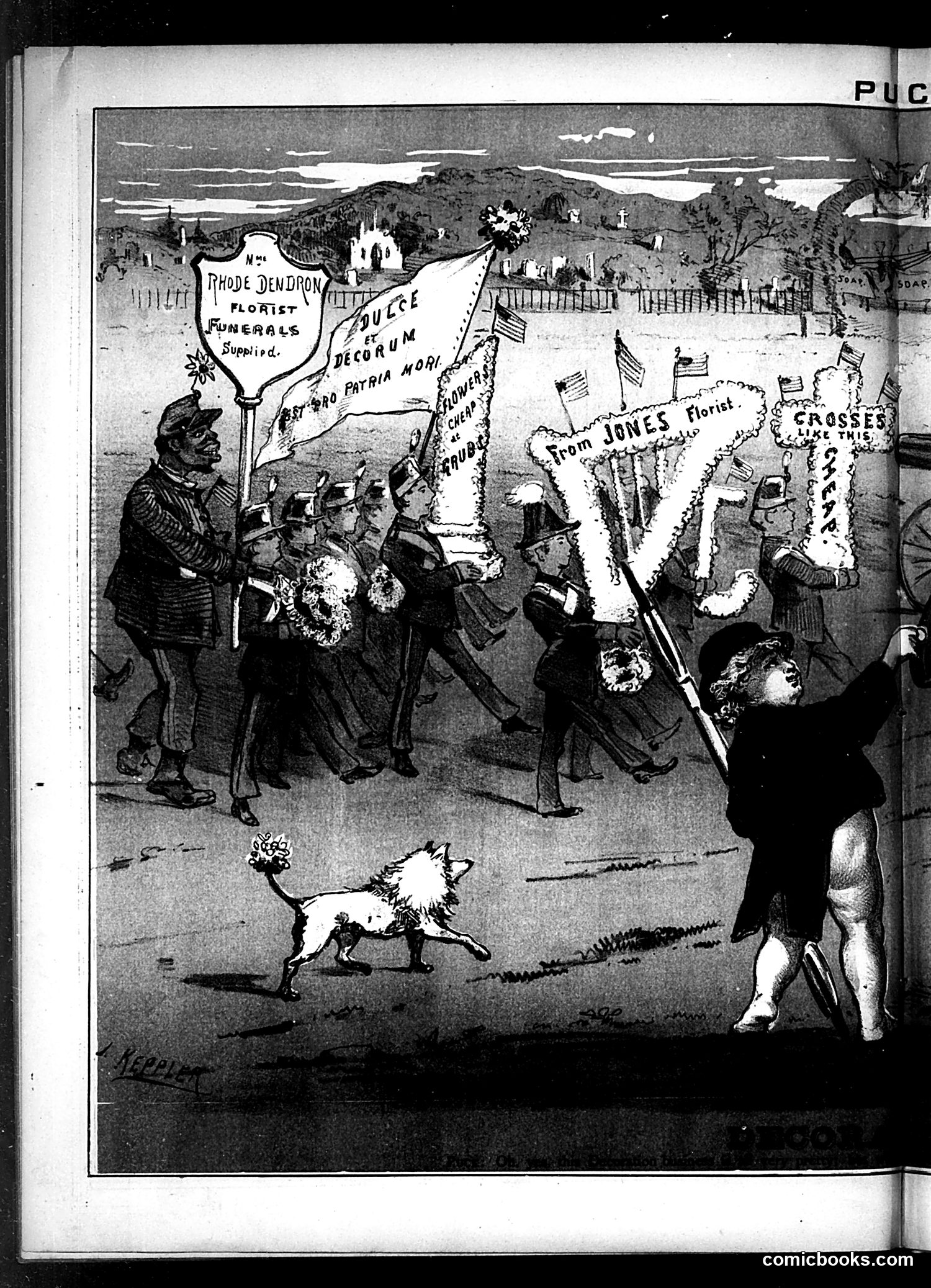
This Puck cartoon satirizes American patriotism and jingoism, likely from the late 1800s. A procession of military and civic figures carries various patriotic banners and crosses, including ones reading "Dulce Decorum" (Latin for "it is sweet to die for one's country"), "Est Pro Patria Mori" (another Latin phrase about dying for country), and florist advertisements ("From Jones Florist," "Crosses This Way"). The satire appears to mock the commercialization and hollow sentimentality surrounding patriotic death—note the small dog carrying flowers in the foreground and the cupid figure on the right. The juxtaposition of military procession imagery with florist advertisements suggests criticism of how patriotic sacrifice becomes merely ornamental, reduced to decorative flowers and commercial enterprise rather than meaningful national service.
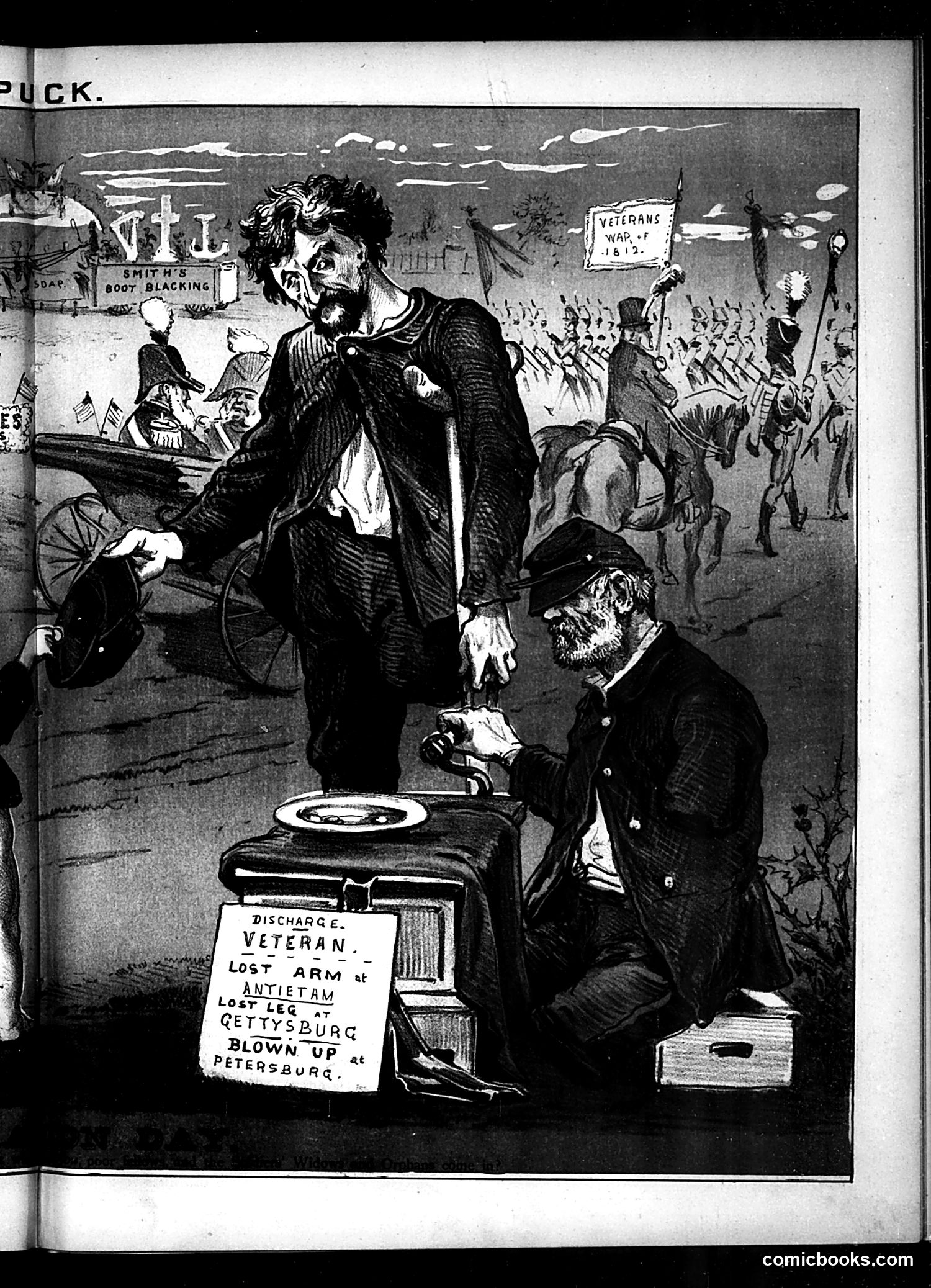
This Puck cartoon satirizes the treatment of Civil War veterans in the postwar period. A disheveled disabled veteran—missing an arm, having lost a leg at Antietam, and injured at Gettysburg and Petersburg—sits begging while a well-dressed man stands over him, seemingly indifferent or dismissive. The contrast is stark: the veteran bears visible wounds from major Civil War battles (labeled on his belongings), yet appears impoverished and abandoned. Meanwhile, in the background, prosperous civilians and military figures move about freely. The satire critiques the government's failure to adequately support disabled veterans after the war, suggesting that those who sacrificed their bodies for the nation were left destitute while society moved on indifferently. It's a pointed commentary on ingratitude and broken social obligation.
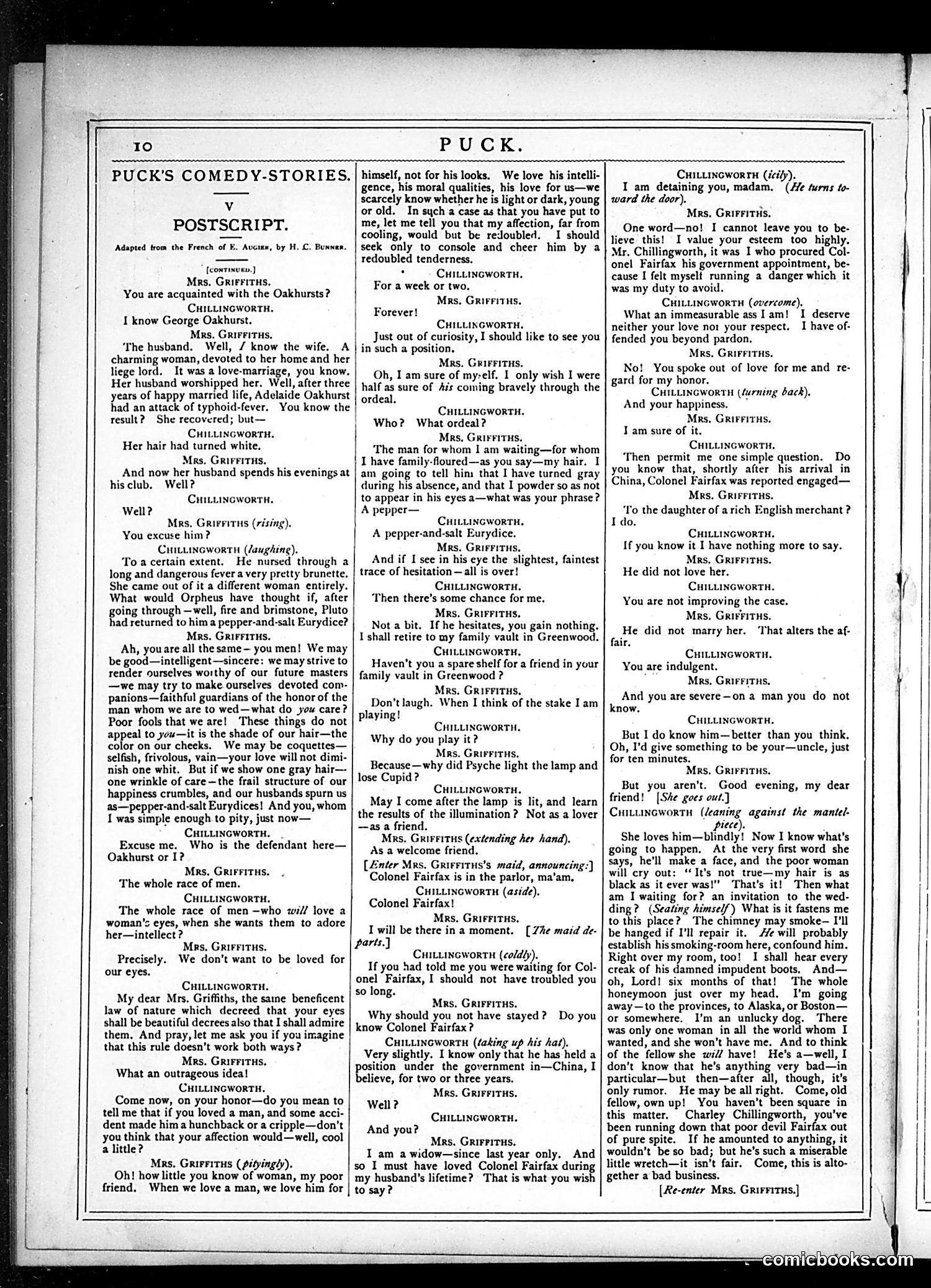
This page contains **"Postscript," a comedy dialogue** adapted from a French play by H.E. Busnach. The piece is entirely text-based—a theatrical script with no cartoons or caricatures. The sketch presents a domestic farce involving **Mrs. Griffiths and Colonel Chillingworth**, who are apparently former lovers. Mrs. Griffiths is married; Chillingworth has recently returned from government service in China. The humor revolves around their rekindled attraction, jealous accusations, and marital complications, particularly regarding her husband's evening habits and a disputed piece of jewelry. The satire targets **Victorian romantic entanglement and bourgeois social hypocrisy**—the tension between proper respectability and actual infidelity. The dialogue emphasizes class anxieties (mentions of family vaults, government positions) alongside romantic melodrama typical of period theatrical comedy.
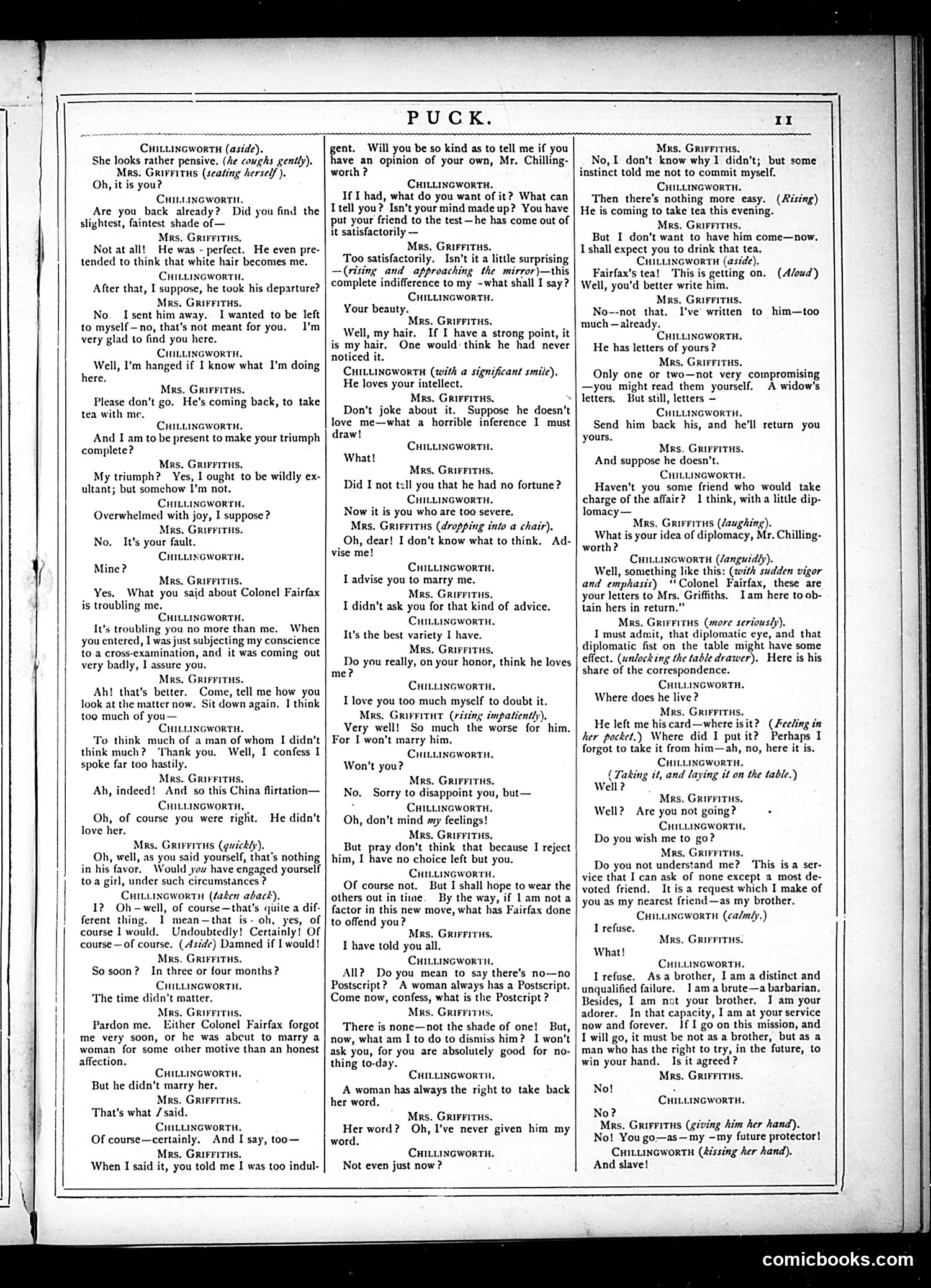
This page contains a theatrical dialogue between two characters: **Chillingworth** and **Mrs. Griffiths**. Based on the formal speech patterns and dramatic structure, this appears to be a **play excerpt or dramatic scene** rather than a political cartoon. The scene depicts a romantic conflict: Mrs. Griffiths confronts Chillingworth about his relationship with another woman. She references Colonel Fairfax and marriage prospects, suggesting this is a **domestic/romantic comedy** about courtship and social expectations. The satire appears to target **Victorian-era relationship dynamics**—particularly women's limited agency in marriage, reliance on male decision-making, and the social pressures around courtship. The dialogue mocks both characters' pretensions and emotional manipulations. Without additional context identifying the specific play or its original publication date, I cannot determine the precise satirical targets beyond these general social observations.
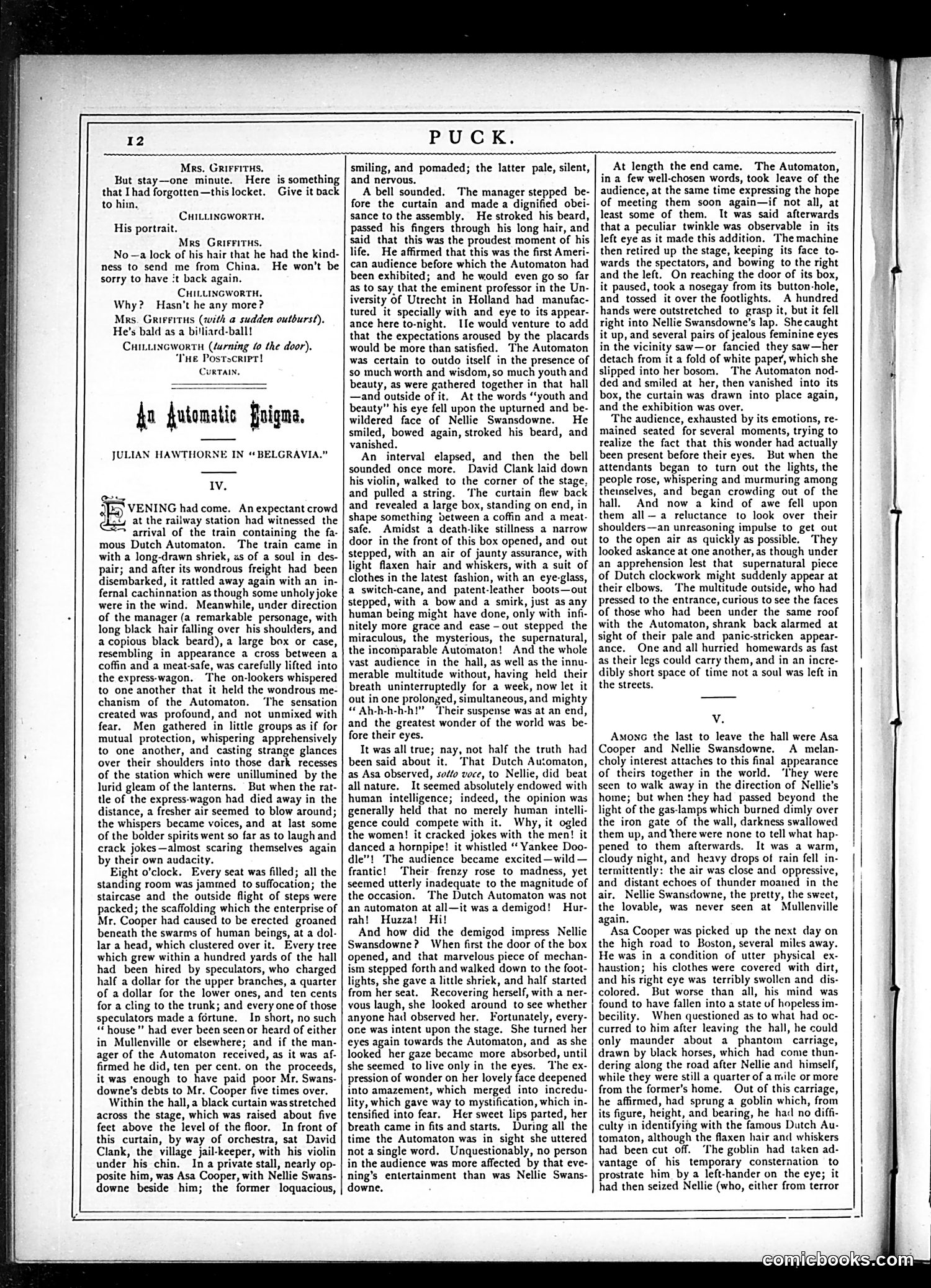
This page from *Puck* contains a serialized story titled "An Automatic Enigma" by Julian Hawthorne, illustrated with text rather than cartoons. The narrative describes a mechanical automaton—a lifelike Dutch creation—that appears at a railway station entertainment hall, captivating audiences with its mysterious humanlike qualities. The story satirizes contemporary fascination with automata and mechanical innovations of the era. Key figures mentioned include David Clark (railway manager), Nellie Swandowne (a young woman who becomes emotionally invested in the automaton), and Asa Cooper. The piece plays on Victorian anxieties about technology, artificial intelligence, and the blurring line between mechanical and human nature—themes reflecting late 19th-century technological advancement and public wonder at such innovations.
This page contains miscellaneous satirical items and anecdotes rather than a single unified cartoon. The central illustration labeled "Puck's Intrigues" appears to show a chaotic scene with figures in distress or conflict, though details are unclear at this resolution. The text items mock various contemporary subjects: Automaton inventions and their practical limitations; a New Jersey clergyman's attempt to poison his wife using Biblical precepts; railroad and steamship industry practices; and general social absurdities of the era (including a fish in Alaska so large it could be burned as a candle). The "Othello's Apology" poem appears to be a satirical response to Shakespeare, likely critiquing marital or social relations. These are typical of *Puck*'s format: brief, pointed jabs at institutions, public figures, and contemporary follies.
This page is primarily **advertising and announcements** rather than political satire. The main content includes: - Multiple product advertisements (Apollinaris mineral water, Hungarian wines, furniture) - A notice from Mathesius & Frey regarding ownership changes - A German Liederkranz festival announcement There are brief **humorous verse snippets** scattered throughout (about a man by a pond, soldiers' antics, etc.), typical of Puck's filler material, but they appear unrelated to specific political figures or events. The page lacks the characteristic political cartoons Puck was known for. Instead, it functions as a commercial issue showcasing period advertisements while maintaining light comedic tone through small poetic interludes. Without additional context about the specific date and political climate, the verse humor remains generic rather than topical satire.
This page is **primarily advertising and business announcements** rather than satirical content. The main feature is Puck's announcement of a new "General Designing Office" that employs cartoonist **Joseph Keppler** (likely the magazine's founder/editor) to create illustrations for clients, particularly theatrical professionals seeking lithographic portraits. The page contains numerous product advertisements typical of 1870s New York: Friedrichshall Bitterwasser, jewelry, printing inks, and a tailor shop. There is one small cartoon labeled "Puck's Almanac for 1878" showing what appears to be allegorical figures, but it's too small to interpret clearly. This is essentially a **business/classified advertising page** with minimal satirical content—the kind of revenue-generating material common in period magazines.
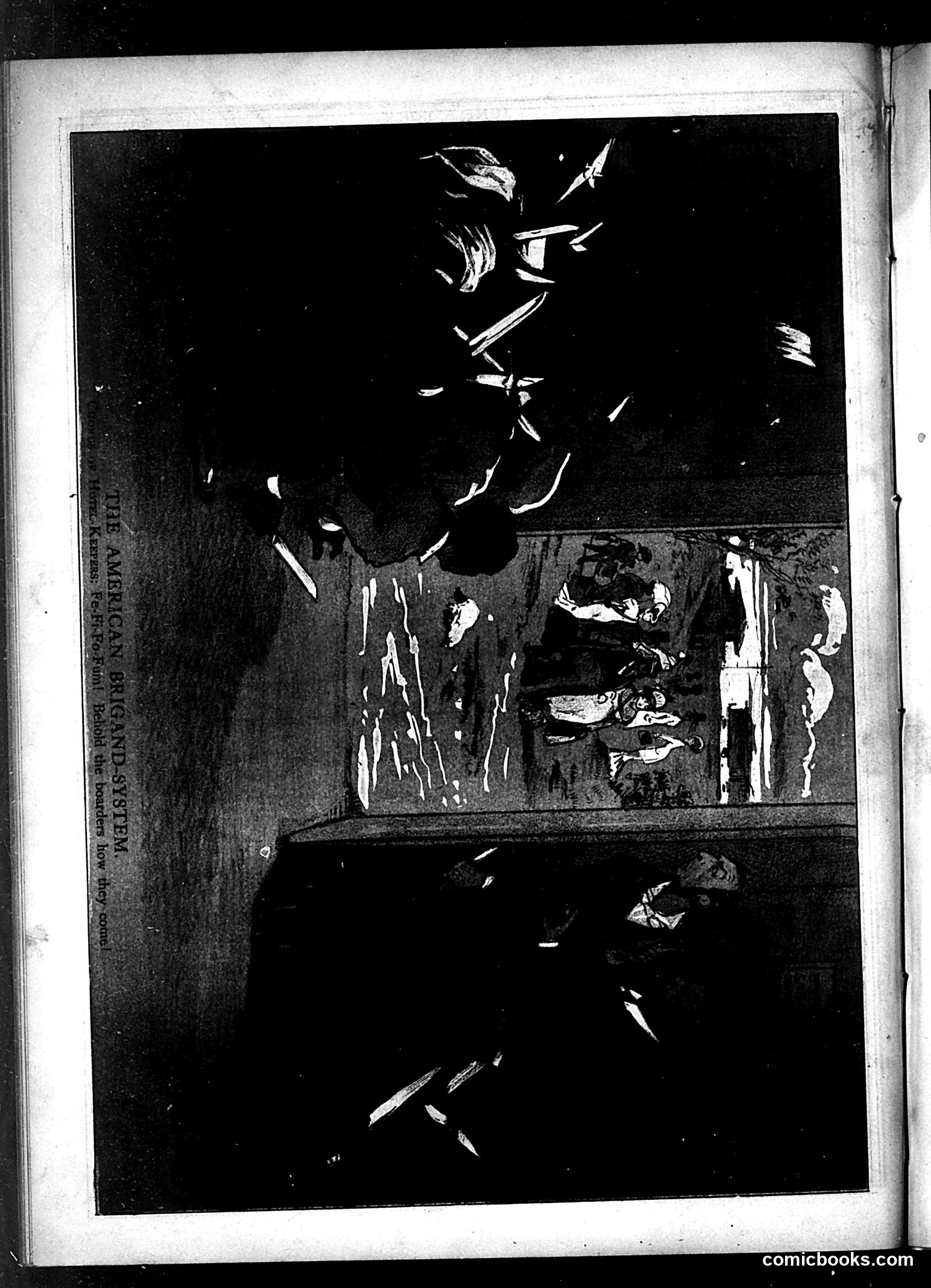
I can see this is a page from Puck magazine, but the image quality and contrast make it difficult to read the OCR text clearly or identify specific figures with confidence. The page appears to contain political or social satire typical of Puck's style, with what looks like caricatured figures in various scenes. However, without being able to reliably read the accompanying text or clearly distinguish the depicted individuals and their characteristics, I cannot accurately explain the cartoon's specific political references or satirical intent to a modern reader. To provide accurate historical context, I would need a higher-quality image or clearer text. I'm unable to meet your accuracy standard here.