
Puck, 1878-05-29 · page 7 of 16
Puck — May 29, 1878 — page 7: what you’re looking at
What you’re looking at
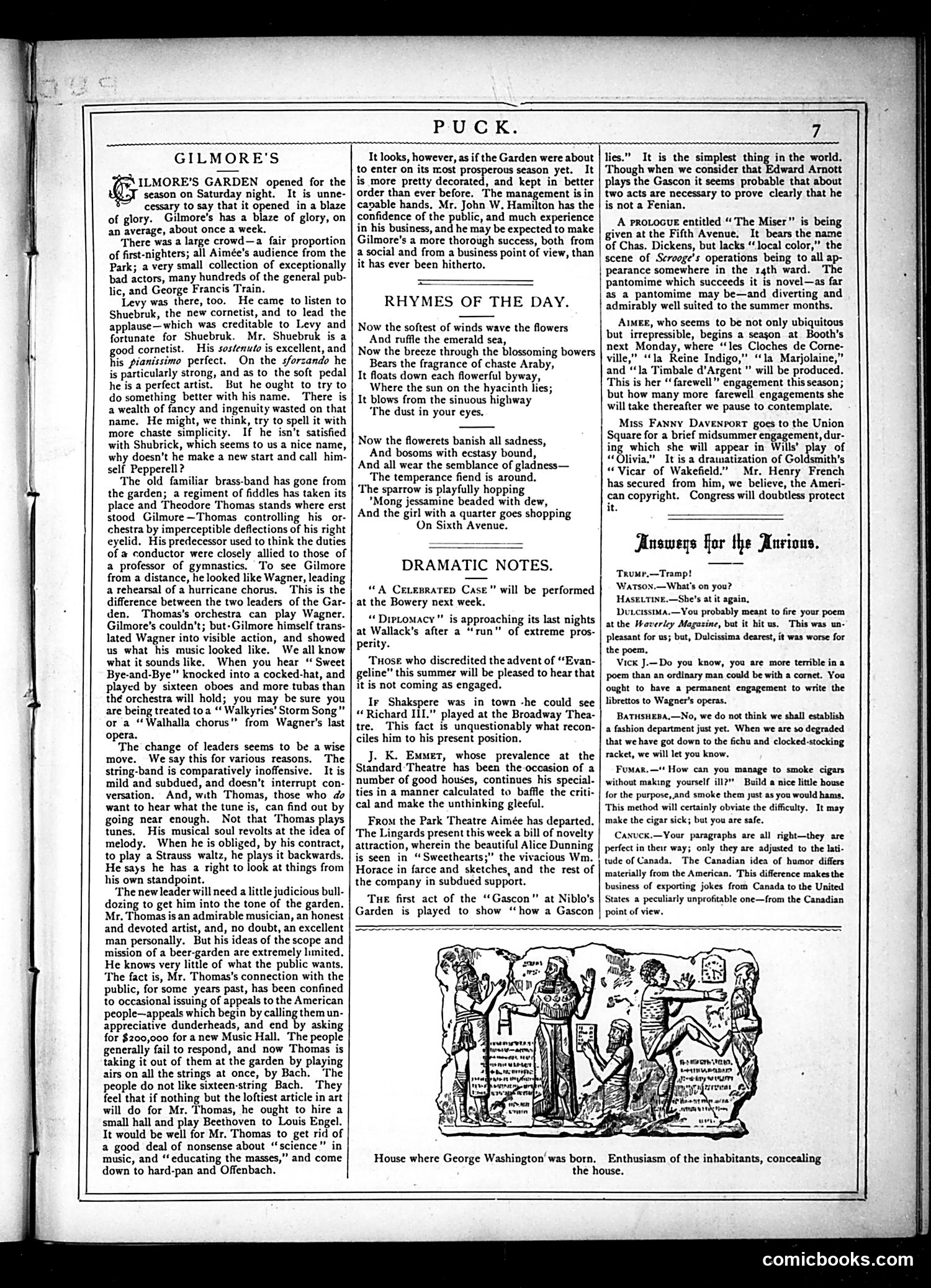
This page contains theatrical reviews and entertainment commentary rather than political satire. The main cartoon at the bottom depicts a colonial-era house with the caption "House where George Washington was born. Enthusiasm of the inhabitants, concealing the house." The joke appears to satirize American patriotic fervor—suggesting that locals' enthusiasm for the Washington birthplace is so excessive they're literally hiding or obscuring the actual historic structure. It's gentle mockery of overwrought nationalism and historical site promotion. The rest of the page covers theater productions ("A Celebrated Case," "Diplomacy") and discusses changes in theatrical leadership. The tone is critical commentary on theater management and artistic direction rather than political cartooning.
📄 Transcribed text from this page (OCR, searchable)
Machine-transcribed from the original scan — historical spelling and the odd misread are preserved.
PUCK. 7 GILMORE'S ILMORE’S GARDEN opened for the season on Saturday night. It is unne- cessary to say that it opened in a blaze of glory. Gilmore's has a blaze of glory, on an average, about once a week. ‘There was a large crowd—a fair proportion of first-nighters; all Aimée’s audience from the Park; a very small collection of exceptionally bad actors, many hundreds of the general pub- lic, and George Francis Train. Levy was there, too. He came to listen to Shuebruk, the new cornetist, and to lead the applause—which was creditable to Levy and fortunate for Shuebruk. Mr. Shuebruk is a good cornetist. His sostenuto is excellent, and his pianissimo perfect. On the sforsando he is particularly strong, and as to the soft pedal he is a perfect artist. But he ought to try to do something better with his name. There is a wealth of fancy and ingenuity wasted on that name. He might, we think, try to spell it with more chaste simplicity. If he isn’t satisfied with Shubrick, which seems to us a nice name, why doesn't he make a new start and call him- self Pepperell? The old familiar brass-band has gone from the garden; a regiment of fiddles has taken its place and Theodore Thomas stands where erst stood Gilmure~Thomas controlling his or- chestra by imperceptible deflections of his right eyelid. His predecessor used to think the duties of a conductor were closely allied to those of a professor of gymnastics. To see Gilmore from a distance, he looked like Wagner, leading a rehearsal of a hurricane chorus. This is the difference between the two leaders of the Gar- den. Thomas's orchestra can play Wagner. Gilmore’s couldn't; but-Gilmore himself trans- lated Wagner into visible action, and showed us what his music looked like. We all know what it sounds like. When you hear “ Sweet Bye-and-Bye” knocked into a cocked-hat, and played by sixteen oboes and more tubas than thé orchestra will hold; you may be sure you are being treated toa “ Walkyries’ Storm Song” or a “Walhalla chorus" from Wagner’s last opera. The change of leaders seems to be a wise move. We say this for various reasons. The string-band is comparatively inoffensive. It is mild and subdued, and doesn’t interrupt con- versation. And, with Thomas, those who do want to hear what the tune is, can find out by going near enough. Not that Thomas plays tunes. His musical soul revolts at the idea of melody. When he is obliged, by his contract, to play a Strauss waltz, he plays it backwards. He says he has a right to look at things from his own standpoint. ‘The new leader will need a little judicious bull- dozing to get him into the tone of the garden. Mr. Thomas is an admirable musician, an honest and devoted artist, and, no doubt, an excellent man personally. But his ideas of the scope and mission of a beer-garden are extremely limited, He knows very little of what the public wants. The fact is, Mr. Thomas's connection with the public, for some years past, has been confined to occasional issuing of appeals to the American people—appeals which begin by calling them un- appreciative dunderheads, and end by asking for $200,000 for a new Music Hall. The people generally fail to respond, and now Thomas is taking it out of them at the garden by playing airs on all the strings at once, by Bach. The people do not like sixteen-string Bach. ‘They feel that if nothing but the loftiest article in art will do for Mr. Thomas, he ought to hire a small hall and play Beethoven to Louis Engel. It would be well for Mr, Thomas to get rid of a good deal of nonsense about “science” in music, and “educating the masses,” and come down to hard-pan and Offenbach. It looks, however, as if the Garden were about to enter on its most prosperous season yet. It is more pretty decorated, and kept in better order than ever before. The management is in capable hands. Mr. John W. Hamilton has the confidence of the public, and much experience in his business, and he may be expected to make Gilmore's a more thorough success, both from a social and from a business point of view, than it has ever been hitherto. RHYMES OF THE DAY. Now the softest of winds wave the flowers And ruffle the emerald sea, Now the breeze through the blossoming bowers Bears the fragrance of chaste Araby, It floats down each flowerful byway, Where the sun on the hyacinth lies; It blows from the sinuous highway ‘The dust in your eyes. Now the flowerets banish all sadness, ‘And bosoms with ecstasy bound, And all wear the semblance of gladness— The temperance fiend is around. ‘The sparrow is playfully hopping *Mong jessamine beaded with dew, And the girl with a quarter goes shopping On Sixth Avenue. DRAMATIC NOTES. “A CeLepratep Case” will be performed at the Bowery next week. “‘Diptomacy"’ is approaching its last nights at Wallack's after a “run” of extreme pros- perity. ‘THose who discredited the advent of ‘‘Evan- geline” this summer will be pleased to hear that it is not coming as engaged. Ir Shakspere was in town -he could see “Richard ILI.” played at the Broadway Thea- tre. This fact is unquestionably what recon- ciles him to his present position. . K. Eset, whose prevalence at the Standard Theatre has been the-occasion of a number of good houses, continues his special- ties in a manner calculated to baffle the criti- cal and make the unthinking gleeful. Fro the Park Theatre Aimée has departed. The Lingards present this week a bill of novelty attraction, wherein the beautiful Alice Dunning is seen in “ Sweethearts;” the vivacious Wm. Horace in farce and sketches, and the rest of the company in subdued support. Tue first act of the ‘Gascon’ at Niblo’s Garden is played to show “how a Gascon lies.” It is the simplest thing in the world. Though when we consider that Edward Arnott plays the Gascon it seems probable that about two acts are necessary to prove clearly that he is not a Fenian. A pRoLocuE entitled “The Miser” is being given at the Fifth Avenue. It bears the name of Chas. Dickens, but lacks ‘local color,” the scene of Scrooge's operations being to all ap- pearance somewhere in the 14th ward. The pantomime which succeeds it is novel—as far as a pantomime may be—and diverting and admirably well suited to the summer months. AIMEE, who seems to be not only ubiquitous but irrepressible, begins a season at Booth’s next Monday, where ‘‘les Cloches de Corne- ville,” ‘la Reine Indigo,” ‘la Marjolaine,” and ‘la Timbale d’Argent " will be produced. ‘This is her “ farewell” engagement this season; but how many more farewell engagements she will take thereafter we pause to contemplate. Miss Fanny Davenport goes to the Union Square for a brief midsummer engagement, dur- ing which she will appear in Wills’ play of “Olivia.” It is a dramatization of Goldsmith’s “Vicar of Wakefield.” Mr. Henry French has secured from him, we believe, the Ameri- can copyright. Congress will doubtless protect it. Answeys for the Anrious. Trumr.—Tramp! Watsox.—What's on you? Haseuti he's at it again, Dvtcisstta.—You probably meant to fire your poem at the Waverley Magazine, but it hit us. This was un- pleasant for us; but, Dulcissima dearest, it was worse for the poem, Vick J.—Do you know, you are more terrible in a poem than an ordinary man could be with a cornet. You ought to have a permanent engagement to write the librettos to Wagner's operas. BATHsHEBA,—No, we do not think we shall establish a fashion department just yet. When we are so degraded that we have got down to the fichu and clocked-stocking racket, we will let you know. Fomar.—‘ How can you manage to smoke cigars without making yourself ill?” Build a nice little house for the purpose, and smoke them yust as you would hams, This method will certainly obviate the difficulty. It may make the cigar sick; but you are safe. Caxvex.—Your paragraphs are all right—they are perfect in their way; only they are adjusted to the lati- tude of Canada. The Canadian idea of humor differs materially from the American. ‘This difference makes the business of exporting jokes from Canada to the United States a peculiarly unprofitable one—from the Canadian point of view. House where George Washington’ was born. Enthusiasm of the inhabitants, concealing the house. comicbooks.com