
Puck, 1878-05-29 · page 5 of 16
Puck — May 29, 1878 — page 5: what you’re looking at
What you’re looking at
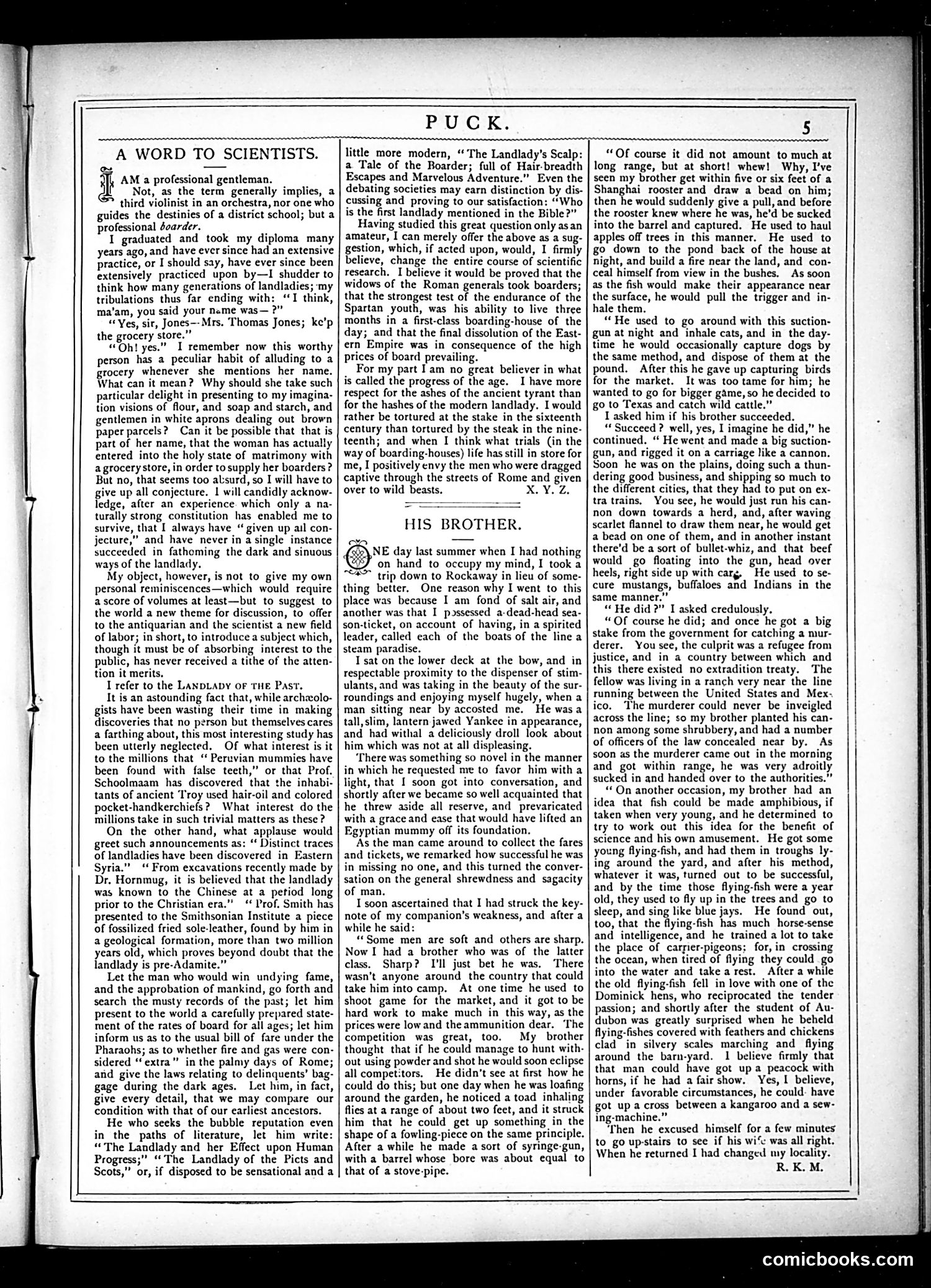
This page contains two separate articles rather than political cartoons. **"A Word to Scientists"** critiques a professional gentleman (identified as "Thomas Jones") who claims expertise across multiple fields—violinist, orchestra member, scientist—despite lacking genuine credentials. The satire mocks dilettantes who dabble in specialized fields without real knowledge, particularly targeting those who make grand claims about scientific progress while misunderstanding the actual work involved. **"His Brother"** is a humorous anecdote about the author's sibling who, while visiting from out West, attempts to hunt game using improvised methods (a homemade cannon, rigged carriage). The story satirizes incompetent city-folk attempting frontier activities, poking fun at their ignorance of practical hunting techniques and wildlife behavior. Both pieces exemplify Puck's satirical approach to American social pretension and incompetence.
📄 Transcribed text from this page (OCR, searchable)
Machine-transcribed from the original scan — historical spelling and the odd misread are preserved.
PUCK. 5 A WORD TO SCIENTISTS. a f, AM a professional gentleman, Not, as the term generally implies, a third violinist in an orchestra, nor one who guides the destinies of a district school; but a professional doarder. I graduated and took my diploma many years ago, and have ever since had an extensive practice, or I should say, have ever since been extensively practiced upon by—I shudder to think how many generations of landladies; my tribulations thus far ending with: “TI think, ma'am, you said your neme was— ?”” “Yes, sir, Jones—-Mrs. Thomas Jones; ke'p the grocery store.” “Oh! yes.” I remember now this worthy person has a peculiar habit of alluding to a grocery whenever she mentions her name. What can it mean? Why should she take such particular delight in presenting to my imagina- tion visions of flour, and soap and starch, and gentlemen in white aprons dealing out brown paper parcels? Can it be possible that that is part of her name, that the woman has actually entered into the holy state of matrimony with a grocery store, in order to supply her boarders? But no, that seems too absurd, so I will have to give up all conjecture. 1 will candidly acknow- ledge, after an experience. which only a na- turally strong constitution has enabled me to survive, that I always have “ given up ail con- jecture,” and have never in a single instance succeeded in fathoming the dark and sinuous ways of the landlady. My object, however, is not to give my own personal reminiscences—which would require a score of volumes at least—but to suggest to the world a new theme for discussion, to offer to the antiquarian and the scientist a new field of labor; in short, to introduce a subject which, though it must be of absorbing interest to the public, has never received a tithe of the atten- tion it merits. I refer to the LANDLADY OF THE Past. It is an astounding fact that, while archzolo- gists have been wasting their time in making discoveries that no person but themselves cares a farthing about, this most interesting study has been utterly neglected. Of what interest is it to the millions that ‘ Peruvian mummies have been found with false teeth,” or that Prof. Schoolmaam has discovered that the inhabi- tants of ancient Troy used hair-oil and colored pocket-handkerchiefs?_ What interest do the millions take in such trivial matters as these ? On the other hand, what applause would greet such announcements as: “ Distinct traces of landladies have been discovered in Eastern Syria.” “ From excavations recently made by Dr. Hornmug, it is believed that the landlady was known to the Chinese at a petiod long prior to the Christian era.” ‘¢ Prof. Smith has presented to the Smithsonian Institute a piece of fossilized fried sole-leather, found by him in a geological formation, more than two million years old, which proves beyond doubt that the landlady is pre-Adamite.” Let the man who would win undying fame, and the approbation of mankind, go forth and search the musty records of the past; let him present to the world a carefully prepared state- ment of the rates of board for all ages; let him inform us as to the usual bill of fare under the Pharaohs; as to whether fire and gas were con- sidered “extra” inthe palmy days of Rome; and give the laws relating to delinquents’ bag: gage during the dark ages. Let him, in fact, give every detail, that we may compare our condition with that of our earliest ancestors. He who seeks the bubble reputation even in the paths of literature, let him write: “The Landlady and her Effect upon Human Progress;” ‘The Landlady of the Picts and Scots,” or, if disposed to be sensational and a little more modern, “The Landlady’s Scalp: a Tale of the Boarder; full of Hair-breadth Escapes and Marvelous Adventure.” Even the debating societies may earn distinction by dis- cussing and proving to our satisfaction: “Who is the first landlady mentioned in the Bible?” Having studied this great question only as an amateur, I can merely offer the above as a sug- gestion, which, if acted upon, would, I firmly believe, change the entire course of scientific research. I believe it would be proved that the widows of the Roman generals took boarders; that the strongest test of the endurance of the Spartan youth, was his ability to live three months in a first-class boarding-house of the day; and that the final dissolution of the East- ern Empire was in consequence of the high prices of board prevailing. For my part Iam no great believer in what is called the progress of the age. I have more respect for the ashes of the ancient tyrant than for the hashes of the modern landlady. I would rather be tortured at the stake in the sixteenth century than tortured by the steak in the nine- teenth; and when I think what trials (in the way of boarding-houses) life has still in store for me, I positively envy the men who were dragged captive through the streets of Rome and given over to wild beasts. X. Y. Z, HIS BROTHER. E day last summer when I had nothing on hand to occupy my mind, I took a trip down to Rockaway in lieu of some- thing better. One reason why I went to this place was because I am fond of salt air, and another was that I possessed a-dead-head sea- son-ticket, on account of having, in a spirited leader, called each of the boats of the line a steam paradise. I sat on the lower deck at the bow, and in respectable proximity to the dispenser of stim- ulants, and was taking in the beauty of the sur- roundings and enjoying myself hugely, when a man sitting near by accosted me. He wasa tall, slim, lantern jawed Yankee in appearance, and had withal a deliciously droll look about him which was not at all displeasing. ‘There was something so novel in the manner in which he requested me to favor him with a light, that I soon got into conversation, and shortly after we became so well acquainted that he threw aside all reserve, and prevaricated with a grace and ease that would have lifted an Egyptian mummy off its foundation. As the man came around to collect the fares and tickets, we remarked how successful he was in missing no one, and this turned the conver- sation on the general shrewdness and sagacity of man, I soon ascertained that I had struck the key- note of my companion’s weakness, and after a while he said: “Some men are soft and others are sharp. Now I had a brother who was of the latter class. Sharp? I'll just bet he was, There wasn’t anyone around the country that could take him into camp. At one time he used to shoot game for the market, and it got to be hard work to make much in this way, as the prices were lowand the ammunition dear. The competition was great, too. My brother thought that if he could manage to hunt with- out using powder and shot he would soon eclipse all competitors. He didn’t see at first how he could do this; but one day when he was loafing around the garden, he noticed a toad inhaling flies at a range of about two feet, and it struck him that he could get up something in the shape of a fowling-piece on the same principle. After a while he made a sort of syringe-gun, with a barrel whose bore was about equal to that of a stove-pipe. “Of course it did not amount to much at long range, but at short! whew! Why, I’ve seen my brother get within five or six feet of a Shanghai rooster and draw a bead on him; then he would suddenly give a pull, and before the rooster knew where he was, he'd be sucked into the barrel and captured. He used to haul apples off trees in this manner. He used to go down to the pond back of the house at night, and build a fire near the land, and con- ceal himself from view in the bushes. As soon as the fish would make their appearance near the surface, he would pull the trigger and in- hale them. “He used to go around with this suction- gun at night and inhale cats, and in the day- time he would occasionally capture dogs by the same method, and dispose of them at the pound. After this he gave up capturing birds for the market. It was too tame for him; he wanted to go for bigger game, so he decided to go to Texas and catch wild cattle.” L asked him if his brother succeeded. “Succeed ? well, yes, I imagine he did,” he continued. “ He went and made a big suction- gun, and rigged it on a carriage like a cannon. Soon he was on the plains, doing such a thun- dering good business, and shipping so much to the different cities, that they had to put on ex- tra trains, You see, he would just run his can- non down towards a herd, and, after waving scarlet flannel to draw them near, he would get a bead on one of them, and in another instant there'd be a sort of bullet-whiz, and that beef would go floating into the gun, head over heels, right side up with carg, He used to se- cure mustangs, buffaloes and Indians in the same manner,” “He did ?” I asked credulously, “Of course he did; and once he got a big stake from the government for catching a mur- derer. You see, the culprit was a refugee from justice, and in a country between which and this there existed no extradition treaty. The fellow was living in a ranch very near the line running between the United States and Mex- ico. The murderer could never be inveigled across the line; so my brother planted his can- non among some shrubbery, and had a number of officers of the law concealed near by. As soon as the murderer came out in the morning and got within range, he was very adroitly sucked in and handed over to the authorities.” “On another occasion, my brother had an idea that fish could be made amphibious, if taken when very young, and he determined to try to work out this idea for the benefit of science and his own amusement. He got some young flying-fish, and had them in troughs ly- ing around the yard, and after his method, whatever it was, turned out to be successful, and by the time those flying-fish were a year old, they used to fly up in the trees and go to sleep, and sing like blue jays. He found out, too, that the flying-fish has much horse-sense and intelligence, and he trained a lot to take the place of carpier-pigeons; for, in crossing the ocean, when tired of flying they could go into the water and take a rest. After a while the old flying-fish fell in love with one of the Dominick hens, who reciprocated the tender passion; and shortly after the student of Au- dubon was greatly surprised when he beheld flying-fishes covered with feathers and chickens clad in silvery scales marching and flying around the barn-yard. 1 believe firmly that that man could have got up a peacock with horns, if he had a fair show. Yes, I believe, under favorable circumstances, he could: have got up across between a kangaroo and a sew- ing-machine.” ‘Then he excused himself for a few minutes to go up-stairs to see if his wi‘ was all right. When he returned I had changed my locality. R.K. M. comicbooks.com