
Puck, 1878-05-29 · page 11 of 16
Puck — May 29, 1878 — page 11: what you’re looking at
What you’re looking at
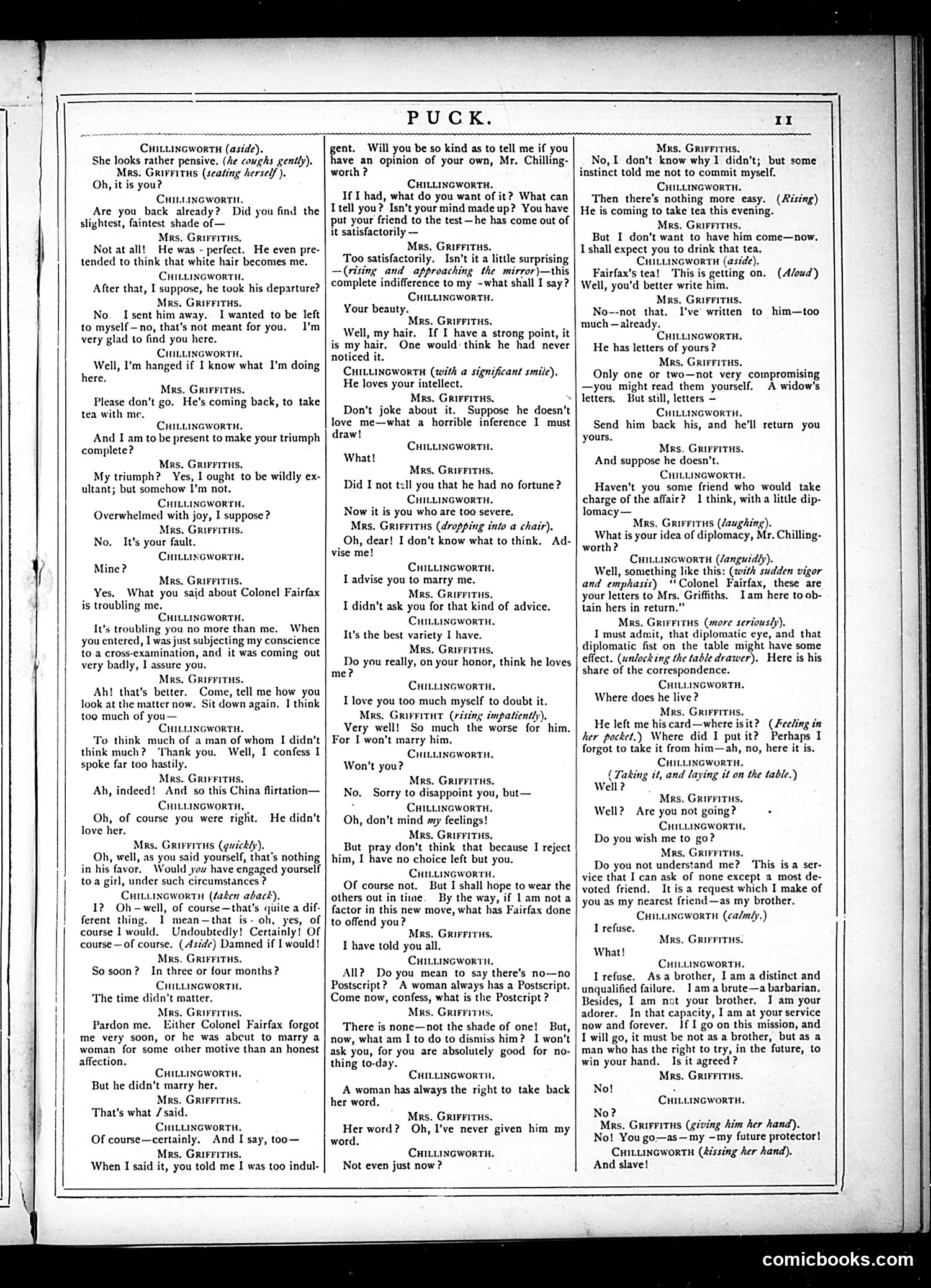
This page contains a theatrical dialogue between two characters: **Chillingworth** and **Mrs. Griffiths**. Based on the formal speech patterns and dramatic structure, this appears to be a **play excerpt or dramatic scene** rather than a political cartoon. The scene depicts a romantic conflict: Mrs. Griffiths confronts Chillingworth about his relationship with another woman. She references Colonel Fairfax and marriage prospects, suggesting this is a **domestic/romantic comedy** about courtship and social expectations. The satire appears to target **Victorian-era relationship dynamics**—particularly women's limited agency in marriage, reliance on male decision-making, and the social pressures around courtship. The dialogue mocks both characters' pretensions and emotional manipulations. Without additional context identifying the specific play or its original publication date, I cannot determine the precise satirical targets beyond these general social observations.
📄 Transcribed text from this page (OCR, searchable)
Machine-transcribed from the original scan — historical spelling and the odd misread are preserved.
PUCK. Il Cuituincwortu (aside). She looks rather pensive. (he coughs gently), Mrs. Grirritus (seating herself ). Oh, it is you? Cuittancworti. Are you back already? Did you find the slightest, faintest shade of — Mrs. Grirritus. Not at all! He was - perfect. He even pre- tended to think that white hair becomes me. CHILLINGWoRTH, After that, I suppose, he took his departure? Mrs, GrirFiTHs. No. Isent him away. 1 wanted to be left to myself —no, that’s not meant for you. I’m very glad to find you here. Ciitincworth, Well, I’m hanged if I know what I'm doing here. Mrs. GrirFitus. Please don’t go. He's coming back, to take tea with me. CHILLINGWORTH. And I am to be present to make your triumph complete? Mrs. GrirFiTus. My triumph? Yes, I ought to be wildly ex- ultant; but somehow I’m not. CHILLINGWORTH, Overwhelmed with joy, I suppose? Mrs. Grirritus. It’s your fault. CiittincwortH. No. Mine? Mrs. Grirritis. Yes, What you said about Colonel Fairfax is troubling me. CHILLINGWORTH. It’s troubling you no more than me. When you entered, I was just subjecting my conscience to a cross-examination, and it was coming out very badly, I assure you. Mrs. Grirrits. Ah! that’s better. Come, tell me how you look at the matter now. Sit down again. I think too much of you— CiiLLincwortH. To think much of a man of whom I didn’t think much? Thank you. Well, I confess I spoke far too hastily. Mrs. Grirrits. Ah, indeed! And so this China flirtation— CrittincwortH. Oh, of course you were right. love her. Mrs. Grirritus (quickly). Oh, well, as you said yourself, that’s nothing in his favor. Would yow have engaged yourself toa girl, under such circumstances ? Cuuxcwortn (taken aback), 1? Oh-well, of course—that’s quite a dif- ferent thing. I mean—that is- oh, yes, of course 1 would. Undoubtedly! Certainly! Of course—of course. (Aside) Damned if I would! Mrs. Grirritus. In three or four months? Cmituincwortn, The time didn’t matter. Mrs. Grirritus. Pardon me. Either Colonel Fairfax forgot me very soon, or he was abcut to marry a woman for some other motive than an honest affection. He didn't So soon? CHILLINGWoRTH. But he didn’t marry her. Mrs. GRIFFITHS. That's what / said. CiLuincworTH. Of course—certainly. And I say, too— Mrs. GrirFiTHs. When I said it, you told me I was too indul- gent. Will you be so kind as to tell me if you have an opinion of your own, Mr. Chilling- worth ? CHILLINGWoRTH. If I had, what do you want of it? What can I tell you? Isn’t your mind made up? You have put your friend to the test —he has come out of it satisfactorily — Mrs. GrirritHs. Too satisfactorily. Isn't it a little surprising —(rising and approaching the mirror)—this complete indifference to my -what shall I say? Cuituncwortu. Your beauty. Mrs. GrirFitHs. Well, my hair. If I have a strong point, it is my hair. One would’ think he had never noticed it. CHILLINGWORTH (with a significant smile). He loves your intellect. Mrs. GRIFFITHS. Don’t joke about it. Suppose he doesn’t love me—what a horrible inference I must draw! CuiLtincwortn, What! Mrs. GrirFitus. Did I not tsll you that he had no fortune? CHILLINGWORTH, Now it is you who are too severe, Mrs. Grirritus (dropping into a chair). Oh, dear! I don’t know what to think, Ad- vise me! CHILLINGWoRTH. T advise you to marry me. Mrs. Grirritus. I didn't ask you for that kind of advice. CHILLiIncworTH. It’s the best variety I have. Mrs. Grirritus, Do you really, on your honor, think he loves me? CHILLInGworTH, I love you too much myself to doubt it. Mrs. Grirritut (rising impatiently. Very well! So much the worse for him. For I won't marry him. CHILLInGworTH. Won't you? Mrs. GriFFITHS. Sorry to disappoint you, but— : Crittincwortn. Oh, don’t mind my feelings! Mrs. Grirritis. But pray don't think that because I reject him, I have no choice left but you. CHiLtincwortH. Of course not. But I shall hope to wear the others out in time. By the way, if lam not a factor in this new move, what has Fairfax done to offend you? Mrs. GrirFITHs. T have told you all. CHILLINGworTH, All? Do you mean to say there’s no—no Postscript? A woman always has a Postscript. Come now, confess, what is the Postcript ? Mrs. Grirritns. There is none—not the shade of one! But, now, what am I to do to dismiss him? I won't | ask you, for you are absolutely good for no- thing to-day. No. CHILLINGworTH, ‘A woman has always the right to take back her word. Mrs. GRirFitH: Her word? Oh, I’ve never given him my word, CHILLINGWORTH. Not even just now ? Mrs. Grirrirus. No, I don’t know why I didn’t; but some instinct told me not to commit myself. CHILLINGWoRTH. Then there’s nothing more easy. (Rising) He is coming to take tea this evening. Mrs, Grirrrrus. But I don’t want to have him come—now. I shall expect you to drink that tea, CHiLLincworTH (aside). Fairfax's tea! This is getting on. Well, you'd better write him. Mrs. GRIFFITHS. No--not that. I've’ written to him—too much —already. CHILLINGWORTH, He has letters of yours? Mrs. GRiFFITHS. Only one or two—not very compromising —you might read them yourself. A widow's letters, But still, letters -— Ciitiincwortn. Send him back his, and he'll return you yours. (Aloud) Mrs. GrirFitHs. And suppose he doesn’t. CiiLLincworTH. Haven't you some friend who would take charge of the affair? 1 think, witha little dip- lomacy — Mrs. Grirrirus (aughing). What is your idea of diplomacy, Mr. Chilling- worth? CHiincwortu (/anguidly). Well, something like this: (with sudden vigor and emphasis) ‘Colonel Fairfax, these are your letters to Mrs. Griffiths. Iam here to ob- tain hers in return.” Mrs, Grirritus (more seriously). I must admit, that diplomatic eye, and that diplomatic fist on the table might have some effect. (unlock ing the table drawer). Here is his share of the correspondence. CHILLINGWORTH. Where does he live? Mrs. Grirritis. He left me his card—where isit? (Feeling in her pocket.) Where did I put it? Perhaps I forgot to take it from him—ah, no, here it is. CHILLINGWoRTH. (Taking it, and laying it on the table.) Well? Mrs. GRIFFITHS, Well? Are you not going? : CHILLINGWoRTH. Do you wish me to go? Mrs, GRIFFITHS. Do you not understand me? This is a ser- vice that I can ask of none except a most de- voted friend. It is a request which I make of you as my nearest friend—as my brother. Cuittincwortn (calmly.) T refuse. Mrs. GRIFFITHS. What! CHILLINGWORTH. I refuse. Asa brother, I ama distinct and unqualified failure. 1 ama brute—a barbarian. Besides, I am not your brother. I am your adorer. In that capacity, I am at your service now and forever. If I go on this mission, and I will go, it must be not as a brother, but as a man who has the right to try, in the future, to win your hand. Is it agreed ? Mrs. GriFFITHS. No! ° CHILLINGWORTH. No? Mrs. Grirritus (giving him her hand). No! You go—as—my -my future protector! Cuiuincwort (kissing her hand). And slave! comicbooks.com