
Puck, 1878-05-29 · page 6 of 16
Puck — May 29, 1878 — page 6: what you’re looking at
What you’re looking at
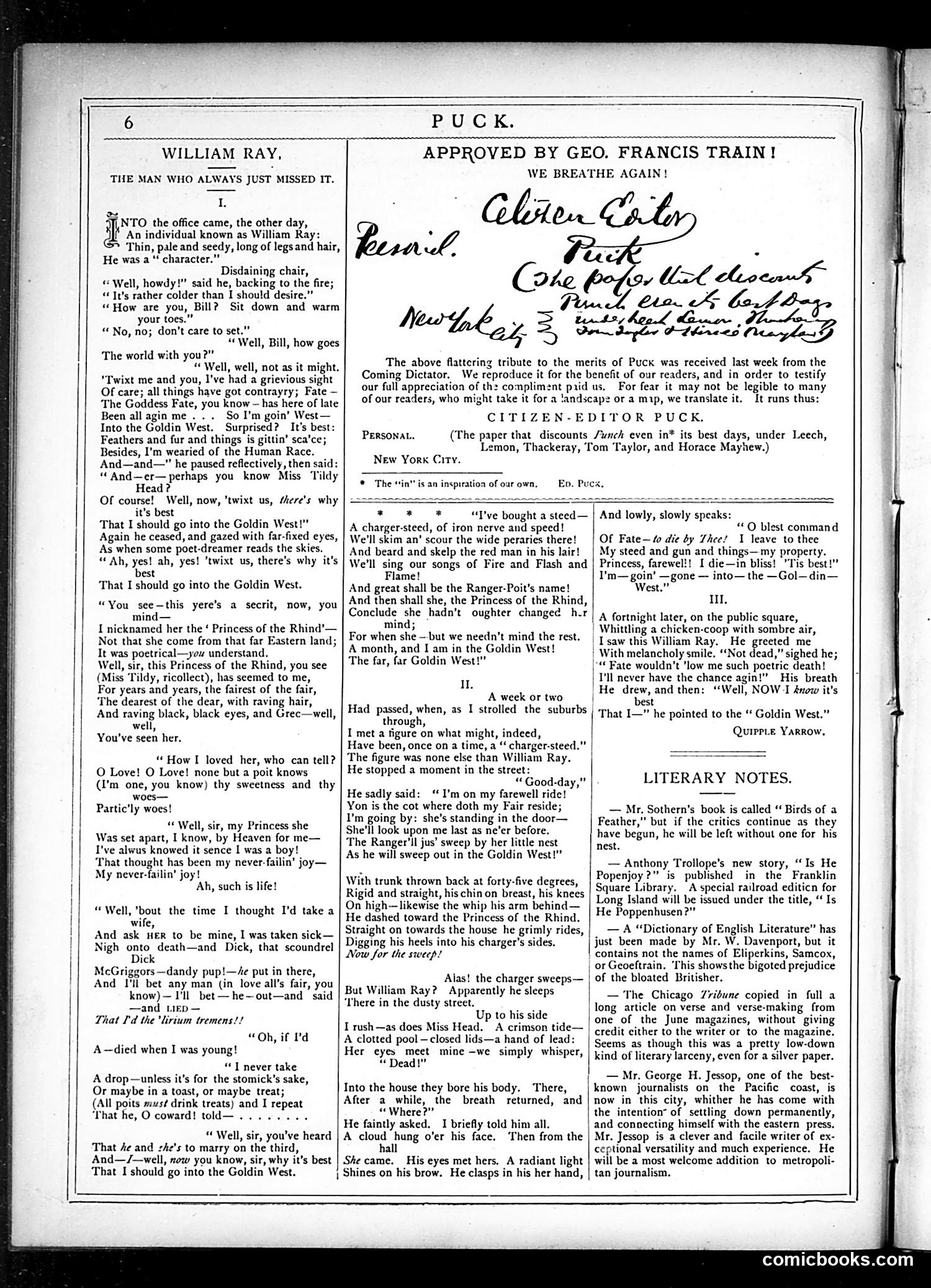
This page contains a poem titled "William Ray: The Man Who Always Just Missed It," accompanied by handwritten editorial approval and notes. The literary content satirizes a character named William Ray who repeatedly fails to achieve success—he "always just missed it." The poem's narrative follows Ray's romantic and financial misadventures, particularly his pursuit of "the Princess of the Rhind" and dreams of striking it rich in the "Golden West." The satire targets the archetypal unsuccessful American dreamer: perpetually on the verge of fortune and romance but perpetually thwarted by bad timing or poor judgment. The page also includes "Literary Notes" reviewing contemporary books and writers, suggesting this is a literary-focused issue. The overall tone mocks aspirational but hapless individuals common in Gilded Age American society.
📄 Transcribed text from this page (OCR, searchable)
Machine-transcribed from the original scan — historical spelling and the odd misread are preserved.
PUCK. WILLIAM RAY, THE MAN WHO ALWAYS JUST MISSED IT. NTO the office came, the other day, i An individual known as William Ray: Thin, pale and seedy, long of legs and hair, He was a “‘ character.” Disdaining chair, « Well, howdy!” said he, backing to the fire; «It’s rather colder than I should desire.” “How are you, Bill? Sit down and warm your toes.” “"No, no; don’t care to set.”” “Well, Bill, how goes The world with you?” “ Well, well, not as it might. "Twixt me and you, I've had a grievious sight Of care; all things have got contrayry; Fate — The Goddess Fate, you know — has here of late Been all agin me . . . So I’m goin’ West— Into the Goldin West. Surprised? It’s best: Feathers and fur and things is gittin’ sca'ce; Besides, I’m wearied of the Human Race. And—and—" he paused reflectively, then said: ““And—er— perhaps you know Miss Tildy lead? Of course! Well, now, ’twixt us, ¢here’s why it’s best That I should go into the Goldin West!” Again he ceased, and gazed with far-fixed eyes, As when some poet-dreamer reads the skies. “Ah, yes! ah, yes! ’twixt us, there’s why it’s best That I should go into the Goldin West. “You see—this yere’s a secrit, now, you mind— I nicknamed her the ‘ Princess of the Rhind’— Not that she come from that far Eastern land; It was poetrical—you understand. Well, sir, this Princess of the Rhind, you see (Miss Tildy, ricollect), has seemed to me, For years and years, the fairest of the fair, The dearest of the dear, with raving hair, And raving black, black eyes, and Grec—well, well, You've seen her. “ How I loved her, who can tell? O Love! O Love! none but a poit knows (I'm one, you know) thy sweetness and thy wots— Partic'ly woes! “ Well, sir, my Princess she Was set apart, I know, by Heaven for me— I've alwus knowed it sence | was a ‘That thought has been my never-failin’ joy— My never-failin’ joy! Ah, such is life! “Well, bout the time I thought I'd take a wife, And ask HER to be mine, I was taken sick— Nigh onto death—and Dick, that scoundrel Dick McGriggors—dandy pup!—Ae put in there, And I'll bet any man (in love all’s fair, you know)— I'll bet —he—out—and said —and Ep — That I'd the'lirium tremens!! “Oh, if I'd A—died when I was young! “T never take A drop—unless it’s for the stomick’s sake, Or maybe in a toast, or maybe treat; (All poits mus¢ drink treats) and I repeat ‘That he, O coward! told—...... “ Well, sir, you've heard That Ae and she's to marry on the third, And—/—well, now you know, sir, why it’s best ‘That I should go into the Goldin’ West. APPROVED BY GEO. FRANCIS TRAIN! WE BREATHE AGAIN! ae, besa Cue Ne alegy 2 Coming Dictator. CITIZEN-ED PERSONAL. New York City. * The “in” is an inspiration of our own, our full appreciation of th: compliment paid us. of our readers, who might take it for a !andscapz or a mip, we translate it. OC Ul Meo en Ko Pon eae GEE The above flattcring tribute to the merits of Puck was received last week from the We reproduce it for the benefit of our readers, and in order to testify For fear it may not be legible to many It runs thus: ITOR PUCK. (The paper that discounts /unch even in* its best days, under Leech, Lemon, Thackeray, Tom Taylor, and Horace Mayhew.) Ep. Pucs, * * * “T’ve bought a steed — A charger-steed, of iron nerve and speed! We'll skim an’ scour the wide peraries there! And beard and skelp the red man in his lair! We'll sing our songs of Fire and Flash and Flame! And great shall be the Ranger-Poit’s name! And then shall she, the Princess of the Rhind, Conclude she hadn’t oughter changed h.r | mind; ) For when she —-but we needn’t mind the rest. A month, and I am in the Goldin West! The far, far Goldin West!” Il. A week or two Had passed, when, as I strolled the suburbs through, I met a figure on what might, indeed, | Have been, once on a time, a “ charger-steed.” ‘The figure was none else than William Ray. He stopped a moment in the street: “ Good-day,” He sadly said: “I’m on my farewell ride! Yon is the cot where doth my Fair reside; I'm going by: she’s standing in the door— She'll look upon me last as ne'er before. The Ranger'll jus’ sweep by her little nest As he will sweep out in the Goldin West!” With trunk thrown back at forty-five degrees, Rigid and straight, his chin on breast, his knees On high—likewise the whip his arm behind— He dashed toward the Princess of the Rhind. Straight on towards the house he grimly rides, | Digging his heels into his charger’s sides. Now for the sweep! Alas! the charger sweeps— | But William Ray? Apparently he sleeps ‘There in the dusty street, Up to his side I rush—as does Miss Head. A crimson tide— A clotted pool —closed lids—a hand of lead: Her eyes meet mine —we simply whisper, “ Dead!" Into the house they bore his body. There, After a while, the breath returned, and “ Where?” | He faintly asked. I briefly told him all. A cone shang over his face, Then from the all She came. His eyes met hers. A radiant light | Shines on his brow. He clasps in his her hand, And lowly, slowly speaks: “O blest command Of Fate—¢o die by Thee! 1 leave to thee My steed and gun and things— my property. Princess, farewel!! I die—in bliss! "Tis best!" I’'m— goin’ —gone — into— the —Gol—din— West.” Ill. A fortnight later, on the public square, Whittling a chicken-coop with sombre air, I saw this William Ray. He greeted me With melancholy smile. ‘Not dead,” sighed he; |" Fate wouldn’t ‘low me such poetric death! I'll never have the chance agin!" His breath He drew, and then: ‘Well, NOW I dnow it's best That I—” he pointed to the “ Goldin West.” Quirp.e Yarrow, LITERARY NOTES. — Mr. Sothern's book is called “ Birds of a Feather,” but if the critics continue as they have begun, he will be left without one for his nest. — Anthony Trollope’s new story, “Is He Popenjoy?” is published in the Franklin Square Library. A special railroad editicn for Long Island will be issued under the title, “ Is He Poppenhusen?” — A “Dictionary of English Literature” has just been made by Mr. W. Davenport, but it contains not the names of Eliperkins, Samcox, or Geoeftrain. ‘This shows the bigoted prejudice of the bloated Britisher. — The Chicago Zribune copied in full a long article on verse and verse-making from one of the June magazines, without giving credit cither to the writer or to the magazine. Seems as though this was a pretty low-down kind of literary larceny, even for a silver paper. — Mr. George H. Jessop, one of the best- known journalists on the Pacific coast, is now in this city, whither he has come with the intention” of settling down permanently, and connecting himself with the eastern press. Mr. Jessop is a clever and facile writer of ex- ceptional versatility and much experience. He will be a most welcome addition to metropoli- tan journalism. Serr EO eee comicbooks.com