
Puck, 1878-05-29 · page 4 of 16
Puck — May 29, 1878 — page 4: what you’re looking at
What you’re looking at
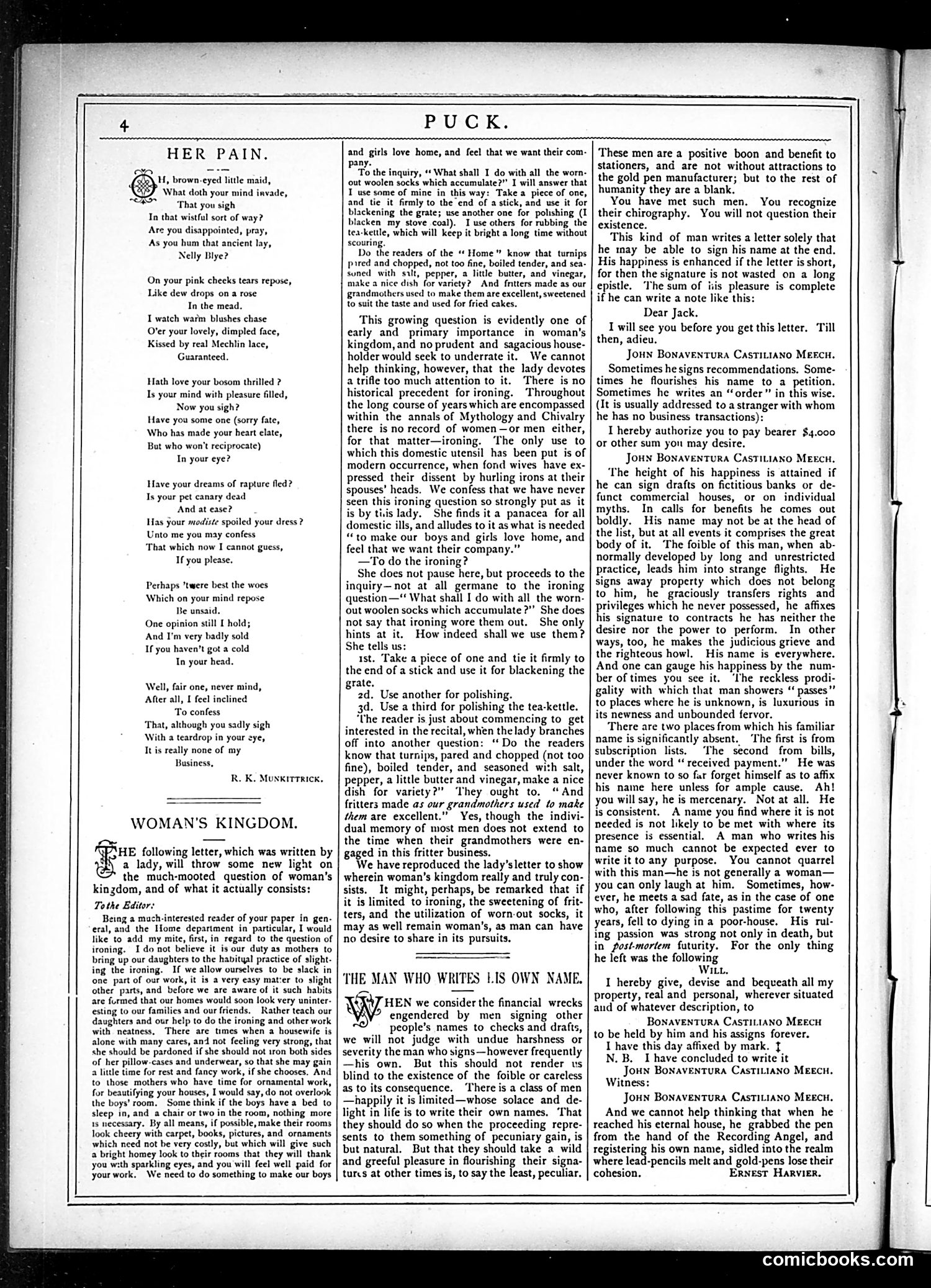
This Puck magazine page contains three distinct sections: a poem titled "Her Pain" (addressing domestic hardship), and two prose pieces on women's issues. The main satirical content is **"Woman's Kingdom,"** which addresses the impractical question of what wives should do with worn-out stockings and household textiles. The letter mocks the triviality of such domestic concerns by suggesting absurd solutions—using worn socks to polish tea kettles, for instance. The satire targets both the advice-column format and the limited scope of "woman's concerns" in Victorian society. **"The Man Who Writes His Own Name"** critiques men who sign financial documents themselves rather than hire professionals, viewing this as foolish pride. It satirizes masculine vanity and poor judgment in business matters. Together, these pieces mock gender roles and domestic preoccupations of the era.
📄 Transcribed text from this page (OCR, searchable)
Machine-transcribed from the original scan — historical spelling and the odd misread are preserved.
PUCK. HER PAIN. H, brown-eyed little maid, What doth your mind invade, That you sigh In that wistful sort of way? Are you disappointed, pray, As you hum that ancient lay, Nelly Blye? poxct) On your pink checks tears repose, Like dew drops on a rose In the mead. I watch warm blushes chase Over your lovely, dimpled face, Kissed by real Mechlin lace, Guaranteed. Hath love your bosom thrilled ? Is your mind with pleasure filled, Now you sigh? Have you some one (sorry fate, Who has made your heart elate, But who won't reciprocate) In your eye? Have your dreams of rapture fled? Is your pet canary dead And at ease? Has your modiste spoiled your dress? Unto me you may confess That which now I cannot guess, If you please. Perhaps "twere best the woes Which on your mind repose Be unsaid. One opinion still I hold; And I'm very badly sold If you haven't got a cold In your head. Well, fair one, never mind, After all, I feel inclined To confess ‘That, although you sadly sigh With a teardrop in your eye, Itis really none of my Business, R. K. Munkrrtrick. WOMAN'S KINGDOM. HE following letter, which was written by a lady, will throw some new light on the much-mooted question of woman's kingdom, and of what it actually consists: Tothe Editor: Being a much-interested reader of your paper in gen: eral, and the Home department in particular, I would like’ to add my mite, first, in regard to the question of ironing. I do not believe it is our duty as mothers to bring up our daughters to the habityal practice of slight- ing the ironing. If we allow ourselves to be slack in one part of our work, it is a very easy mat:er to slight other parts, and before we are aware of it such habits are furmed that our homes would soon look very uninter- esting to our families and our friends. Rather teach our daughters and our help to do the ironing and other work with neatness, There are times when a housewife is alone with many cares, and not feeling very strong, that she should be pardoned if she should not sron both sides of her pillow-cases and underwear, so that she may gain a little time for rest and fancy work, if she chooses, And to those mothers who have time for ornamental work, for beautifying your houses, I would say, do not overlook the boys’ room. Some think if the boys have a bed to sleep in, and_a chair or two in the room, nothing more 1s necessary. By all means, if possible, make their rooms look cheery with carpet, books, pictures, and ornaments which need not be very costly, but which will give such a bright homey look to their rooms that they will thank you w:th sparkling eyes, and you will feel well paid for your work. We need to do something to make our boys and girls love home, and feel that we want their com- ny. PTD the inquiry, What shall T do wit all the worn- cout woolen socks which accumulate?” I will answer that I use some of mine in this way: Take a piece of one, and tie it firmly to the end of astick, and use it for blackening the grate; use another one for polishing (I blacken my stove coal). I use others for rubbing the tea-kettle, which will keep it bright a long time without scouring. Do the readers of the Home" know that turnips pired and chopped, not too fine, boiled tender, and sea- suned with silt, pepper, a litte butter, and vinegar, make a nice dish for variety? And fntters made as our grandmothers used to make them are excellent, sweetened to suit the taste and used for fried cakes. This growing question is evidently one of early and primary importance in woman's kingdom, and no prudent and sagacious house- holder would seck to underrate it. We cannot help thinking, however, that the lady devotes a trifle too much attention to it. There is no historical precedent for ironing. ‘Throughout the long course of years which are encompassed within the annals of Mythology and Chivalry there is no record of women—or men either, for that matter—ironing. The only use to which this domestic utensil has been put is of modern occurrence, when fond wives have ex- pressed their dissent by hurling irons at their spouses’ heads. We confess that we have never seen this ironing question so strongly put as it is by tis lady. She finds it a panacea for all domestic ills, and alludes to it as what is needed “to make our boys and girls love home, and feel that we want their company.” —To do the ironing? She does not pause here, but proceeds to the inquiry—not at all germane to the ironing question —‘ What shall I do with all the worn- out woolen socks which accumulate ?”” She does not say that ironing wore them out. She only hints at it. How indeed shall we use them? She tells us: 1st. Take a piece of one and tie it firmly to the end of a stick and use it for blackening the grate, 2d. Use another for polishing. 3d. Use a third for polishing the tea-kettle. ‘the reader is just about commencing to get interested in the recital, when thelady branches off into another question: ‘Do the readers know that turnips, pared and chopped (not too fine), boiled tender, and seasoned with salt, pepper, a little butter and vinegar, make a nice dish for variety?” ‘They ought to. “And fritters made as our grandmothers used to make them are excellent.” Yes, though the indivi- dual memory of most men does not extend to the time when their grandmothers were en- gaged in this fritter business. We have reproduced the lady’sletter to show wherein woman's kingdom really and truly con- sists. It might, perhaps, be remarked that if it is limited to ironing, the sweetening of fri ters, and the utilization of worn-out socks, it may as well remain woman's, as man can have no desire to share in its pursuits, THE MAN WHO WRITES 11S OWN NAME. <M47 HEN we consider the financial wrecks engendered by men signing other people’s names to checks and drafts, we will not judge with undue harshness or severity the man who signs—however frequently —his own. But this should not render us blind to the existence of the foible or careless as to its consequence. There is a class of men —happily it is limited—whose solace and de- light in life is to write their own names. That they should do so when the proceeding repre- sents to them something of pecuniary gain, is but natural. But that they should take a wild and greeful pleasure in flourishing their signa- turcs at other times is, to say the least, peculiar, These men are a positive boon and benefit to stationers, and are not without attractions to the gold pen manufacturer; but to the rest of humanity they are a blank. You have met such men. You recognize their chirography. You will not question their existence. This kind of man writes a letter solely that he may be able to sign his name at the end. His happiness is enhanced if the letter is short, for then the signature is not wasted on a long epistle. ‘The sum of isis pleasure is complete if he can write a note like this: Dear Jack. I will see you before you get this letter. Till then, adieu. Joun Bonaventura CastILIANo MEECH. Sometimes he signs recommendations. Some- times he flourishes his name to a petition. Sometimes he writes an “order” in this wise. (It is usually addressed to a stranger with whom he has no business transactions): I hereby authorize you to pay bearer $4.000 or other sum yon may desire, Joun Bonaventura Castitiano MEECH. ‘The height of his happiness is attained if he can sign drafts on fictitious banks or de- funct commercial houses, or on individual myths. In calls for benefits he comes out boldly. His name may not be at the head of the list, but at all events it comprises the great body of it. The foible of this man, when ab- normally developed by long and unrestricted practice, leads him into strange flights. He signs away property which does not belong to him, he graciously transfers rights and P ileges which he never possessed, he affixes is signature to contracts he has neither the desire nor the power to perform. In other ways, too, he makes the judicious grieve and the righteous howl. His name is everywhere. And one can gauge his happiness by the num- ber of times you see it. ‘Ihe reckless prodi- gality with which that man showers “ passes” to places where he is unknown, is luxurious in its newness and unbounded fervor. There are two places from which his familiar name is significantly absent, ‘The first is from subscription 1 ‘The second from bills, under the word “ received payment.” He was never known to so far forget himself as to affix his name here unless for ample cause. Ah! you will say, he is mercenary. Not at all. He is consistent. A name you find where it is not needed is not likely to be met with where its presence is essential. A man who writes his name so much cannot be expected ever to write itto any purpose. You cannot quarrel with this man—he is not generally a woman— you can only laugh at him. Sometimes, how- ever, he meets a sad fate, as in the case of one who, after following this pastime for twenty years, fell to dying ina poor-house, His rul- ing passion was strong not only in death, but in post-mortem faturity. For the only thing he left was the following Win. I hereby give, devise and bequeath all my property, real and personal, wherever situated aud of whatever description, to BoNAVENTURA CASTILIANO MEECH to be held by him and his assigns forever. I have this day affixed by mark. ] N.B. Ihave concluded to write it Joun Bonaventura CasTiLiano MEECH, Witness: Joun Bonaventura CAsTILIANO MEECH. And we cannot help thinking that when he reached his eternal house, he grabbed the pen from the hand of the Record g Angel, and registering his own name, sidled into the realm where lead-pencils melt and gold-pens lose their cohesion. Ernest HarvigR. comicbooks.com