
Puck, 1878-05-29 · page 12 of 16
Puck — May 29, 1878 — page 12: what you’re looking at
What you’re looking at
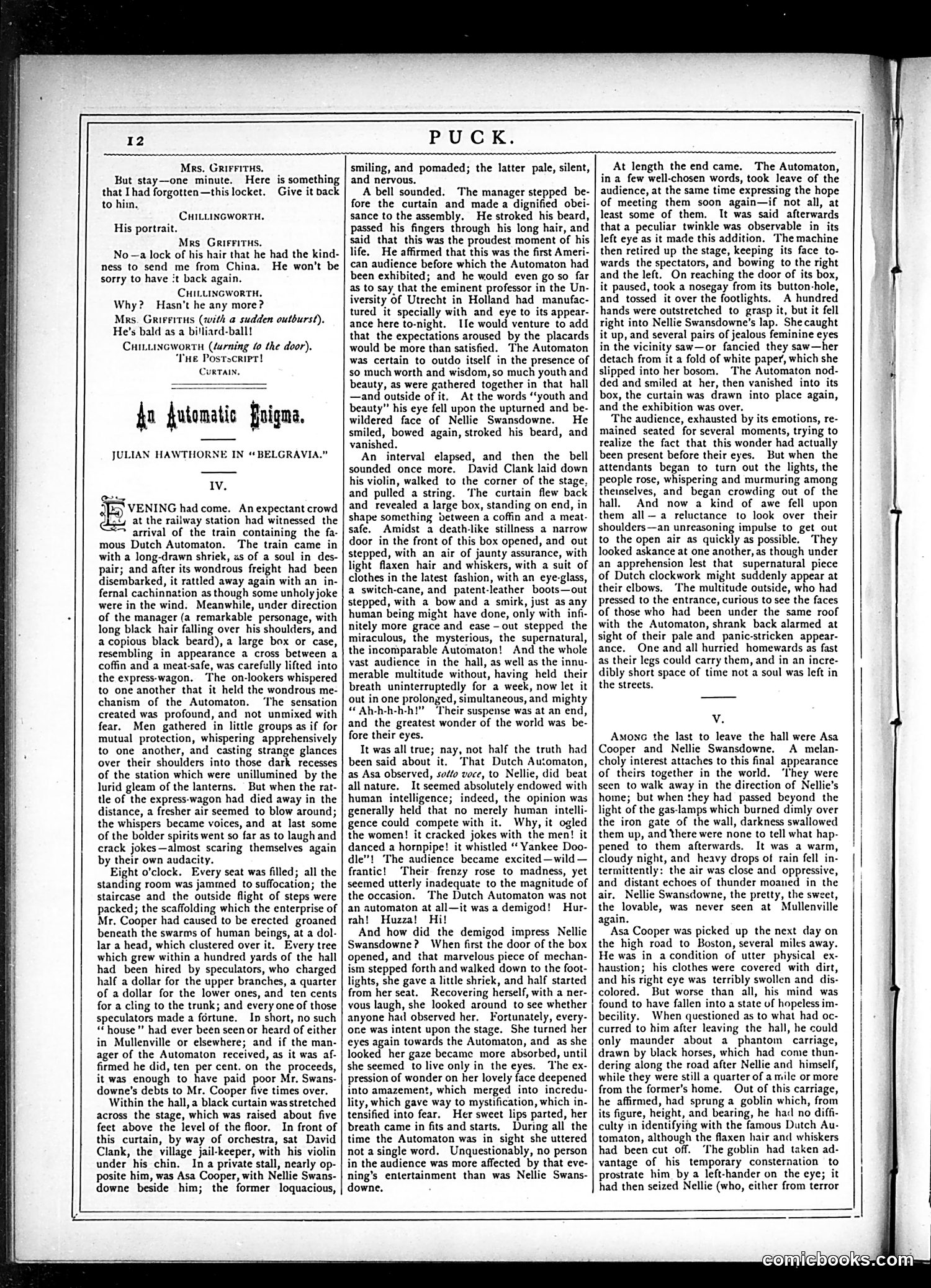
This page from *Puck* contains a serialized story titled "An Automatic Enigma" by Julian Hawthorne, illustrated with text rather than cartoons. The narrative describes a mechanical automaton—a lifelike Dutch creation—that appears at a railway station entertainment hall, captivating audiences with its mysterious humanlike qualities. The story satirizes contemporary fascination with automata and mechanical innovations of the era. Key figures mentioned include David Clark (railway manager), Nellie Swandowne (a young woman who becomes emotionally invested in the automaton), and Asa Cooper. The piece plays on Victorian anxieties about technology, artificial intelligence, and the blurring line between mechanical and human nature—themes reflecting late 19th-century technological advancement and public wonder at such innovations.
📄 Transcribed text from this page (OCR, searchable)
Machine-transcribed from the original scan — historical spelling and the odd misread are preserved.
| | 12 PUCK. ee Mrs. GRIFFITHS, But stay—one minute. Here is something that I had forgotten—this locket. Give it back to him, CHILLINGWoRTH. His portrait. Mrs Grirritus. No —a lock of his hair that he had the kind- ness to send me from China. He won't be sorry to have :t back again. CHILLINGWoRTH, Why? Hasn't he any more? Mrs. Grivertus (2vith a sudden outburst). He's bald as a billiard-ball! CHILLincwortH (turning fo the door). ‘THe Postscript! RTAL ha Auionati frigne, JULIAN HAWTHORNE IN “BELGRAVIA.” Iv. f >) VENING had come. Anexpectant crowd 4 at the railway station had witnessed the ‘> arrival of the train containing the fa- mous Dutch Automaton. The train came in with a long-drawn shriek, us of a soul in des- pair; and after its wondrous freight had been disembarked, it rattled away again with an in- fernal cachinnation as though some unholy joke were in the wind. Meanwhile, under direction of the manager (a remarkable personage, with long black hair falling over his shoulders, and acopious black beard), a large box or case, resembling in appearance a cross between a coffin and a meat-safe, was carefully lifted into the express-wagon. The on-lookers whispered to one another that it held the wondrous me- chanism of the Automaton. ‘he sensation created was profound, and not unmixed with fear. Men gathered in little groups as if for mutual protection, whispering apprehensively to one another, and casting strange glances over their shoulders into those dark recesses of the station which were unillumined by the lurid gleam of the lanterns. But when the rat- tle of the express-wagon had died away in the distance, a fresher air seemed to blow around; the whispers became voices, and at last some of the bolder spirits went so far as to laugh and crack jokes—almost scaring themselves again by their own audacity. Eight o'clock. Every seat was filled; all the standing room was jammed to suffocation; the staircase and the outside flight of steps were packed; the scaffolding which the enterprise of Mr. Cooper had caused to be erected groaned beneath the swarms of human beings, at a dol- lar a head, which clustered over it. Every tree which grew within a hundred yards of the hall had been hired by speculators, who charged half a dollar for the upper branches, a quarter of a dollar for the lower ones, and ten cents for a cling to the trunk; and every one of those speculators made a fortune. In short, no such “house” had ever been seen or heard of either in Mullenville or elsewhere; and if the man- ager of the Automaton received, as it was af- firmed he did, ten per cent. on the proceeds, it was enough to have paid poor Mr. Swans- downe’s debts to Mr. Cooper five times over. Within the hall, a black curtain was stretched across the stage, which was raised about five feet above the level of the floor. In front of this curtain, by way of orchestra, sat David Clank, the village jail-keeper, with his violin under his chin. Ina private stall, nearly op- posite him, was Asa Cooper, with Nellie Swans- downe beside him; the former loquacious, smiling, and pomaded; the latter pale, silent, and nervous. A bell sounded. The manager stepped _be- fore the curtain and made a dignified obei- sance to the assembly. He stroked his beard, passed his fingers through his long hair, and said that this was the proudest moment of his life. He affirmed that this was the first Ameri- can audience before which the Automaton had been exhibited; and he would even go so far as to say that the eminent professor in the Un- iversity Of Utrecht in Holland had manufac- tured it specially with and eye to its appear- ance here to-night. Ile would venture to add that the expectations aroused by the placards would be more than satisfied. The Automaton was certain to outdo itself in the presence of so much worth and wisdom, so much youth and beauty, as were gathered together in that hall —and outside of it. At the words “youth and beauty” his eye fell upon the upturned and be- wildered face of Nellie Swansdowne. He smiled, bowed again, stroked his beard, and vanished. An interval elapsed, and then the bell sounded once more. David Clank laid down his violin, walked to the corner of the stage, and pulled a string. ‘The curtain flew back and revealed a large box, standing on end, in shape something between a coffin and a meat- safe. Amidst a death-like stillness a narrow door in the front of this box opened, and out stepped, with an air of jaunty assurance, with light flaxen hair and whiskers, with a suit of clothes in the latest fashion, with an eye-glass, a switch-cane, and patent-leather boots—out stepped, with a bow and a smirk, just as any human being might have done, only with infi- nitely more grace and ease -out stepped the miraculous, the mysterious, the supernatural, the incomparable Automaton! And the whole vast audience in the hall, as well as the innu- merable multitude without, having held their breath uninterruptedly for a week, now let it out in one prolonged, simultaneous, and mighty “ Ab-h-h-h-h!”" ‘Their suspense was at an end, and the greatest wonder of the world was be- fore their eyes. It was all true; nay, not half the truth had been said about it. That Dutch Automaton, as Asa observed, soto voce, to Nellie, did beat all nature. It seemed absolutely endowed with human intelligence; indeed, the opinion was generally held that no merely human intelli- gence could compete with it. Why, it ogled the women! it cracked jokes with the men! it danced a hornpipe! it whistled “Yankee Doo- dle”! The audience became excited—wild — frantic! Their frenzy rose to madness, yet seemed utterly inadequate to the magnitude of the occasion. The Dutch Automaton was not an automaton at all—it was a demigod! Hur- rah! Huzza! Hi! And how did the demigod impress Nellic Swansdowne? When first the door of the box opened, and that marvelous piece of mechan- ism stepped forth and walked down to the foot- lights, she gave a little shriek, and half started from her seat. Recovering herself, with a ner- vous laugh, she looked around to see whether anyone hail observed her. Fortunately, every- one was intent upon the stage. She turned her eyes again towards the Automaton, and as she looked her gaze became more absorbed, until she seemed to live only in the eyes. ‘The ex- pression of wonder on her lovely face deepened into amazement, which merged into incredu- lity, which gave way to mystification, which in- tensified into fear. Her sweet lips parted, her breath came in fits and starts. During all the time the Automaton was in sight she uttered not a single word. Unquestionably, no person in the audience was more affected by that eve- ning’s entertainment than was Nellie Swans- downe. At length the end came. The Automaton, in a few well-chosen words, took leave of the audience, at the same time expressing the hope of meeting them soon again—if not all, at least some of them, It was said afterwards that a peculiar twinkle was observable in its left eye as it made this addition, The machine then retired up the stage, keeping its face to- wards the spectators, and bowing to the right and the left. On reaching the door of its box, it paused, took a nosegay from its button-hole, and tossed it over the footlights. A hundred hands were outstretched to grasp it, but it fell right into Nellie Swansdowne’s lap. She caught it up, and several pairs of jealous feminine eyes in the vicinity saw—or fancied they saw—her detach from it a fold of white paper, which she slipped into her bosom. ‘The Automaton nod- ded and smiled at her, then vanished into its box, the curtain was drawn into place again, and the exhibition was over. The audience, exhausted by its emotions, re- mained seated for several moments, trying to realize the fact that this wonder had actually been present before their eyes. But when the attendants began to turn out the lights, the people rose, whispering and murmuring among theinselves, and began crowding out of the hall. And now a kind of awe fell upon them all—a reluctance to look over their shoulders—an unreasoning impulse to get out to the open air as quickly as possible. ‘They looked askance at one another, as though under an apprehension lest that supernatural piece of Dutch clockwork might suddenly appear at their elbows. ‘The multitude outside, who had pressed to the entrance, curious to see the faces of those who had been under the same roof with the Automaton, shrank back alarmed at sight of their pale and panic-stricken appear- ance, One and all hurried homewards as fast as their legs could carry them, and in an incre- dibly short space of time not a soul was left in the streets. v. Amonc the last to leave the hall were Asa Cooper and Nellie Swansdowne, A melan- choly interest attaches to this final appearance of theirs together in the world. ‘hey were seen to walk away in the direction of Nellie’s home; but when they had passed beyond the light of the gas-lamps which burned dimly over the iron gate of the wall, darkness swallowed them up, and there were none to tell what hap- pened to them afterwards. It was a warm, cloudy night, and heavy drops of rain fell in- termittently: the air was close and oppressive, and distant echoes of thunder moaned in the air, Nellie Swansdowne, the pretty, the sweet, the lovable, was never seen at Mullenville again. ‘Asa Cooper was picked up the next day on the high road to Boston, several miles away. He was in a condition of utter physical ex- haustion; his clothes were covered with dirt, and his right eye was terribly swollen and dis- colored. But worse than all, his mind was found to have fallen into a state uf hopeless im- becility. When questioned as to what had oc- curred to him after leaving the hall, he could only maunder about a phantom carriage, drawn by black horses, which had come thun- dering along the road after Nellie and himself, while they were still a quarter of a mile or more from the former's home. Out of this carriage, he affirmed, had sprung a goblin which, from its figure, height, and bearing, he had no diffi- culty in identifying with the famous Dutch Au- tomaton, although the flaxen hair and whiskers had been cut off. ‘The goblin had taken ad- vantage of his temporary consternation to prostrate him by a left-hander on the eye; it had then seized Nellie (who, either from terror ieomiecboOoKks-com==