
Puck, 1878-05-29 · page 10 of 16
Puck — May 29, 1878 — page 10: what you’re looking at
What you’re looking at
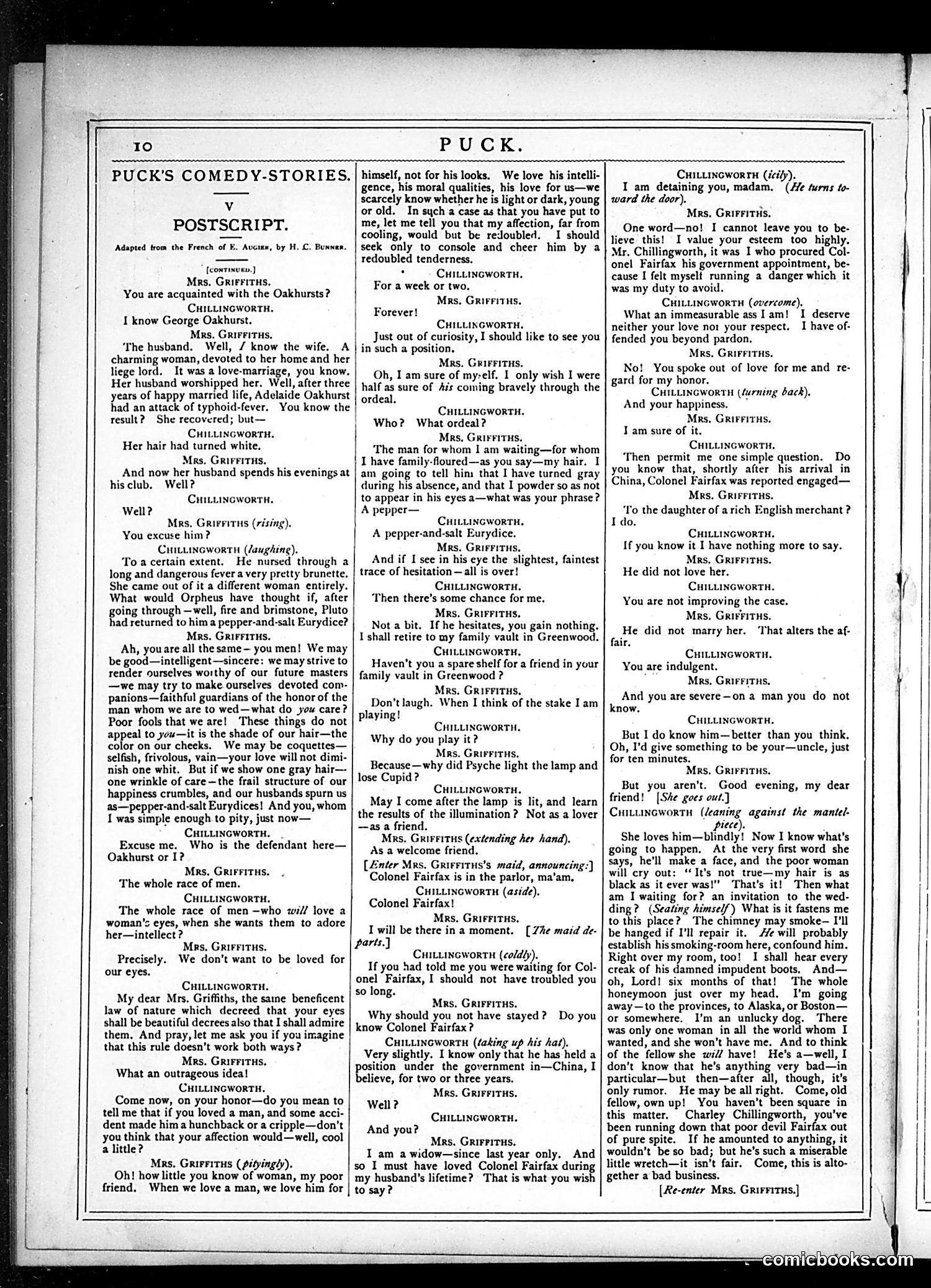
This page contains **"Postscript," a comedy dialogue** adapted from a French play by H.E. Busnach. The piece is entirely text-based—a theatrical script with no cartoons or caricatures. The sketch presents a domestic farce involving **Mrs. Griffiths and Colonel Chillingworth**, who are apparently former lovers. Mrs. Griffiths is married; Chillingworth has recently returned from government service in China. The humor revolves around their rekindled attraction, jealous accusations, and marital complications, particularly regarding her husband's evening habits and a disputed piece of jewelry. The satire targets **Victorian romantic entanglement and bourgeois social hypocrisy**—the tension between proper respectability and actual infidelity. The dialogue emphasizes class anxieties (mentions of family vaults, government positions) alongside romantic melodrama typical of period theatrical comedy.
📄 Transcribed text from this page (OCR, searchable)
Machine-transcribed from the original scan — historical spelling and the odd misread are preserved.
| -_ 10 PUCK. PUCK’S COMEDY-STORIES. v POSTSCRIPT. ‘Adapted from the French of E. Avciax, by H.C, Bunwen, [contmmven.] Mrs. GrirritHs. You are acquainted with the Oakhursts? CHILLINGWoRTH. I know George Oakhurst. Mrs. GrirFitus. | ‘The husband. Well, / know the wife. A | charming woman, devoted to her home and her liege lord. It was a love-marriage, you know. Her husband worshipped her. Well, after three years of happy married life, Adelaide Oakhurst | | | had an attack of typhoid-fever. You know the result? She recovered; but— CHILLINGWORTH, Her hair had turned white. Mrs. GrirFitus, ‘And now her husband spends his evenings at his club. Well? CuHiLLincwortH. Well? Mrs. Grirritus (rising). You excuse him? Cuituincwortn (Jaughing). Toa certain extent. He nursed through a long and dangerous fever a very pretty brunette, She came out of it a different woman entirely. What would Orpheus have thought if, after going through —well, fire and brimstone, Pluto had returned to hima pepper-and-salt Eurydice? Mrs. GrirFitHs, Ah, youare all the same— you men! We may be good—intelligent—sincere: we may strive to render ourselves worthy of our future masters —we may try to make ourselves devoted com- panions—faithful guardians of the honor of the man whom we are to wed—what do you care? Poor fools that we are! These things do not appeal to you—it is the shade of our hair—the color on our cheeks. We may be coquettes— selfish, frivolous, vain—your love will not di nish one whit, But if we show one gray hair— one wrinkle of care—the frail structure of our happiness crumbles, and our husbands spurn us as—pepper-and-salt Eurydices! And you, whom 1 was simple enough.to pity, just now— CHILLINGWoRTH. Who is the defendant here— Excuse me. Oakhurst or I? Mrs. GrirFiTHs. The whole race of men. CHILLINGWORTH, The whole race of men —who will love a woman’s eyes, when she wants them to adore her—intellect ? Mrs, Grirritus. Precisely. We don’t want to be loved for our eyes. CHiLLincworTH. My dear Mrs. Griffiths, the saine beneficent law of nature which decreed that your eyes shall be beautiful decrees also that I shall admire them, And pray, let me ask you if you imagine that this rule doesn’t work both ways? Mrs. GriFFiTHs, What an outrageous idea! CHILLINGWoRTH, Come now, on your honor—do you mean to tell me that if you loved a man, and some acci- dent made hima hunchback or a cripple—don’t you think that your affection would—well, cool a little? Mrs. Grirritus (pityingly). Oh! how little you know of woman, my poor friend. When we love a man, we love him for himself, not for his looks. We love his intelli- gence, his moral qualities, his love for us—we scarcely know whether he is light or dark, young orold. In sych a case as that you have put to me, let me tell you that my affection, far from cooling, would but be redoubled. I should seek only to console and cheer him by a redoubled tenderness. Q CHILLINGworRTH. For a week or two, Mrs, Grirritus, Forever! CHILLINGWORTH, Just out of curiosity, I should like to see you in such a position, Mrs. GriFFitHs. Oh, I am sure of my-elf. 1 only wish I were half as sure of Ais coming bravely through the ordeal, CHILLINGWORTH. Who? What ordeal? Mrs. Grirritus, The man for whom I am waiting—for whom I have family-floured—as you say—my hair. I am going to tell hin that I have turned gray during his absence, and that I powder so as not to appear in his eyes a—what was your phrase? A pepper— Ciituincwortn. A pepper-and-salt Eurydice. Mrs. GrirFitus, And if I see in his eye the slightest, faintest trace of hesitation —all is over! CHILLINGWoRTH. Then there’s some chance for me. Mrs. GrirFitHs. Not a bit. Ifhe hesitates, you gain nothing. I shall retire to my family vault in Greenwood. CHILLINGWoRTH, Haven't you a spare shelf for a friend in your family vault in Greenwood ? Mrs, Grirritus, Don’t laugh. When I think of the stake I am playing! CHILLINGWorRTH. Why do you play it? Mrs. Grirritus, Because—why did Psyche light the lamp and lose Cupid ? CHILLINGworRTH. May I come after the lamp is lit, and learn the results of the illumination? Not as a lover —as a friend. Mrs. Grirritus (extending her hand). As a welcome friend. [Enter Mrs. Grirritus’s maid, announcing:) Colonel Fairfax is in the parlor, ma’am, Cuituincwortn (aside). Colonel Fairfax! Mrs. GRIFFITHS. I will be there in a moment. parts.) Cuuincworth (coldly). If you had told me you were waiting for Col- onel Fairfax, I should not have troubled you so long. [Zhe maid de- Mrs. GrirFitHs. Why should you not have stayed? Do you know Colonel Fairfax? Cuituincwortu (‘aking up his hat). Very slightly. I know only that he has held a Position under the government in—China, I lieve, for two or three years. Mrs. GrirritHs. Well? CHILLINGWORTH. And you? Mrs. Grirrirus. I am a widow—since last year only, And so I must have loved Colonel Fairfax durin, my husband's lifetime? That is what you wisl to say? CuiuincwortH (‘cily). I am detaining you, madam. (He turns to- ward the door). Mrs. GrirFitis. One word—no! I cannot leave you to be- lieve this! I value your esteem too highly. Mr. Chillingworth, it was 1 who procured Col- onel Fairfax his government appointment, be- cause I felt myself running a danger which it was my duty to avoid. Cuiuincwortn (overcome). What an immeasurable ass I am! I deserve neither your love nor your respect. I have of- fended you beyond pardon, Mrs, Grirritus, No! You spoke out of love for me and re- gard for my honor. Cuituincwortn (turning back), And your happiness. Mrs. GriFFITHS. Tam sure of it. CHILLINGWoRTH. ‘Then permit me one simple question. Do you know that, shortly after his arrival in China, Colonel Fairfax was reported engaged— Mrs, GriFFitus. ‘To the daughter of a rich English merchant ? Ido. CuituincwortH. If you know it I have nothing more to say. Mrs. GRIFFITHS. He did not love her. CHILLINGWORTH, You are not improving the case. Mrs, GrirFitus. He did not marry her. ‘That alters the af- fair. CHiLLincwortH. You are indulgent. Mrs, GrirFitus, And you are severe—on a man you do not know. CHiLLincwortH. But I do know him—better than you think, Oh, I'd give something to be your—uncle, just for ten minutes. Mrs. GrirFitus, But you aren't. Good evening, my dear friend! [She goes out.] Cuituincwortn (leaning against the mantel piece). She loves him—blindly! Now I know what's going to happen. At the very first word she says, he'll make a face, and the poor woman will cry out: ‘It’s not true—my hair is as black as it ever was!” That's it! Then what am I waiting for? an invitation to the wed- ding? (Seating himself) What is it fastens me to this place? The chimney may smoke— I'll be hanged if I'll repair it. “He will probably establish his smoking-room here, confound him. Right over my room, too! I shall hear every creak of his damned impudent boots. And— oh, Lord! six months of that! The whole honeymoon just over my head. I’m going away —to the provinces, to Alaska, or Boston— or somewhere, I'm an unlucky dog. There was only one woman in all the world whom I wanted, and she won't have me. And to think of the fellow she wi// have! He's a—well, I don’t know that he’s anything very bad—in particular—but then—after all, though, it’s only rumor. He may be all right. Come, old fellow, own up! You haven’t been square in this matter. Charley Chillingworth, you've been running down that poor devil Fairfax out of pure spite. If he amounted to anything, it wouldn’t be so bad; but he’s such a miserable little wretch—it isn’t fair. Come, this is alto- gether a bad business. [Re-enter Mrs, Grirritus.] =-cComMmicDOOoks.com I