
Puck, 1878-05-29 · page 13 of 16
Puck — May 29, 1878 — page 13: what you’re looking at
What you’re looking at
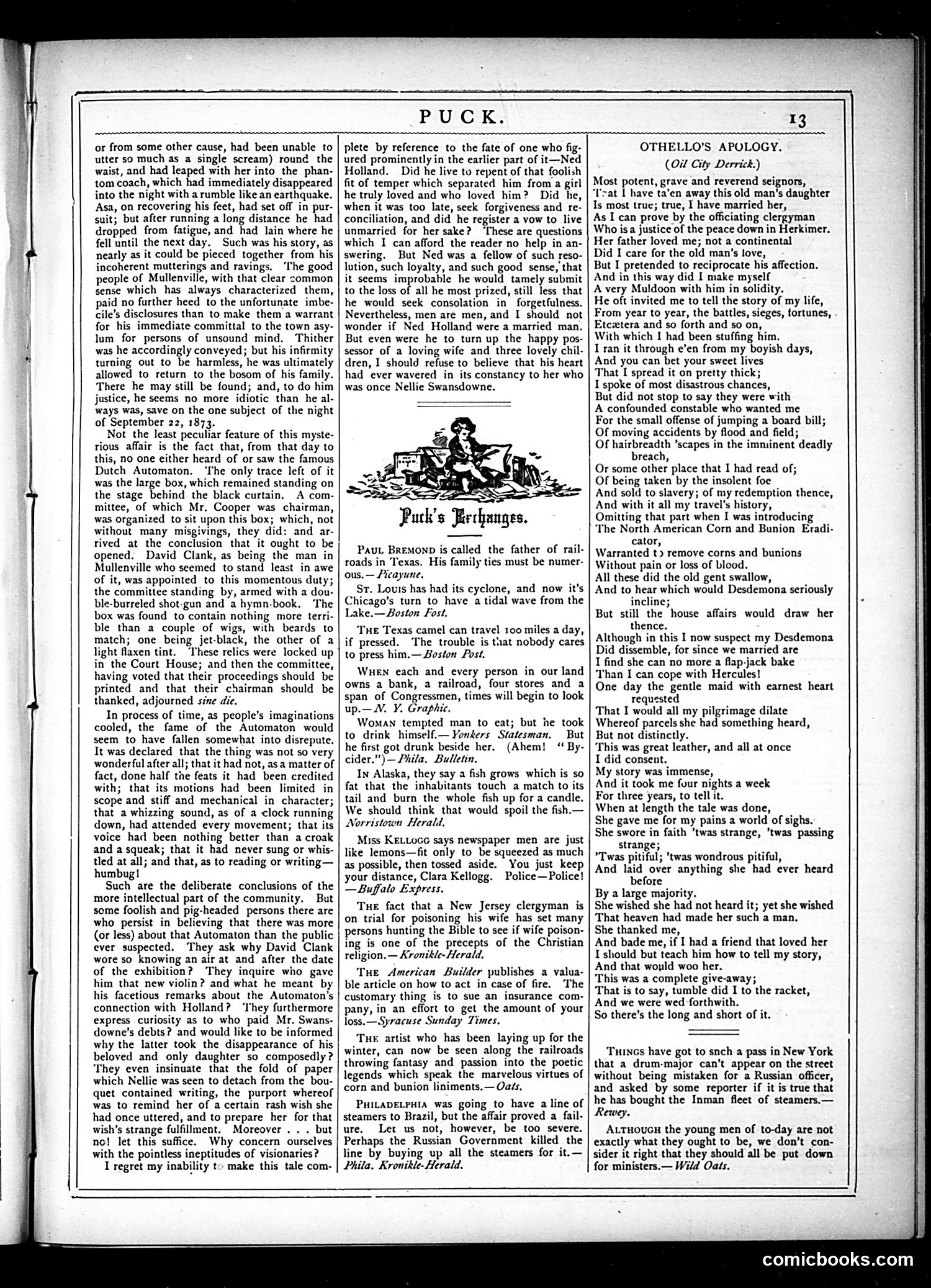
This page contains miscellaneous satirical items and anecdotes rather than a single unified cartoon. The central illustration labeled "Puck's Intrigues" appears to show a chaotic scene with figures in distress or conflict, though details are unclear at this resolution. The text items mock various contemporary subjects: Automaton inventions and their practical limitations; a New Jersey clergyman's attempt to poison his wife using Biblical precepts; railroad and steamship industry practices; and general social absurdities of the era (including a fish in Alaska so large it could be burned as a candle). The "Othello's Apology" poem appears to be a satirical response to Shakespeare, likely critiquing marital or social relations. These are typical of *Puck*'s format: brief, pointed jabs at institutions, public figures, and contemporary follies.
📄 Transcribed text from this page (OCR, searchable)
Machine-transcribed from the original scan — historical spelling and the odd misread are preserved.
PUCK. or from some other cause, had been unable to utter so much as a single scream) round the waist, and had leaped with her into the phan- tom coach, which had immediately disappeared into the night with arumble like an earthquake. ‘Asa, on recovering his feet, had set off in pur- suit; but after running a Hong distance he had dropped from fatigue, and had lain where he fell until the next day. Such was his story, as nearly as it could be pieced together from his incoherent mutterings and ravings. ‘I'he good people of Mullenville, with that clear common sense which has always characterized them, paid no further heed to the unfortunate imbe- cile’s disclosures than to make them a warrant for his immediate committal to the town asy- lum for persons of unsound mind. Thither was he accordingly conveyed; but his infirmity turning out to be harmless, he was ultimately allowed to return to the bosom of his family. There he may still be found; and, to do him justice, he seems no more idiotic than he al- ways was, save on the one subject of the night of September 22, 1873. Not the least peculiar feature of this myste- rious affair is the fact that, from that day to this, no one either heard of or saw the famous Dutch Automaton. ‘The only trace left of it was the large box, which remained standing on the stage Behind the black curtain. A com- mittee, of which Mr. Cooper was chairman, was organized to sit upon this box; which, not without many misgivings, they did: and ar- rived at the conclusion that it ought to be opened. David Clank, as being the man in Mullenville who seemed to stand least in awe of it, was appointed to this momentous duty; the committee standing by, armed with a dou- ble-burreled shot-gun and a hymn-book. The box was found to contain nothing more terri- ble than a couple of wigs, with beards to match; one being jet-black, the other of a light flaxen tint. ‘These relics were locked up in the Court House; and then the committee, having voted that their proceedings should be printed and that their chairman should be thanked, adjourned sine die. In process of time, as people’s imaginations cooled, the fame of the Automaton would seem to have fallen somewhat into disrepute. It was declared that the thing was not so very wonderful after all; that it had not, asa matter of fact, done half the feats it had been credited with; that its motions had been limited in scope and stiff and mechanical in character; that a whizzing sound, as of a clock running down, had attended every movement; that its voice had been nothing better than a croak and a squeak; that it had never sung or whis- tled at all; and that, as to reading or writing— humbug! Such are the deliberate conclusions of the more intellectual part of the community. But some foolish and pig-headed persons there are who persist in believing that there was more (or less) about that Automaton than the public ever suspected. They ask why David Clank wore so knowing an air at and after the date of the exhibition? They inquire who gave him that new violin? and what he meant by his facetious remarks about the Automaton’s connection with Holland? ‘They furthermore express curiosity as to who paid Mr. Swans- downe's debts? and would like to be informed why the latter took the disappearance of his beloved and only daughter so composedly ? ‘They even insinuate that the fold of paper which Nellie was seen to detach from the bou- quet contained writing, the purport whereof was to remind her of a certain rash wish she had once uttered, and to prepare her for that wish’s strange fulfillment. Moreover . . . but no! let this suffice. Why concern ourselves with the pointless ineptitudes of visionaries? I regret my inability to make this tale com- plete by reference to the fate of one who fig- ured prominently in the earlier part of it—Ned Holland. Did he live to repent of that foolish fit of temper which separated him from a girl he truly loved and who loved him? Did he, when it was too late, seek forgiveness and re- conciliation, and did he register a vow to live unmarried for her sake? “These are questions which I can afford the reader no help in an- swering. But Ned was a fellow of such reso- lution, such loyalty, and such good sense, that it seems improbable he would tamely submit to the loss of all he most prized, still less that he would seek consolation in forgetfulness. Nevertheless, men are men, and I should not wonder if Ned Holland were a married man. But even were he to turn up the happy pos- sessor of a loving wife and three lovely chil- dren, I should refuse to believe that his heart had ever wavered in its constancy to her who was once Nellie Swansdowne. Paut Brenonp is called the father of rail- roads in Texas. His family ties must be numer- ous. — Picayune, Sr. Louis has had its cyclone, and now it’s Chicago’s turn to have a tidal wave from the Lake.—Boston Fost, ‘Tne Texas camel can travel 100 miles a day, if pressed. The trouble is that nobody cares to press him.— Boston Post. When each and every person in our land owns a bank, a railroad, four stores and a span of Congressmen, times will begin to look up.—. ¥. Graphic. Woman tempted man to eat; but he took to drink himself.— Yonkers Statesman. But he first got drunk beside her. (Ahem! “ By- cider.”)— Phila, Bulletin. In Alaska, they say a fish grows which is so fat that the inhabitants touch a match to its tail and burn the whole fish up for a candle. We should think that would spoil the fish.— Norristown Herald, Miss KELLOGG says newspaper men are just like lemons—fit only to be squeezed as much as possible, then tossed aside. You just keep your distance, Clara Kellogg. Police—Police! —Buffalo Express. Tue fact that a New Jersey clergyman is on trial for poisoning his wife has set many persons hunting the Bible to see if wife poison- ing is one of the precepts of the Christian religion.— Kronikle-Herald, THe American Builder publishes a valua- ble article on how to act in case of fire. The customary thing is to sue an insurance com- pany, in an effort to get the amount of your loss.—Syracuse Sunday Times, ‘Tue artist who has been laying up for the winter, can now be seen along the railroads throwing fantasy and passion into the poetic legends which speak the marvelous virtues of corn and bunion liniments.— Oats, PHILADELPHIA was going to have a line of steamers to Brazil, but the affair proved a fail- ure. Let us not, however, be too severe. Perhaps the Russian Government killed the line by buying up all the steamers for it.— Phila, Kronikle-Herald, OTHELLO'S APOLOGY. (Oil City Derrick.) Most potent, grave and reverend seignors, ‘I'sat 1 have ta’en away this old man’s daughter Is most true; true, I have married her, As I can prove by the officiating clergyman Who isa justice of the peace down in Herkimer. Her father loved me; not a continental Did I care for the old man’s love, But I pretended to reciprocate his affection. And in this way did I make myself A very Muldoon with him in solidity. He oft invited me to tell the story of my life, From year to year, the battles, sieges, fortunes, Etcetera and so forth and so on, With which I had been stuffing him. Iran it through e’en from my boyish days, And you can bet your sweet lives That I spread it on pretty thick; I spoke of most disastrous chances, But did not stop to say they were with A confounded constable who wanted me For the small offense of jumping a board bill; Of moving accidents by flood and field; Of hairbreadth 'scapes in the imminent deadly breach, Or some other place that I had read of; Of being taken by the insolent foe And sold to slavery; of my redemption thence, And with it all my travel’s history, Omitting that part when I was introducing ‘The North American Corn and Bunion Eradi- cator, Warranted t> remove corns and bunions Without pain or loss of blood. All these did the old gent swallow, And to hear which would Desdemona seriously incline; But still the house affairs would draw her thence. Although in this I now suspect my Desdemona Did dissemble, for since we married are I find she can no more a flap-jack bake Than I can cope with Hercules! One day the gentle maid with earnest heart requested That I would all my pilgrimage dilate Whereof parcels she had something heard, But not distinctly. ‘This was great leather, and all at once I did consent. My story was immense, And it took me four nights a week For three years, to tell it. When at length the tale was done, She gave me for my pains a world of sighs. She swore in faith ‘twas strange, ‘twas passing strange; "Twas pitiful; ‘twas wondrous pitiful, And laid over anything she had ever heard before By a large majority. She wished she had not heard it; yet she wished That heaven had made her such a man, She thanked me, And bade me, if I had a friend that loved her I should but teach him how to tell my story, And that would woo her. This was a complete give-away; That is to say, tumble did I to the racket, And we were wed forthwith. So there's the long and short of it. Tunes have got to snch a pass in New York that a drum-major can’t appear on the street without being mistaken for a Russian officer, and asked by some reporter if it is true that he has bought the Inman fleet of steamers.— Rewey. ALTHOUGH the young men of to-day are not exactly what they ought to be, we don’t con- sider it right that they should all be put down for ministers.— Wild Oats. comicbooks.com