
Puck, 1878-05-29 · page 3 of 16
Puck — May 29, 1878 — page 3: what you’re looking at
What you’re looking at
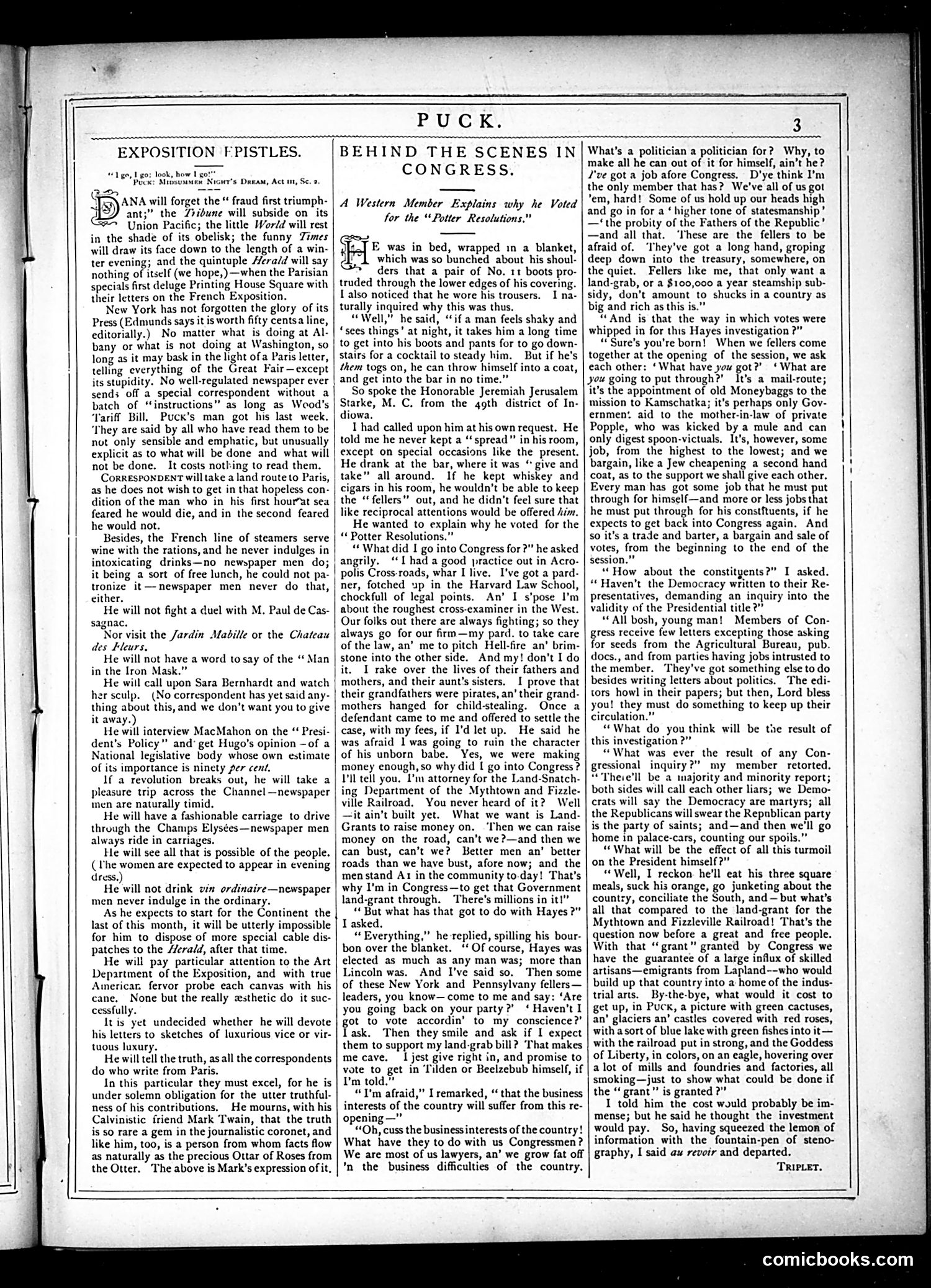
This page contains two sections: "Exposition Epistles" (newspaper parody) and "Behind the Scenes in Congress" (political commentary). **"Behind the Scenes in Congress"** features a Western congressman explaining his voting record to constituents. The satire targets congressmen who prioritize personal enrichment over public service—the politician admits voting based on which interests benefit him personally rather than constituent welfare. References include land-grab schemes, railroad investments, and the "Mythtown and Fizzleville Railroad," suggesting satirical critiques of corporate influence on Congress. The piece mocks elected officials' hypocritical justifications for corrupt votes and exposes how legislators abandon agricultural/labor constituencies to serve wealthy business interests. The congressman's candid admissions about voting for personal profit constitute the satire's core joke: exposing what politicians normally conceal.
📄 Transcribed text from this page (OCR, searchable)
Machine-transcribed from the original scan — historical spelling and the odd misread are preserved.
PUCK. 3 EXPOSITION FPISTLES. #41 g6, 1 €0: look, how 1 B pgoe: Altisuantte 2 ——— SS ANA will forget the“ fraud first triumph- BY any” the Zridune will subside on its Union Pacific; the little Wor/d will rest in the shade of its obelisk; the funny Times will draw its face down to the length of a win- ter evening; and the quintuple Hera/d will say nothing of itself (we hope,)—when the Parisian specials first deluge Printing House Square with their letters on the French Exposition. New York has not forgotten the glory of its Press (Edmunds says it is worth fifty centsa line, editorially.) No matter what is doing at Al- bany or what is not doing at Washington, so long as it may bask in the light ofa Paris letter, telling everything of the Great Fair—except its stupidity. No well-regulated newspaper ever sends off a special correspondent without a batch of “instructions” as long as Weod’s ‘ariff Bill, Puck’s man got his last week. ‘They are said by all who have read them to be not only sensible and emphatic, but unusually explicit as to what will be done and what will not be done. It costs nothing to read them, CorresPonpDeENT willtake a land route to Paris, as he does not wish to get in that hopeless con- dition of the man who in his first hourvat sea feared he would die, and in the second feared he would not. Besides, the French line of steamers serve wine with the rations, and he never indulges in intoxicating drinks—no newspaper men do; it being a sort of free lunch, he could not pa- tronize it— newspaper men never do that, either, He will not fight a duel with M. Paul de Cas- sagnac, Nor visit the Jardin Madille or the Chateau des Fleurs, He will not have a word to say of the “ Man in the Iron Mask.” He will call upon Sara Bernhardt and watch ur’s Danas, Act ttt, Sc. 2 er sculp. (No correspondent has yet said any- | thing about this, and we don’t want you to give it away.) He will interview MacMahon on the “ Presi- dent’s Policy" and’ get Hugo's opinion - of a National legislative body whose own estimate of its importance is ninety per cent, Jf a revolution breaks out, he will take a pleasure trip across the Channel—newspaper men are naturally timid. He will have a fashionable carriage to drive through the Champs Elysées—newspaper men always ride in carriages. He will see all that is possible of the people. (Uhe women are expected to appear in evening dress.) He will not drink vin ordinaire—newspaper men never indulge in the ordinary. As he expects to start for the Continent the last of this month, it will be utterly impossible for him to dispose of more special cable dis- patches to the Hera/d, after that time. He will pay particular attention to the Art Department of the Exposition, and with true Americar fervor probe each canvas with his cane, None but the really zesthetic do it suc- cessfully. It is yet undecided whether he will devote his letters to sketches of luxurious vice or vir- tuous luxury. He will tell the truth, as all the correspondents do who write from Paris. In this particular they must excel, for he is under solemn obligation for the utter truthful- ness of his contributions. He mourns, with his Calvinistic friend Mark Twain, that the truth is so rare a gem in the journalistic coronet, and like him, too, is a person from whom facts flow as naturally as the precious Ottar of Roses from the Otter. The above is Mark’s expression of it, BEHIND THE SCENES IN CONGRESS. A Western Member Explains why he Voted for the “Potter Resolutions.” which was so bunched about his shoul- ders that a pair of No. 11 boots pro- truded through the lower edges of his covering. [also noticed that he wore his trousers. I na- turally inquired why this was thus. “Well,” he said, “if man feels shaky and ‘sees things’ at night, it takes him a long time to get into his boots and pants for to go down- stairs for a cocktail to steady him. But if he's | them togs on, he can throw himself into a coat, | and get into the bar in no time.” So spoke the Honorable Jeremiah Jerusalem Starke, M. C. from the ggth district of In- diowa. Thad called upon him at his own request. He told me he never kept a “spread” in his room, except on special occasions like the present. He drank at the bar, where it was “ give and take” all around. If he kept whiskey and cigars in his room, he wouldn’t be able to keep the ‘fellers” out, and he didn't feel sure that like reciprocal attentions would be offered Aim. He wanted to explain why he voted for the ‘Potter Resolutions.” “What did I go into Congress for?” he asked angrily. “1 had a good practice out in Acro- polis Cross-roads, whar I live. I've got a pard- ner, fotched up in the Harvard Law School, chockfull of legal points. An’ I s'pose I'm about the roughest cross-examiner in the West. Our folks out there are always fighting; so they always go for our firm—my pard. to take care of the law, an’ me to pitch Hell-fire an’ brim- stone into the other side. And my! don't I do | it. I rake over the lives of their fathers and | mothers, and their aunt's sisters. I prove that their grandfathers were pirates, an’ their grand- mothers hanged for child-stealing. Once a defendant came to me and offered to settle the case, with my fees, if I'd let up. He said he was afraid Iwas going to ruin the character of his unborn babe. Yes, we were making money enough,so why did [ go into Congress ? I'll tell you, I’m attorney for the Land-Snatch- ing Department of the Mythtown and Fizzle- ville Railroad. You never heard of it? Well —it ain’t built yet. What we want is Land- Grants to raise money on. ‘I'hen we can raise money on the road, can’t we ?—and then we can bust, can’t we? Better men an’ better roads than we have bust, afore now; and the men stand Ax in the community to-day! That's why I'm in Congress—to get that Government land-grant through. ‘There's millions in it!” “ But what has that got to do with Hayes?” Lasked. “ Everything,” he replied, spilling his bour- bon over the blanket. ‘ Of course, Hayes was elected as much as any man was; more than Lincoln was. And I've said so. Then some of these New York and Pennsylvany fellers— leaders, you know—come to me and say: ‘Are you going back on your party?’ ‘ Haven't I got to vote accordin’ to my conscience?’ Task. Then they smile and ask if I expect them to support my land-grab bill? ‘That makes me cave. I jest give right in, and promise to vote to get in Tilden or Beelzebub himself, if I'm told. “T'm afraid,” I remarked, “ that the business interests of the country will suffer from this re- opening —” “Oh, cuss the business interests of the country! What have they to do with us Congressmen? We are most of us lawyers, an’ we grow fat off 'n the business difficulties of the country. Fe was in bed, wrapped in a blanket, Gy What's a politician a politician for? Why, to make all he can out of it for himself, ain’t he? P've got a job afore Congress. D'ye think I’m the only member that has? We've all of us got ‘em, hard! Some of us hold up our heads high and go in for a ‘higher tone of statesmanship’ —‘the probity of the Fathers of the Republic’ —and all that. ‘These are the fellers to be afraid of. ‘Ihey’ve got a long hand, groping deep down into the treasury, somewhere, on the quiet. Fellers like me, that only want a land-grab, or a $100,000 a year steamship sub- sidy, don’t amount to shucks in a country as big and rich as this is.”” “And is that the way in which votes were whipped in for this Hayes investigation ?” “'Sure’s you're born! When we fellers come together at the opening of the session, we ask each other: ‘What have you got?’ ‘What are you going to put through?’ It’s a mail-route; it’s the appointment of old Moneybaggs to the mission to Kamschatka; it's perhaps only Gov- ernmen: aid to the mother-in-law of private Popple, who was kicked by a mule and can only digest spoon-victuals. It’s, however, some job, from the highest to the lowest; and we bargain, like a Jew cheapening a second hand coat, as to the support we shall give each other. Every man has got some job that he must put through for himself—and more or less jobs that he must put through for his constftuents, if he expects to get back into Congress again. And so it’s a trade and barter, a bargain and sale of votes, from the beginning to the end of the session.” “How about the constityents?” I asked. “Haven't the Democracy written to their Re- presentatives, demanding an inquiry into the validity of the Presidential title ?” “All bosh, young man! Members of Con- gress receive few letters excepting those asking for seeds from the Agricultural Bureau, pub. docs., and from parties having jobs intrusted to the member. They've got something else todo besides writing letters about politics. The edi- tors howl in their papers; but then, Lord bless you! they must do something to keep up their circulation.” “What do you think will be the result of this investigation ?” “What was ever the result of any Con- gressional inquiry?” my member retorted. “Theie'll be a majority and minority report; both sides will call each other liars; we Demo- crats will say the Democracy are martyrs; all the Republicans will swear the Republican party is the party of saints; and—and then we'll go home in palace-cars, counting our spoils.” “What will be the effect of all this turmoil on the President himself?” “Well, I reckon he'll eat his three square meals, suck his orange, go junketing about the country, conciliate the South, and—but what's all that compared to the land-grant for the Mythtown and Fizzleville Railroad! That's the question now before a great and free people. With that grant” granted by Congress we have the guarantee of a large influx of skilled artisans—emigrants from Lapland--who would build up that country into a home of the indus- trial arts. By-the-bye, what would it cost to get up, in Puck, a picture with green cactuses, an’ glaciers an’ castles covered with red roses, with asort of blue lake with green fishes into it— with the railroad put in strong, and the Goddess of Liberty, in colors, on an eagle, hovering over alot of mills and foundries and factories, all smoking—just to show what could be done if the “ grant” is granted ?” I told him the cost would probably be im- mense; but he said he thought the investment would pay. So, having squeezed the lemon of information with the fountain-pen of steno- graphy, I said au revoir and departed. ‘TRIPLET. comicbooks.com