
A complete issue · 16 pages · 1878
Puck — May 22, 1878
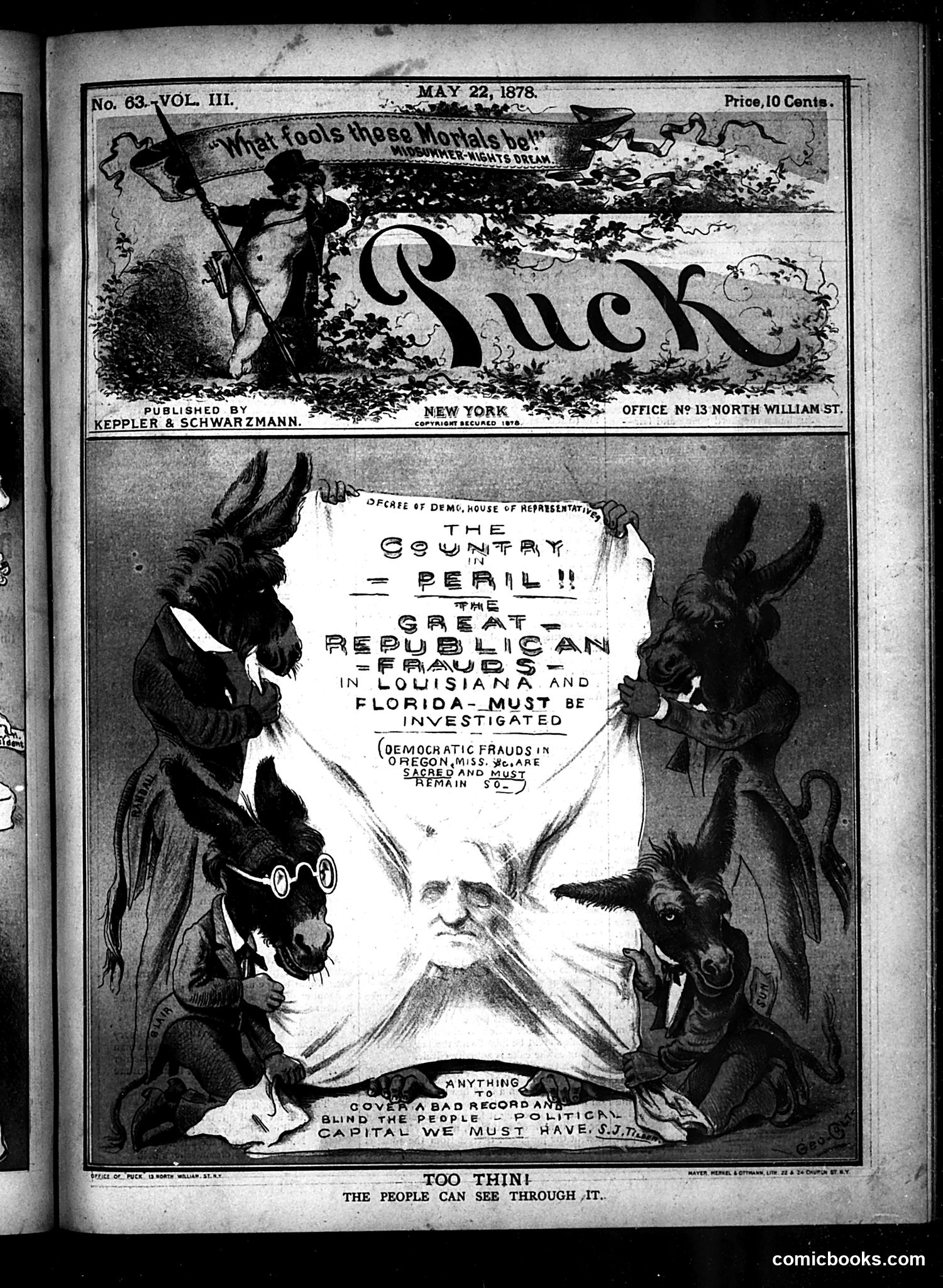
This political cartoon satirizes Republican corruption scandals. The main image depicts a transparent figure revealing internal frauds, held aloft by two demon-like creatures (representing Republican misdeeds). The central text demands investigation of "COUNTRY PERIL!!" regarding "GREAT REPUBLICAN FRAUDS IN LOUISIANA AND FLORIDA," alongside references to "DEMOCRATIC FRAUDS IN OREGON, MISS., CARE" and "CAPITAL WE MUST HAVE." The caption "TOO THIN! THE PEOPLE CAN SEE THROUGH IT" suggests that Republican attempts to obscure or justify their electoral fraud (likely referencing the disputed 1876 election reconstruction era) are transparent to voters. The overall message: Republicans cannot hide their corruption behind excuses or counter-accusations of Democratic wrongdoing.
This page contains primarily text articles rather than political cartoons. The main pieces are: 1. **"The New Judgment of Paris"** — a literary parody of the classical myth, using it to satirize contemporary political figures who traded electoral votes for personal gain during what appears to be a disputed election period (possibly the 1876 Hayes-Tilden controversy, given the reference to "November, 1876"). 2. **"A Question of Frauds"** — discusses election fraud, specifically mentioning Chandler and Hayes, suggesting this commentary addresses the corrupt practices and disputed electoral processes of the era. 3. Several shorter satirical pieces about social hypocrisy and behavioral absurdities. The page demonstrates Puck's approach of using classical allusions and extended metaphors to critique contemporary political corruption and moral failings among public figures.
This page satirizes the political coverage of journalist **W.E. Chandler** regarding congressman **Josiah Robinson**, who appears to have fabricated or misrepresented events in his public statements. The "Silly Billy" section exposes Chandler's contradictory reports about Robinson's activities and claims—particularly involving disputes over cotton prices and political maneuvering. The satire suggests Chandler repeatedly changed his story about Robinson's movements and intentions, creating confusion. The piece ridicules both figures: Chandler for unreliable reporting and Robinson for the underlying deceptions being reported. The "Degrading Drama" section below shifts to theatrical criticism, discussing an actor named Jefferson Pym's difficulty obtaining roles after playing disreputable characters.
This page from *Puck* contains three distinct sections: 1. **"At Table" (Rondeau)** — A poem by R.K. Munkittrick about dining pleasures, with no political content. 2. **"An Operatic Champion"** — A prose article critiquing New York's opera culture. The writer argues opera companies waste money on poor productions while claiming artistic merit. He advocates for better judgment in casting and production quality rather than expensive spectacle. This is cultural criticism, not political satire. 3. **"Strange Sights"** and **"Literary Notes"** — Brief humor items and book/publication notices. **No cartoon illustrations appear on this page.** It's primarily text-based content offering social commentary on opera and literary notices typical of *Puck*'s format.
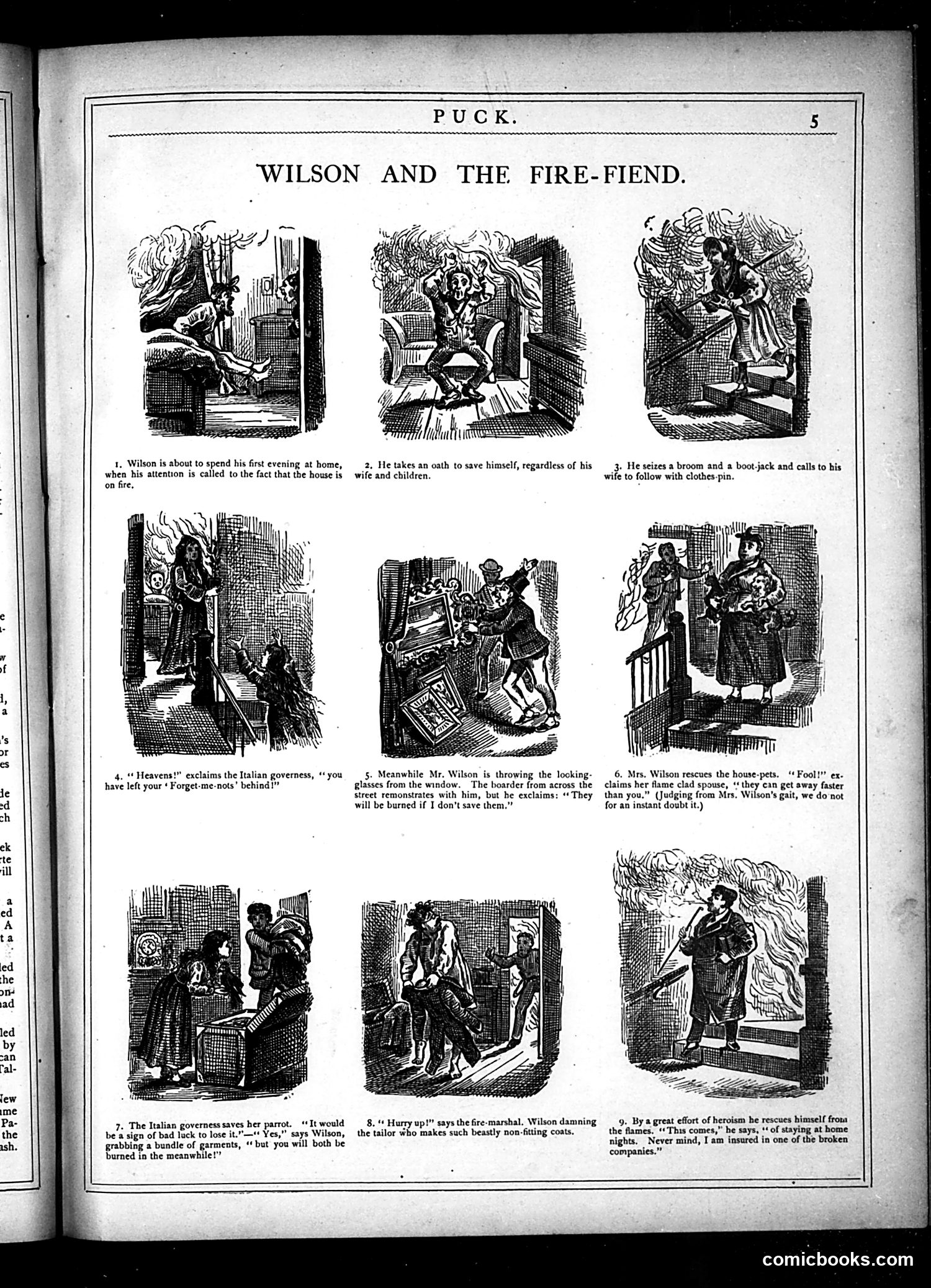
This is a narrative comic strip satirizing President Woodrow Wilson during a domestic crisis. The story follows Wilson attempting to spend an evening at home when he discovers his house is on fire. Panicked, he swears an oath, grabs a broom and boot jack, and desperately calls his wife. The Italian governess exclaims in exasperation about Wilson's poor housekeeping. Meanwhile, Wilson throws belongings out windows while the governess saves the parrot. A fire marshal arrives as Wilson frantically tosses more items. Finally, Mrs. Wilson reassures him that she rescued the house pets. The satire appears to mock Wilson's perceived incompetence and chaotic management style, using domestic disaster as metaphor for his political fumbling—likely referencing his presidency's early challenges.
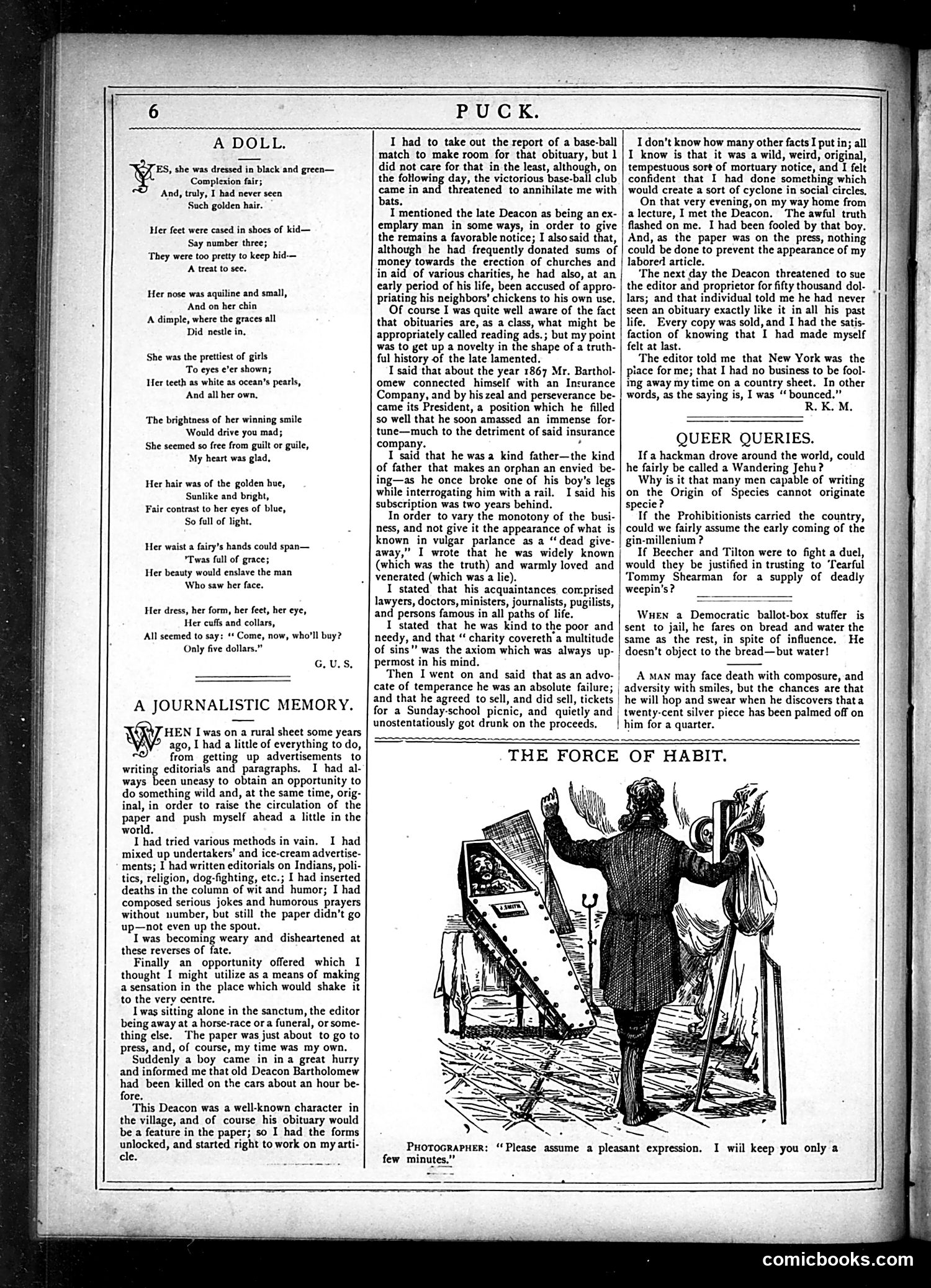
This page contains three distinct pieces: 1. **"A Doll"** (poem, left): A sentimental verse about a girl's cherished doll, with no apparent satire. 2. **"A Journalistic Memory"** (center): An editor's anecdote about struggling to boost a rural newspaper's circulation through various sensational content until finally publishing an obituary of "Deacon Bartholomew" that generated genuine reader interest—satirizing how newspapers exploit death for engagement. 3. **"The Force of Habit"** (cartoon, bottom right): Shows a photographer asking a subject to "assume a pleasant expression" while the subject appears distressed or uncomfortable—likely satirizing the awkwardness of early photography's long exposure times and stiff conventions, where subjects endured discomfort to appear proper for the camera. The page offers light social commentary on journalism and photography practices of the era.
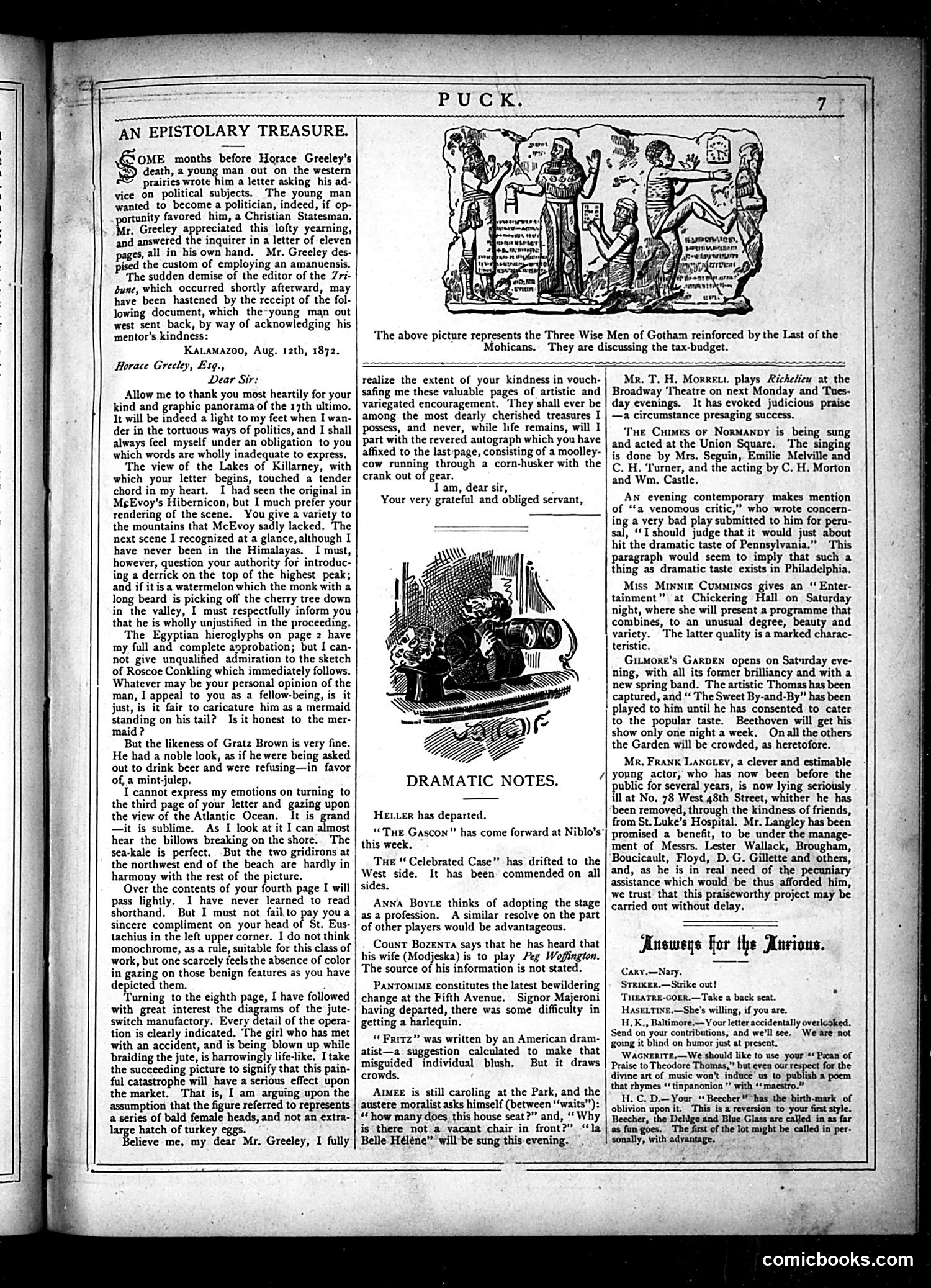
This page contains primarily **theatrical and entertainment reviews** rather than political cartoons. The main illustration shows "The Three Wise Men of Gotham reinforced by the Last of the Mohicans," which appears to be a satirical theatrical sketch depicting characters discussing or debating something, likely contemporary political or social issues of the era. The bulk of the page consists of: - An epistolary piece (letter from someone to Horace Greeley about becoming a politician) - "Dramatic Notes" reviewing various stage productions and actors - A humor column titled "Amusement for the Anxious" The cartoons and text target contemporary theater performances, actors' abilities, and New York entertainment venues rather than serving as direct political satire. This reflects Puck's mix of theatrical criticism alongside its better-known political commentary.
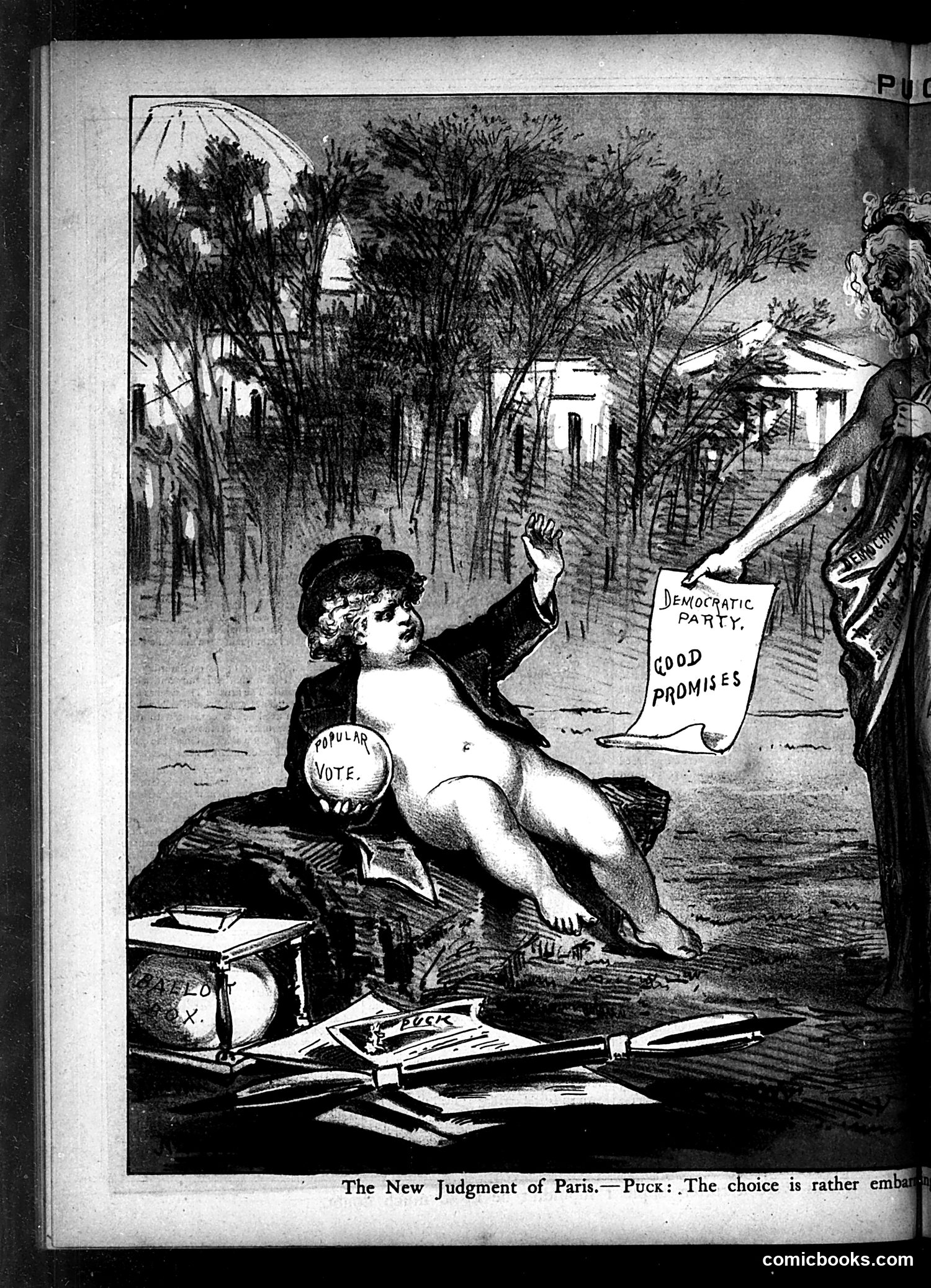
This political satire depicts a cherub or cupid figure choosing between two options, paralleling the classical myth where Paris judged which goddess deserved a prize. Here, the figure holds a "Popular Vote" and must choose between the "Democratic Party" (represented by a scroll of "Good Promises") offered by a figure on the right. The cartoon critiques the Democratic Party's campaign strategy, suggesting their electoral appeal rests on mere promises rather than substantive accomplishments. The classical reference frames the choice as a fateful decision comparable to mythology's most consequential judgment. The satire implies voters are being seduced by empty rhetoric rather than genuine policy—a commentary on campaign dishonesty common in Gilded Age American politics.
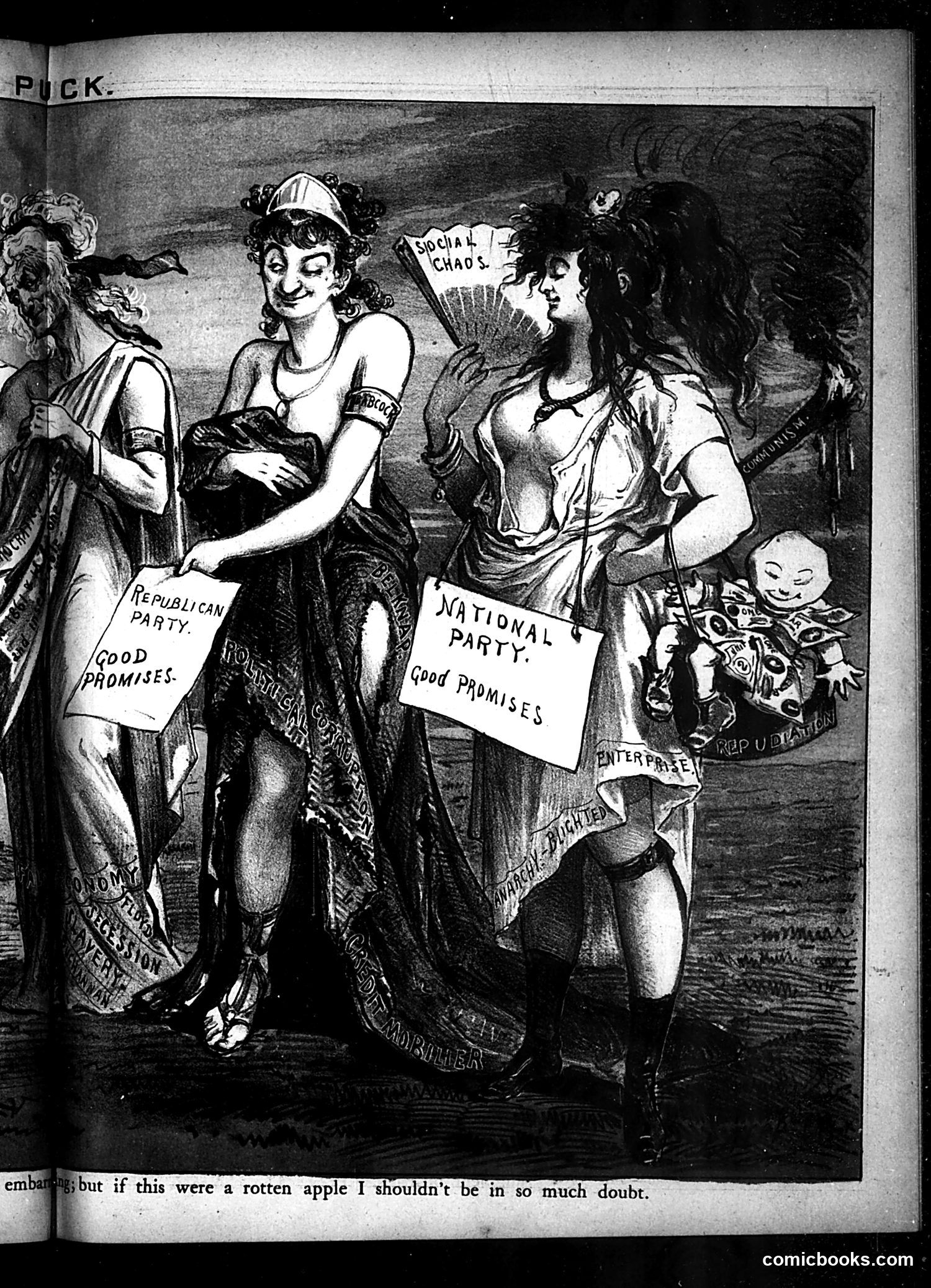
This Puck cartoon satirizes the "good promises" made by both major American political parties—the Republican Party and National Party (likely referring to a splinter faction). The cartoon depicts allegorical female figures representing these parties as seductive women offering attractive promises to win support. The figures hold signs reading "GOOD PROMISES," suggesting the parties are making empty or dishonest pledges to voters. Various labels visible on their garments and accessories reference political concepts like "Enterprise" and specific policies. The satirical point appears to be that both parties manipulate voters with attractive rhetoric that cannot be trusted—they're essentially "selling" themselves through deception. The tone is cynical about electoral politics and campaign promises of the era.
This page contains a comedic dialogue (rather than a visual cartoon) between two characters: **Charles Chillingworth**, a bachelor, and **Mrs. Griffiths**, a widow. The satire mocks the social conventions of courtship and marriage in the era. Chillingworth pursues Mrs. Griffiths romantically, but she tests his sincerity by demanding he abandon his bachelor lifestyle, change his name, and accept her terms for marriage as a "marriage of sober reason." The humor lies in exposing the hypocrisy of romantic declarations—Chillingworth claims to seek genuine connection while actually desiring an "affinity," and Mrs. Griffiths exposes how marriage proposals often mask self-interest and social convenience rather than authentic love. The piece satirizes both male romantic pretense and female skepticism about matrimonial sincerity.
This page contains a fictional dialogue between characters named Chillingworth and Mrs. Griffiths, apparently about romantic entanglements and marriage. The left column is the dramatic dialogue itself. The right column presents "An Automatic Enigma," a narrative by Julian Hawthorne describing events in Mullenville related to a postal delivery mix-up involving letters about a dental election. The story appears satirical—mail gets distributed incorrectly to residents, causing confusion about who received whose correspondence. Without seeing accompanying illustrations, it's difficult to identify specific political figures or targets. The piece appears to be general social satire about romantic complications and small-town mail service confusion rather than commentary on specific current events or politicians.
This page is primarily text—a dialogue between characters named Nellie, Ned, and Miss Swansdowne discussing romance and marriage prospects. The conversation centers on Nellie's potential engagement to Mr. Cooper and Ned's feelings about it. The piece appears to be a serialized story or humorous sketch rather than a political cartoon. It includes stage directions in italics describing characters' actions and emotions (e.g., "looking down, and excessively lovely"). The satire seems directed at Victorian courtship conventions—the awkwardness of romantic entanglements, parental expectations around marriage, and the tension between genuine affection and social propriety. References to "papa" and concerns about financial prospects reflect period anxieties about matrimonial arrangements. Without identifying specific individuals, the humor relies on recognizable social situations rather than topical political commentary.
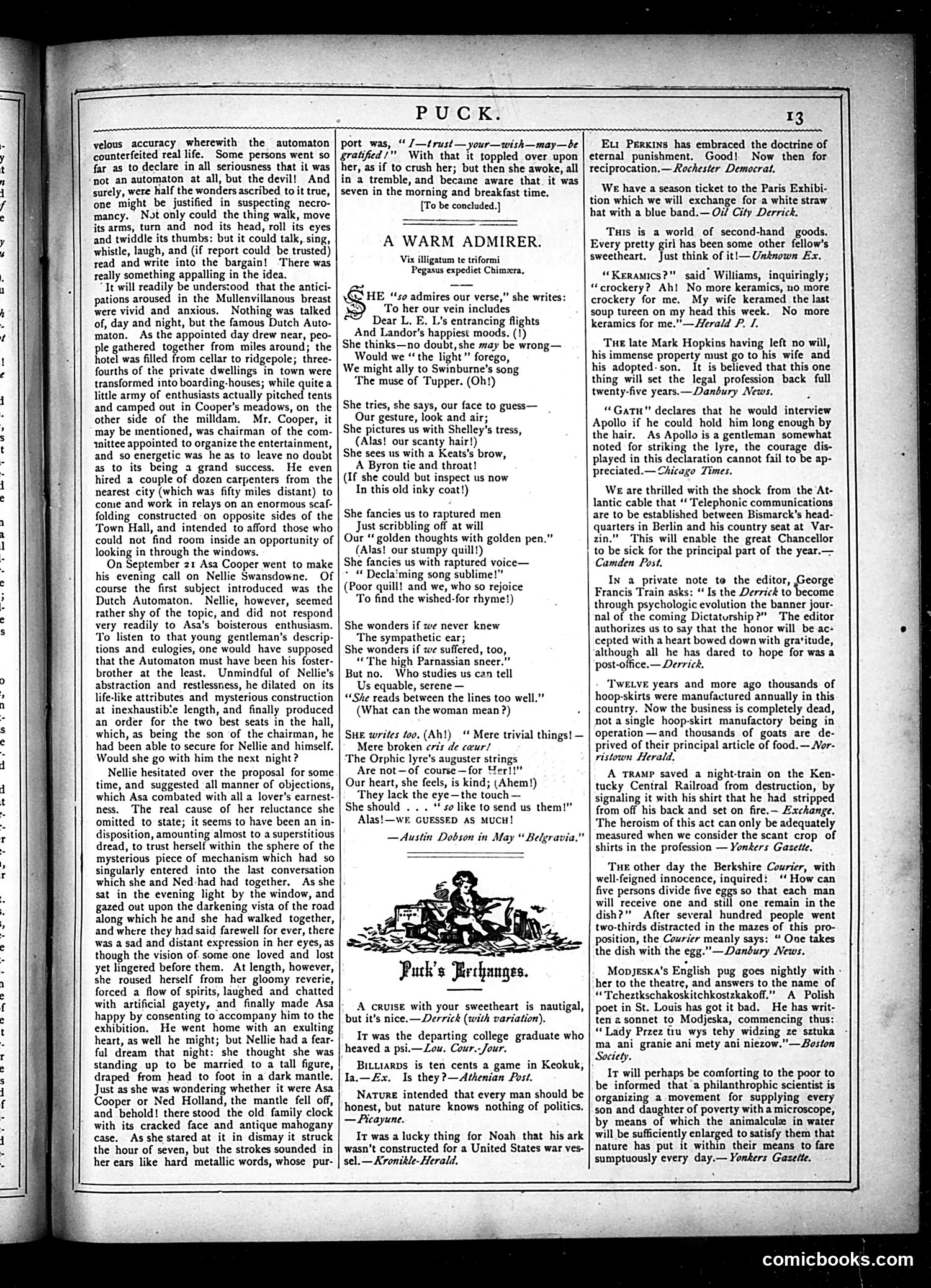
This small cartoon titled "Puck's Birthdays" appears to depict a cherub or putto (classical baby figure) surrounded by celebratory elements. The accompanying text discusses various birthday-related observations and quips. The left column contains satirical commentary on contemporary matters, including references to the Dutch Automation, Nellie Bly's engagement, and various social observations. The right column features "A Warm Admirer"—a poem about a woman admiring a man, with playful commentary on romance and courtship. Without clearer identification of specific individuals in the cartoon itself, I cannot definitively state which public figures are being satirized. The overall tone is typical of Puck's light satirical approach to social customs, romance, and contemporary news items of the period.
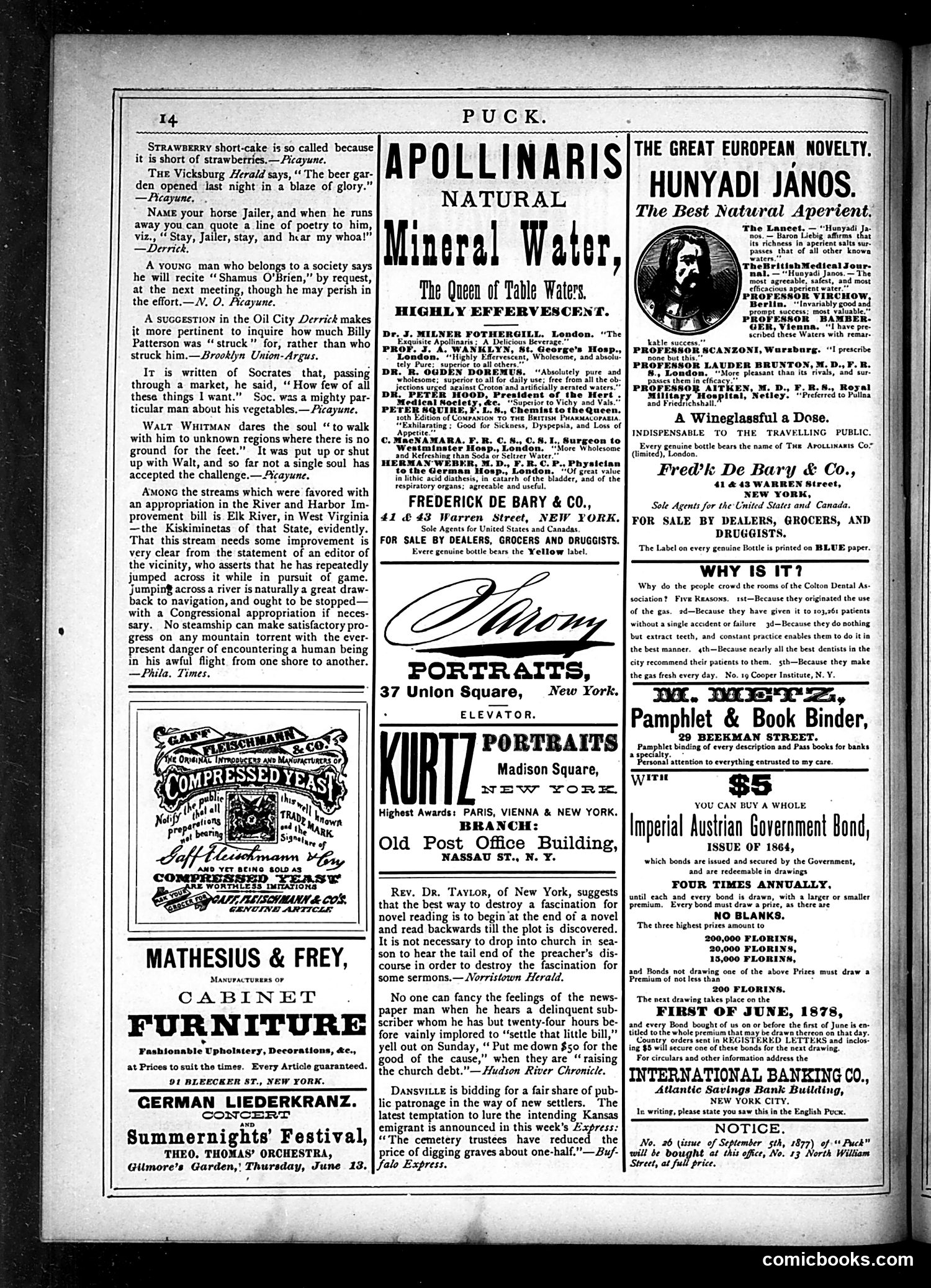
This is primarily an **advertising page** from Puck magazine, not a political cartoon or satirical content. The page features various commercial advertisements including: - **Apollinaris Natural Mineral Water** ("The Queen of Table Waters") - **Hunyadi János** aperient (a Hungarian laxative product) - **Kurtz Portraits** photography studio in Madison Square, New York - **Mathesius & Frey** furniture company - **German Liederkranz** (a singing group's festival) - **Imperial Austrian Government Bond** investment opportunity - **International Banking Company** The only potentially satirical content is **Rev. Dr. Taylor's advice** about destroying fascination for novels by beginning at the end—a humorous suggestion about reading habits. Otherwise, this represents typical 19th-century magazine revenue: densely packed advertisements targeting urban, educated readers with consumer goods and investment opportunities.
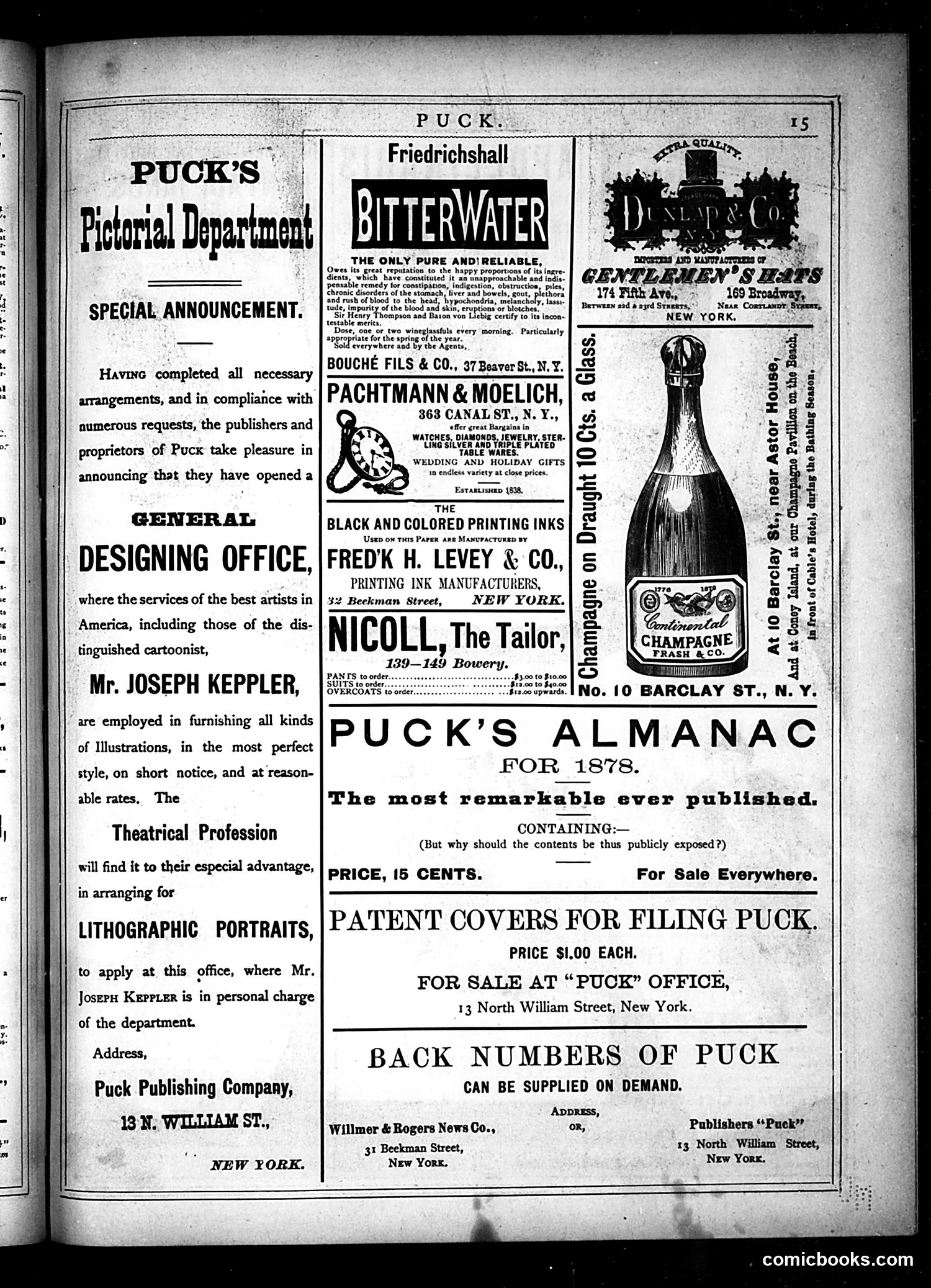
This page is primarily **advertising and announcements** rather than satirical content. It contains: 1. **Puck's Pictorial Department announcement** — advertising a new General Designing Office with artist Joseph Keppler (a distinguished cartoonist) available for lithographic portraits and theatrical profession illustrations. 2. **Commercial advertisements** for various products: Friedrichshall Bitterwater, champagne, printing inks, a tailor's services, and jewelry. 3. **Puck's Almanac for 1878** promotion (15 cents, "the most remarkable ever published"). 4. **Back issue availability notice** for Puck magazine. The page serves primarily as a house organ promoting Puck's in-house services and related products rather than presenting satirical commentary. No political cartoons or social satire are evident on this particular page.
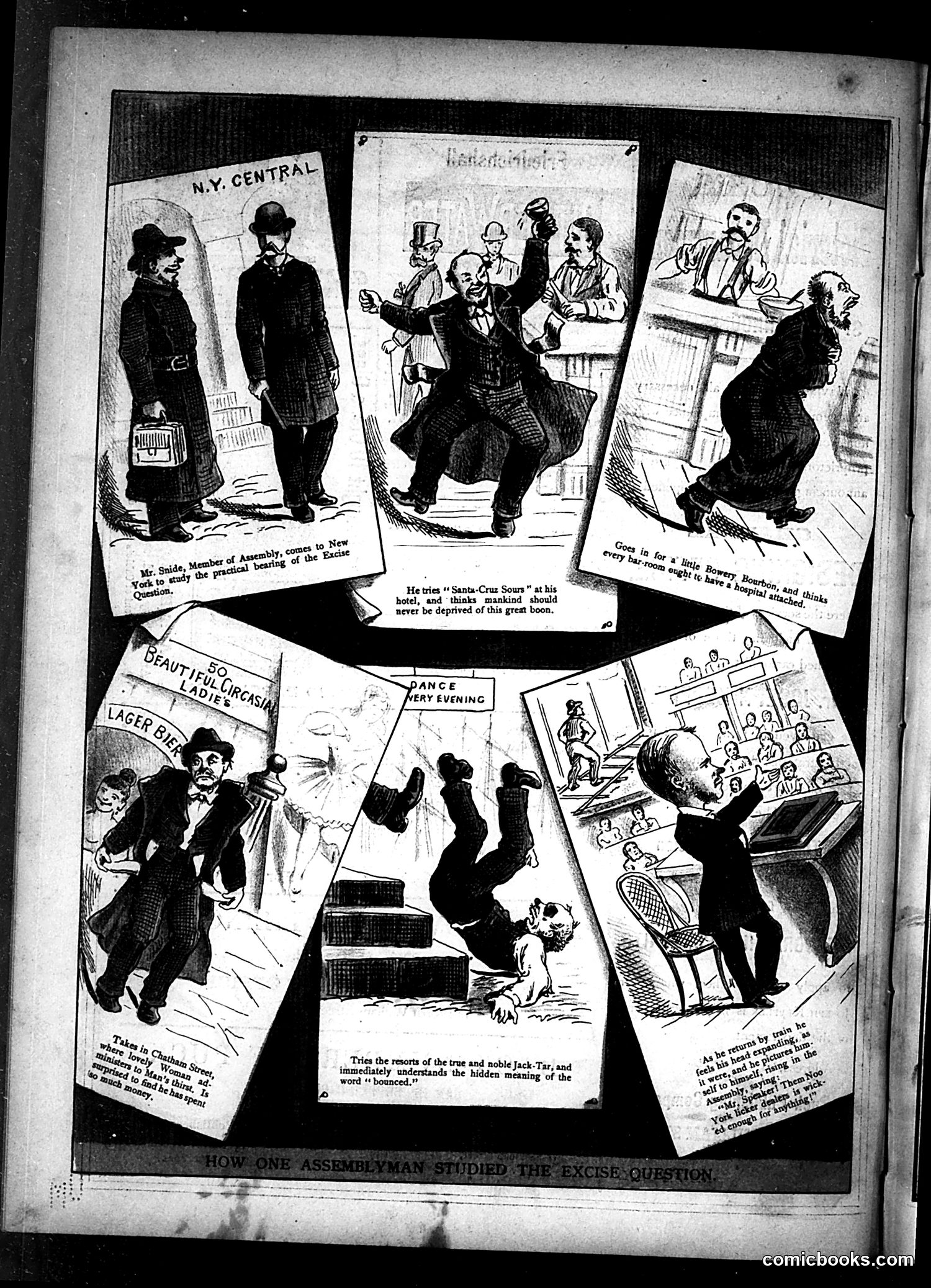
This Puck cartoon satirizes an assemblyman's (likely New York state legislator's) approach to studying alcohol excise tax policy. The sequential panels mock his research method: he visits bars and dance halls rather than conducting serious legislative study. The top panels show him in formal settings with colleagues. The bottom panels depict him in increasingly disreputable venues—a "Beautiful Circassian" lager beer hall, a dance hall, and what appears to be a theater or entertainment establishment—apparently gathering "evidence" through personal indulgence rather than proper investigation. The satire targets both legislative incompetence and the excuse-making politicians used to justify visits to saloons under the guise of official business.