
Puck, 1878-05-22 · page 13 of 16
Puck — May 22, 1878 — page 13: what you’re looking at
What you’re looking at
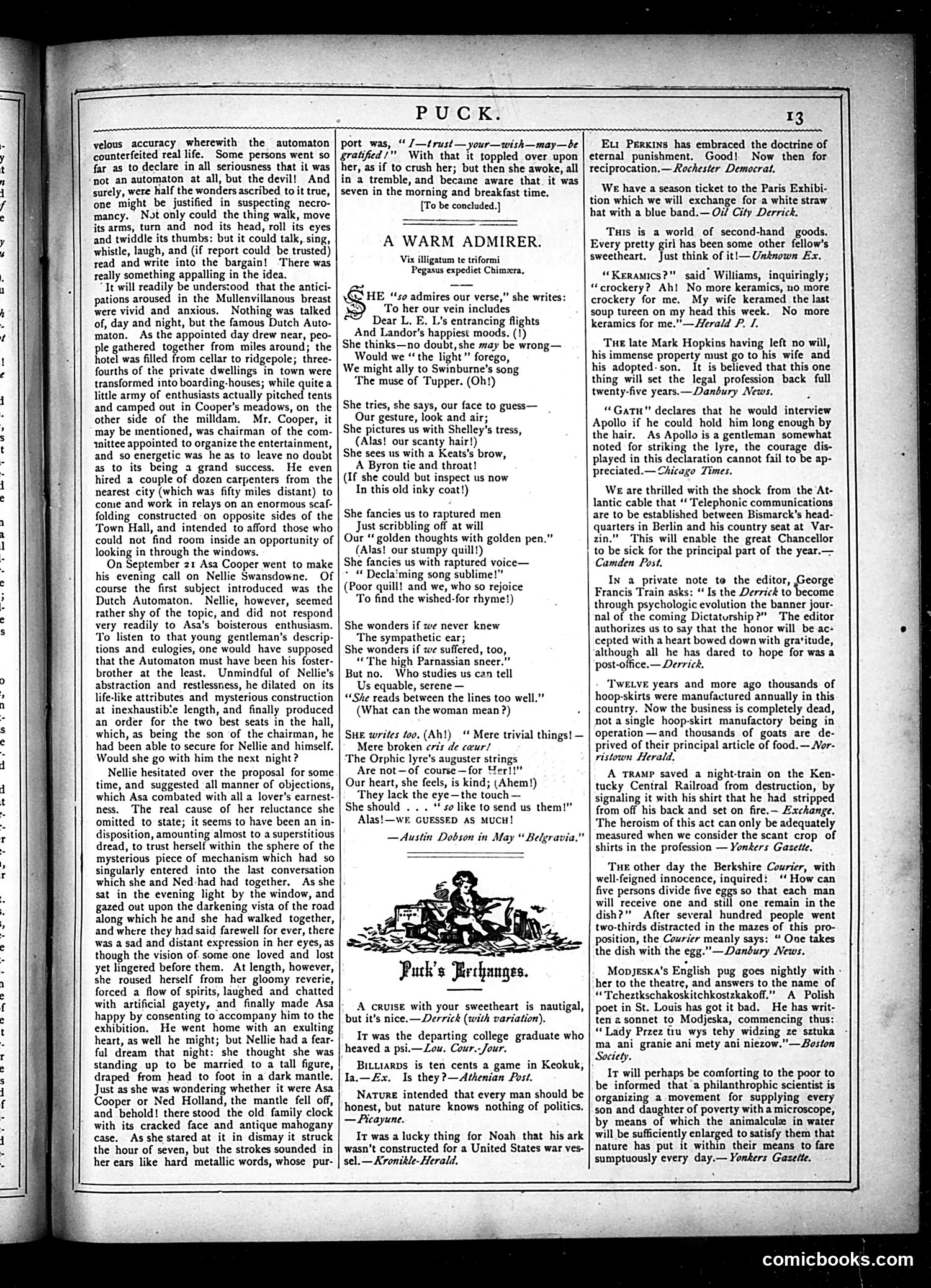
This small cartoon titled "Puck's Birthdays" appears to depict a cherub or putto (classical baby figure) surrounded by celebratory elements. The accompanying text discusses various birthday-related observations and quips. The left column contains satirical commentary on contemporary matters, including references to the Dutch Automation, Nellie Bly's engagement, and various social observations. The right column features "A Warm Admirer"—a poem about a woman admiring a man, with playful commentary on romance and courtship. Without clearer identification of specific individuals in the cartoon itself, I cannot definitively state which public figures are being satirized. The overall tone is typical of Puck's light satirical approach to social customs, romance, and contemporary news items of the period.
📄 Transcribed text from this page (OCR, searchable)
Machine-transcribed from the original scan — historical spelling and the odd misread are preserved.
PUCK. 13 yelous accuracy wherewith the automaton counterfeited real life. Some persons went so far as to declare in all seriousness that it was not an automaton at all, but the devil! And surely, were half the wonders ascribed to it true, one might be justified in suspecting necro- mancy. Not only could the thing walk, move its arms, turn and nod its head, roll its eyes and twiddle its thumbs: but it could talk, sing, whistle, laugh, and (if report could be trusted) read and write into the bargain! ‘There was really something appalling in the idea. It will readily be understood that the antici- pations aroused in the Mullenvillanous breast were vivid and anxious. Nothing was talked of, day and night, but the famous Dutch Auto- maton, As the appointed day drew near, peo- ple gathered together from miles around; the hotel was filled from cellar to ridgepole; three- fourths of the private dwellings in town were transformed into boarding-houses; while quite a little army of enthusiasts actually pitched tents and camped out in Cooper’s meadows, on the other side of the milldam. Mr. Cooper, it may be mentioned, was chairman of the com- mittee appointed to organize the entertainment, and so energetic was he as to leave no doubt as to its being a grand success. He even hired a couple of dozen carpenters from the nearest city (which was fifty miles distant) to come and work in relays on an enormous scaf- folding constructed on opposite sides of the Town Hall, and intended to afford those who could not find room inside an opportunity of looking in through the windows. On September 21 Asa Cooper went to make his evening call on Nellie Swansdowne. Of course the first subject introduced was the Dutch Automaton. Nellie, however, seemed rather shy of the topic, and did not respond very readily to Asa's boisterous enthusiasm. To listen to that young gentleman's descrip- tions and eulogies, one would have supposed that the Automaton must have been his foster- brother at the least. Unmindful of Nellie's abstraction and restlessness, he dilated on its life-like attributes and mysterious construction at inexhaustib‘e length, and finally produced an order for the two best seats in the hall, which, as being the son of the chairman, he had been able to secure for Nellie and himself. Would she go with him the next night? Nellie hesitated over the proposal for some time, and suggested all manner of objections, which Asa combated with all a lover's earnest- ness, The real cause of her reluctance she omitted to state; it seems to have been an in- disposition, amounting almost to a superstitious dread, to trust herself within the sphere of the mysterious piece of mechanism which had so singularly entered into the last conversation which she and Ned-had had together. As she sat in the evening light by the window, and gazed out upon the darkening vista of the road along which he and she had walked together, and where they had said farewell for ever, there was a sad and distant expression in her eyes, as though the vision of. some.one loved and lost yet lingeted before them. At length, however, she roused herself from her gloomy reverie, forced a flow of spirits, laughed and chatted with artificial gayety, and finally made Asa happy by consenting to accompany him to the exhibition. He went home with an exulting heart, as well he might; but Nellie had a fear- ful dream that night: she thought she was standing up to be married to a tall figure, draped from head to foot in a dark mantle. Just as she was wondering whether it were Asa Cooper or Ned Holland, the mantle fell off, and behold! there stood the old family clock with its cracked face and antique mahogany case. As she stared at it in dismay it struck the hour of seven, but the strokes sounded in her ears like hard metallic words, whose pur- port was, “/—trust—your—wish—may—be gratified /"’ With that it toppled over upon her, as if to crush her; but then she awoke, all in a tremble, and became aware that. it was seven in the morning and breakfast time. [To be concluded. A WARM ADMIRER. Vix illigatum te triformi Pegasus expediet Chimera, HE “so admires our verse,” she writes: To her our vein includes Dear L. E. L's entrancing flights And Landor’s happiest moods. (1) She thinks—no doubt, she may be wrong— Would we ‘the light” forego, We might ally to Swinburne’s song ‘The muse of Tupper. (Oh!) She tries, she says, our face to guess— Our gesture, look and air; She pictures us with Shelley's tress, (Alas! our scanty hair!) She sees us with a Keats's brow, A Byron tie and throat! (If she could but inspect us now In this old inky coat!) She fancies us to raptured men Just scribbling off at will Our golden thoughts with golden pen.” (Alas! our stumpy quill!) She fancies us with raptured voice— ~ “ Decla'ming song sublime!” (Poor quill! and we, who so rejoice To find the wished-for rhyme!) She wonders if we never knew ‘The sympathetic ear; She wonders if we suffered, too, “The high Parnassian sneer.” But no. Who studies us can tell Us equable, serene — “(She reads between the lines too well.” (What can the woman mean ?) SHE writes too. (Ah!) “ Mere trivial things! — Mere broken eris de ceur! ‘The Orphic lyre’s auguster strings Are not—of course—for Yer!!" Our heart, she feels, is kind; (Ahem!) They lack the eye—the touch — She should . . . “so like to send us them!” Alas!—We GUESSED as MUCH! —Austin Dobson in May “Belgravia.” A cruise with your sweetheart is nautigal, but it’s nice.—Derrick (with variation). It was the departing college graduate who heaved a psii—Zou. Cour.-Jour. Bituiarps is ten cents a game in Keokuk, Ia.—£x. Is they?—Athenian Post. Nature intended that every man should be honest, but nature knows nothing of politics. —Picayune. Ir was a lucky thing for Noah that his ark wasn’t constructed for a United States war ves- sel.—Kronikle-Herald, Ett Perkins has embraced the doctrine of eternal punishment. Good! Now then for reciprocation.— Rochester Democrat, We have a season ticket to the Paris Exhibi- tion which we will exchange for a white straw hat with a blue band.— Oi! City Derrick, Tus is a world of second-hand goods. Every pretty girl has been some other fellow’s sweetheart. Just think of it!— Unknown Ex. “Keramics?” said Williams, inquiringly; “crockery? Ah! No more keramics, uo more crockery for me. My wife keramed the last soup tureen on my head this week. No more keramics for me.” —Herald P. /. ‘Tue late Mark Hopkins having left no will, his immense property must go to his wife and his adopted. son. It is believed that this one thing will set the legal profession back full twenty-five years.—Danbury News. “Gatun” declares that he would interview Apollo if he could hold him long enough by the hair. As Apollo is a gentleman somewhat noted for striking the lyre, the courage dis- played in this declaration cannot fail to be ap- preciated.— Chicago Times. We are thrilled with the shock from the At- lantic cable that ‘‘ Telephonic communications are to be established between Bismarck’s head- quarters in Berlin and his country seat at Var- zin.” This will enable the great Chancellor to be sick for the principal part of the year.— Camden Post. In a private note to the editor, George Francis Train asks: ‘Is the Derrick to become through psychologic evolution the banner jour- nal of the coming Dictaturship?” The editor authorizes us to say that the honor will be ac+ cepted with a heart bowed down with gratitude, although all he has dared to hope for was a post-office. — Derrick. TWweLve years and more ago thousands of hoop-skirts were manufactured annually in this country. Now the business is completely dead, not a single hoop-skirt manufactory being in operation—and thousands of goats are de- prived of their principal article of food.—Vor- ristown Herald, A Tramp saved a night-train on the Ken- tucky Central Railroad from destruction, by signaling it with his shirt that he had stripped from off his back and set on fire.— Exchange. The heroism of this act can only be adequately measured when we consider the scant crop of shirts in the profession — Yonkers Gazette. Tue other day the Berkshire Courier, with well-feigned innocence, inquired: |“ How can five persons divide five eggs so that each man will receive one and still one remain in the dish?" After several hundred people went two-thirds distracted in the mazes of this pro- position, the Courier meanly says: “ One takes the dish with the egg.""—Danbury News. Mopjeska’s English pug goes nightly with - her to the theatre, and answers to the name of “Tcheztkschakoskitchkostzkakoff.” A Polish poet in St. Louis has got it bad. He has writ- ten 2 sonnet to Modjeska, commencing thus: “Lady Przez tru wys tehy widzing ze sztuka - ma ani granie ani mety ani niezow.”—Boston Society. Ir will perhaps be comforting to the poor to be informed that a philanthrophic scientist is organizing a movement for supplying every son and daughter of poverty with a microscope, by means of which the animalcule in water will be sufficiently enlarged to satisfy them that nature has put it within their means to fare sumptuously every day.— Yonkers Gaselte. comicbooks.com