
Puck, 1878-05-22 · page 6 of 16
Puck — May 22, 1878 — page 6: what you’re looking at
What you’re looking at
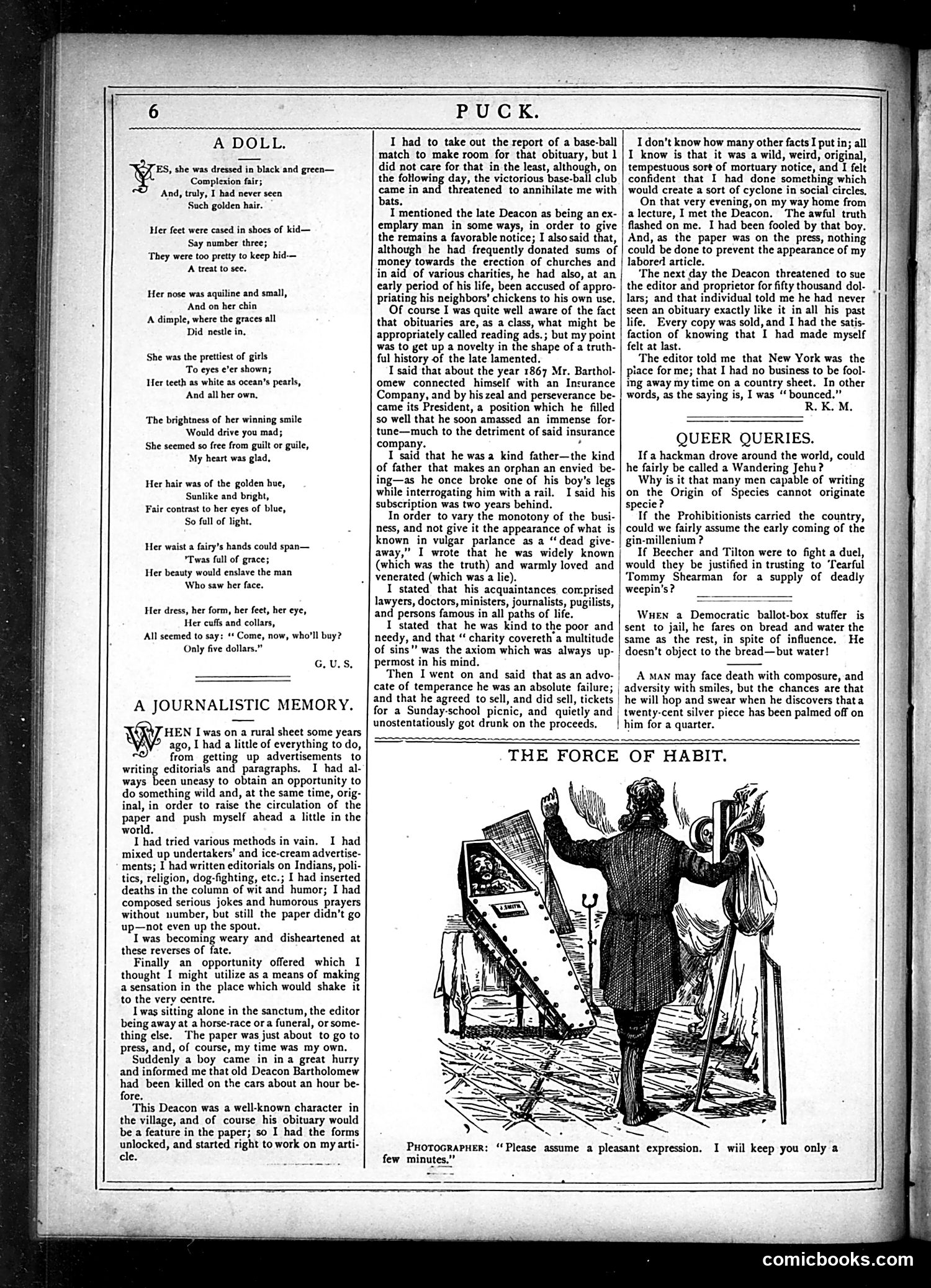
This page contains three distinct pieces: 1. **"A Doll"** (poem, left): A sentimental verse about a girl's cherished doll, with no apparent satire. 2. **"A Journalistic Memory"** (center): An editor's anecdote about struggling to boost a rural newspaper's circulation through various sensational content until finally publishing an obituary of "Deacon Bartholomew" that generated genuine reader interest—satirizing how newspapers exploit death for engagement. 3. **"The Force of Habit"** (cartoon, bottom right): Shows a photographer asking a subject to "assume a pleasant expression" while the subject appears distressed or uncomfortable—likely satirizing the awkwardness of early photography's long exposure times and stiff conventions, where subjects endured discomfort to appear proper for the camera. The page offers light social commentary on journalism and photography practices of the era.
📄 Transcribed text from this page (OCR, searchable)
Machine-transcribed from the original scan — historical spelling and the odd misread are preserved.
PUCK. | A DOLL. ES, she was dressed in black and green— ‘Complexion fair; ‘And, truly, I had never seen Such golden hair. Her feet were cased in shoes of kid— Say number three; They were too pretty to keep hid-— A treat to see. Her nose was aquiline and small, And on her chin A dimple, where the graces all Did nestle in, She was the prettiest of girls To eyes e'er shown; Her teeth as white as ocean’s pearls, And all her own, ‘The brightness of her winning smile Would drive you mad; She seemed so free from guilt or guile, My heart was glad, Her hair was of the golden hue, Sunlike and bright, Fair contrast to her eyes of blue, So full of light. Her waist a fairy’s hands could span— "Twas full of grace; Her beauty would enslave the man Who saw her face. Her dress, her form, her feet, her eye, Her cuffs and collars, All seemed to say: ‘ Come, now, who'll buy? Only five dollars.” G.U.S. A JOURNALISTIC MEMORY. HEN Iwas on a rural sheet some years ago, I had a little of everything to do, from getting up advertisements to writing editorials and paragraphs. I had al- ways been uneasy to obtain an opportunity to do something wild and, at the same time, orig- inal, in order to raise the circulation of the paper and push myself ahead a little in the world. I had tried various methods in vain, I had mixed up undertakers’ and ice-cream advertise- ments; I had written editorials on Indians, poli- tics, religion, dog-fighting, etc.; I had inserted deaths in the column of wit and humor; I had composed serious jokes and humorous prayers without number, but still the paper didn’t go up—not even up the spout. Iwas becoming weary and disheartened at these reverses of fate. Finally an opportunity offered which I thought I might utilize as a means of making a sensation in the place which would shake it to the very centre. Iwas sitting alone in the sanctum, the editor being away at a horse-race ora funeral, or some- thing else. The paper was just about to go to press, and, of course, my time was my own, Suddenly a boy came in ina great hurry and informed me that old Deacon Bartholomew had been killed on the cars about an hour be- fore. This Deacon was a well-known character in the village, and of course his obituary would be a feature in the paper; so I had the forms unlocked, and started right to work on my arti- le. I had to take out the report of a base-ball match to make room for that obituary, but 1 did not care for that in the least, although, on the following day, the victorious base-ball club came in and threatened to annihilate me with bats, I mentioned the late Deacon as being an ex- emplary man in some ways, in order to give | the remains a favorable notice; I also said that, although he had frequently donated sums of money towards the erection of churches and | in aid of various charities, he had also, at an early period of his life, been accused of appro- priating his neighbors’ chickens to his own use. Of course I was quite well aware of the fact that obituaries are, as a class, what might be appropriately called reading ads.; but my point was to get up a novelty in the shape of a truth- ful history of the late lamented. I said that about the year 1867 Mr. Barthol- omew connected himself with an Insurance Company, and by his zeal and perseverance be- came its President, a position which he filled so well that he soon amassed an immense for- tune—much to the detriment of said insurance company. , I said that he wasa kind father—the kind of father that makes an orphan an envied be- ing—as he once broke one of his boy’s legs while interrogating him with a rail. I said his subscription was two years behind. In order to vary the monotony of the busi- ness, and not give it the appearance of what is known in vulgar parlance as a “dead give- away,” I wrote that he was widely known (which was the truth) and warmly loved and venerated (which was a lie). I stated that his acquaintances comprised lawyers, doctors, ministers, journalists, pugilists, and persons famous in all paths of life. I stated that he was kind to the poor and needy, and that “ charity covereth’a multitude of sins" was the axiom which was always up- | permost in his mind. Then I went on and said that as an advo- | cate of temperance he was an absolute failure; | and that he agreed to sell, and did sell, tickets | for a Sunday-school picnic, and quietly and unostentatiously got drunk on the proceeds, | I don’t know how many other facts I put in; all 1 know is that it was a wild, weird, original, tempestuous sort of mortuary notice, and I felt confident that I had done something which would create a sort of cyclone in social circles, On that very evening, on my way home from a lecture, I met the Deacon. The awful truth flashed on me. I had been fooled by that boy. And, as the paper was on the press, nothing could be done to prevent the appearance of my labored article. The next day the Deacon threatened to sue the editor and proprietor for fifty thousand dol- , lars; and that individual told me he had never seen an obituary exactly like it in all his past life. Every copy was sold, and I had the satis- faction of knowing that I had made myself felt at last. ‘The editor told me that New York was the piace for me; that I had no business to be fool- img away my time on a country sheet. In other words, as the saying is, I was ‘ bounced.” QUEER QUERIES. If a hackman drove around the world, could he fairly be called a Wandering Jehu? Why is it that many men capable of writing on the Origin of Species cannot originate specie? If the Prohibitionists carried the country, could we fairly assume the early coming of the gin-millenium ? If Beecher and Tilton were to fight a duel, would they be justified in trusting to ‘Tearful Tommy Shearman for a supply of deadly weepin’s? Wuen a Democratic ballot-box stuffer is sent to jail, he fares on bread and water the same as the rest, in spite of influence. He doesn’t object to the bread—but water! A MAN may face death with composure, and adversity with smiles, but the chances are that he will hop and swear when he discovers that a twenty-cent silver piece has been palmed off on him for a quarter. THE FORCE OF HABIT. PHOTOGRAPHER: “Please assume a pleasant expression. I wiil keep you only a few minutes.” comicbooks.com