
Puck, 1878-05-22 · page 12 of 16
Puck — May 22, 1878 — page 12: what you’re looking at
What you’re looking at
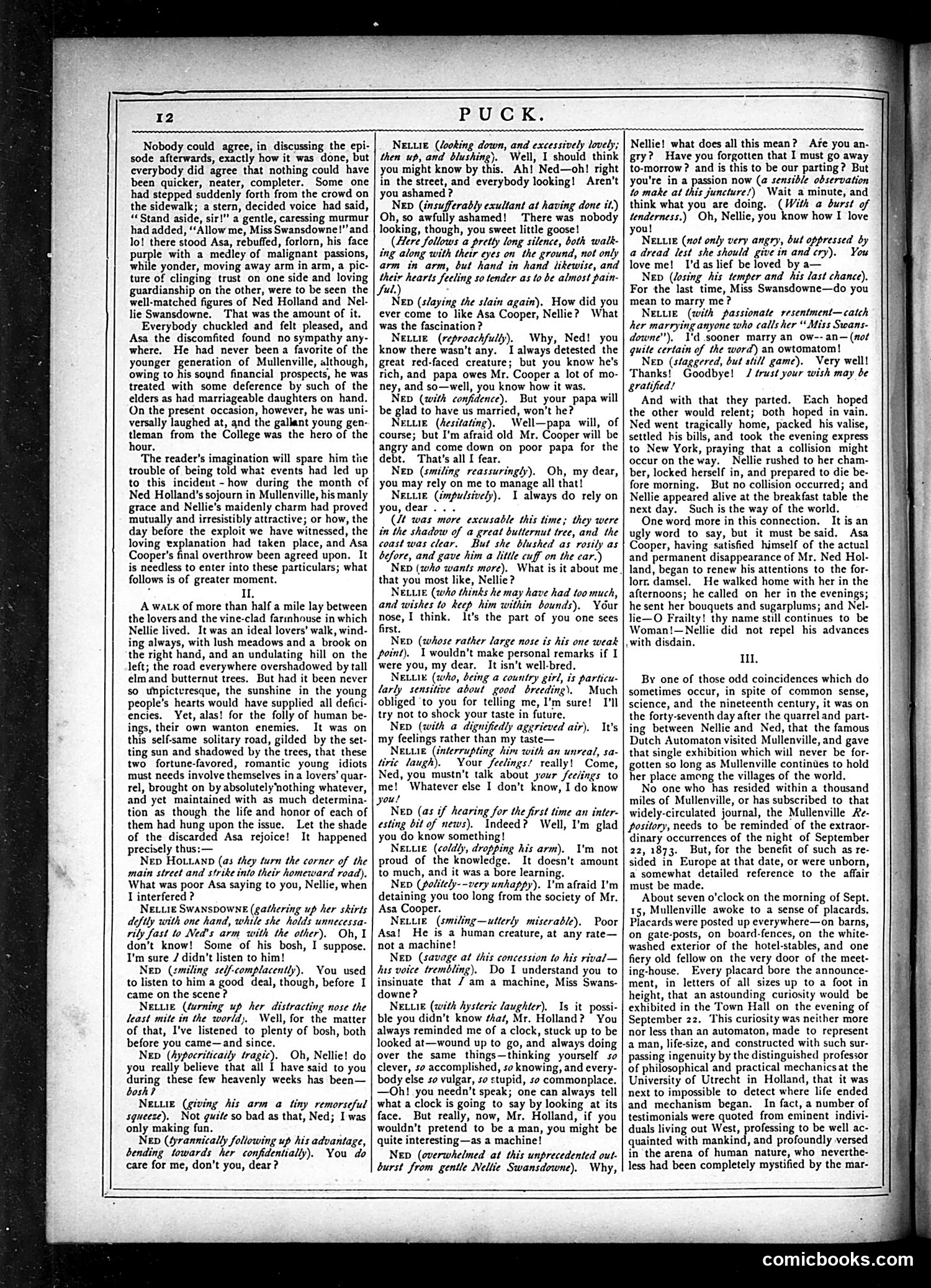
This page is primarily text—a dialogue between characters named Nellie, Ned, and Miss Swansdowne discussing romance and marriage prospects. The conversation centers on Nellie's potential engagement to Mr. Cooper and Ned's feelings about it. The piece appears to be a serialized story or humorous sketch rather than a political cartoon. It includes stage directions in italics describing characters' actions and emotions (e.g., "looking down, and excessively lovely"). The satire seems directed at Victorian courtship conventions—the awkwardness of romantic entanglements, parental expectations around marriage, and the tension between genuine affection and social propriety. References to "papa" and concerns about financial prospects reflect period anxieties about matrimonial arrangements. Without identifying specific individuals, the humor relies on recognizable social situations rather than topical political commentary.
📄 Transcribed text from this page (OCR, searchable)
Machine-transcribed from the original scan — historical spelling and the odd misread are preserved.
12 Nobody could agree, in discussing the epi- sode afterwards, exactly how it was done, but everybody did agree that nothing could have been quicker, neater, completer. Some one had stepped suddenly forth from the crowd on the sidewalk; a stern, decided voice had said, “Stand aside, sir!” a gentle, caressing murmur had added, “Allow me, Miss Swansdowne!”’ and lo! there stood Asa, rebuffed, forlorn, his face purple with a medley of malignant passions, while yonder, moving away arm in arm, a pic- ture of clinging trust on one side and loving guardianship on the other, were to be seen the well-matched figures of Ned Holland and _Nel- lie Swansdowne. That was the amount of it. Everybody chuckled and felt pleased, and Asa the discomfited found no sympathy any- where. He had never been a favorite of the younger generation of Mullenville, although, owing to his soynd financial prospects, he was treated with some deference by such of the elders as had marriageable daughters on hand. On the present occasion, however, he was uni- versally laughed at, and the gallant young gen- tleman from the College was the hero of the hour. ‘The reader's imagination will spare him the trouble of being told what events had led up to this incident - how during the month of Ned Holland's sojourn in Mullenville, his manly grace and Nellie’s maidenly charm had proved mutually and irresistibly attractive; or how, the day before the exploit we have witnessed, the loving explanation had taken place, and Asa Cooper's final overthrow been agreed upon. It is needless to enter into these particulars; what follows is of greater moment. Il, A watk of more than half a mile lay between the lovers and the vine-clad farmhouse in which Nellie lived. It was an ideal lovers’ walk, wind- ing always, with lush meadows and a_ brook on the right hand, and an undulating hill on the left; the road everywhere overshadowed by tall elmand butternut trees. But had it been never so whpicturesque, the sunshine in the young people's hearts would have supplied all defici- encies. Yet, alas! for the folly of human be- ings, their own wanton enemies. It was on this self-same solitary road, gilded by the set- ting sun and shadowed by the trees, that these two fortune-favored, romantic young idiots must needs involve themselves ina lovers’ quar- rel, brought on by absolutely’nothing whatever, and yet maintained with as much determina- tion as though the life and honor of each of them had hung upon the issue. Let the shade of the discarded Asa rejoice! It happened precisely thus:— Nep Hottanp (as they turn the corner of the main street and strike into their homeward road). What was poor Asa saying to you, Nellie, when I interfered ? NELLIE SWANSDOWNE (gathering up her shirts deftly with one hand, while she holds unnecessa- rily fast to Ned's arm with the other). Oh, 1 don’t know! Some of his bosh, I suppose. I'm sure / didn’t listen to him! Nep (smiling seif-complacently). You used to listen to him a good deal, though, before I came on the scene? NELLIE (turning up her distracting nose the least mite in the world), Well, for the matter of that, I've listened to plenty of bosh, both before you came—and since. Nep (Aypocriticaily tragic). Oh, Nellie! do you really believe that all I have said to you during these few heavenly weeks has been— bosh? Neue (giving his arm a tiny remorseful squeeze). Not gutte so bad as that, Ned; I was only making fun. Nep (Hrannically following up his advantage, bending towards her confidentially). You do care for me, don’t you, dear? Neue (looking down, and excessively lovely; then up, and blushing). Well, 1 should think you might know by this. Ah! Ned—oh! right in the street, and everybody looking! Aren't you ashamed ? Nep (insufferably exultant at having done it.) Oh, so awfully ashamed! There was nobody looking, though, you sweet little goose! (Here follows a pretly long silence, both walk- ing along with their eyes on the ground, not only arm in arm, but hand in hand likewise, and aes hearts feeling so tender as to be almost pain- ul. Nep (slaying the slain again). How did you ever come to like Asa Cooper, Nellie? What was the fascination? NELUE (reproachfully). Why, Ned! you know there wasn’t any. I always detested the great red-faced creature; but you know he's rich, and papa owes Mr. Cooper a lot of mo- ney, and so—well, you know how it was. Nev (with confidence). But your papa will be glad to have us married, won't he? NELLIE (hesitating). Well—papa will, of course; but I’m afraid old Mr. Cooper will be angry and come down on poor papa for the debt. That's all I fear. NeEp (smiling reassuringly). Oh, my dear, you may rely on me to manage all that! NELLIE (tmpulsively). 1 always do rely on you, dear... (Ut was more excusable this time; they were in the shadow of a great butternut tree, and the coast was clear. But she blushed as rosily as before, and gave him a little cuff on the car.) Nep (who wants more). What is it about me that you most like, Nellie? NELLIE (who thinks he may have had too much, and wishes to keep him within bounds). Y6ut nese) I think, It’s the part of you one sees rst. Nep (whose rather large nose is his one weak point), I wouldn't make personal remarks if I were you, my dear. It isn’t well-bred. NELLIE (who, being a country girl, is particu- larly sensitive about good breeding). Much obliged ‘to you for telling me, I’m sure! I'll try not to shock your taste in future. Nep (with a dignifiedly aggrieved air). my feelings rather than my taste— NELLIE (interrupting him with an unreal, sa- tiric laugh). Your feelings! really! Come, Ned, you mustn’t talk about your feelings to me! Whatever else I don’t know, I do know you! 7?Nep (as if hearing for the first ime an inter. esting bit of news). Indeed? Well, I’m glad you do know something! NELLIE (coldly, dropping his arm). I'm not proud of the knowledge. It doesn’t amount to much, and it was a bore learning. Nep (folitely--very unhappy). Vm afraid I'm detaining you too long from the society of Mr. Asa Cooper. NeLUE (smiling—utterly miserable). Poor Asa! He is a human creature, at any rate— not a machine! Nep (savage at this concession to his rival— Aus voice trembling), Do I understand you to insinuate that / am a machine, Miss Swans- downe? NELLIE (with hysteric laughter). Is it possi- ble you didn’t know ¢a/, Mr. Holland? You always reminded me of a clock, stuck up to be looked at—wound up to go, and always doing over the same things—thinking yourself so clever, so accomplished, so knowing, and every- body else so vulgar, so stupid, so commonplace. —Oh! you needn’t speak; one can always tell what a clock is going to say by looking at its face. But really, now, Mr. Holland, if you wouldn’t pretend to be a man, you might be quite interesting —as a machine! Nep (overwhelmed at this unprecedented out- It’s burst from gentle Nellie Swansdowne). Why, Nellie! what does all this mean? Are you an- gry? Have you forgotten that I must go away to-morrow? and is this to be our parting? But you're in a passion now (4 sensible observation to make at this juncture!) Wait a minute, and think what you are doing. (With a burst of tenderness.) Oh, Nellie, you know how I love ‘ou! z NELLIE (not only very angry, but oppressed by a dread lest she should give in and cry). You love me! I’das lief be loved by a— Nep (losing his temper and his last chance). For the last time, Miss Swansdowne—do you mean to marry me? NELLIE (with passionate resentment—catch her marrying anyone who calls her “Miss Swans- downe”). Y'd sooner marry an ow-- an—(not quite certain of the word) an owtomatom! Nep (staggered, but still game). Very well! Thanks! Goodbye! / trust your wish may be gratified! And with that they parted. Each hoped the other would relent; both hoped in vain. Ned went tragically home, packed his valise, settled his bills, and took the evening express to New York, praying that a collision might occur on the way. Nellie rushed to her cham- ber, locked herself in, and prepared to die be- fore morning. But no collision occurred; and Nellie appeared alive at the breakfast table the next day. Such is the way of the world. One word more in this connection. It is an ugly word to say, but it must be said. Asa Cooper, having satisfied himself of the actual and permanent disappearance of Mr. Ned Hol- land, began to renew his attentions to the for- lorr. damsel. He walked home with her in the afternoons; he called on her in the evenings; he sent her bouquets and sugarplums; and Nel- lie—O Frailty! thy name still continues to be Woman!—Nellie did not repel his advances :with disdain. Ill. By one of those odd coincidences which do sometimes occur, in spite of common sense, science, and the nineteenth century, it was on the forty-seventh day after the quarrel and part- ing between Nellie and Ned, that the famous Dutch Automaton visited Mullenville, and gave that single exhibition which will never be for- gotten so long as Mullenville continues to hold her place among the villages of the world. No one who has resided within a thousand miles of Mullenville, or has subscribed to that widely-circulated journal, the Mullenville Re- posttory, needs to be reminded of the extraor- dinary occurrences of the night of September 22, 1873. But, for the benefit of such as re- sided in Europe at that date, or were unborn, a somewhat detailed reference to the affair must be made. About seven o’clock on the morning of Sept. 15, Mullenville awoke to a sense of placards. Placards were posted up everywhere—on barns, on gate-posts, on board-fences, on the white- washed exterior of the hotel-stables, and one fiery old fellow on the very door of the meet- ing-house. Every placard bore the announce- ment, in letters of all sizes up to a foot in height, that an astounding curiosity would be exhibited in the Town Hall on the evening of September 22. This curiosity was neither more nor less than an automaton, made to represent a man, life-size, and constructed with such sur- passing ingenuity by the distinguished professor of philosophical and practical mechanics at the University of Utrecht in Holland, that it was next to impossible to detect where life ended and mechanism began. In fact, a number of testimonials were quoted from eminent indivi- duals living out West, professing to be well ac- quainted with mankind, and profoundly versed in the arena of human nature, who neverthe- less had been completely mystified by the mar- comicbooks.com