
Puck, 1878-05-22 · page 3 of 16
Puck — May 22, 1878 — page 3: what you’re looking at
What you’re looking at
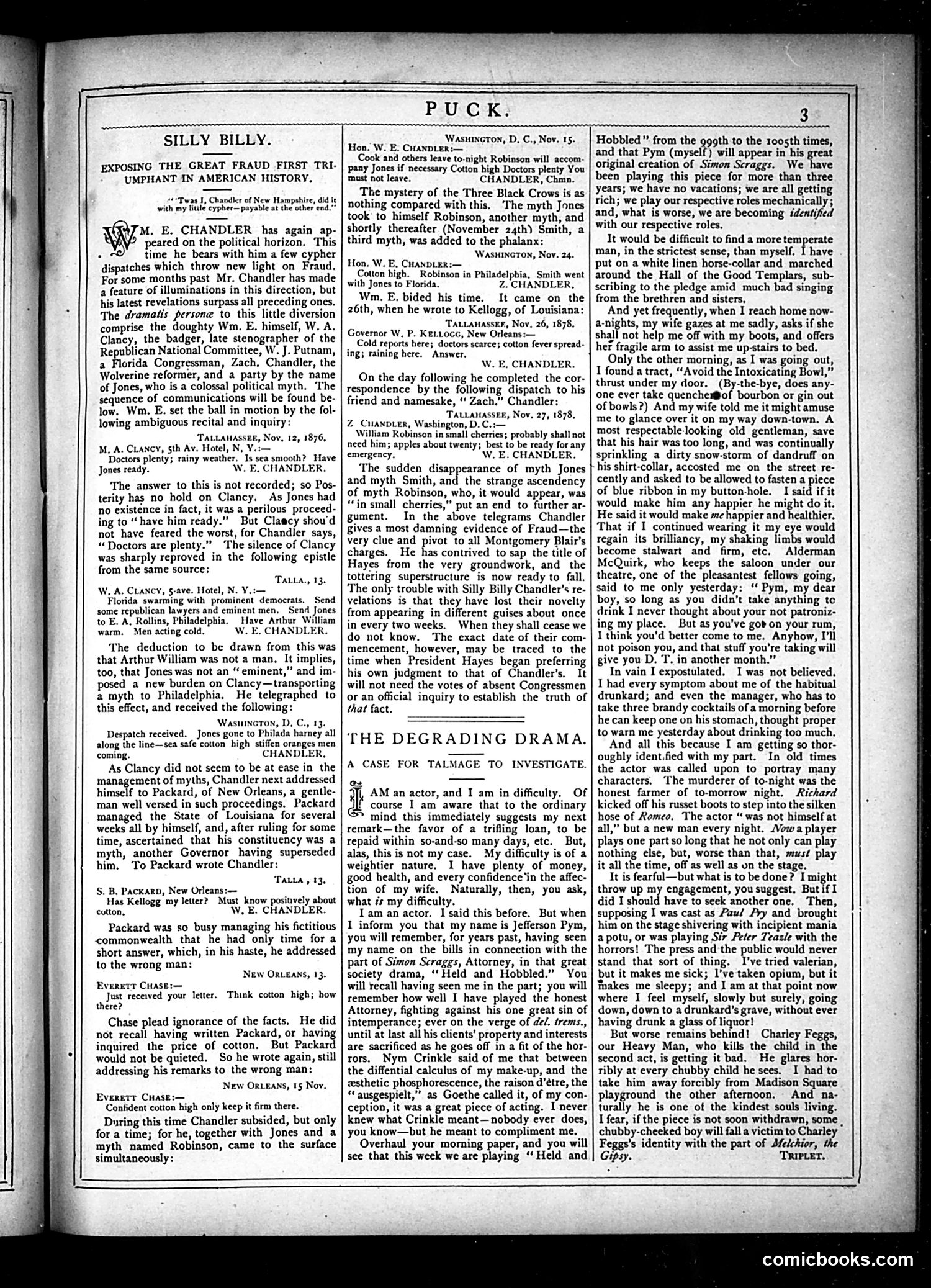
This page satirizes the political coverage of journalist **W.E. Chandler** regarding congressman **Josiah Robinson**, who appears to have fabricated or misrepresented events in his public statements. The "Silly Billy" section exposes Chandler's contradictory reports about Robinson's activities and claims—particularly involving disputes over cotton prices and political maneuvering. The satire suggests Chandler repeatedly changed his story about Robinson's movements and intentions, creating confusion. The piece ridicules both figures: Chandler for unreliable reporting and Robinson for the underlying deceptions being reported. The "Degrading Drama" section below shifts to theatrical criticism, discussing an actor named Jefferson Pym's difficulty obtaining roles after playing disreputable characters.
📄 Transcribed text from this page (OCR, searchable)
Machine-transcribed from the original scan — historical spelling and the odd misread are preserved.
PUCK. SILLY BILLY. EXPOSING THE GREAT FRAUD FIRST TRI- UMPHANT IN AMERICAN HISTORY, «Twas I, Chandler of New Hampshire, did it with my litle eypher—payable at the other end.”” 47M. E. CHANDLER has again ap- peared on the political horizon. ‘This . time he bears with him a few cypher dispatches which throw new light on Fraud. For some months past Mr. Chandler has made a feature of illuminations in this direction, but his latest revelations surpass all preceding ones. The dramatis persone to this little diversion comprise the doughty Wm. E. himself, W. A. Clancy, the badger, late stenographer of the Republican National Committee, W. J. Putnam, a Florida Congressman, Zach, Chandler, the Wolverine reformer, and a party by the name of Jones, who is a colossal political myth. The sequence of communications will be found be- low. Wm. E. set the ball in motion by the fol- lowing ambiguous recital and inquiry: TALLAMAssEE, Nov, 12, 1876, M.A. CLaNcy, sth Av. Hotel, N, Yii— Doctors plenty; rainy weather. Is sea smooth? Have Jones ready. W. E, CHANDLER. The answer to this is not recorded; so Pos- terity has no hold on Clancy. As Jones had no existence in fact, it was a perilous proceed- ing to “have him ready.” But Claacy shou'd not have feared the worst, for Chandler says, “Doctors are plenty.” ‘The silence of Clancy was sharply reproved in the following epistle from the same source: Jog with prominent democrats. Send some republican lawyers and eminent men. Send Jones to E. A, Rollins, Philadelphia. Have Arthur William warm. Men acting cold. W. E, CHANDL The deduction to be drawn from this was that Arthur William was not a man. It implies, too, that Jones was not an “eminent,” and im- posed a new burden on Clancy—transporting a myth to Philadelphia. He telegraphed to this effect, and received the following: Wasutncton, D.C. 13. Despatch received. Jones gone to Philada harney all along the line—sea safe cotton high stiffen oranges men coming. CHANDLER, As Clancy did not seem to be at ease in the management of myths, Chandler next addressed himself to Packard, of New Orleans, a gentle- man well versed in such proceedings. Packard managed the State of Louisiana for several weeks all by himself, and, after ruling for some time, ascertained that his constituency was a myth, another Governor having superseded him. To Packard wrote Chandler: TALLA , 13. S. B. Packarb, New Orleans:— Has Kellogg my letter? Must know positively about cotton, W, E. CHANDLER. Packard was so busy managing his fictitious «commonwealth that he had only time for a short answer, which, in his haste, he addressed to the wrong man: New ORLEANS, 13. Everett CHAsE:— Just received your letter. Think cotton high; how there? Chase plead ignorance of the facts. He did not recall having written Packard, or having inquired the price of cotton. But Packard would not be quieted. So he wrote again, still addressing his remarks to the wrong man: New ORLEANS, 15 Nov. Everett CHase:— Confident cotton high only keep it firm there. During this time Chandler subsided, but only for a time; for he, together with Jones and a myth named Robinson, came to the surface simultaneously: Wasuincton, D, C., Nov. 15. Hon. W. E. CHANDLER: Cook and others leave to-night Robinson will accom- pany Jones if necessary Cotton high Doctors plenty You must not leave. CHANDLER, Chmn. The mystery of the Three Black Crows is as nothing compared with this. ‘The myth Jones took to himself Robinson, another myth, and shortly thereafter (November 24th) Smith, a third myth, was added to the phalanx: Wasutncton, Nov. 24. Hon. W. E, CHANDLER:— Cotton high. Robinson in Philadelphia, Smith went with Jones to Florida. Z. CHANDLER. Wm. E. bided his time. It came on the 26th, when he wrote to Kellogg, of Louisiana: TALLAMASSER, Nov, 26, 1878, Governor W, P. KetLocc, New Orleans:— Cold reports here; doctors scarce; cotton fever spread- ing; raining here. “Answer. W. E. CHANDLER. On the day following he completed the cor- respondence by the following dispatch to his friend and namesake, ‘ Zach.” Chandler: TALLanasser, Nov, 27, 1878, Z_Cuanpier, Washington, D.C. William Robinson in small cherries; probably shall not need him; apples about twenty; best to be ready for any emergency, W. E. CHANDLER. ‘The sudden disappearance of myth Jones and myth Smith, and the strange ascendency of myth Robinson, who, it would appear, was “in small cherries,” put an end to further ar- gument. In the above telegrams Chandler gives a most damning evidence of Fraud—the very clue and pivot to all Montgomery Blair's charges. He has contrived to sap the title of Hayes from the very groundwork, and the tottering superstructure is now ready to fall. The only trouble with Silly Billy Chandler's re- velations is that they have lost their novelty from appearing in different guises about once in every two weeks, When they shall cease we do not know. The exact date of their com- mencement, however, may be traced to the time when President Hayes began preferring his own judgment to that of Chandler's. It will not need the votes of absent Congressmen or an official inquiry to establish the truth of that fact. THE DEGRADING DRAMA. A CASE FOR TALMAGE TO INVESTIGATE. cs Bi course I am aware that to the ordinary mind this immediately suggests my next remark—the favor of a trifling loan, to be repaid within so-and-so many days, etc. But, alas, this is not my case. My difficulty is of a weightier nature. I have plenty of money, good health, and every confidence’in the affec- tion of my wife. Naturally, then, you ask, what és my difficulty. lam an actor. I said this before. But when I inform you that my name is Jefferson Pym, you will remember, for years past, having seen my name on the bills in connection with the part of Simon Scraggs, Attorney, in that great society drama, ‘‘Held and Hobbled.” You will recall having seen me in the part; you will remember how well I have played the honest Attorney, fighting against his one great sin of intemperance; ever on the verge of de/. trems., until at last all his clients’ property and interests are sacrificed as he goes off in a fit of the hor- rors. Nym Crinkle said of me that between the diffential calculus of my make-up, and the zsthetic phosphorescence, the raison d’étre, the “ ausgespielt,” as Goethe called it, of my con- ception, it was a great piece of acting. I never knew what Crinkle meant—nobody ever does, you know—but he meant to compliment me. Overhaul your morning paper, and you will see that this week we are playing “Held and AM an actor, and I am in difficulty. Of Hobbled” from the gggth to the roosth times, and that Pym (myself) will appear in his reat original creation of Simon Scraggs. We have been playing this piece for more than three years; we have no vacations; we are all getting rich; we play our respective roles mechanically ; and, what is worse, we are becoming identified with our respective roles, It would be difficult to find a more temperate man, in the strictest sense, than myself. I have put on a white linen horse-collar and marched around the Hall of the Good Templars, sub- scribing to the pledge amid much bad singing from the brethren and sisters. And yet frequently, when I reach home now- acnights, my wife gazes at me sadly, asks if she shall not help me off with my boots, and offers her fragile arm to assist me up-stairs to bed. Only the other morning, as I was going out, I found a tract, ‘Avoid the Intoxicating Bowl,” thrust under my door. (By-the-bye, does any- one ever take quenchemBof bourbon or gin out of bowls?) And my wife told me it might amuse me to glance over it on my way down-town. A most respectable-looking old gentleman, save that his hair was too long, and was continually sprinkling a dirty snow-storm of dandruff on his shirt-collar, accosted me on the street re- cently and asked to be allowed to fasten a piece of blue ribbon in my button-hole. I said if it would make him any happier he might do He said it would make me happier and healthier. That if 1 continued wearing it my eye would regain its brilliancy, my shaking limbs would become stalwart and firm, etc. Alderman McQuirk, who keeps the saloon under our theatre, one of the pleasantest fellows going, said to me only yesterday: ‘‘ Pym, my dear boy, so long as you didn’t take anything to drink I never thought about your not patroniz- ing my place. But as you've got on your rum, I think you'd better come to me. Anyhow, I'll not poison you, and that stuff you're taking will give you D. T. in another month.” In vain I expostulated. I was not believed. I had every symptom about me of the habitual drunkard; and even the manager, who has to take three brandy cocktails of a morning before he can keep one on his stomach, thought proper to warn me yesterday about drinking too much. And all this because I am getting so thor- oughly ident.fied with my part. In old times the actor was called upon to portray many characters. The murderer of to-night was the honest farmer of to-morrow night. Richard kicked off his russet boots to step into the silken hose of Komeo, The actor “ was not himself at all,” but a new man every night. Nowa player plays one part so long that he not only can play nothing else, but, worse than that, must play it all the time, off as well as on the stage. It is fearful—but what is to be done? I might throw up my engagement, you suggest. Butif I did I should have to seek another one. Then, supposing I was cast as Pau/ Pry and brought him on the stage shivering with incipient mania a potu, or was playing Sir Peter Teas/e with the horrors! The press and:the public would never stand that sort of thing. I’ve tried valerian, but it makes me sick; I’ve taken opium, but it Tnakes me sleepy; and I am at that point now where I feel myself, slowly but surely, going down, down to a drunkard’s grave, without ever having drunk a glass of liquor! But worse remains behind! Charley Feg, our Heavy Man, who kills the child in the second act, is getting it bad. He glares hor- ribly at every chubby child he sees. I had to take him away forcibly from Madison Square playground the other afternoon. And na- turally he is one of the kindest souls living. I fear, if the piece is not soon withdrawn, some chubby-cheeked boy will fall a victim to Charley Feggs’s identity with the part of Afe/chior, Gipsy. ‘TRIPLET. comicbooks.com