
Puck, 1878-05-22 · page 11 of 16
Puck — May 22, 1878 — page 11: what you’re looking at
What you’re looking at
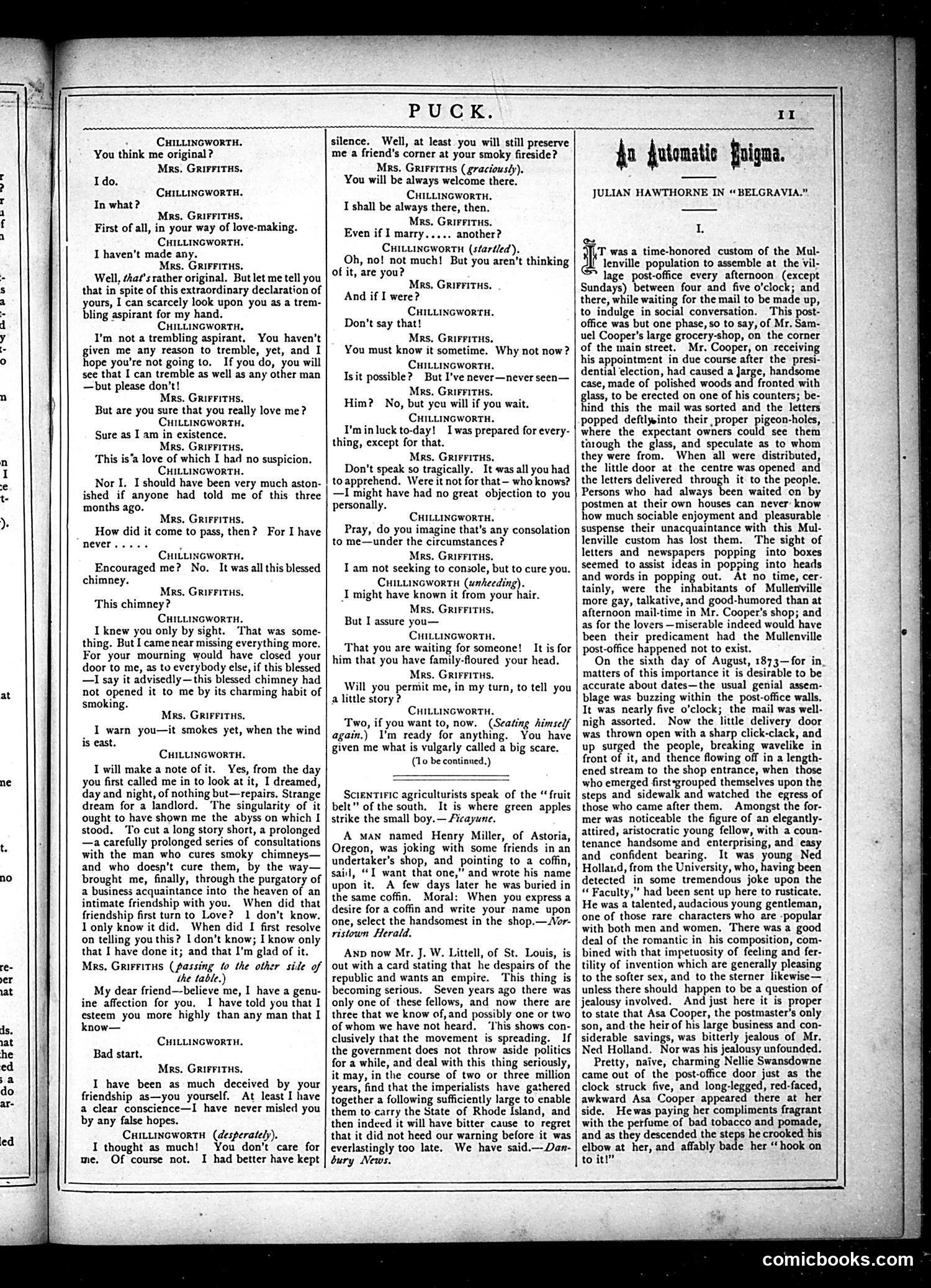
This page contains a fictional dialogue between characters named Chillingworth and Mrs. Griffiths, apparently about romantic entanglements and marriage. The left column is the dramatic dialogue itself. The right column presents "An Automatic Enigma," a narrative by Julian Hawthorne describing events in Mullenville related to a postal delivery mix-up involving letters about a dental election. The story appears satirical—mail gets distributed incorrectly to residents, causing confusion about who received whose correspondence. Without seeing accompanying illustrations, it's difficult to identify specific political figures or targets. The piece appears to be general social satire about romantic complications and small-town mail service confusion rather than commentary on specific current events or politicians.
📄 Transcribed text from this page (OCR, searchable)
Machine-transcribed from the original scan — historical spelling and the odd misread are preserved.
PUCK. CHILLINGWoRTH. You think me original? Mrs. GRIFFITHS. Ido. CHILLINGWORTH. In what? Mrs, GRIFFITHS. First of all, in your way of love-making. CHILLINGWORTH. I haven't made any. Mrs. GriFFiTHs. Well, that’s rather original. But let me tell you that in spite of this extraordinary declaration of yours, I can scarcely look upon you as a trem- bling aspirant for my hand, CHILLINGWORTH, I'm not a trembling aspirant. You haven't iven me any reason to tremble, yet, and I Rope you're not going to. If you do, you will see that I can tremble as well as any other man —but please don’t! Mrs. GrirFitHs. But are you sure that you really love me? Cuittincwortn, Sure as I am in existence. Mrs. Grirritus. This is‘a love of which I had no suspicion. CHILLINGWoRTH. Nor I. I should have been very much aston- ished if anyone had told me of this three months ago. Mrs. Grirritus. How did it come to pass, then? For I have CHILLINGWworTH, Encouraged me? No. It was all this blessed chimney. Mrs. GrirFitus, This chimney? CHILLINGWorRTH, I knew you only by sight. ‘That was some- thing. But I came near missing everything more. For your mourning would have closed your door to me, as to everybody else, if this blessed —I say it advisedly—this blessed chimney had not opened it to me by its charming habit of smoking. Mrs, Grirritis. 1 warn you—it smokes yet, when the wind is east. CHILLINGWoRTH. I will make a note of it. Yes, from the day you first called me in to look at it, I dreamed, day and night, of nothing but—repairs. Strange dream for a landlord. The singularity of it ought to have shown me the abyss on which I stood. ‘To cut a long story short, a prolonged —a carefully prolonged series of consultations with the man who cures smoky chimneys— and who doesn’t cure them, by the way— brought me, finally, through the purgatory of a business acquaintance into the heaven of an intimate friendship with you. When did that friendship first turn to Love? 1 don’t know. lonly know it did. When did I first resolve on telling you this? I don’t know; I know only that I have done it; and that I'm glad of it. Mrs, GrirFitus (passing to the other side of the table.) My dear friend—believe me, I have a genu- ine affection for you, I have told you that I esteem you more highly than any man that I know— CuiLiincwortH. Bad start. Mrs. GrirFiTHs. I have been as much deceived by your friendship as—you yourself. At least I have a clear conscience—I have never misled you by any false hopes. CuittincwortH (desperately). I thought as much! You don’t care for me. Of course not. I had better have kept silence. Well, at least you will still preserve me a friend's corner at your smoky fireside? Mrs. Grirrits (graciously). You will be always welcome there. CHILLINGworTH. I shall be always there, then. Mrs. Grirritus. Even if I marry..... another? Crituincwortn (startled). Oh, no! not much! But you aren’t thinking of it, are you? Mrs. Grirritus. And if I were? CuILuincwortH. Don't say that! Mrs. Grirrits. You must know it sometime. Why not now? Cuittincwortu. Isit possible? But I've never—never seen— Mrs, GRIFFITHS. Him? No, but ycu will if you wait. CHiLtincworTH. I'minluck to-day! Iwas prepared for every- thing, except for that. Mrs. Grirritus. Don't speak so tragically. It was all you had toapprehend. Were it not for that — who knows? —I might have had no great objection to you personally. CHILLINGWoRTH. Pray, do you imagine that’s any consolation to me—under the circumstances? Mrs. GrirFitus. I am not seeking to console, but to cure you. Cuituincwortn (unheeding). I might have known it from your hair. Mrs. GRIFFITHS, But I assure you— CHILLincwortu. That you are waiting for someone! It is for him that you have family-floured your head. Mrs. GrirFitus. Will you permit me, in my turn, to tell you a little story ? CHILLINGWoRTH. Two, if you want to, now. (Seating himself again.) \'m ready for anything. You have given me what is vulgarly called a big scare. (To be continned.) Scientiric agriculturists speak of the “fruit belt" of the south, It is where green apples strike the small boy.— Ficayune. A Man named Henry Miller, of Astoria, Oregon, was joking with some friends in an undertaker’s shop, and pointing to a coffin, sail, “I want that one,” and wrote his name upon it. A few days later he was buried in the same coffin. Moral: When you express a desire for a coffin and write your name upon one, select the handsomest in the shop.—Vor- ristown Herald. Anp now Mr. J. W. Littell, of St. Louis, is out with a card stating that he despairs of the republic and wants an empire. This thing is becoming serious. Seven years ago there was only one of these fellows, and now there are three that we know of, and possibly one or two of whom we have not heard, ‘I'his shows con- clusively that the movement is spreading. If the government does not throw aside politics for a while, and deal with this thing seriously, it may, in the course of two or three million years, find that the imperialists have gathered together a following sufficiently large to enable them to carry the State of Rhode Island, and then indeed it will have bitter cause to regret that it did not heed our warning before it was everlastingly too late. We have said.—Dan- bury News. An Automatic foigma. JULIAN HAWTHORNE IN “BELGRAVIA.” AT was a time-honored custom of the Mul- lenville population to assemble at the vil- lage post-office every afternoon (except Sundays) between four and five o'clock; and there, while waiting for the mail to be made up, to indulge in social conversation. This post- office was but one phase, so to say, of Mr. Sam- uel Cooper’s large grocery-shop, on the corner of the main street. Mr. Cooper, on receiving his appointment in due course after the presi- dential election, had caused a Jarge, handsome case, made of polished woods and fronted with glass, to be erected on one of his counters; be- hind this the mail was sorted and the letters popped deftlyinto their proper pigeon-holes, where the expectant owners could see them tarough the glass, and speculate as to whom they were from. When all were distributed, the little door at the centre was opened and the letters delivered through it to the people. Persons who had always been waited on by jostmen at their own houses can never: know how much sociable enjoyment and pleasurable suspense their unacquaintance with this Mul- lenville custom has lost them, The sight of letters and newspapers popping into boxes seemed to assist ideas in popping into heads and words in popping out. At no time, cer- tainly, were the inhabitants of Mullenville more gay, talkative, and good-humored than at afternoon mail-time in Mr. Cooper's shop; and as for the lovers —miserable indeed would have been their predicament had the Mullenville post-office happened not to exist. On the sixth day of August, 1873—for in. matters of this importance it is desirable to be accurate about dates—the usual genial assem- blage was buzzing within the post-office walls. It was nearly five o'clock; the mail was well- nigh assorted. Now the little delivery door was thrown open with a sharp click-clack, and up surged the people, breaking wavelike in front of it, and thence flowing off in a length- ened stream to the shop entrance, when those who emerged first-grouped themselves upon the steps and sidewalk and watched the egress of those who came after them. Amongst the for- mer was noticeable the figure of an elegantly- attired, aristocratic young fellow, with a coun- tenance handsome and enterprising, and easy and confident bearing. It was young Ned Holland, from the University, who, having been detected in some tremendous joke upon the “Faculty,” had been sent up here to rusticate. He was a talented, audacious young gentleman, one of those rare characters who are -popular with both men and women. There was a good deal of the romantic in his composition, com- bined with that impetuosity of feeling and fer- tility of invention which are generally pleasing to the softer sex, and to the sterner likewise— unless there should happen to be a question of jealousy involved. And just here it is proper to state that Asa Cooper, the postmaster’s only son, andthe heir of his large business and con- siderable savings, was bitterly jealous of Mr. Ned Holland. Nor was his jealousy unfounded. Pretty, naive, charming Nellie Swansdowne came out of the post-office door just as the clock struck five, and long-legged, red-faced, awkward Asa Cooper appeared there at her side. Hewas paying her compliments fragrant with the perfume of bad tobacco and pomade, and as they descended the Steps he crooked his elbow at her, and affably bade her “hook on to it!” comicbooks.com