
Puck, 1878-05-22 · page 2 of 16
Puck — May 22, 1878 — page 2: what you’re looking at
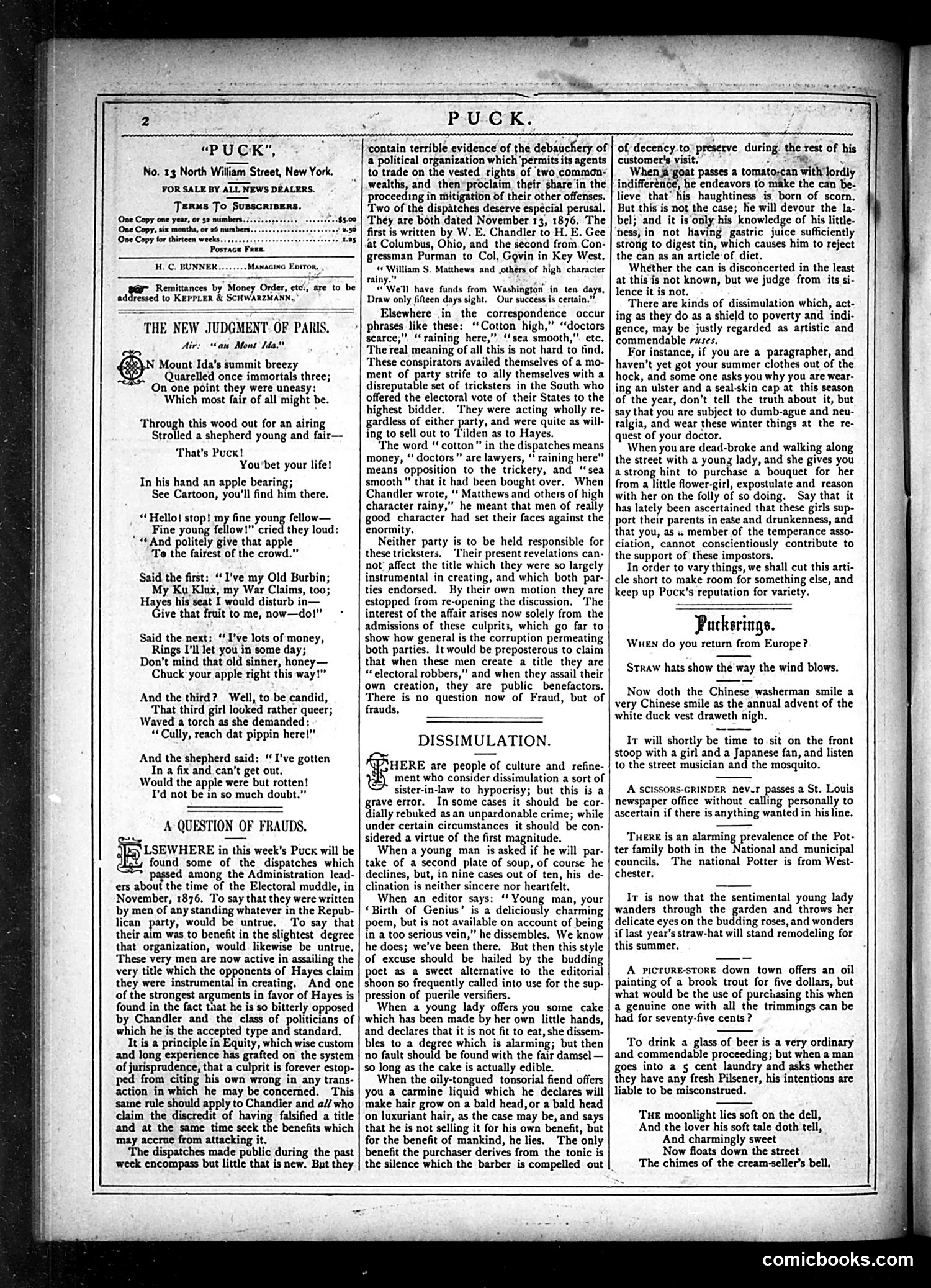
What you’re looking at
This page contains primarily text articles rather than political cartoons. The main pieces are: 1. **"The New Judgment of Paris"** — a literary parody of the classical myth, using it to satirize contemporary political figures who traded electoral votes for personal gain during what appears to be a disputed election period (possibly the 1876 Hayes-Tilden controversy, given the reference to "November, 1876"). 2. **"A Question of Frauds"** — discusses election fraud, specifically mentioning Chandler and Hayes, suggesting this commentary addresses the corrupt practices and disputed electoral processes of the era. 3. Several shorter satirical pieces about social hypocrisy and behavioral absurdities. The page demonstrates Puck's approach of using classical allusions and extended metaphors to critique contemporary political corruption and moral failings among public figures.
📄 Transcribed text from this page (OCR, searchable)
Machine-transcribed from the original scan — historical spelling and the odd misread are preserved.
PUCK. “PUCK”, No. 13 North William Street, New York. VOR SALE BY ALL NEWS DEALERS. Terms To Supscripers. One Copy one year, or s2 numbers... One Copy, six months, or 26 numbers. -Manacina Eprron, fot Remittances by Money Order, etc!, are to be addressed to Krrrier & ScHWARZMANN., THE NEW JUDGMENT OF PARIS. Mount Ida's summit breezy Air: ‘a Mont Ida." @ Quarelled once immortals three; On one point they were uneasy: Which most fair of all might be. Through this wood out for an airing Strolled a shepherd young and fair— That's Puck! You’bet your life! In his hand an apple bearing; See Cartoon, you'll find him there. “Hello! stop! my fine young fellow— Fine young fellow!" cried they loud: * “And politely give that apple To the fairest of the crowd.” Said the first: ‘I've my Old Burbin; My Ku Klux, my War Claims, too; Hayes his seat I would disturb in— ive that fruit to me, now—dol” Said the next: ‘I've lots of money, Rings I'll let you in some day; Don’t mind that old sinner, honey— Chuck your apple right this way!" And the third? Well, to be candid, That third girl looked rather queer; Waved a torch as she demanded: “Cully, reach dat pippin here!” And the shepherd said: “I've gotten In a fix and can’t get out. Would the apple were but rotten! I'd not be in so much doubt.” A QUESTION OF FRAUDS. LSEWHERE in this week's Puck will be found some of the dispatches which passed among the Administration lead- ers about the time of the Electoral muddle, in November, 1876. To say that they were written by men of any standing whatever in the Repub- lican 'y, would be untrue. ‘To say that their aim was to benefit in the slightest degree that organization, would likewise be untrue. ‘These very men are now active in assailing the very title which the opponents of Hayes claim they were instrumental in creating. And one of the strongest ments in favor of Hayes is found in the fact that he is so bitterly opposed by Chandler and the class of politicians of which he is the accepted type and standard. It is a principle in Equity, which wise custom and long experience has grafted on the system of jurisprudence, that a culprit is forever estop- ped from citing his own wrong in any trans- action in which he may be concerned. This ‘same rule should apply to Chandler and a// who claim the discredit of having falsified a title and at the same time seck the benefits which may accrue from attacking it. The dispatches made public during the past week encompass but little that is new. But they ‘contain terrible evidence of the debauchery of a political organization which ‘permits its agents to trade on the vested rights of ‘two common- wealths, and then*proclaim their share in the proceeding in mitigation of their other offenses. ‘Two of the dispatches deserve especial perusal. They are both dated November 13, 1876. The first is written by W. E. Chandler to H. E. Gee at Columbus, Ohio, and the second from.Con- gtessman Purman to Col, Govin in Key West. « William S. Matthews and othérs of high character rainy.”” $ «We'll have funds from Washington in ten Draw only fifteen days sight. Our success is certai Elsewhere .in the correspondence occur +| phrases like these: ‘Cotton high,” “doctors scarce,” “raining here,” ‘sea smooth,” etc. The real meaning of all this is not hard to tind, These conspirators availed themselves of a mo- ment of party strife to ally themselves with a disreputable set of tricksters in the South who offered the electoral vote of their States to the highest bidder. They were acting wholly re- gardless of either party, and were quite as will- ing to sell out to Tilden as to Hayes. ‘The word “ cotton” in the dispatches means money, “‘ doctors" are lawyers, “ raining here” means opposition to the trickery, and “sea smooth" that it had been bought over. When Chandler wrote, “ Matthews and others of high character rainy,” he meant that men of really good character had set their faces against the enormity. Neither party is to be held responsible for these tricksters. ‘Their present revelations can- not’ affect the title which they were so largely instrumental in creating, and which both par- ties endorsed. By their own motion they are estopped from re-opening the discussion. ‘The interest of the affair arises now solely from the admissions of these culprits, which go far to show how general is the corruption permeating both parties. 1t would be preposterous to claim that when these men create a title they are * electoral robbers,” and when they assail their own creation, they are public benefactors. There is no question now of Fraud, but of frauds, DISSIMULATION. eee are people of culture and refine- ment who consider dissimulation a sort of sister-in-law to hypocrisy; but this is a grave error. In some cases it should be cor- dially rebuked as an unpardonable crime; while under certain circumstances it should be con- sidered a virtue of the first magnitude. When a young man is asked if he will par- take of a second plate of soup, of course he declines, but, in nine cases out of ten, his de- clination is neither sincere nor heartfelt. When an editor says: “Young man, your ‘Birth of Genius’ is a deliciously charming poem, but is not available on account of being in a too serious vein,” he dissembles. We know he does; we've been there. But then this style of excuse should be hailed by the budding poet as a sweet alternative to the editorial shoon so frequently called into use for the sup- pression of puerile versifiers. When a young lady offers you some cake which has been made by her own little hands, and declares that it is not fit to eat, she dissem- bles to a degree which is alarming; but then no fault should be found with the fair damsel — so long as the cake is actually edible. When the oily-tongued tonsorial fiend offers you a carmine liquid which he declares will make hair grow on a bald head, or a bald head on luxuriant hair, as the case may be, and says that he is not selling it for his own benefit, but for the benefit of mankind, he lies. The only benefit the purchaser derives from the tonic is the silence which the barber is compelled out |. of decency.to preserve during. the rest of his customer's visit.” |” 53 % eto s When goat passes a tomato-can with’ lord): indifference, he endeavors to make the can be. lieve that” his haughtiness is born of scorn, But this is not the case; hie will devour the la- bel; and it is only, his knowledge of his little- ‘hess, in not having gastric juice sufficiently strong to digest tin, which causes him to reject the can as an article of diet. Whether the can is disconcerted in the least at this is not known, but we judge from its si- lence it is not. There are kinds of dissimulation which, act- ing as they do as a shield to poverty and indi- gence, may be justly regarded as artistic and commendable ruses. For instance, if you are a paragrapher, and haven’t yet got your summer clothes out of the hock, and some one asks you why you are wear- ing an ulster and a seal-skin cap at this season of the year, don’t tell the truth about it, but say that you are subject to dumb-ague and neu- ralgia, and wear these winter things at the re- quest of your doctor. When you are dead-broke and walking along the street with a young lady, and she gives you astrong hint to purchase a bouquet for her from a little flower-girl, expostulate and reason with her on the folly of so doing. Say that it has lately been ascertained that these gizls sup- port their parents in ease and drunkenness, and that you, as 4 member of the temperance asso- ciation, cannot conscientiously contribute to the support of these impostors. In order to vary things, we shall cut this arti- cle short to make room for something else, and keep up Puck's reputation for variety. Parkerings. Wuen do you return from Europe? Straw hats show the’ way the wind blows. Now doth the Chinese washerman smile a very Chinese smile as the annual advent of the white duck vest draweth nigh. Ir will shortly be time to sit on the front stoop with a girl and a Japanese fan, and listen to the street musician and the mosquito. A SCISSORS-GRINDER nev.r passes a St. Louis newspaper office without calling personally to ascertain if there is anything wanted in his line. ‘Tuere is an alarming prevalence of the Pot- ter family both in the National and municipal councils, The national Potter is from West- chester, Ir is now that the sentimental young lady wanders through the garden and throws her delicate eyes on the budding roses, and wonders if last year’s straw-hat will stand remodeling for this summer. A PICTURE-STORE down town offers an oil painting of a brook trout for five dollars, but what would be the use of purchasing this when a genuine one with all the trimmings can be had for seventy-five cents ? To drink a glass of beer is a very ordinary and commendable proceeding; but when a man goes into a 5 cent laundry and asks whether they have any fresh Pilsener, his intentions are liable to be misconstrued. THE moonlight lies soft on the dell, And the lover his soft tale doth tell, And charmingly sweet Now floats down the street The chimes of the cream-seller’s bell. comicbooks.com