
Puck, 1878-05-22 · page 4 of 16
Puck — May 22, 1878 — page 4: what you’re looking at
What you’re looking at
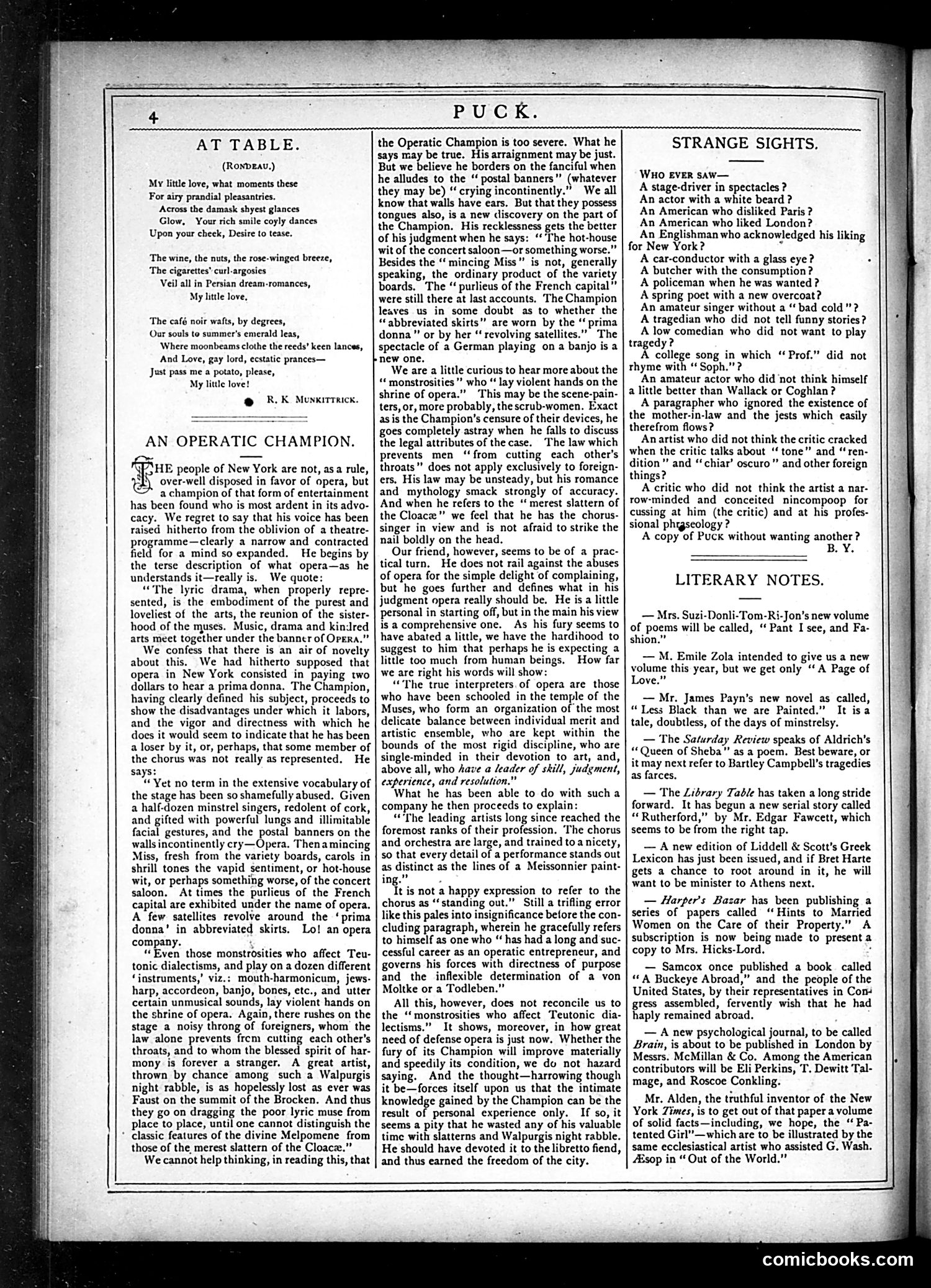
This page from *Puck* contains three distinct sections: 1. **"At Table" (Rondeau)** — A poem by R.K. Munkittrick about dining pleasures, with no political content. 2. **"An Operatic Champion"** — A prose article critiquing New York's opera culture. The writer argues opera companies waste money on poor productions while claiming artistic merit. He advocates for better judgment in casting and production quality rather than expensive spectacle. This is cultural criticism, not political satire. 3. **"Strange Sights"** and **"Literary Notes"** — Brief humor items and book/publication notices. **No cartoon illustrations appear on this page.** It's primarily text-based content offering social commentary on opera and literary notices typical of *Puck*'s format.
📄 Transcribed text from this page (OCR, searchable)
Machine-transcribed from the original scan — historical spelling and the odd misread are preserved.
AT TABLE. (Rowveav.) My little love, what moments these For airy prandial pleasantries. ‘Across the damask shyest glances Glow, Your rich smile coyly dances Upon your cheek, Desire to tease. The wine, the nuts, the rose-winged breeze, The cigarettes’ curl-argosies Veil all in Persian dream-romances, My little love, The café noir watts, by degrees, Oar souls to summer's emerald leas, ‘Where moonbeams clothe the reeds’ keen lances, And Love, gay lord, ecstatic prances— Just pass me a potato, please, My little love! @ R.K Moyxirrric. AN OPERATIC CHAMPION. ‘pen people of New York are not, asa rule, rey over-well disposed in favor of opera, but <a champion of that form of entertainment has been found who is most ardent in its advo- cacy. We regret to say that his voice has been raised hitherto from the oblivion of a theatre- programme—clearly a narrow and contracted field for a mind so expanded. He begins by the terse description of what opera—as he understands it—really is. We quote: “The lyric drama, when properly repre- sented, is the embodiment of the purest and loveliest of the arts, the reunion of the sister- hood of the muses. Music, drama and kindred arts meet together under the banner of Opera.” We confess that there is an air of novelty about this. We had hitherto supposed that opera in New York consisted in paying two dollars to hear a prima donna. The Champion, having clearly defined his subject, proceeds to show the disadvantages under which it labors, and the vigor and directness with which he does it would seem to indicate that he has been a loser by it, or, perhaps, that some member of the chorus was not really as represented. He says: wt Yet no term in the extensive vocabulary of the stage has been so shamefully abused. Given a half-dozen minstrel singers, redolent of cork, and gifted with powerful lungs and illimitable facial gestures, and the postal banners on the walls incontinently cry—Opera. Thena mincing Miss, fresh from the variety boards, carols in shrill tones the vapid sentiment, or hot-house wit, or perhaps something worse, of the concert saloon, At times the purlieus of the French capital are exhibited under the name of opera. A few satellites revolve around the ‘prima donna’ in abbreviated skirts. Lo! an opera company. ‘ “Even those monstrosities who affect Teu- tonic dialectisms, and play on a dozen different ‘instruments,’ viz.: mouth-harmonicum, jews- harp, accordeon, banjo, bones, etc., and utter certain unmusical sounds, lay violent hands on the shrine of opera. Again, there rushes on the stage a noisy throng of foreigners, whom the law alone prevents frem cutting each other's throats, aaa to whom the blessed spirit of har- mony is forever a stranger. A great artist, thrown by chance among such a Walpurgis night rabble, is as hopelessly lost as ever was Faust on the summit of the Brocken. And thus they go on dragging the poor lyric muse from place to place, until one cannot distinguish the * classic features of the divine Melpomene from those of the merest slattern of the Cloacx.”” We cannot help thinking, in reading this, that the Operatic Champion is too severe. What he says may be true. His arraignment may be just. But we believe he borders on the fanciful when he alludes to the “ postal banners" (whatever they may be) “crying incontinently.” We all know that walls have ears. But that they possess tongues also, is a new discovery on the part of the Champion. His recklessness gets the better of his judgment when he says: “The hot-house wit of the concert saloon—or something worse.” Besides the “ mincing Miss” is not, generally speaking, the ordinary product of the variety boards. The “ purlieus of the French capital” were still there at last accounts. The Champion leaves us in some doubt as to whether the “abbreviated skirts” are worn by the “ prima donna"' or by her “revolving satellites.” The spectacle of a German playing on a banjo is a fnew one. We are a little curious to hear more about the * monstrosities” who “ lay violent hands on the shrine of opera.” This may be the scene-pain- ters, or, more probably, the scrub-women. Exact as is the Champion’s censure of their devices, he goes completely astray when he falls to discuss the legal attributes of the case. The law which prevents men ‘from cutting cach other's throats” does not apply exclusively to foreign- ers, His law may be unsteady, but his romance and mythology smack strongly of accuracy. And when he refers to the “ merest slattern of the Cloace” we feel that he has the chorus- singer in view and is not afraid to strike the nail boldly on the head. Our friend, however, seems to be of a prac- tical turn, He does not rail against the abuses of opera for the simple delight of complaining, but ho goes further and defines what in his judgment opera really should be. He isa little personal in starting off, but in the main his view is a comprehensive one. As his fury seems to have abated a little, we have the hardihood to suggest to him that perhaps he is expecting a little too much from human beings. How far we are right his words will show: “The true interpreters.of opera are those who have been schooled in the temple of the Muses, who form an organization of the most delicate balance between individual merit and artistic ensemble, who are kept within the bounds of the most rigid discipline, who are single-minded in their devotion to art, and, above all, who have a /eader of skill, judgment, experience, and resolution.” What he has been able to do with such a company he then proceeds to explain: “The leading artists long since reached the foremost ranks of their profession. ‘The chorus and orchestra are large, and trained toa nicety, so that every detail of a performance stands out as distinct as the lines of a Meissonnier paint- ing.” 2 te is not a happy expression to refer to the chorus as ‘‘ standing out.” Still a trifling error like this pales into insignificance betore the con- cluding paragraph, wherein he gracefully refers to himself as one who “ has had a long and suc- cessful career as an operatic entrepreneur, and governs his forces with directness of purpose and the inflexible determination of a von Moltke or a Todleben.” All this, however, does not reconcile us to the ‘monstrosities who affect Teutonic dia- lectisms.” It shows, moreover, in how great need of defense opera is just now. Whether the fury of its Champion will improve materially and speedily its condition, we do not hazard saying. And the thought—harrowing though it be—forces itself upon us that the intimate knowledge gained by the Champion can be the result of personal experience only. If so, it seems a pity that he wasted any of his valuable time with slatterns and Walpurgis night rabble. He should have devoted it to the libretto fiend, and thus earned the freedom of the city. STRANGE SIGHTS. Wuo EVER SAW— A stage-driver in spectacles ? An actor with a white beard ? An American who disliked Paris ? An American who liked London? An Englishman who acknowledged his liking for New York? id A car-conductor with a glass eye? A butcher with the consumption? A policeman when he was wanted ? A spring poet with a new overcoat? An amateur singer without a “ bad cold"? A tragedian who did not tell funny stories? A low comedian who did not want to play tragedy ? college song in which “Prof.” did not thyme with “ Soph,”? An amateur actor who did ‘not think himself a little better than Wallack or Coghlan? A paragrapher who ignored the existence of the mother-in-law and the jests which easily therefrom flows? An artist who did not think the critic cracked when the critic talks about “tone” and “ren- dition” and “ chiar’ oscuro” and other foreign things? Accritic who did not think the artist a nar- row-minded and conceited nincompoop for cussing at him (the critic) and at his profes- sional phtgscology ? A copy of Puck without wanting another? B. LITERARY NOTES. — Mrs. Suzi-Donli-Tom-Ri-Jon’s new volume of poems will be called, “Pant I see, and Fa- shion.” — M. Emile Zola intended to give us a new volume this year, but we get only “A Page of Love.” — Mr. James Payn’s new novel as called, “Less Black than we are Painted.” It isa tale, doubtless, of the days of minstrelsy, — The Saturday Review speaks of Aldrich's “Queen of Sheba” as a poem. Best beware, or it may next refer to Bartley Campbell's tragedies as farces. — The Library Table has taken a long stride forward. It has begun a new serial story called “Rutherford,” by Mr. Edgar Fawcett, which seems to be from the right tap. — A new edition of Liddell & Scott's Greek Lexicon has just been issued, and if Bret Harte gets a chance to root around in it, he will want to be minister to Athens next. — Harpers Bazar has been publishing a series of papers called ‘‘Hints to Married Women on the Care of their Property.” A subscription is now being made to presenta copy to Mrs. Hicks-Lord. , — Samcox once published a book called “A Buckeye Abroad,” and the people of the United States, by their representatives in Cons gress assembled, fervently wish that he had haply remained abroad. — A new psychological journal, to be called Brain, is about to be published in London by Messrs. McMillan & Co. Among the American contributors will be Eli Perkins, T. Dewitt Tal- mage, and Roscoe Conkling. Mr. Alden, the truthful inventor of the New York Zimes, is to get out of that paper a volume of solid facts—including, we hope, the ‘ Pa- tented Girl”—which are to be illustrated by the same ecclesiastical artist who assisted G. Wash. sop in “Out of the World.”” comicbooks.com