
Puck, 1878-05-22 · page 7 of 16
Puck — May 22, 1878 — page 7: what you’re looking at
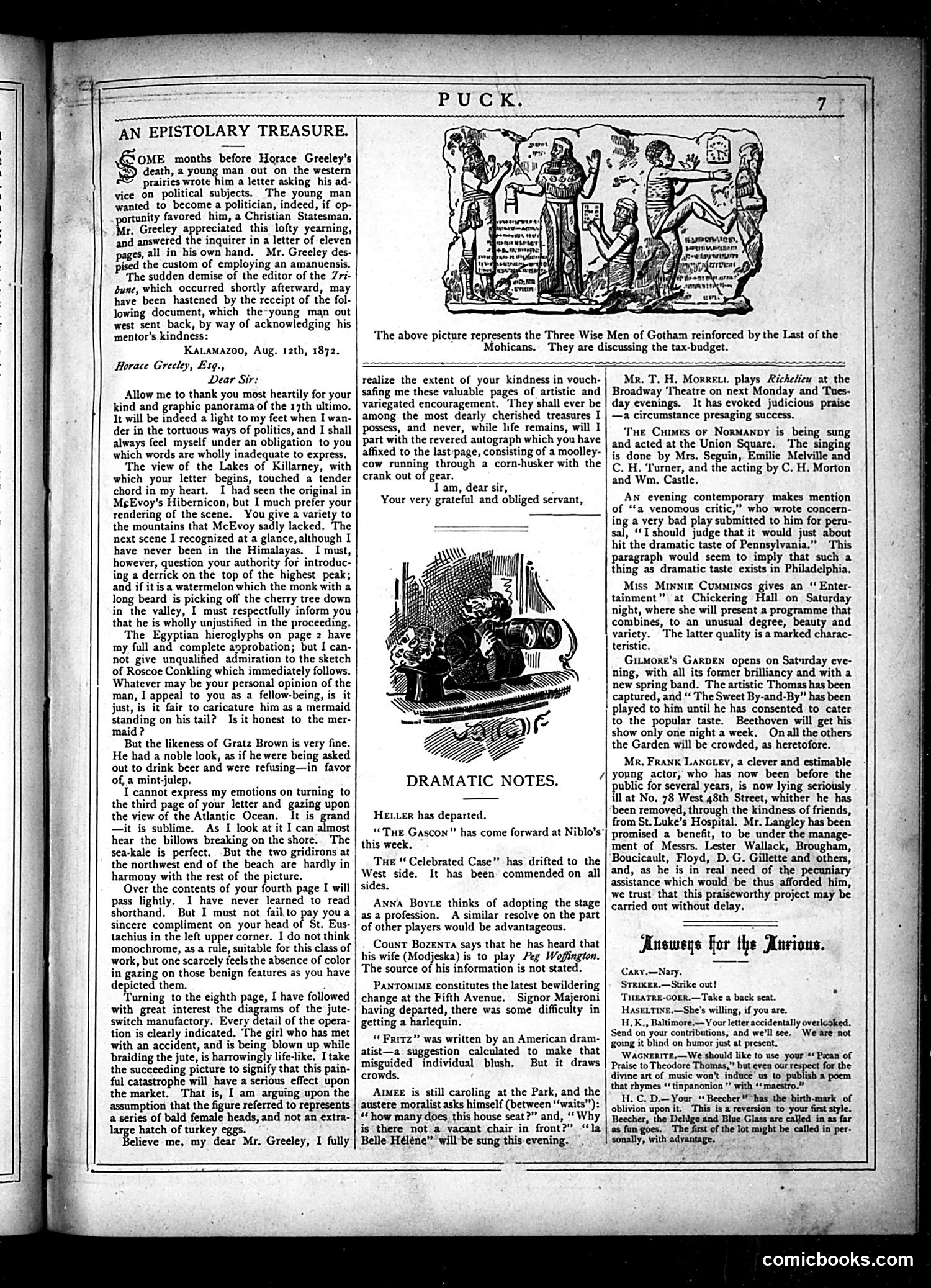
What you’re looking at
This page contains primarily **theatrical and entertainment reviews** rather than political cartoons. The main illustration shows "The Three Wise Men of Gotham reinforced by the Last of the Mohicans," which appears to be a satirical theatrical sketch depicting characters discussing or debating something, likely contemporary political or social issues of the era. The bulk of the page consists of: - An epistolary piece (letter from someone to Horace Greeley about becoming a politician) - "Dramatic Notes" reviewing various stage productions and actors - A humor column titled "Amusement for the Anxious" The cartoons and text target contemporary theater performances, actors' abilities, and New York entertainment venues rather than serving as direct political satire. This reflects Puck's mix of theatrical criticism alongside its better-known political commentary.
📄 Transcribed text from this page (OCR, searchable)
Machine-transcribed from the original scan — historical spelling and the odd misread are preserved.
AN EPISTOLARY TREASURE. OME months before Horace Greeley’s death, a young man out on the western prairies wrote him a letter asking his ad- yice on political subjects. The young man wanted to become a politician, indeed, if op- rtunity favored him, a Christian Statesman. » Mr. Greeley appreciated this lofty yearning, ‘and answered the inquirer in a letter of eleven es, all in his own hand. Mr. Greeley des- pised the custom of employing an amanuensis. The sudden demise of the editor of the 77i- bune, which occurred shortly afterward, may have been hastened by the receipt of the fol- lowing document, which the-young man out west sent back, by way of acknowledging his mentor’s kindness: Katamazoo, Aug. 12th, 1872. Horace Greeley, Esq., Dear Sir: Allow me to thank you most heartily for your kind and graphic panorama of the 17th ultimo. It will be indeed a light to my feet when I wan- der in the tortuous ways of politics, and I shall always feel myself under an obligation to you which words are wholly inadequate to express. The view of the Lakes of Killarney, with which your letter begins, touched a tender chord in my heart. I had seen the original in MgEvoy’s Hibernicon, but I much prefer your rendering of the scene. You give a variety to the mountains that McEvoy sadly lacked. The next scene I recognized at a glance, although I have never been in the Himalayas. I must, however, question your authority for introduc- ing a derrick on the top of the highest peak; and if it is a watermelon which the monk with a long beard is picking off the cherry tree down in the valley, I must respectfully inform you that he is wholly unjustified in the proceeding. The Egyptian hieroglyphs on page 2 have my full and complete approbation; but I can- not give unqualified admiration to the sketch of Roscoe Conkling which immediately follows. Whatever may be your personal opinion of the man, I appeal to you as a fellow-being, is it just, is it fair to caricature him as a mermaid standing on his tail? Is it honest to the mer- maid? But the likeness of Gratz Brown is very fine. He had a noble look, as if he were being asked out to drink beer and were refusing—in favor of, a mint-julep. I cannot express my emotions on turning to the third page of your letter and gazing upon the view of the Atlantic Ocean. It is grand —it is sublime. As I look at it I can almost hear the billows breaking on the shore. The sea-kale is perfect. But the two gridirons at the northwest end of the beach are hardly in harmony with the rest of the picture. Over the contents of your fourth page I will pass lightly. I have never learned to read shorthand. But I must not failto pay youa sincere compliment on your head of St. Eus- tachius in the left upper corner. I do not think monochrome, as a rule, suitable for this class of work, but one scarcely teels the absence of color in gazing on those benign features as you have depicted them. Z ‘Turning to the eighth page, I have followed with great interest the diagrams of the jute- switch manufactory. Every detail of the opera- tion is clearly indicated. ‘The girl who has met with an accident, and is being blown up while braiding the jute, is harrowingly life-like. Itake the succeeding picture to signify that this pain- ful catastrophe will have a serious effect upon the market. That is, I am arguing upon the assumption that the figure referred to represents a series of bald female heads, and not an extra- large hatch of turkey eggs. “Believe me, my dear Mr. Greeley, I fully 4 ‘The above picture represents the Three Wise Men of Gotham reinforced by the Last of the Mohicans. They are discussing the tax-budget. realize the extent of your kindness in vouch- safing me these valuable pages of artistic and variegated encouragement. ‘They shall ever be among the most dearly cherished treasures I possess, and never, while hfe remains, will I part with the revered autograph which you have affixed to the last page, consisting of a moolley- cow running through a corn-husker with the crank out of gear. I am, dear sir, x Your very grateful and obliged servant, DRAMATIC NOTES. HELteR has departed. “Tue Gascon” has come forward at Niblo’s this week. Tue “Celebrated Case” has drifted to the West side. It has been commended on all sides, Anna Boyte thinks of adopting the stage asa profession. A similar resolve on the part of other players would be advantageous. Count Bozenta says that he has heard that his wife (Modjeska) is to play Peg Woffington. The source of his information is not stated. PANTOMIME constitutes the latest bewildering change at the Fifth Avenue. Signor Majeroni having departed, there was some difficulty in getting a harlequin. “Fritz” was written by an American dram- atist—a suggestion calculated to make that misguided individual blush. But it draws crowds. Armee is still caroling at the Park, and the austere moralist asks himself (between ‘‘waits”): “‘ how many does, this house seat?” and, “Why is there not a vacant chair in front?” “‘la Belle Héléne’’ ‘will’be sung this-evening. Mr. T. H. Morrew plays Richelieu at the Broadway ‘Theatre on next Monday and Tues- day evenings. It has evoked judicious praise —a circumstance presaging success. Tue Cximes or Normanpy is being sung and acted at the Union Square, The singin; is done by Mrs. Seguin, Emilie Melville ans C. H. ‘Turner, and the acting by C. H. Morton and Wm. Castle, An evening contemporary makes mention of ‘a venomous critic,” who wrote concern- ing a very bad play submitted to him for peru- sal, ‘I should judge that it would just about hit the dramatic taste of Pennsylvania,” This paragraph would seem to imply that such a thing as dramatic taste exists in Philadelphia. Miss Minnie Cummines gives an “ Enter- tainment” at Chickering Hall on Saturday night, where she will present a programme that combines, to an unusual degree, beauty and variety. The latter quality is a marked charac- teristic. Gitmore’s GARDEN opens on Saturday eve- ning, with all its former brilliancy and with a new spring band. The artistic Thomas has been captured, and “ The Sweet By-and-By” has been played to him until he has consented to cater to the popular taste. Beethoven will get his show only one night a week, Onall the others the Garden will be crowded, as heretofore. Mr. Frank Lanctey, a clever and estimable young actor, who has now been before the public for several years, is now lying seriously ill at No. 78 West 48th Street, whither he has ‘been removed, through the kindness of friends, from St. Luke's Hospital. Mr. Langley has been promised a benefit, to be under the manage- ment of Messrs. Lester Wallack, Brougham, Boucicault, Floyd, D, G. Gillette and others, and, as he is in real need of the pecuniary assistance which would be thus afforded him, we trust that this praiseworthy project may be carried out without delay. Answers for the Anvions. ER.—Take a back seat. —She's willing, if you are. H.K., Baltimore.—Your letter accidentally overlooked. Send on your contributions, and we'll see. We are not going it blind on humor just at present, Wacnerite,—We should like to use your #« Pzcan of Praise to Theodore Thomas,” but even our: for the divine art of music won't induce’ us to publish a poem that rhymes “tinpanonion ” with “maestro. H.C. D.—Your ‘Beecher ™*has the birth-mark of oblivion upon it. This is a reversion to your first style. Beecher, the Delige and Blue Glass are caljed in as far as fun goes, The first of the lot might be called in per- sonally, with advantage. * comicbooks.com