
A complete issue · 16 pages · 1878
Puck — May 8, 1878
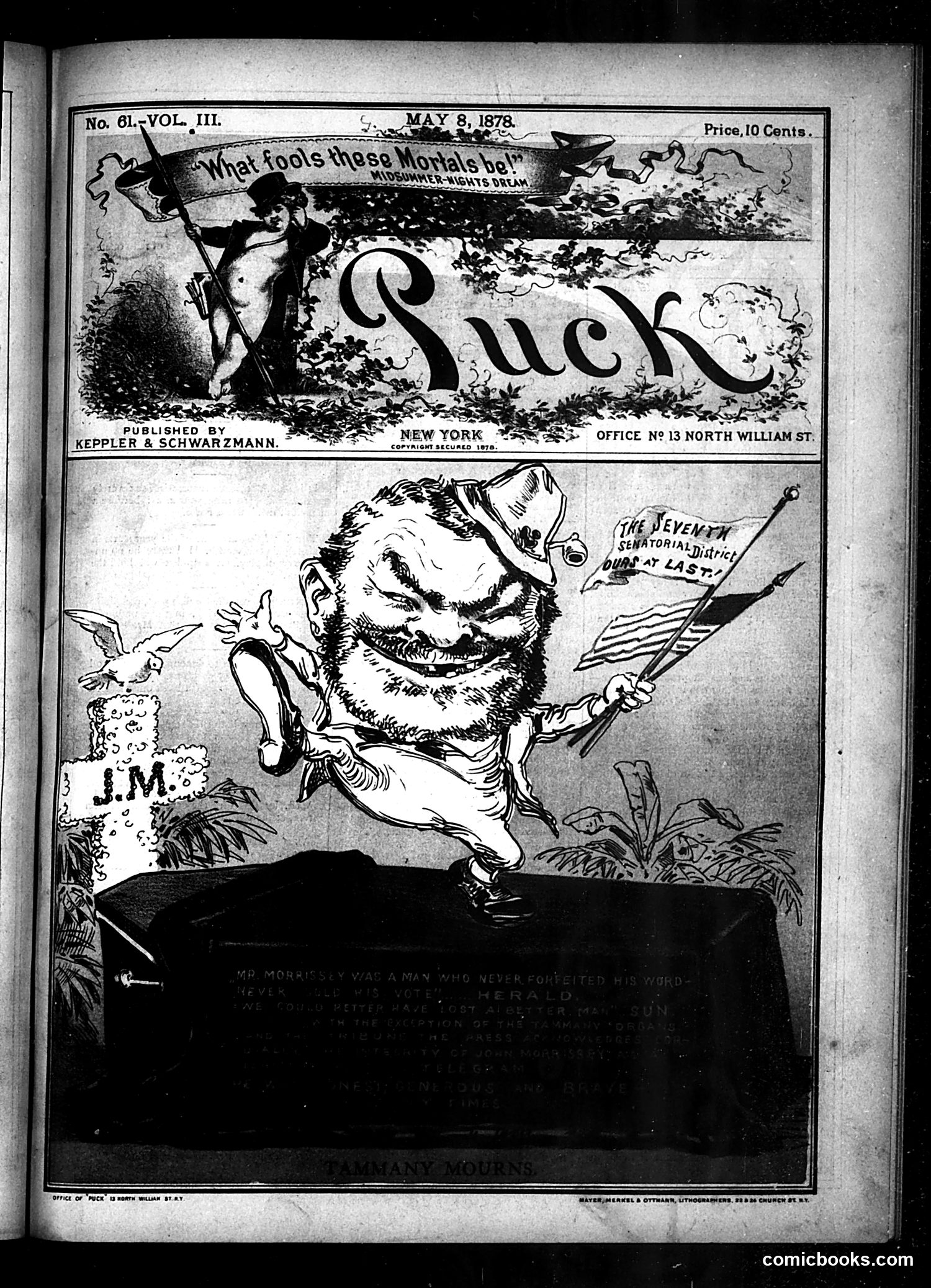
The main cartoon depicts a caricatured bearded man in period dress holding an American flag, labeled with initials "J.M." A banner reads "THE SEVENTH SENATORIAL DISTRICT BURNT AT LAST!" The figure appears to represent a political candidate or officeholder in New York's Seventh Senatorial District. The satire suggests he has been decisively defeated or removed from power—"burnt" being slang for political defeat. The American flag he holds may indicate claims of patriotism or legitimacy now rendered hollow. Without additional context about 1878 New York state politics, the specific identity of "J.M." and the exact senatorial race referenced remain unclear, though the cartoon mocks what appears to be a notable political upset or comeuppance.
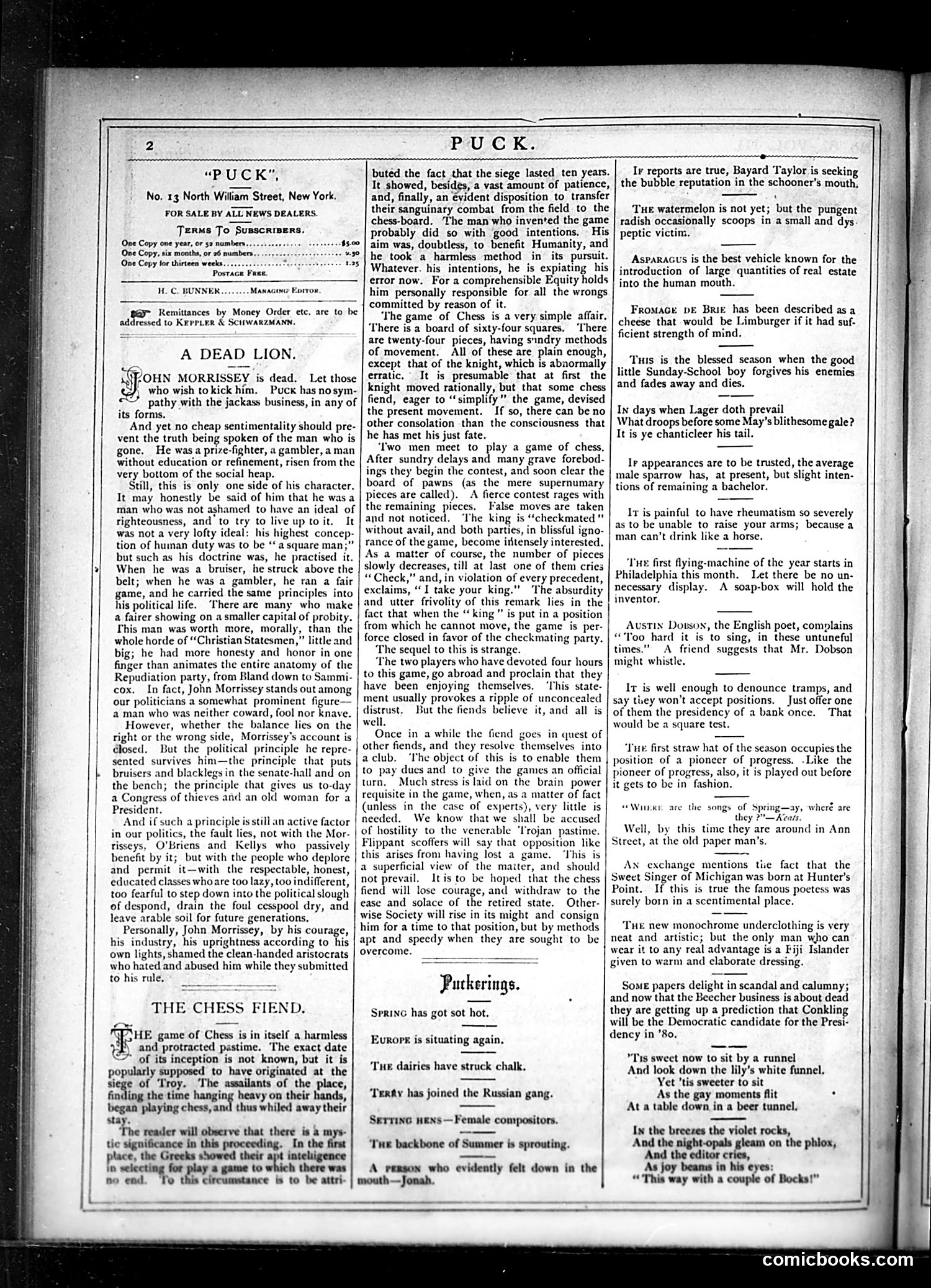
This page consists primarily of **text articles and brief notices** rather than political cartoons. The main pieces include: 1. **"A Dead Lion"** — an obituary-style article about John Morrissey, a deceased prize-fighter and politician. The text critiques his political career while acknowledging his personal integrity. 2. **"The Chess Fiend"** — discusses a chess match's historical origins, referencing the siege lasting ten years and relating it to the game's strategy and rules. 3. **"Puckerings"** — a section of brief satirical notices on current events, including mentions of Spring, European situations, dairy strikes, and Russian gangs. The page represents **Puck's editorial commentary** on contemporary issues through short-form satire rather than visual cartooning, typical of 19th-century magazine format.
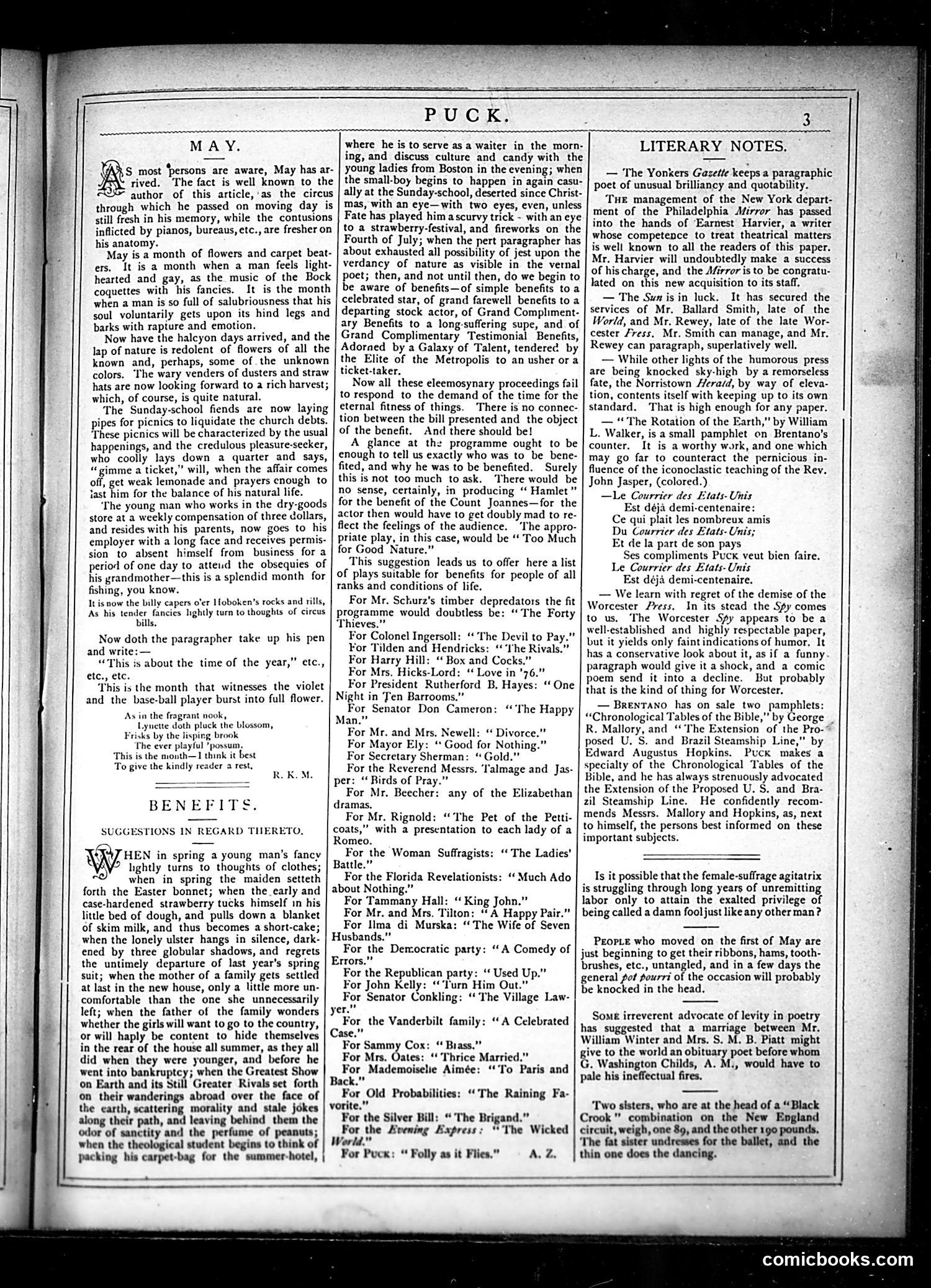
This page is primarily **literary notes and theatrical criticism**, not political satire. The "Benefits" section lists suggested plays for various public figures and organizations—a common Puck feature mixing humor with social commentary. The suggestions pair plays with their subjects satirically. For example, recommending "The Forty Thieves" for a lumber company or "The Devil to Pay" for a Colonel suggests ironic commentary on their characters or actions. The left column discusses May's characteristics and seasonal observations in typical Puck fashion—lighthearted social humor rather than hard political satire. Without identifying specific individuals or events in the theatrical recommendations, this appears to be **entertainment-focused satire** typical of Puck's miscellaneous content pages, relying on contemporary theatrical and social knowledge for its humor.
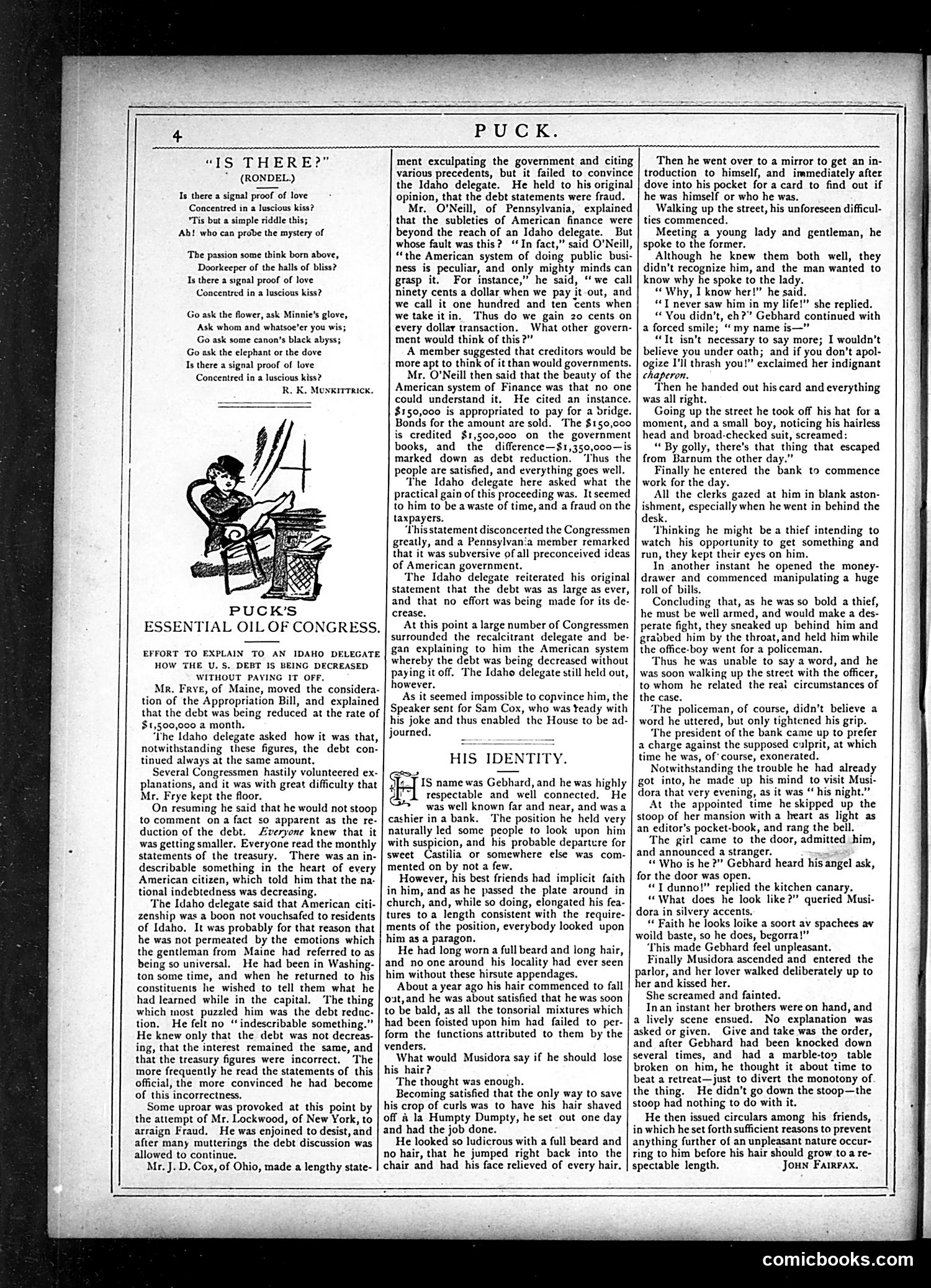
This page satirizes Congressional debates over the federal debt and deficit spending. The central cartoon, "Puck's Essential Oil of Congress," depicts a small figure (the Idaho delegate) presenting arguments about debt reduction to skeptical lawmakers. The text mocks an Idaho congressman's attempts to convince colleagues that creative accounting—counting debt reduction in creative ways—could resolve fiscal problems. Mr. O'Neill (Pennsylvania) and others dispute his claims, arguing the debt remains unchanged regardless of how it's presented. The satire targets government fiscal dishonesty: politicians making false claims about budget improvements through accounting manipulation rather than genuine spending cuts. The humor lies in exposing the gap between political rhetoric and economic reality—a timeless concern applicable to modern debates.
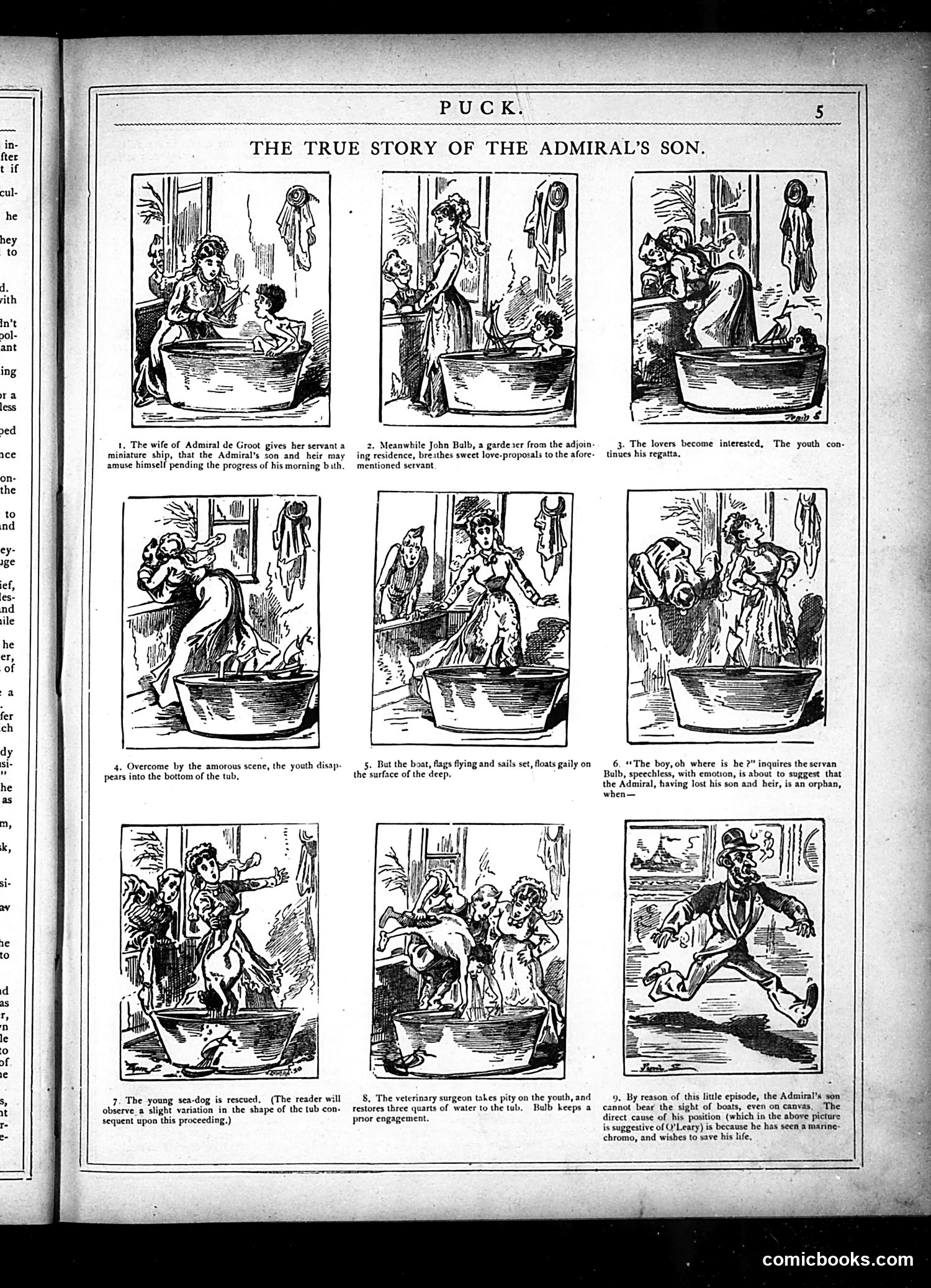
This is a humorous nine-panel comic strip rather than political satire. It depicts a domestic comedy involving an Admiral's wife, their son, and a gardener named John Bulk who proposes to a servant. The joke unfolds through escalating romantic complications in a bathtub scene. The narrative follows a love triangle that causes the youth to despair, leading to a comedic rescue sequence involving a sea-dog (sailor) and veterinary intervention. The final panel reveals the Admiral's son is actually an orphan being raised by the family—"Leary" apparently being a mascot or pet name, suggesting the entire romantic drama was ultimately insignificant. The humor relies on physical comedy, mistaken situations, and the absurdist resolution typical of Victorian-era comic strips.
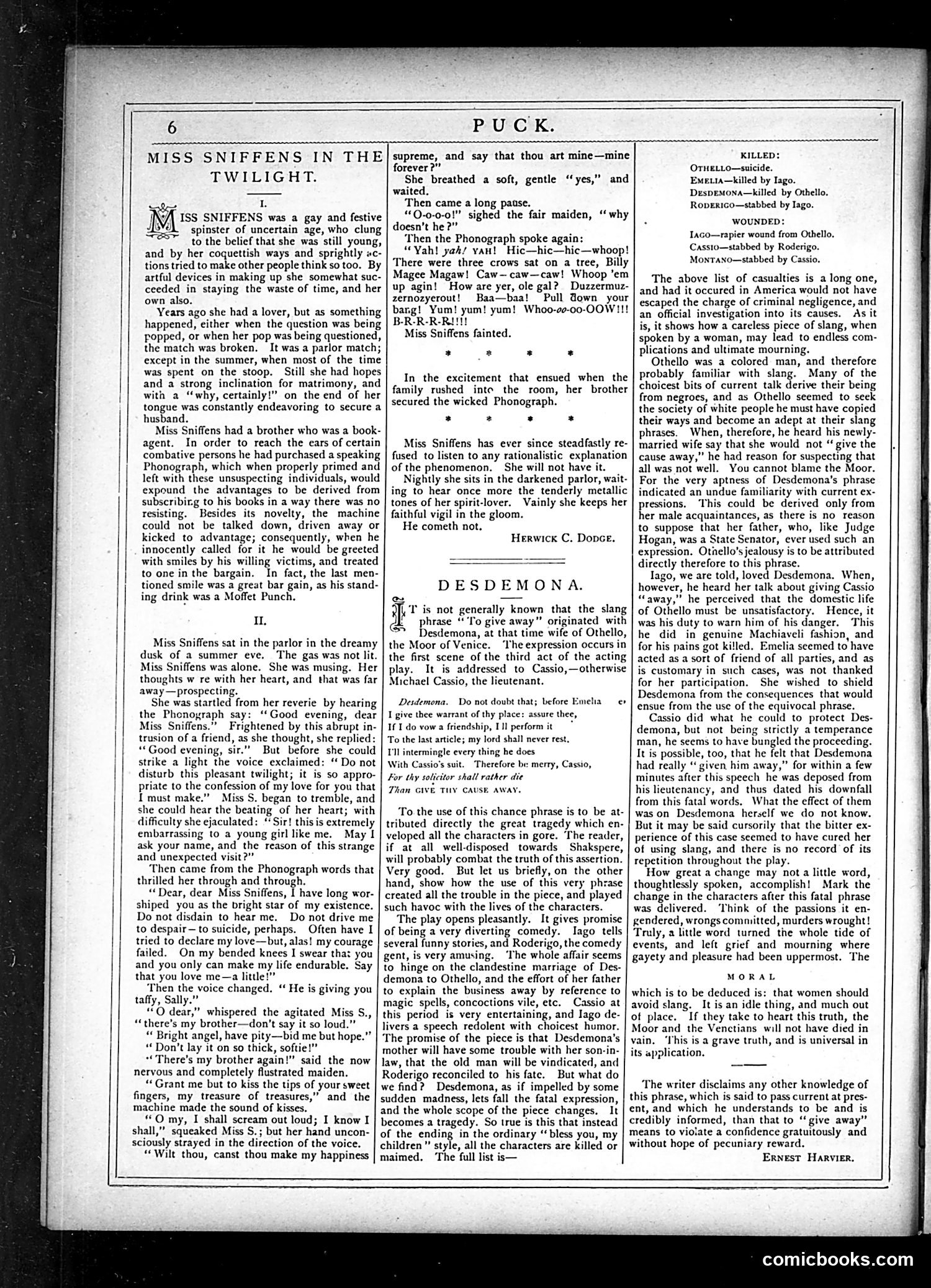
This page from *Puck* contains two literary pieces rather than political cartoons. "Miss Sniffens in the Twilight" is a humorous short story about an eccentric unmarried woman who owns a phonograph and resists rational explanation of the device's mechanism. The second piece, "Desdemona," appears to be critical commentary on Shakespeare's *Othello*, specifically addressing Iago's use of the phrase "give away" and its role in the tragedy. The Desdemona section discusses how a single word can alter the meaning of a character's speech and change dramatic impact—arguing that Iago's language choices directly contributed to the play's tragic outcome. This is literary criticism rather than political satire, focusing on how language shapes character and fate in drama.
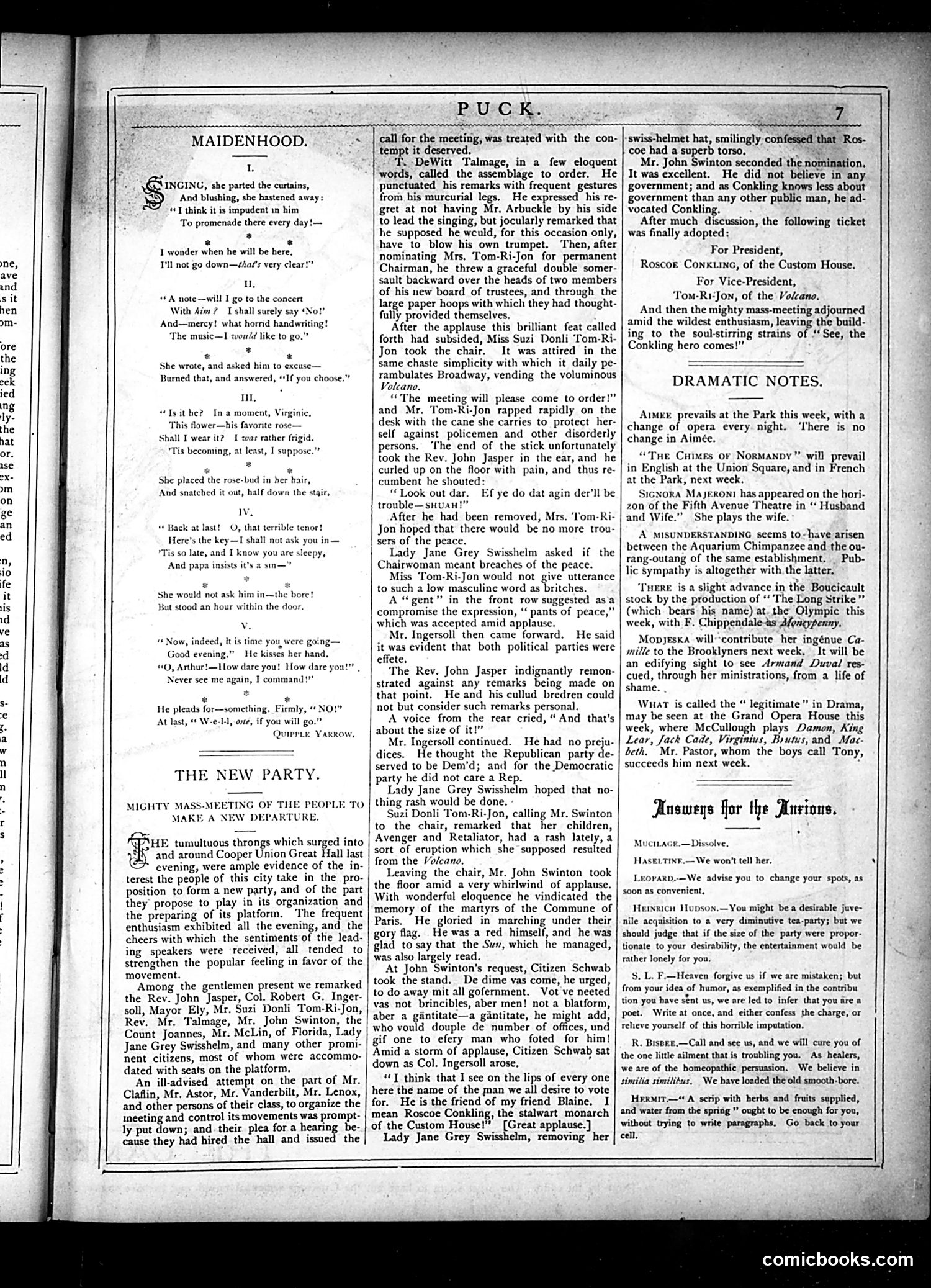
This page is primarily **text content**, not visual satire. It contains three sections: 1. **"Maidenhood"** — a poem about a young woman's romantic anticipation 2. **"The New Party"** — satire about a "mighty mass-meeting" organizing a new political party, mocking the enthusiastic rhetoric and inflated promises of political organizing 3. **"Dramatic Notes"** and **"Answers for the Anxious"** — theater reviews and advice columns The political satire in "The New Party" section appears to reference **late 19th-century American political reorganization**, with speakers like "John Swinton" and "Citizen Schwab" making grand declarations. The humor mocks the grandiose language and unrealistic expectations of political movements, but **without more specific historical context visible on this page, the exact political event referenced is unclear**. The page functions primarily as **literary/cultural content** rather than visual cartooning.
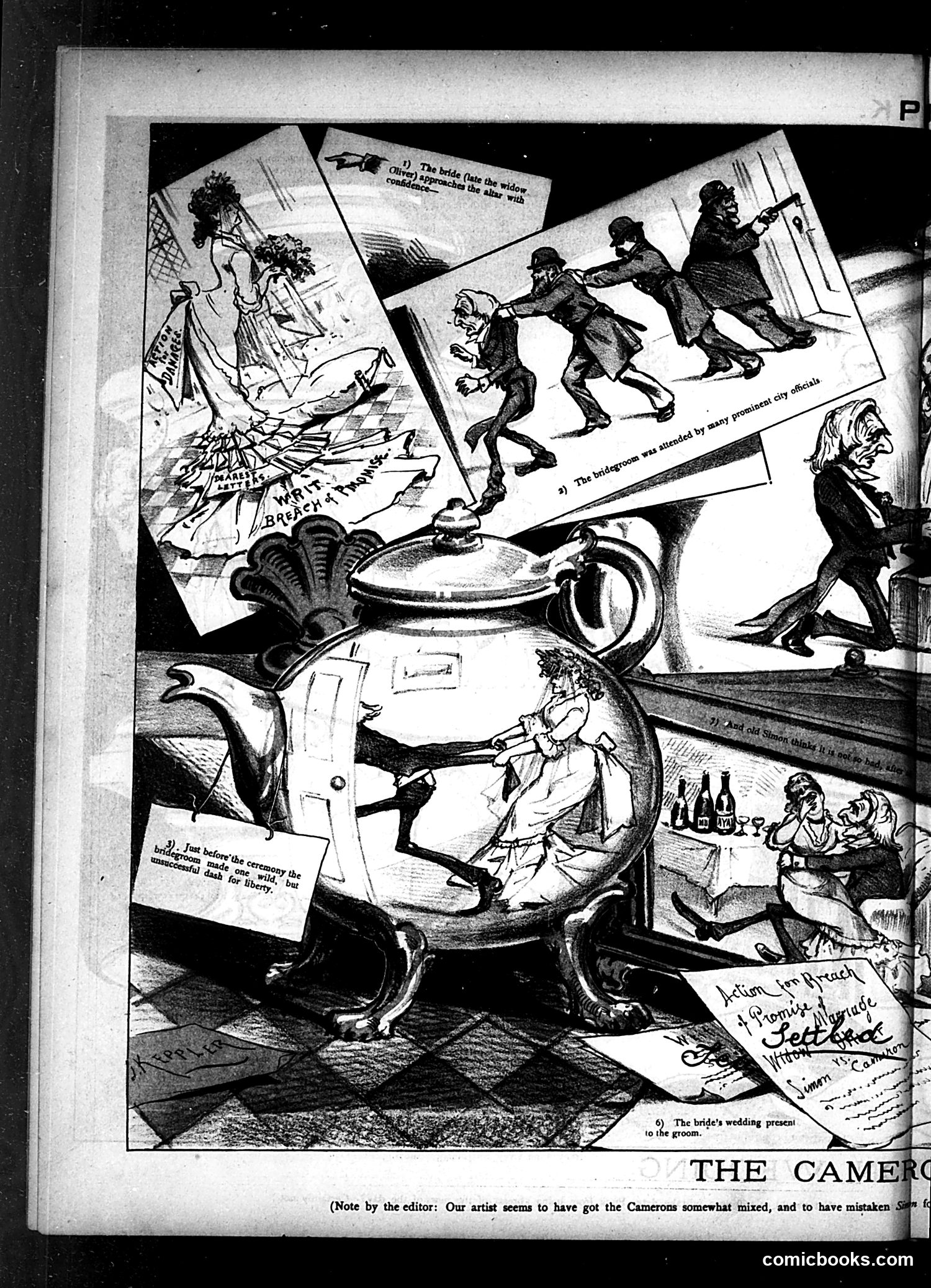
This page presents a satirical narrative using teapot imagery as the central metaphor. The sequential panels depict what appears to be a domestic scandal or breach of trust, with the teapot serving as a vessel containing secrets or private matters. The illustrated scenes show: - A woman discovering something shocking - Multiple figures in apparent conflict or confrontation - References to a "bridegroom" and "bride's wedding present" The editor's note at bottom acknowledges confusion about the "Camerons," suggesting this satirizes a specific contemporary scandal involving people with that surname, likely a breach of confidentiality or betrayal within a marriage or engagement. Without clearer text or historical context, the precise political or social reference remains unclear, though the teapot metaphor clearly represents gossip or secrets being "spilled."
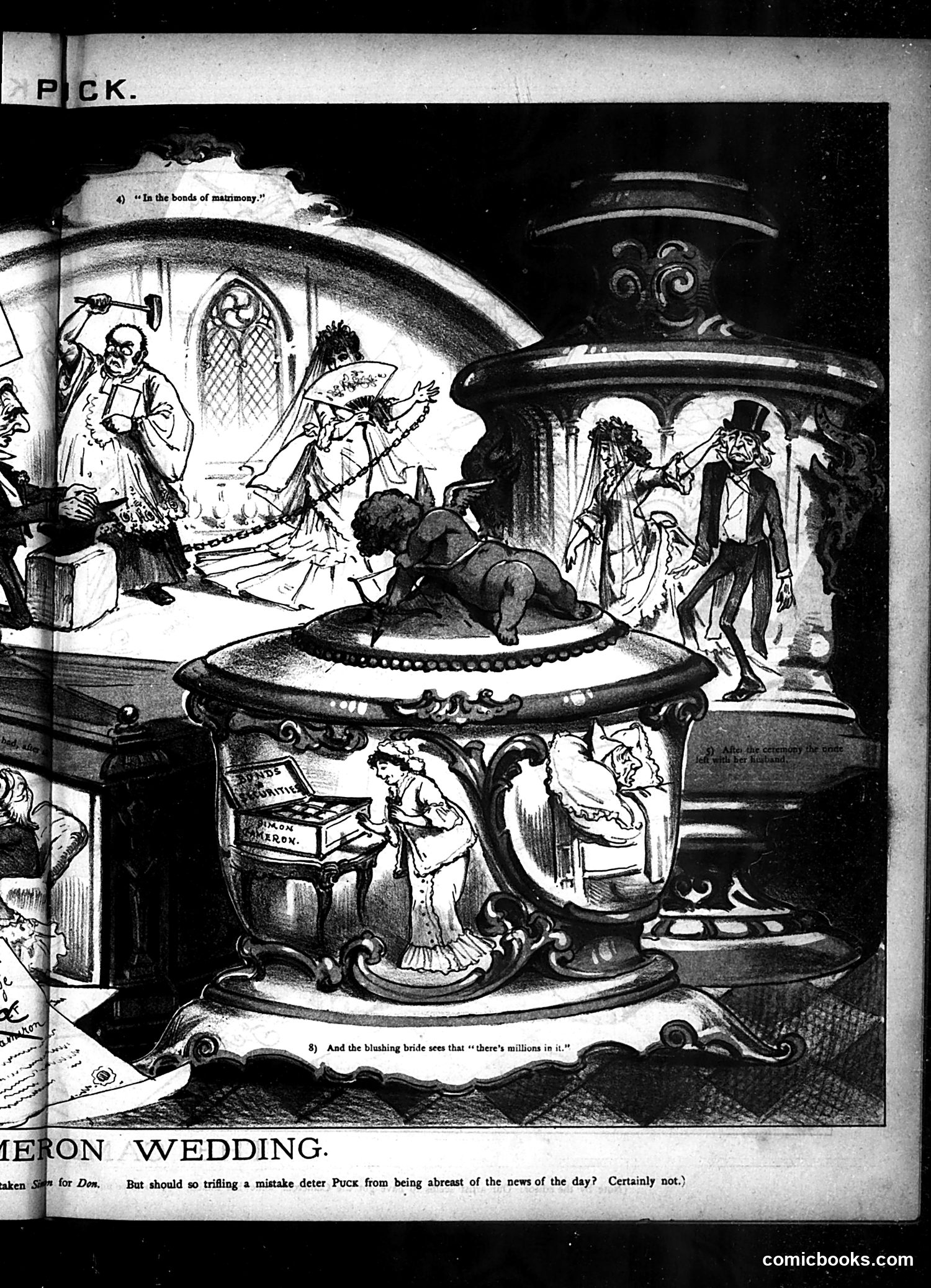
This satirical cartoon depicts a lavish wedding ceremony with fantastical elements. The central image shows an ornate vessel or altar with a couple being married inside, while various figures observe from different levels—suggesting both earthly and supernatural participation. The captions reference "the bonds of matrimony" and a bride noticing "there's millions in it," indicating satire about marriages motivated by wealth rather than love. The elaborate, theatrical staging—complete with cherubs and decorative architecture—mocks the ostentation of high-society weddings. The implied critique appears to target mercenary marriages among the wealthy elite, where financial considerations trump genuine affection. The fantastical framing suggests such unions are absurdly theatrical performances rather than sincere commitments.
This page contains a theatrical comedy sketch titled "The Late Lamented," adapted from French by H.C. Bosseux. The dialogue features characters including Champfleury, Frontin, Julie, and Lisette engaging in a comedic plot involving a Countess, a Count's death, inheritance disputes, and romantic entanglements. The satire targets **French aristocratic absurdities**: the Count's death triggers complications over wealth distribution among various heirs, while characters engage in schemes around marriage, honor, and financial interest. Julie and Lisette represent servant/lower-class perspectives critiquing their "betters'" moral hypocrisy. The humor mocks **aristocratic pretension**—characters claim nobility while pursuing purely mercenary motives. The title "The Age of Fable" suggests the entire aristocratic system itself is fictional mythology rather than justified social reality.
This page contains two sections: a dramatic play scene titled "Puck" (left) and a short story titled "Wide Awake" by W.S. Gilbert (right). The left column shows dialogue between aristocratic French characters—Julie, Lisette, Jokie, and Champlain—discussing romantic entanglements, infidelity, and a scandal involving "the Marquis." The theatrical scene satirizes upper-class French society's hypocrisies regarding honor, marriage, and propriety. Characters make witty, pointed remarks about deception and moral compromise. The right column begins a narrative about a man reflecting on his attachment to a woman named Georgia, hinting at past romantic complications and social awkwardness. The content suggests social satire targeting romantic pretension and class dynamics. Both pieces use humor to mock aristocratic and bourgeois conventions of the era.
This page contains primarily **text narrative** rather than a cartoon—it appears to be a serialized story or article. The visible content is a first-person account describing various domestic and social situations, including discussions about marriage, somnambulism (sleepwalking), and family interactions involving characters named John, James, Georgina, and Uncle Sparrow. The narrative touches on themes of Victorian-era domestic propriety, including concerns about unmarried couples, sleeping arrangements, and social scandal. Without seeing the page's title or illustrations clearly, I cannot definitively identify the specific satirical target or social commentary this story was meant to convey to contemporary Puck readers. **The text alone does not clearly indicate the political or social satire intended.**
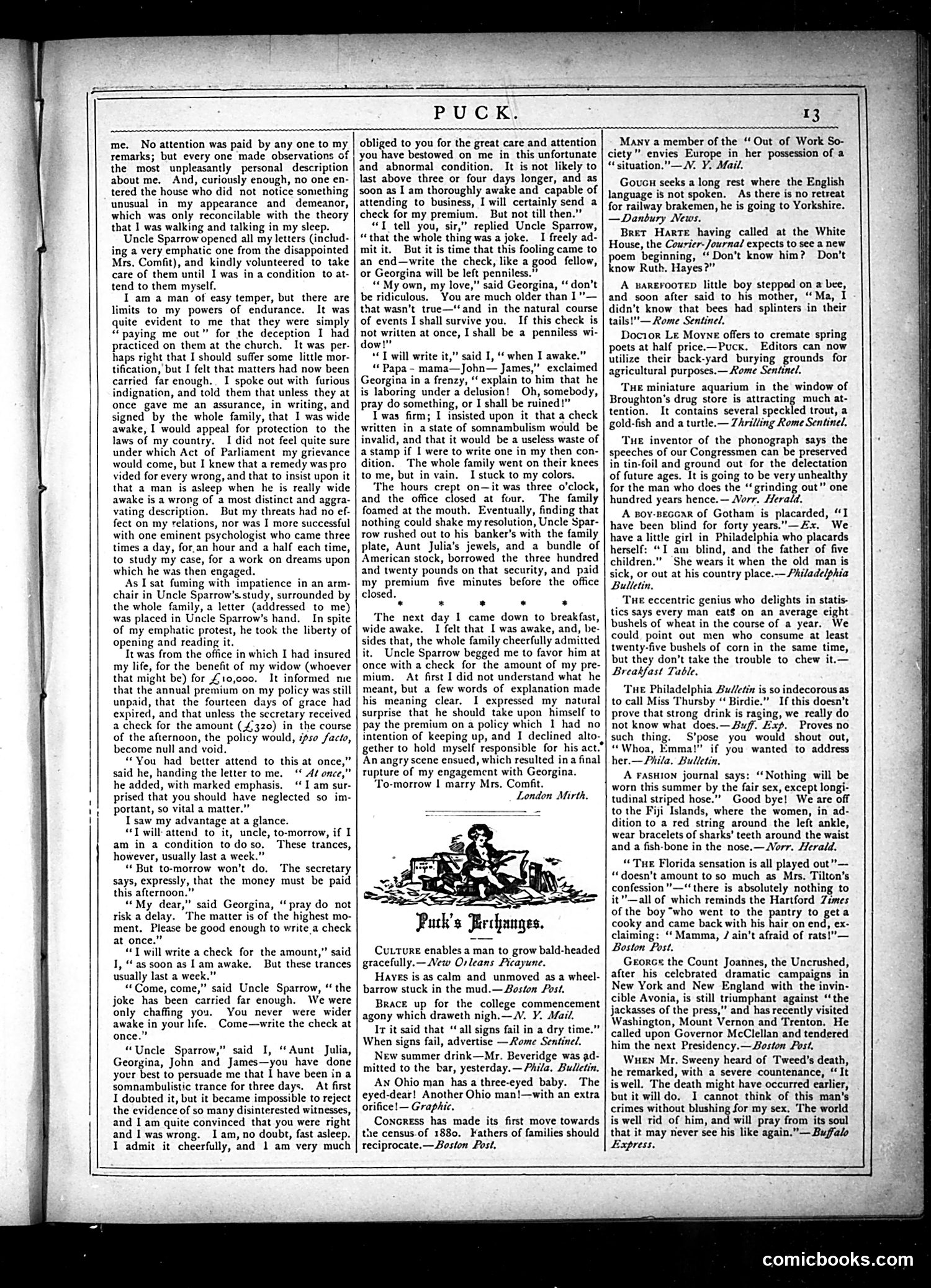
This page consists primarily of **short satirical news items and jokes** rather than a major cartoon. The section titled "Puck's Exchanges" collects brief, witty commentary on contemporary news and social observations. The items mock various subjects: railroad accidents, agricultural pricing, fashions, political speeches, and eccentric behaviors. For example, one joke criticizes someone's attempt to write a check while in a "state of nonambulism" (sleepwalking), suggesting absurd absent-mindedness. There's a small illustration at the bottom showing what appears to be **figures in a casual scene**, but it's difficult to discern specific political figures or detailed meaning from the image quality. The overall tone is **light mockery of everyday follies and current events** typical of Puck's satirical style.
This page is dominated by commercial advertisements rather than political cartoons. The visible content includes: **Main advertisements:** - Apollinaris Natural Mineral Water ("The Queen of Table Waters") - Hunyadi János (a Hungarian laxative), featuring a bearded man's portrait - Fred'k De Bary & Co. (pharmaceutical products) - Fred'k H. Levey & Co. (printing inks) - Compressed Yeast - Portrait photography services - Various other commercial products **Political/satirical content appears minimal** on this page. The upper left contains brief editorial commentary about cooking and journalism, but no clear political cartoon is visible. This appears to be a typical late-19th-century magazine page mixing modest editorial content with extensive paid advertising.
This is primarily an advertising and announcements page from Puck magazine (page 15), not a satirical cartoon page. The page contains advertisements for various 1870s products and services: Friedrichshall Bitterwater (a digestive tonic), Dunlap & Co. gentlemen's hats, Nicoll the Tailor, and Continental Champagne. The main editorial content announces Puck's new "General Designing Office" employing artist Joseph Keppler to provide illustrations for theatrical productions and lithographic portraits. The magazine also promotes its 1878 Almanac (15 cents) and offers patent covers for filing back issues, along with information about obtaining back numbers of Puck. No political satire or caricature appears on this particular page—it functions as a business and service directory for the publication.
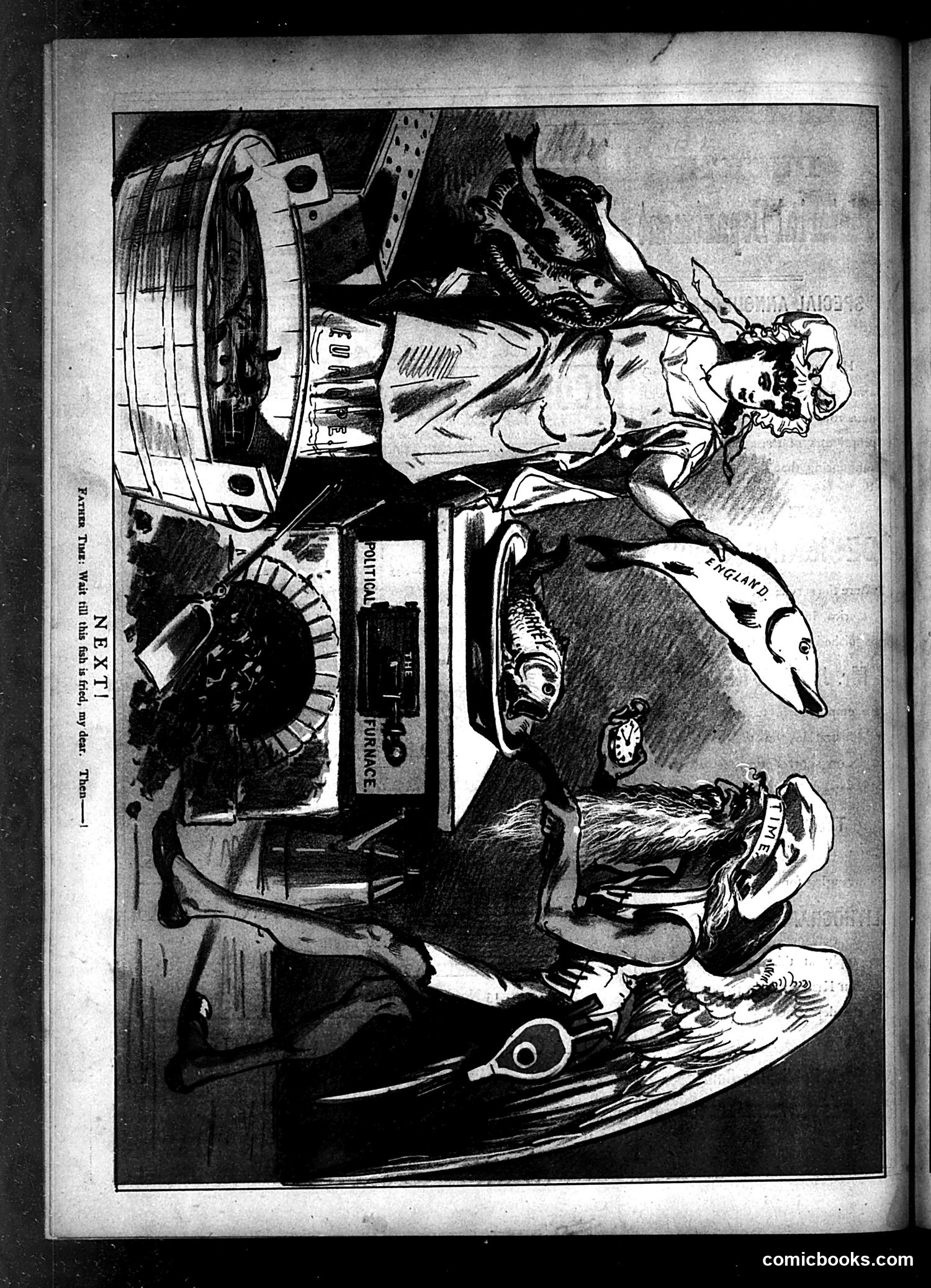
This appears to be a Puck magazine satirical cartoon, though the OCR text is too degraded to read clearly. The image shows what appears to be a political or social commentary scene, rotated 90 degrees, depicting figures in period dress (likely early 20th century) around an automobile and other elements. The cartoon includes allegorical or anthropomorphic figures, and visible text references "ENGLAND" on what appears to be a shield or emblem. Without legible text identifying the specific figures or clearer historical markers, I cannot definitively state which political event or personalities this cartoon lampoons. The style and composition suggest commentary on British-American relations or international politics of the era, but the specific satire's point remains unclear from this reproduction's quality. To properly explain the cartoon's meaning would require either clearer text or additional historical documentation.