
Puck, 1878-05-08 · page 3 of 16
Puck — May 8, 1878 — page 3: what you’re looking at
What you’re looking at
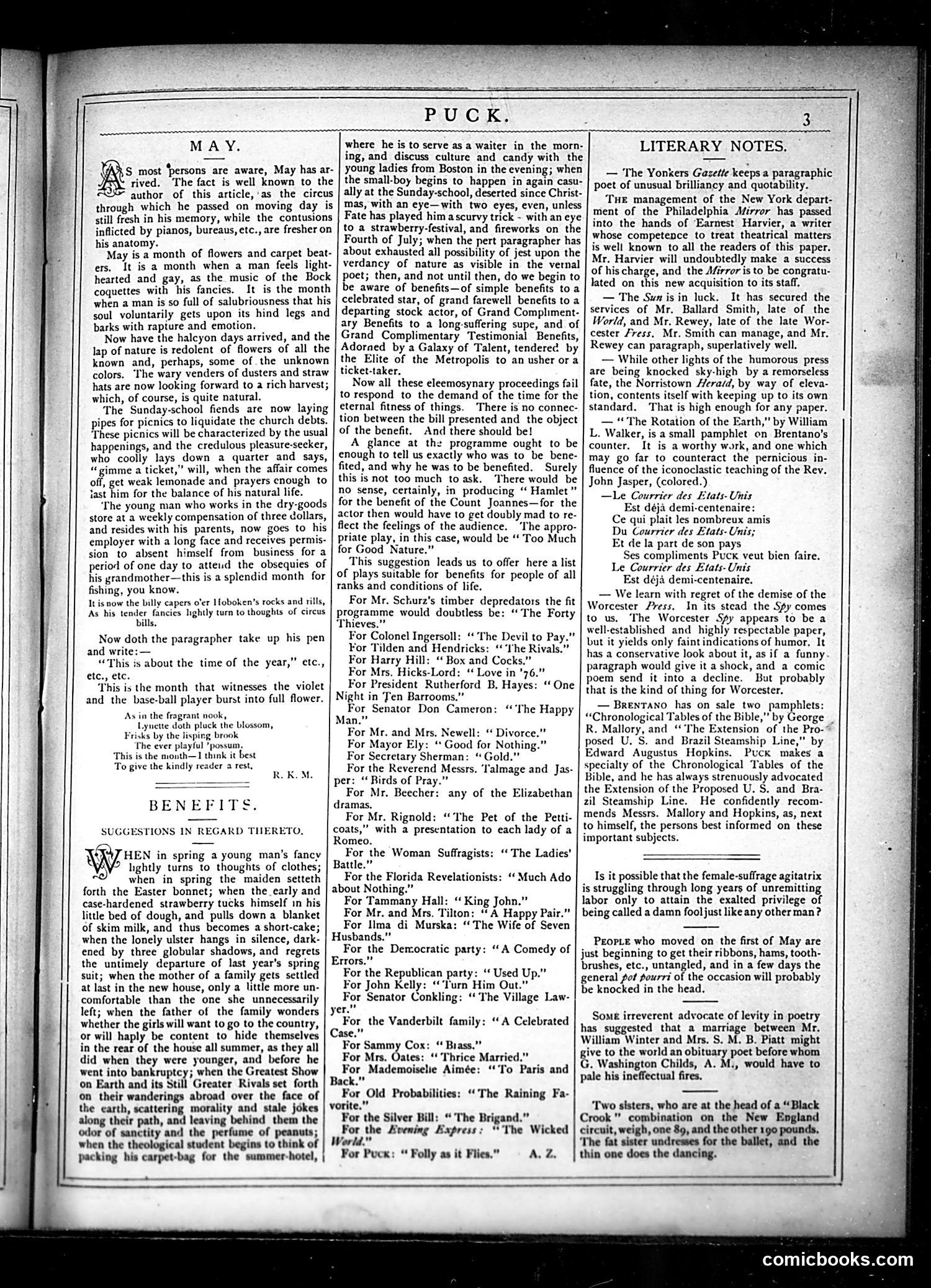
This page is primarily **literary notes and theatrical criticism**, not political satire. The "Benefits" section lists suggested plays for various public figures and organizations—a common Puck feature mixing humor with social commentary. The suggestions pair plays with their subjects satirically. For example, recommending "The Forty Thieves" for a lumber company or "The Devil to Pay" for a Colonel suggests ironic commentary on their characters or actions. The left column discusses May's characteristics and seasonal observations in typical Puck fashion—lighthearted social humor rather than hard political satire. Without identifying specific individuals or events in the theatrical recommendations, this appears to be **entertainment-focused satire** typical of Puck's miscellaneous content pages, relying on contemporary theatrical and social knowledge for its humor.
📄 Transcribed text from this page (OCR, searchable)
Machine-transcribed from the original scan — historical spelling and the odd misread are preserved.
MAY. S most ‘persons are aware, May has ar- rived. The fact is well known to the AWS author of this article,+as the circus through which he passed on moving day is still fresh in his memory, while the contusions inflicted by pianos, bureaus, etc., are fresher on his anatomy. May is a month of flowers and carpet beat- ers, It is a month when a man feels light- hearted and gay, as the music of the Bock coquettes with his fancies. It is the month when a man is so full of salubriousness that his soul voluntarily gets upon its hind legs and barks with rapture and emotion. Now have the halcyon days arrived, and the lap of nature is redolent of flowers of all the known and, perhaps, some ofthe unknown colors. The wary venders of dusters and straw hats are now looking forward to a rich harvest; which, of course, is quite natural. ; The Sunday-school fiends are now laying pipes for picnics to liquidate the church debts. ‘These picnics will be characterized by the usual happenings, and the credulous pleasure-seeker, who coolly lays down a quarter and says, “gimme a ticket,” will, when the affair comes off, get weak lemonade and prayers enough to last him for the balance of his natural life. ‘The young man who works in the dry-goods store at a weekly compensation of three dollars, and resides with his parents, now goes to his employer with a long face and receives permis- sion to absent himself from business for a period of one day to atteud the obsequies of his grandmother—this is a splendid month for fishing, you know. It is now the billy capers o'er Hoboken’s rocks and rills, As his tender fancies lightly turn to thoughts of circus bills. Now doth the paragrapher take up his pen and writ “Thi etc., etc. This is the month that witnesses the violet and the base-ball player burst into full flower. As in the fragrant nook, Lynewe doth pluck Frisks by the lisping br The ever playful possum, This is the month—I think it best To give the kindly reader a rest, s about the time of the year,” etc., lossom, R.K.M. BENEFITS. PIONS IN REGARD THERETO, “V7 HEN in spring a young man’s fancy P lightly turns to thoughts of clothes; when in spring the maiden setteth forth the Easter bonnet; when the early and case-hardened strawberry tucks himself in his little bed of dough, and pulls down a blanket of skim milk, and thus becomes a short-cake; when the lonely ulster hangs in silence, dark- ened by three globular shadows, and regrets the untimely departure of last year’s spring suit; when the mother of a family gets settled at last in the new house, only a little more un- comfortable than the one she unnecessarily left; when the father of the family wonders whether the girls will want to go to the country, or will haply be content to hide themselves in the rear of the house all summer, as they all did when they were younger, and before he went into bankruptcy; when the Greatest Show on Earth and its Still Greater Rivals set forth on their wanderings abroad over the face of the earth, scattering morality and stale jokes along their path, and leaving behind them the odor of sanctity and the perfume of peanuts; when the theological student begins to think of packing his carpet-bag for the summer-hotel, | where he is to serve as a waiter in the morn- ing, and discuss culture and candy with the young ladies from Boston in the evening; when the small-boy begins to happen in again casu- ally at the Sunday-school, deserted since Christ- mas, with an eye—with two eyes, even, unless Fate has played him ascurvy trick - with an eye to a strawberry-festival, and fireworks on the Fourth of July; when the pert paragrapher has about exhausted all possibility of jest upon the verdancy of nature as visible in the vernal poet; then, and not until then, do we begin to be aware of benefits—of simple benefits toa celebrated star, of grand farewell benefits to a departing stock actor, of Grand Compliment- ary Benefits to a long-suffering supe, and of Grand Complimentary Testimonial Benefits, Adorned by a Galaxy of Talent, tendered by the Elite of the Metropolis to an usher or a ticket-taker. Now all these eleemosynary proceedings fail to respond to the demand of the time for the eternal fitness of things. There is no connec- tion between the bill presented and the object of the benefit. And there should be! A glance at the programme ought to be enough to tell us exactly who was to be bene- fited, and why he was to be benefited. Surely this is not too much to ask. ‘There would be no sense, certainly, in producing “ Hamlet” for the benefit of the Count Joannes—for the actor then would have to get doubly mad to re- flect the feelings of the audience. ‘The appro- priate play, in this case, would be “Too Much for Good Nature.” This suggestion leads us to offer here a list of plays suitable for benefits for people of all ranks and conditions of life. For Mr. Schurz's timber depredators the fit programme would doubtless be: “The Forty ‘Thieves.”” For Colonel Ingersoll: “The Devil to Pay.” For Tilden and Hendricks: ‘ ‘he Rivals.” For Harry Hill: ‘ Box and Cocks.” For Mrs. Hicks-Lord: ‘ Love in '76.” For President Rutherford B, Hayes: ‘One Night in Ten Barrooms.” For Senator Don Cameron: “ ‘The Happy Man.” For Mr. and Mrs. Newell: “ Divorce.’ For Mayor Ely: “ Good for Nothing.” For Secretary Sherman: “ Gold.” For the Reverend Messrs. ‘'almage and Jas- per: “Birds of Pray.” For Mr. Beecher: any of the Elizabethan dramas. For Mr. Rignold: “The Pet of the Petti- coats,” with a presentation to each lady of a Romeo. For the Woman Suffragists: ‘The Ladies’ Battle.” For the Florida Revelationists: “ Much Ado about Nothing.” For Tammany Hall: ‘ King John.” For Mr. and Mrs. Tilton: ‘A Happy Pair.” For Ilma di Murska: ‘“ The Wife of Seven Husbands.” For the Democratic party: ‘A Comedy of Errors.”” party: ‘‘ Used Up.” ‘Turn Him Out.” For Senator Conkling: ‘The Village Law- yer.” For the Vanderbilt family: ‘‘A Celebrated Case.” For Sammy Cox: “ Brass.”” For Mrs. Oates Thrice M For Mademoiselie Aimée: Back.” For Old Probabilities: ‘The Raining Fa- vorite.” For the Silver Bill: “ The Brigand.” For the Avening Express: “The Wicked World.” For Puck: “ Folly as it Flies.” A. Z, LITERARY NOTES. — The Yonkers Gazette keeps a paragraphic poet of unusual brilliancy and quotability. THE management of the New York depart- ment of the Philadelphia Afirror has passed into the hands of ‘Earnest Harvier, a writer whose competence to treat theatrical matters is well known to all the readers of this paper. Mr. Harvier will undoubtedly make a success of his charge, and the Mirroris to be congratu- lated on this new acquisition to its staff, — The Sun is in luck. It has secured the services of Mr. Ballard Smith, late of the World, and Mr. Rewey, late of the late Wor- cester Fress. Mr. Smith can manage, and Mr. Rewey can paragraph, superlatively well. — While other lights of the humorous press are being knocked sky-high by a remorseless fate, the Norristown Hera/d, by way of eleva- tion, contents itself with keeping up to its own standard. That is high enough for any paper. — ‘‘ The Rotation of the Earth,” by William L. Walker, is a small pamphlet on Brentano's counter. It is a worthy work, and one which may go far to counteract the pernicious in- fluence of the iconoclastic teaching of the Rev. John Jasper, (colored.) —Le Courrier des Etats-Unis Est déja demi-centenaire: Ce qui plait les nombreux amis Du Courrier des Etats-Unis; Et de la part de son pays Ses compliments Puck veut bien faire. Le Courrier des Etats-Unis Est déja demi-centenaire. — We learn with regret of the demise of the Worcester /ress. In its stead the Spy comes to us. The Worcester Spy appears to be a well-established and highly respectable paper, but it yields only faint indications of humor, It has a conservative look about it, as if a funny paragraph would give it a shock, and a comic poem send it into a decline. But probably that is the kind of thing for Worcester, — Brentano has on sale two pamphlets: “Chronological Tables of the Bible,” by George R. Mallory, and ‘The Extension of the Pro- posed U.S. and Brazil Steamship Line,” by Edward Augustus Hopkins. Puck makes a specialty of the Chronological Tables of the Bible, and he has always strenuously advocated the Extension of the Proposed U. S. and Bra- zil Steamship Line. He confidently recom- mends Messrs. Mallory and Hopkins, as, next to himself, the persons best informed on these important subjects. Is it possible that the female-suffrage agitatrix is struggling through long years of unremitting labor only to attain the exalted privilege of being called a damn fool just like any other man? PeopLe who moved on the first of May are just beginning to get their ribbons, hams, tooth- brushes, etc., untangled, and in a few days the general fot pourri of the occasion will probably be knocked in the head. Some irreverent advocate of levity in poetry has suggested that a marriage between Mr. William Winter and Mrs. S. M. B. Piatt might give to the world an obituary poet before whom G. Washington Childs, A. M., would have to pale his ineffectual fires. ‘Two sisters, who are at the head of a “Black Crook" combination on the New England circuit, weigh, one 89, and the other 190 pounds, ‘The fat sister undresses for the ballet, and the thin one does the dancing. comicbooks.com