
Puck, 1878-05-08 · page 11 of 16
Puck — May 8, 1878 — page 11: what you’re looking at
What you’re looking at
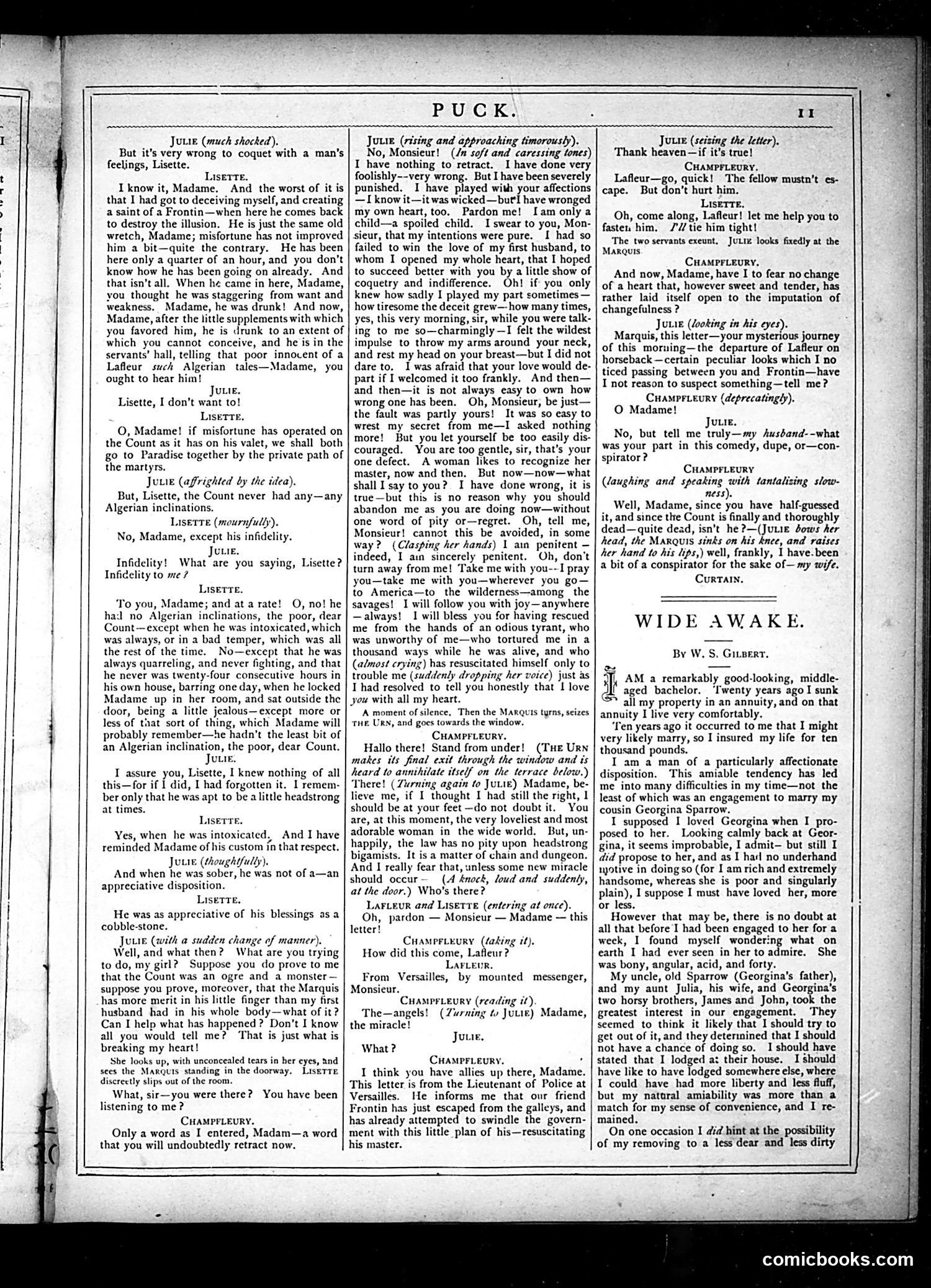
This page contains two sections: a dramatic play scene titled "Puck" (left) and a short story titled "Wide Awake" by W.S. Gilbert (right). The left column shows dialogue between aristocratic French characters—Julie, Lisette, Jokie, and Champlain—discussing romantic entanglements, infidelity, and a scandal involving "the Marquis." The theatrical scene satirizes upper-class French society's hypocrisies regarding honor, marriage, and propriety. Characters make witty, pointed remarks about deception and moral compromise. The right column begins a narrative about a man reflecting on his attachment to a woman named Georgia, hinting at past romantic complications and social awkwardness. The content suggests social satire targeting romantic pretension and class dynamics. Both pieces use humor to mock aristocratic and bourgeois conventions of the era.
📄 Transcribed text from this page (OCR, searchable)
Machine-transcribed from the original scan — historical spelling and the odd misread are preserved.
PUCK. JuLie (much shocked). But it’s very wrong to coquet with a man’s feelings, Lisette. LiserTe. I know it, Madame. And the worst of it is that I had got to deceiving myself, and creating a saint of a Frontin—when here he comes back to destroy the illusion. He is just the same old wretch, Madame; misfortune has not improved him a bit—quite the contrary. He has been here only a quarter of an hour, and you don’t know how he has been going on already. And that isn’t all, When he came in here, Madame, you thought he was staggering from want and weakness. Madame, he was drunk! And now, Madame, after the little supplements with which you favored him, he is drunk to an extent of which you cannot conceive, and he is in the servants’ hall, telling that poor innocent of a Lafleur such Algerian tales—Madame, you ought to hear him! Junie. Lisette, I don’t want to! LisetTe. O, Madame! if misfortune has operated on the Count as it has on his valet, we shall both go to Paradise together by the private path of the martyrs. Juiie (afrighted by the idea). But, Lisette, the Count never had any—any Algerian inclinations. Liserre (mournfully). No, Madame, except his infidelity. June. Infidelity! What are you saying, Lisette? Infidelity to me? Lisette. ‘To you, Madame; and at a rate! O, no! he hal no Algerian inclinations, the poor, dear Count—except when he was intoxicated, which was always, or in a bad temper, which was all the rest of the time. No—except that he was always quarreling, and never fighting, and that he never was twenty-four consecutive hours in his own house, barring one day, when he locked Madame up in her room, and sat outside the door, being a little jealous—except more or less of that sort of thing, which Madame will probably remember—he hadn't the least bit of an Algerian inclination, the poor, dear Count. Jutie. I assure you, Lisette, I knew nothing of all this—for if 1 did, I had forgotten it. 1 remem- ber only that he was apt to be alittle headstrong at times. Liserre, Yes, when he was intoxicated, And I have reminded Madame of his custom in that respect. Jutte (thoughtfully). And when he was sober, he was not of a—an appreciative disposition. LisetTe. He was as appreciative of his blessings as a cobble-stone. Juuie (with a sudden change of manner). Well, and what then? What are you trying to do, my girl? Suppose you do prove to me that the Count was an ogre and a monster— suppose you prove, moreover, that the Marquis has more merit in his little finger than my first husband had in his whole body—what of it? Can I help what has happened ? Don’t I know all you would tell me? That is just what is breaking my heart! She looks up, with unconcealed tears in her eyes, and sees the MARQUIS standing in the doorway. Lise tt discreetly slips out of the room. What, sir—you were there? You have been listening to me? CHAMPFLEURY. Only a word as I entered, Madam—a word Juuie (rising and approaching timorously). No, Monsieur! (Jn soft and caressing tones) I have nothing to retract. I have done very foolishly--very wrong. But I have been severely punished. I have played with your affections —I know it—it was wicked—butl have wronged my own heart, too. Pardon me! [am only a child—a spoiled child. I swear to you, Mon- sieur, that my intentions were pure. I had so failed to win the love of my first husband, to whom I opened my whole heart, that I hoped to succeed better with you by a little show of coquetry and indifference. Oh! if you only knew how sadly I played my part sometimes — how tiresome the deceit grew—-how many times, yes, this very morning, sir, while you were talk- ing to me so—charmingly—I felt the wildest impulse to throw my arms around your neck, and rest my head on your breast—but I did not dare to. 1 was afraid that your love would de- part if I welcomed it too frankly. And then— and then—it is not always easy to own how wrong one has been. Oh, Monsieur, be just— the fault was partly yours! It was so easy to wrest my secret from me—I asked nothing more! But you let yourself be too easily dis- couraged. You are too gentle, sir, that's your one defect. A woman likes to recognize her master, now and then, But now—now—what shall I'say to you? I have done wrong, it is true—but this is no reason why you should abandon me as you are doing now—without one word of pity or—regret. Oh, tell me, Monsieur! cannot this be avoided, in some way? (Clasping her hands) 1 ain penitent — indeed, I ain sincerely penitent. Oh, don’t turn away from me! ‘Take me with you--I pray you—take me with you—wherever you go— to America—to the wilderness—among the savages! I will follow you with joy—anywhere —always! I will bless you for having rescued me from the hands of an odious tyrant, who was unworthy of me—who tortured me in a thousand ways while he was alive, and who (almost crying) has resuscitated himself only to trouble me (suddenly dropping her voice) just as Thad resolved to tell you honestly that 1 love you with all my heart. A moment of silence, Then the MARQuis tyrns, seizes ‘THE Urs, and goes towards the window, (CHAMPFLEURY. Hallo there! Stand from under! (THe Urn makes its final exit through the window and is heard to annihilate itself on the terrace below.) There! (Zurning again to Jute) Madame, be- lieve me, if I thought I had still the right, 1 should be at your feet —do not doubt it. You are, at this moment, the very loveliest and most adorable woman in the wide world. But, un- happily, the law has no pity upon headstrong bigamists. It is a matter of chain and dungeon. And I really fear that, unless some new miracle should occur— (A Anock, loud and suddenly, at the door.) Who's there? LaFLeuR and Lisetre (entering at once). Oh, pardon — Monsieur — Madame — this letter! CHAMPFLEURY ehing it). How did this come, Lafleur? LaFleur. jes, by mounted messenger, From Versai Monsieur. CuamprLeury (reading it). The—angels! (Zurning to Jue) Madame, the miracle! Jui. What? CHaMmprLeury. a I think you have allies up there, Madame. This letter is from the Lieutenant of Police at Versailles. He informs me that our friend Frontin has just escaped from the galleys, and has already attempted to swindle the govern- ment with this little plan of his—resuscitating that you will undoubtedly retract now. his master. Jute (seizing the letter). Thank heaven—if it’s true! CHAMPFLEURY. Lafleur—go, quick! The fellow mustn’t ¢s- cape. But don’t hurt him, Lisetre. Oh, come along, Lafleur! let me help you to fasten him. /'// tie him tight! The two servants exeunt, JuLtz looks fixedly at the Marquis CHAMPFLEURY, And now, Madame, have I to fear no change of a heart that, however sweet and tender, has rather laid itself open to the imputation of changefulness ? Jutie (ooking in his eyes). Marquis, this letter—your mysterious journey of this morning—the departure of Lafleur on horseback—certain peculiar looks which I no ticed passing between you and Frontin—have I not reason to suspect something—tell me? CHAMPFLEURY (deprecatingly). O Madame! June. No, but tell me truly—my Ausband--what was your part in this comedy, dupe, or—con- spirator ? CHAMPFLEURY (laughing and speaking with tantalising slow- ness). Well, Madame, since you have half-guessed it, and since the Count is finally and thoroughly dead—quite dead, isn’t he ?—(Junie dows her head, the Marquis sinks on his knee, and raises her hand to his lips,) well, frankly, I have.been a bit of a conspirator for the sake of— my wife. Curtain, WIDE AWAKE. By W. S. Giveert. Bi AM a remarkably good-looking, middle- aged bachelor. ‘Twenty years ago I sunk ‘>> all my property in an annuity, and on that annuity I live very comfortably. ‘Ten years ago it occurred to me that I might very likely marry, so I insured my life for ten thousand pounds. I am a man of a particularly affectionate disposition. This amiable tendency has led me into many difficulties in my time—not the least of which was an engagement to marry my cousin Georgina Sparrow. I supposed I loved Georgina when I pro- posed to her. Looking calmly back at Geor- gina, it seems improbable, I admit— but still I did propose to her, and as I had! no underhand motive in doing so (for I am rich and extremely handsome, whereas she is poor and singularly plain), I suppose I must have loved her, more or less. However that may be, there is no doubt at all that before I had been engaged to her for a week, I found myself wondering what on earth I had ever seen in her to admire, She was bony, angular, acid, and forty. My uncle, old Sparrow (Georgina’s father), and my aunt Julia, his wife, and Georgina’s two horsy brothers, James and John, took the greatest interest in our engagement. They seemed to think it likely that I should try to get out of it, and they determined that I should not have a chance of doing so. I should have stated that I lodged a: their house. I should have like to have lodged somewhere else, where I could have had more liberty and less fluff, but my natoral amiability was more than a match for my sense of convenience, and I re- mained, On one occasion I did hint at the possibility of my removing to a less dear and less dirty comicbooks.com