
Puck, 1878-05-08 · page 6 of 16
Puck — May 8, 1878 — page 6: what you’re looking at
What you’re looking at
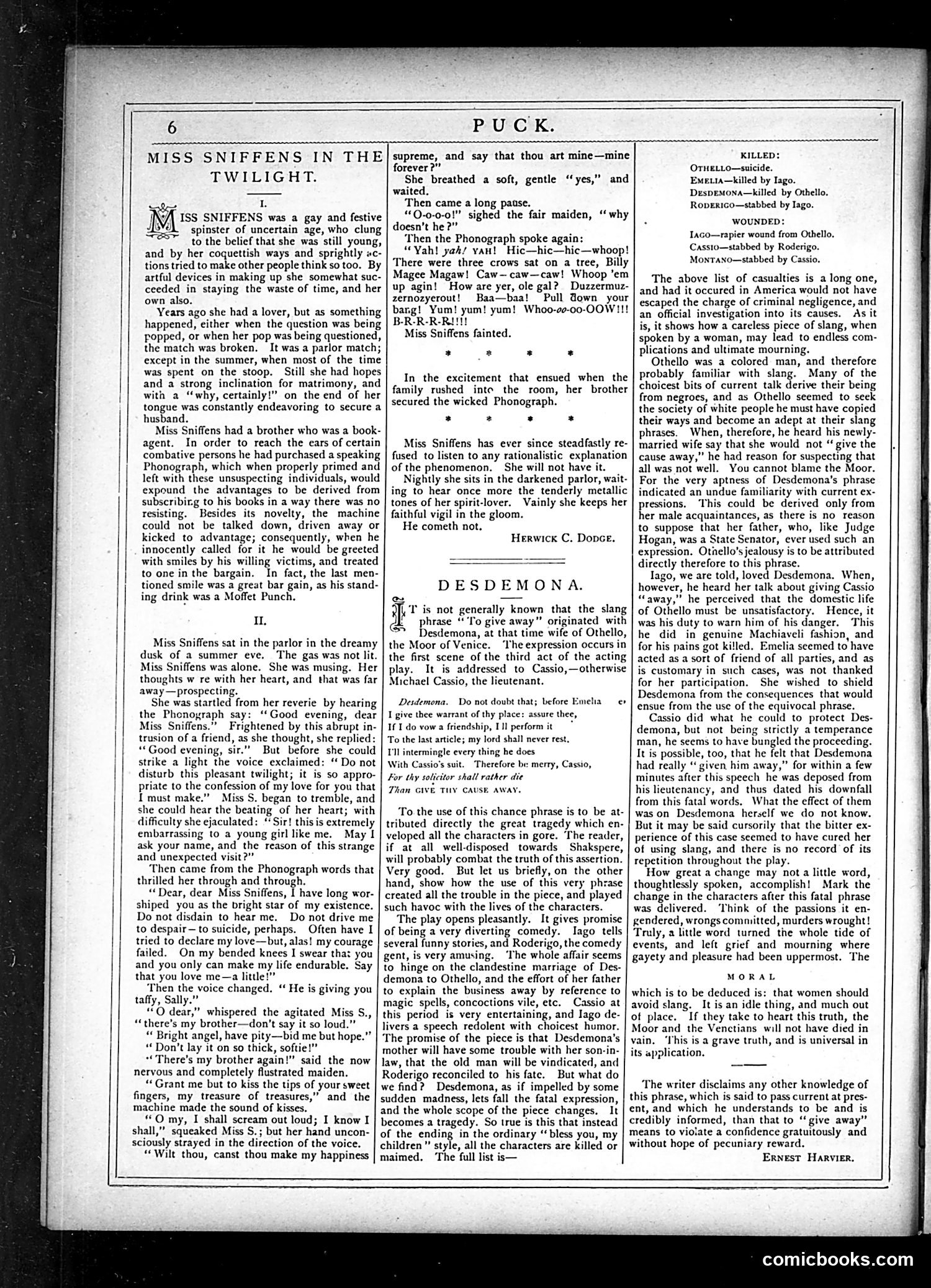
This page from *Puck* contains two literary pieces rather than political cartoons. "Miss Sniffens in the Twilight" is a humorous short story about an eccentric unmarried woman who owns a phonograph and resists rational explanation of the device's mechanism. The second piece, "Desdemona," appears to be critical commentary on Shakespeare's *Othello*, specifically addressing Iago's use of the phrase "give away" and its role in the tragedy. The Desdemona section discusses how a single word can alter the meaning of a character's speech and change dramatic impact—arguing that Iago's language choices directly contributed to the play's tragic outcome. This is literary criticism rather than political satire, focusing on how language shapes character and fate in drama.
📄 Transcribed text from this page (OCR, searchable)
Machine-transcribed from the original scan — historical spelling and the odd misread are preserved.
6 PUCK. MISS SNIFFENS IN THE TWILIGHT. shoe tb IN/{ ISS SNIFFENS was a gay and festive ae spinster of uncertain age, who clung to the belief that she was still young, and by her coquettish ways and sprightly #c- tions tried to make other people think so too. artful devices in making up she somewhat suc- ceeded in staying the waste of time, and her own also. Years ago she had a lover, but as something happened, either when the question was being popped, or when her pop was being questioned, the match was broken. It was a parlor match; except in the summer, when most of the time was spent on the stoop. Still she had hopes and a strong inclination for matrimony, and with a ‘why, certainly!” on the end of her tongue was constantly endeavoring to secure a husband. Miss Sniffens had a brother who was a book- agent. In order to reach the ears of certain combative persons he had purchased a speaking Phonograph, which when properly primed and left with these unsuspecting individuals, would expound the advantages to be derived from subscribing to his books in a way there was no resisting. Besides its novelty, the machine could not be talked down, driven away or kicked to advantage; consequently, when he innocently called for it he would be greeted with smiles by his willing victims, and treated to one in the bargain. In fact, the last men- tioned smile was a great bar gain, as his stand- ing drink was a Moffet Punch, I. Miss Sniffens sat in the parlor in the dreamy dusk of a summer eve, The gas was not lit. Miss Sniffens was alone. She was musing. Her thoughts w re with her heart, and that was far away —prospecting. She was startled from her reverie by hearing the Phonograph say: “Good evening, dear Miss Sniffens.” Frightened by this abrupt in- trusion of a friend, as she thought, she replied: “Good evening, sir.” But before she could strike a light the voice exclaimed: ‘ Do not disturb this pleasant twilight; it is so appro- priate to the confession of my love for you that I must make.” Miss S. began to tremble, and she could hear the beating of her heart; with difficulty she ejaculated: “Sir! this is extremely embarrassing to a young girl like me. May I ask your name, and the reason of this strange and unexpected visit?” ‘Then came from the Phonograph words that thrilled her through and through. “Dear, dear Miss Sniffens, I have long wor- shiped you as the bright star of my existence. Do not disdain to hear me. Do not drive me to despair—to suicide, perhaps. Often have I tried to declare my love—but, alas! my courage failed. On my bended knees I swear tha: you and you only can make my life endurable. Say that you love me—a little!” ‘Then the voice changed. “ He is giving you taffy, Sally.” “© dear,” whispered the agitated Miss S., “there’s my brother—don’t say it so loud.” “ Bright angel, have pity—bid me but hope.” ‘Don’t lay it on so thick, softie!” ‘There's my brother again!” said the now nervous and completely flustrated maiden. “Grant me but to kiss the tips of your sweet fingers, my treasure of treasures,” and the machine made the sound of kisses. “O my, I shall scream out loud; I know I shall,” squeaked Miss S.; but her hand uncon- sciously strayed in the direction of the voice. “Wilt thou, canst thou make my happiness supreme, and say that thou art mine—mine forever?” She breathed a soft, gentle “ yes,’ waited. Then came a long pause. “*Q-0-0-0!" sighed the fair maiden, “why doesn’t he?” ‘Then the Phonograph spoke again: “Yah! yah! va! Hic—hic—hic—whoop! There were three crows sat on a tree, Billy Magee Magaw! Caw-caw—caw! Whoop ’em up agin! How are yer, ole gal? Duzzermuz- zernozyerout! Baa—baa! Pull Gown your bang! Yum! yum! yum! Whoo-00-00-OOW!!! B-R-R-R-R!! Miss Sniffens fainted. and * * * + In the excitement that ensued when the family rushed inte the room, her brother secured the wicked Phonograph. * 2 * * Miss Sniffens has ever since steadfastly re- fused to listen to any rationalistic explanation of the phenomenon. She will not have it. Nightly she sits in the darkened parlor, wait- ing to hear once more the tenderly metallic tones of her spirit-lover. Vainly she keeps her faithful vigil in the gloom. He cometh not. Herwick C. Donce. DESDEMONA. ew et is not generally known that the slang phrase “‘To give away” originated with > Desdemona, at that time wife of Othello, the Moor of Venice. ‘Ihe expression occurs in the first scene of the third act of the acting play. It is addressed to Cassio,—otherwise Michael Cassio, the lieutenant. Desdemona. Do not doubt that; before Emelia—e I give thee warrant of thy place: assure thee, If I do vowa friendship, II perform it To the last article; my lord shall never rest, I'll intermingle every thing he does With Cassio’s suit. ‘Therefore be merry, Cassio, For thy solicitor shall rather die Than Give THY CAUSE AWAY. To the use of this chance phrase is to be at- tributed directly the great tragedy which en- veloped all the characters in gore. ‘The reader, if at all well-disposed towards Shakspere, will probably combat the truth of this assertion. Very good. But let us briefly, on the other hand, show how the use of this very phrase created all the trouble in the piece, and played such havoc with the lives of the characters. The play opens pleasantly. It gives promise of being a very diverting comedy. Iago tells several funny stories, and Roderigo, the comedy gent, is very amusing. ‘The whole affair seems to hinge on the clandestine marriage of Des- demona to Othello, and the effort of her father to explain the business away by reference to magic spells, concoctions vile, etc. Cassio at this period is very entertaining, and Iago de- livers a speech redolent with choicest humor. The promise of the piece is that Desdemona’s mother will have some trouble with her son-in- law, that the old man will be vindicated, and Roderigo reconciled to his fate. But what do we find? Desdemona, as if impelled by some sudden madness, lets fall the fatal expression, and the whole scope of the piece changes. It becomes a tragedy. So true is this that instead of the ending in the ordinary “bless you, my children” style, all the characters are killed or maimed. The full list is— KILLED: OrneLLo—suicide. EmeLia—killed by Iago. Despemona—killed by Othello. RoveRico—stabbed by Iago. WOUNDED: Iaco—rapier wound from Othello. Cassio—stabbed by Roderigo. MontTaxo—stabbed by Cassio. The above list of casualties is along one, and had it occured in America would not have escaped the charge of criminal negligence, and an official investigation into its causes. As it is, it shows how a careless piece of slang, when spoken by a woman, may lead to endless com- plications and ultimate mourning. Othello was a colored man, and therefore probably familiar with slang. Many of the choicest bits of current talk derive their being from negroes, and as Othello seemed to seek the society of white people he must have copied their ways and become an adept at their slang phrases. When, therefore, he heard his newly- married wife say that she would not “give the cause away,” he had reason for suspecting that all was not well. You cannot blame the Moor. For the very aptness of Desdemona’s phrase indicated an undue familiarity with current ex- pressions. This could be derived only from her male acquaintances, as there is no reason to suppose that her father, who, like Judge Hogan, was a State Senator, ever used such an expression. Othello’s jealousy is to be attributed directly therefore to this phrase. Iago, we are told, loved Desdemona. When, however, he heard her talk about giving Cassio “away,” he perceived that the domestic life of Othello must be unsatisfactory. Hence, it was his duty to warn him of his danger. This he did in genuine Machiaveli fashion, and for his pains got killed. Emelia seemed to have acted as a sort of friend of all parties, and as is customary in such cases, was not thanked for her participation. She wished to shield Desdemona from the consequences that would ensue from the use of the equivocal phrase. Cassio did what he could to protect Des- demona, but not being strictly a temperance man, he seems to have bungled the proceeding. It is possible, too, that he felt that Desdemona had really “ given him away,” for within a few minutes after this speech he was deposed from his lieutenancy, and thus dated his downfall from this fatal words, What the effect of them was on Desdemona herself we do not know. But it may be said cursorily that the bitter ex- perience of this case seemed to have cured her of using slang, and there is no record of its repetition throughout the play. How great a change may nota little word, thoughtlessly spoken, accomplish! Mark the change in the characters after this fatal phrase was delivered. ‘Think of the passions it en- gendered, wrongs committed, murders wrought! Truly, a little word turned the whole tide of events, and left grief and mourning where gayety and pleasure had been uppermost. The MORAL which is to be deduced is: that women should avoid slang. It is an idle thing, and much out of place. If they take to heart this truth, the Moor and the Venctians will not have died in vain. ‘This is a grave truth, and is universal in its application. The writer disclaims any other knowledge of this phrase, which is said to pass current at pres- ent, and which he understands to be and is credibly informed, than that to “give away” means to violate a confidence gratuitously and without hope of pecuniary reward. Ernest Harvier. ea comicbooks.com